
Choosing the wrong email platform in 2026 isn’t just a technical oversight; it’s a structural failure that can cap your brand’s global potential before you even scale. The choice between Klaviyo vs Mailchimp ecommerce is no longer about which interface looks better. It’s about which data architecture will survive the rising cost of customer acquisition. You understand that a business built on fragmented data is a house built on sand. It’s frustrating to see your marketing efforts diluted by tools that cannot speak to your Shopify store’s deep behavioral insights.
Discover which email powerhouse will fuel your brand’s global expansion and drive sustainable revenue growth in 2026. This guide moves beyond surface-level features to examine the systemic integration required for a high-converting sales funnel. We’re not just comparing buttons and templates; we’re performing a strategic evaluation of how marketing automation transforms your Hong Kong business into a global commercial force. We’ll analyze the pricing shifts and AI capabilities that define the current landscape, ensuring your choice supports a robust e-commerce presence that scales.
Key Takeaways
- Shift from basic broadcasts to integrated lifecycle automation to effectively combat rising customer acquisition costs in the 2026 landscape.
- Analyze the architectural divergence in the Klaviyo vs Mailchimp ecommerce debate to ensure your data infrastructure supports deep behavioral segmentation rather than just broad reach.
- Master revenue attribution by selecting a platform that provides a clear line of sight between specific automated flows and sustainable profit growth.
- Utilize a strategic decision framework tailored for Hong Kong SMEs to determine when the cost of migration is outweighed by the cost of lost opportunity.
- Synchronize your brand identity with high-converting Shopify stores and marketing automation to build a unified growth engine ready for global expansion.
Beyond the Inbox: Why the Klaviyo vs Mailchimp Debate Matters in 2026
In 2026, the distinction between a marketing tool and a commercial engine has never been more critical. For Hong Kong SMEs, the decision between Klaviyo vs Mailchimp ecommerce is not a matter of preference; it’s a foundational choice that determines your brand’s ability to survive rising customer acquisition costs (CAC). Traditional email marketing was a broadcast medium. Modern ecommerce requires a lifecycle automation system that acts as the high-margin backbone of your entire sales funnel. If your email tool isn’t talking to your Shopify back-end in real-time, you’re losing money on every ad click.
The Evolution of Ecommerce Communication
Newsletters are a legacy format. In the 2026 landscape, success is built on behavior-triggered flows that respond to specific customer actions in real-time. This shift requires absolute data ownership. As AI-driven marketing becomes the standard, the quality of your first-party data dictates the effectiveness of your predictive modeling. If your data is fragmented across disconnected systems, your marketing will remain superficial. “Good enough” marketing is no longer a viable strategy for sustainable scaling; it’s a recipe for stagnation. You need a system that captures every viewed product and added to cart event to fuel a truly personalized experience.
Aligning Software with Strategic Brand Foundations
Your technical requirements are a direct reflection of your strategic brand development. When evaluating Klaviyo vs Mailchimp ecommerce capabilities, you must consider the danger of outgrowing your marketing stack during a global expansion. While Mailchimp offers a versatile entry point for general marketing, it often lacks the deep event-based logic required for complex DTC scaling.
At Senses Group, we advocate for choosing a strategic partner rather than just a software provider. We view email tools as vehicles for global market entry. For a Hong Kong startup, the goal isn’t just to send emails to a local list. The goal is to build a growth engine that integrates seamlessly with your brand identity and your Shopify store. This systemic approach ensures that your marketing automation doesn’t just work, but actively drives sustainable profit growth by lowering the long-term reliance on expensive paid advertising.
The Architectural Difference: Data Science vs. Marketing Simplicity
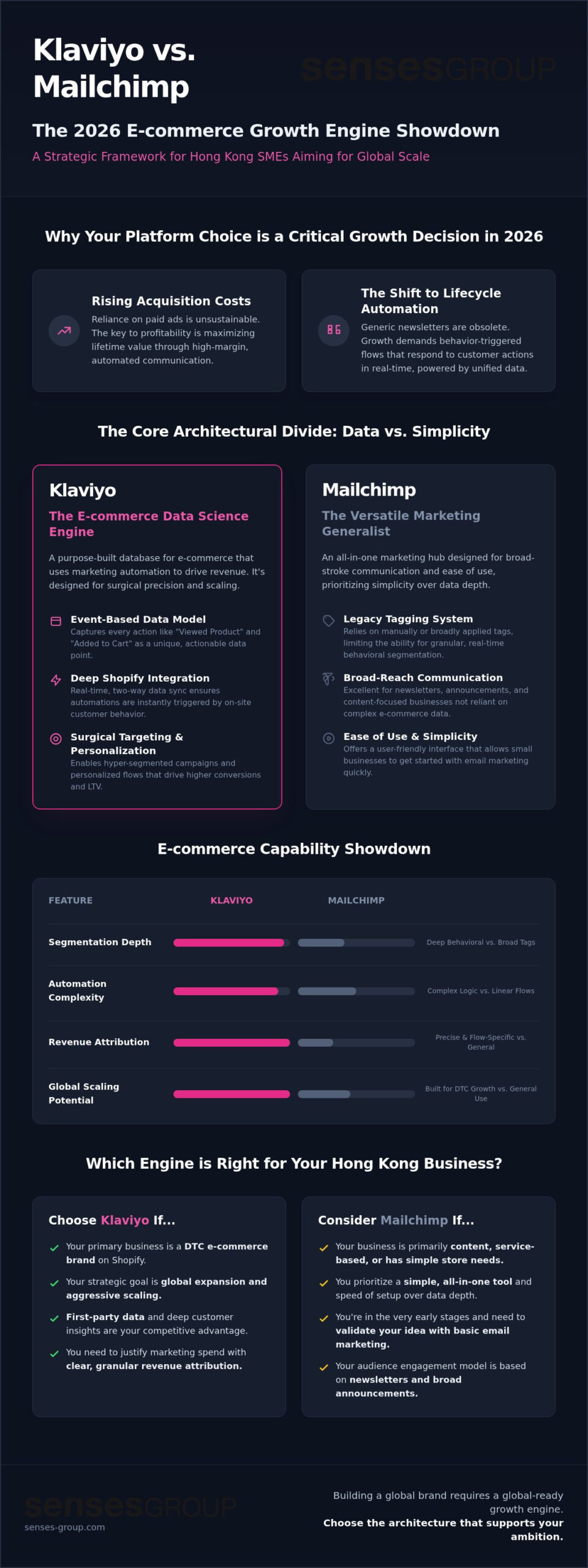
The fundamental divergence between these platforms isn’t found in their email templates, but in their underlying data architecture. Klaviyo is a purpose-built database for ecommerce that happens to send email. Mailchimp is a versatile marketing hub designed for broad reach. In 2026, this distinction determines your return on investment. Klaviyo utilizes an event-based model, recording every “Viewed Product” or “Started Checkout” as a distinct, actionable data point. Mailchimp relies on a legacy tagging system. This is not just a technical detail; it’s the difference between surgical precision and broad-stroke guessing.
Klaviyo’s Deep Integration with Shopify
Real-time data syncing is the foundation of surgical targeting. When a customer abandons a cart, Klaviyo knows within seconds. It doesn’t just recognize they left; it identifies the specific SKU, its value, and the customer’s historical engagement. Leveraging Klaviyo flows for Shopify allows you to build personalized customer journeys that feel intuitive rather than intrusive. It’s why Shopify Plus merchants almost exclusively choose this platform. They require a system that scales with their complexity. If you’re building a growth engine, your database must be as robust as your ambition.
Mailchimp’s Multi-Channel Generalist Approach
Mailchimp simplifies the marketing stack for smaller, content-focused businesses. It’s an excellent choice for those prioritizing ease of use over deep technical integration. However, there is a clear trade-off. Choosing simplicity often limits your ability to execute complex automated email flows for ecommerce. This in-depth comparison of Klaviyo and Mailchimp highlights how generalist tools can become a bottleneck as your brand matures. A tool that is “enough” for a local startup may fail when you transition to a digital-first global model. The choice of Klaviyo vs Mailchimp ecommerce capability depends on whether you need a megaphone or a scalpel.
Predictive analytics in 2026 have moved beyond novelty to necessity. Klaviyo’s architecture allows for automated calculation of Customer Lifetime Value (CLV) and churn risk. It identifies at-risk customers before they disappear, allowing you to intervene with precision. It’s not just about sending mail; it’s about building a system that predicts commercial outcomes. If you’re ready to transition from a traditional model to a data-driven powerhouse, our team at Senses Group can help you architect the right solution. The goal is systemic integration, ensuring your brand identity and marketing automation work as one.
Ecommerce Feature Showdown: Automation, Attribution, and ROI
While architecture provides the foundation, the feature set is the engine that executes your strategy. In a comprehensive 2026 Klaviyo vs. Mailchimp analysis, the divergence in automation philosophy becomes clear. Klaviyo’s logic-driven flows allow for intricate branching based on minute customer actions. Mailchimp’s journeys prioritize a visual, linear progression. For a scaling brand, the ability to trigger an email based on a specific product SKU rather than a general interest group is the difference between a generic message and a high-converting offer. Precision is the only way to maintain relevance in a crowded inbox.
Revenue attribution is where the Klaviyo vs Mailchimp ecommerce battle is won. You need to know exactly which email drove which dollar to optimize your spend effectively. Klaviyo’s attribution model is built specifically for the ecommerce transaction cycle. Mailchimp often captures broader engagement metrics that don’t always correlate with direct sales. As SMS and multi-channel integration become standard in the 2026 ecommerce ecosystem, having a single source of truth for attribution prevents the double-counting of conversions. This clarity is essential for Hong Kong SMEs looking to lower their CAC while expanding into international markets.
Mastering High-Value Automation Flows
A robust Klaviyo abandoned cart strategy serves as your primary revenue recovery engine. It’s not just a reminder; it’s a dynamic sequence that adjusts based on cart value and customer history. Beyond the cart, behavior-based triggers like post-purchase upsells and win-back sequences ensure you’re maximizing the value of every acquired lead. By using dynamic product blocks and AI recommendations, you deliver personalization at a scale that manual campaigns can’t match. You aren’t just sending mail; you’re automating a conversation.
Reporting and Predictive Analytics
Success in 2026 requires looking beyond open rates. You must focus on Customer Lifetime Value (CLV) to understand the true health of your brand. Klaviyo’s predictive modeling identifies patterns for stock replenishment and churn prevention, allowing you to act before a customer is lost. These data-driven insights shouldn’t exist in a vacuum. They must inform your broader high converting Shopify store strategy. This ensures your site design and marketing automation work in a unified, profitable loop that supports long-term commercial growth. A disciplined focus on ecommerce retention marketing is what separates brands that scale sustainably from those that remain dependent on costly paid acquisition.
Strategic Decision Framework: Choosing the Right Engine for Your Growth Stage
Selecting a platform based on arbitrary revenue milestones is a common strategic error. Many industry discussions suggest switching tools only after hitting specific sales targets; however, this ignores the structural complexity of your business model. The Klaviyo vs Mailchimp ecommerce decision should be dictated by your data needs and your 2026 expansion goals. If your current marketing stack cannot support the transition from a traditional model to a digital-first global presence, you aren’t just saving money on software; you’re capping your brand’s potential. Migration is a temporary friction. Lost opportunity is a permanent drain on profit.
Hong Kong businesses act as a critical gateway to international trade. This unique position requires a system capable of managing cross-border data, regional preferences, and complex customer journeys across multiple time zones. You must also evaluate your internal team’s capabilities. A sophisticated engine is useless without a driver who understands the mechanics of segmentation. If your objective is to build a growth engine that operates with minimal manual intervention, your choice must favor systemic integration over mere ease of use.
When Mailchimp is the Strategic Choice
Mailchimp remains a viable option for startups prioritizing brand awareness over deep transactional data. It’s particularly effective for businesses establishing a foundational brand identity for retailers who are not yet ready for high-volume DTC scaling. If your model relies on simple newsletters or basic lead nurturing for a service-based business, Mailchimp allows you to manage tighter budgets while validating your market fit. It provides a polished, professional entry point without the immediate need for a dedicated data strategist.
When Klaviyo is Non-Negotiable
Klaviyo is the essential choice for any brand scaling a Shopify store with a high volume of SKUs and diverse customer segments. Once you move beyond a handful of hero products, the ability to trigger flows based on specific SKU data becomes your most powerful lever for growth. Partnering with a specialized Klaviyo email automation agency allows you to execute strategies that can triple average order values through surgical precision. This platform is for businesses ready to weaponize AI and Generative Engine Optimization (GEO) to maintain a competitive advantage in global markets. It transforms your email list from a simple directory into a robust, high-margin sales funnel.
Building a sustainable commercial presence requires a partner who understands the deeper mechanics of success. If you’re ready to architect a system that drives long-term revenue, consult with Senses Group today to align your marketing technology with your global ambitions.
Integrating Email Automation into Your Global Sales Funnel
In 2026, the debate between Klaviyo vs Mailchimp ecommerce isn’t just about software features; it’s about ecosystem integration. A standalone email tool is a liability. You need a system where your Meta and Google advertising, SEO efforts, and email flows work as a single, unified organism. For Hong Kong brands, this means transforming your website from a passive digital brochure into a high-velocity revenue engine that captures every drop of traffic value. Your website should not be a business card; it must be a commercial thinker that identifies and converts intent at every stage of the funnel. A comprehensive understanding of email marketing automation for Shopify is what separates brands that build scalable international revenue from those that remain trapped in manual campaign cycles.
The Senses Group Approach to Digital Transformation
At Senses Group, we don’t just set up accounts. We build bespoke sales atoms that align with your overarching brand strategy to ensure maximum commercial impact. Our approach has successfully helped clients double their revenue by moving away from fragmented marketing tactics toward integrated ecommerce systems. With over 18 years of expertise and 4 million dollars in ad spend managed, we understand that the psychological impact of your brand must be mirrored in your marketing automation. We focus on tripling average order value by ensuring your Shopify store and Klaviyo flows communicate with surgical precision.
Building Your 2026 Growth Roadmap
Scaling internationally from Hong Kong requires a disciplined audit of your current technical stack. Is your software a bridge to the global market or a barrier to your scaling goals? Implementation of complex behavior-based triggers requires an expert hand to ensure that every flow is optimized for long-term retention rather than just a single transaction. You’re building a growth engine, and that requires a foundational strategy that accounts for regional preferences and cross-border trade complexities.
As you evaluate Klaviyo vs Mailchimp ecommerce potential for your specific business model, remember that the tool is merely the vehicle. The strategy is the fuel. Transitioning from a traditional model to a robust, digital-first presence is a significant transformation that demands a strategic partner, not just a service provider. We specialize in Generative Engine Optimization and AI-driven growth to keep your brand at the forefront of the 2026 market. Let’s build your growth engine with Senses Group.
Building Your Commercial Legacy in 2026
The decision between Klaviyo vs Mailchimp ecommerce capabilities is the defining factor for your brand’s technical and commercial resilience. You don’t just need a tool that sends email. You need a system that captures behavioral data to lower your customer acquisition costs and drive sustainable profit. By choosing a platform that prioritizes deep event-based logic over generalist simplicity, you’re investing in the foundation of your global expansion. It’s the difference between merely existing in a market and dominating it.
Transitioning from a traditional retail model to a high-velocity digital presence requires more than just software; it requires strategic implementation. At Senses Group, we leverage 18 years of strategic branding expertise and a history of managing over $4 million in digital ad spend to architect these growth engines. We specialize in the seamless integration of Shopify and Klaviyo to ensure your brand identity and marketing automation function as a single, unified system. Ready to scale? Let Senses Group build your high-converting Klaviyo engine. Your brand’s potential is limitless when your data and strategy finally align.
Frequently Asked Questions
Is Klaviyo significantly more expensive than Mailchimp for ecommerce?
Klaviyo often commands a higher price point because it functions as a data-driven growth engine rather than a simple mailer. While Mailchimp increased prices for legacy users by an average of 11% to 13% in April 2026, Klaviyo’s billing model focuses on active profiles. You aren’t just paying for sends; you’re investing in the architectural depth required to triple average order values through surgical precision and behavioral triggers.
How difficult is it to migrate from Mailchimp to Klaviyo on Shopify?
The technical sync is straightforward, but a strategic migration typically requires four to eight weeks to execute correctly. This period involves mapping historical data, rebuilding complex automation flows, and warming up your new sending domain. Rushing this process can damage your deliverability. It’s essential to treat migration as a structural upgrade that aligns your email system with your broader brand identity and global scaling goals.
Does Klaviyo offer better email deliverability for international markets?
Klaviyo excels in global deliverability because its infrastructure is built specifically for high-volume ecommerce transactions. By using real-time engagement data to filter your sending lists, it ensures your brand stays out of the spam folder in diverse regional markets. This engagement-first approach is critical for Hong Kong SMEs acting as a gateway to international trade, where maintaining a pristine sender reputation is non-negotiable for growth.
Can I use Mailchimp effectively for a high-growth Shopify store?
Mailchimp can manage basic needs, but it often becomes a commercial bottleneck as you scale. High-growth stores require the event-based logic found in the Klaviyo vs Mailchimp ecommerce comparison to execute SKU-specific triggers. While Mailchimp is a versatile generalist, it lacks the deep Shopify integration needed to automate complex customer journeys that respond to minute behavioral shifts, ultimately capping your potential ROI.
What are the must-have Klaviyo flows for a new ecommerce brand in 2026?
Every modern brand requires a foundational set of automated flows to survive. You must implement:
- A high-converting Welcome Series to establish brand authority.
- An Abandoned Cart sequence to recover the average 70% of lost shoppers.
- Post-purchase upsells to maximize customer lifetime value.
- Win-back sequences to proactively prevent customer churn.
These flows transform your store into a 24/7 revenue-generating machine.
How does Klaviyo’s AI integration compare to Mailchimp’s features?
Klaviyo’s AI is surgically focused on predictive commercial outcomes. It analyzes your data to forecast replenishment dates and identify churn risks before they happen. Mailchimp’s AI tools are more general, focusing on content generation and basic design suggestions. For a business owner, the ability to predict when a customer is ready to buy again is far more valuable than a tool that simply helps write a subject line.
Which platform is better for managing SMS and email in a single funnel?
Klaviyo is the superior choice for unified multi-channel marketing. It allows you to build “smart” flows where SMS and email work in tandem based on real-time customer behavior. This prevents the fragmented experience of sending redundant messages across different platforms. In the 2026 landscape, a single dashboard that manages the entire customer lifecycle is essential for maintaining a sophisticated and polished brand demeanor.
Should a Hong Kong startup start with Mailchimp and switch later?
Starting with the correct engine is almost always more cost-effective than migrating later. While Mailchimp’s entry-level pricing is attractive, the cost of lost data and the friction of a future migration can hinder your momentum. If your goal is global expansion and sustainable profit growth, building your foundation on Klaviyo from day one ensures your marketing stack is ready to scale whenever you are.