
What if the document meant to keep your brand consistent is the very thing your team stops using? Effective brand guidelines creation isn’t about producing a polished logo manual. It’s about turning strategic decisions into a working system that helps people make consistent choices across channels.
As a business grows, brand expression can shift between a Shopify store, social ads, email campaigns and printed materials, especially as teams expand or the business reaches overseas customers. A guide focused only on logos and colours won’t resolve that drift. Your team and external partners need clear direction they can apply to real situations, without making every asset feel identical or limiting the brand’s ability to adapt.
This practical guide explains what to include, how to connect strategy and identity to everyday marketing and ecommerce touchpoints, and how to make the system clear enough to use while flexible enough to evolve. The result is a reliable reference for expressing your brand across markets, teams and formats.
Key Takeaways
- Build each guideline section around a recurring decision, so teams can apply the rules to real work rather than simply consult a template.
- Use brand guidelines creation to connect strategy, story, visual identity and voice in one practical reference for internal teams and external partners.
- Define which identity elements must stay consistent and where channel or audience adaptations are appropriate across digital, print and ecommerce.
- Start with stakeholder input, audience needs, existing assets and growth priorities, then document, validate and roll out the system.
- Make guidance easy to access and assign clear ownership, so the brand system remains useful as the business expands into new channels and markets.
Why brand guidelines creation matters when a business starts to grow
Growth multiplies brand decisions. A founder may once have reviewed every product page, campaign and customer email. As the business expands, those choices pass to employees, agencies and other partners. Without shared direction, each person fills the gaps differently. The result can be a brand that feels polished in one place and unfamiliar in another.
Brand guidelines are the shared rules and reasoning that help people express a brand consistently and make repeatable decisions as the business grows. A useful guide does more than show what the logo looks like. It explains how the brand should come across and how that intention informs everyday communication.
When does a growing business need brand guidelines?
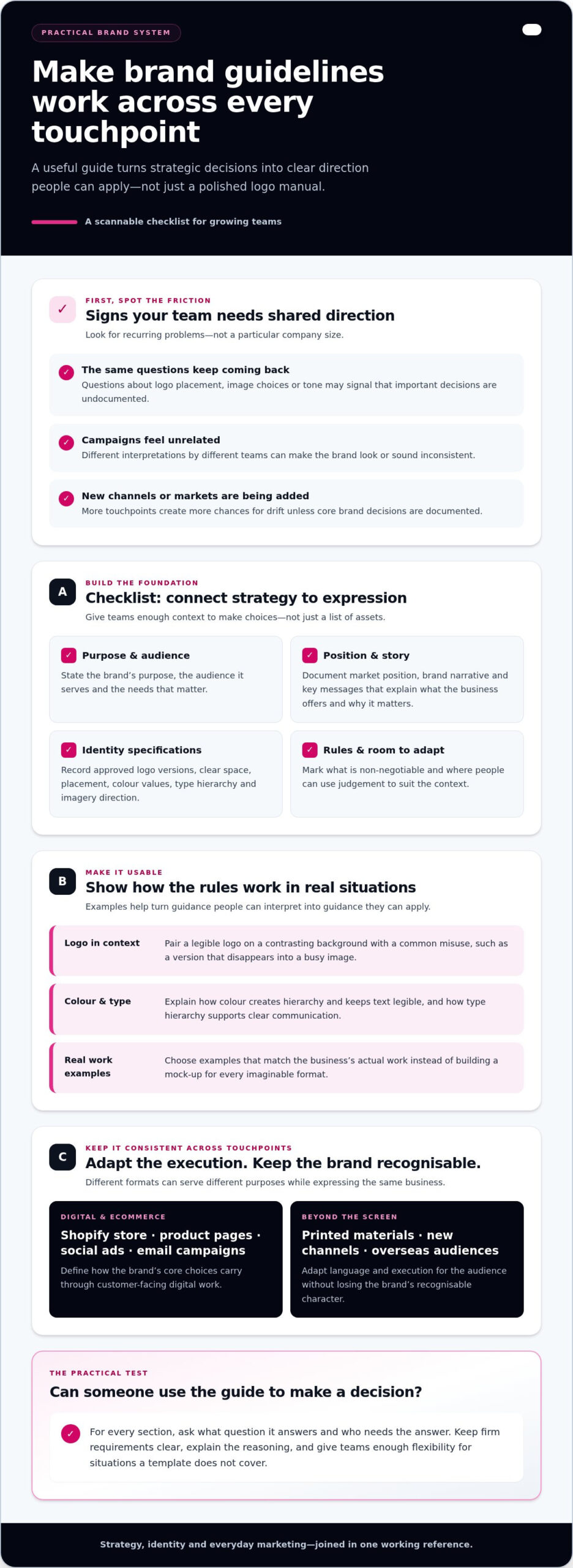
Look for friction, not a particular company size. If campaigns vary in tone, new team members struggle to create on-brand materials, or the same design questions keep returning, important decisions may exist only in the founder’s head. Documenting the reasoning behind those decisions gives others a dependable reference and makes delegation more practical.
The need becomes sharper as a business adds ecommerce touchpoints or enters overseas markets. A product page, paid advert and email may serve different purposes, but they should still feel like expressions of the same business. Guidelines help teams adapt language and execution for an audience without losing the brand’s recognisable character.
- Repeated questions about logo placement, image choices or tone suggest guidance is missing.
- Campaigns that look or sound unrelated indicate that teams may be interpreting the brand independently.
- New sales channels or markets create more opportunities for inconsistency unless core decisions are documented.
Brand guidelines versus a basic visual style sheet
A visual style sheet typically records specifications such as logo variations, colour values and typefaces. That’s useful, but it answers only part of the problem: which assets to use. Practical guidelines also explain why those choices matter, how they support the intended audience perception, and how to apply them in common situations.
For example, listing a colour palette tells a designer which colours are available. A working guide can also clarify how colours create hierarchy, keep text legible and help a product campaign feel connected to the wider brand. This broader view aligns with the concept of corporate identity, where visual elements and guidelines work together to shape how an organisation is presented.
Strong brand guidelines creation therefore connects strategy to execution. It sets essential boundaries while giving teams enough context to make sound decisions when a template doesn’t cover the situation. For further principles on how identity supports a retail experience, explore retail brand identity design.
What to include in practical brand guidelines
A useful guide earns its place by helping someone make a decision. For every section, ask: what question will this answer, and who needs the answer? This keeps brand guidelines creation focused on real work rather than filling a template. A small business may need clear direction for product pages, campaign assets and customer emails before it needs an extensive library of examples.
Documented identity choices turn strategy into consistent customer-facing experiences, from the first advert a customer sees to the product details they read before buying. Make that connection visible, and distinguish firm requirements from recommendations that can flex with context.
Start with brand foundations and positioning
Begin with concise, usable statements about the brand’s purpose, audience, story and position in the market. Add key messages that explain what the business offers and why it matters to the people it serves. These foundations help teams judge whether a design or piece of copy supports the business direction, rather than relying on vague descriptors such as “bold” or “premium.”
Then explain how those foundations inform expression. If the intended perception is expertise and clarity, the guide might favour direct language, clear information hierarchy and imagery that feels considered rather than cluttered. Treat this as a decision-making principle, not a promise about how customers will respond. Make the guidance specific enough that a writer or designer can act on it.
Specify identity rules and real-world examples
Record the essential specifications, then show them in context. Include approved logo variations and when to use them, clear-space guidance, colour values, type hierarchy and direction for selecting imagery. Explain which rules are non-negotiable, such as preserving the logo’s proportions, and which allow judgement, such as choosing a suitable photograph for a particular campaign.
Examples make the difference between a rule people can interpret and one they can apply. Pair a correct use with a common mistake, such as a legible logo against a contrasting background beside a version that disappears into a busy image. Choose examples that match the business’s actual work, rather than creating a mock-up for every imaginable format.
- Strategy and story: Purpose, audience, positioning, brand narrative and key messages.
- Logo: Approved versions, minimum clear space, placement and misuse to avoid.
- Colour and typography: Colour values and roles, type hierarchy, and guidance for headings, body text and emphasis.
- Imagery and voice: Direction for image subject, mood and composition, plus tone principles and sample language.
For a business selling through ecommerce, make the examples relevant to the storefront, product information, email and campaign creative. Add print applications only where they serve a real business need. This keeps the guide manageable while helping internal teams and external partners produce work that feels connected across customer touchpoints.
Because strategy, identity and application need to work together, brand guidelines creation is strongest when it grows from the brand’s foundations rather than being assembled as a standalone design file. A connected approach to brand strategy and identity can turn those decisions into practical guidance for everyday marketing.
How to make brand guidelines flexible across channels and markets
A consistent brand doesn’t require every touchpoint to look identical. It requires customers to encounter the same core identity, even as the format, message emphasis or language changes. Strong brand guidelines creation defines both sides: the elements people must preserve and the choices they can adapt to suit a channel or audience.
What should stay consistent across customer touchpoints?
Keep the brand’s central story, logo integrity, typography principles and recognisable visual cues stable. These signals help customers connect an ecommerce product page with a social post, campaign or package. Repetition builds familiarity; rigidly repeating the same layout does not. A mobile product page, for instance, has different content needs from a social post, but both can use the same visual hierarchy, tone and identity cues.
State the boundaries clearly. A logo’s proportions and approved colours may be fixed, while image selection or content length can vary. This gives teams room to create for a particular placement without making each asset feel like a different business.
Where can a brand adapt for different audiences or markets?
Adapt the expression, not the foundation. For overseas audiences, a business may adjust language, examples or the order in which product benefits are presented. For social media, content may be shorter and more immediate; a product page may need fuller descriptions and clearer navigation. Record why each adaptation is appropriate and where its limits sit, so local decisions remain deliberate rather than improvised.
| Brand element | Consistent rule | Channel-specific application |
|---|---|---|
| Core story | Preserve the same positioning and central promise. | Emphasise a relevant benefit in a campaign; explain it in more depth on a product page. |
| Logo and visual cues | Use approved logo versions and retain recognisable colours and forms. | Adjust scale and placement to suit a social post, storefront or package. |
| Typography and voice | Keep the hierarchy and character recognisable. | Use concise copy in social content and fuller explanations in ecommerce content. |
| Imagery | Maintain the established visual mood and selection principles. | Choose product, lifestyle or campaign imagery that fits the audience and format. |
Use the table as a starting point, then test the rules against real customer journeys. Compare a product listing, a social post and a package: can a customer recognise the same brand, and does each format still serve its purpose? For online retail, apply these principles across the storefront, promotional content and product information. Shopify store development can bring brand choices together with the structure and experience of an ecommerce store.
Finally, document adaptations with a simple rationale: what changes, what stays fixed, and why. This creates a practical boundary for teams working across markets. The result is not a single template imposed everywhere, but a recognisable identity that can respond to different customer contexts without losing its meaning.
How to create brand guidelines: a practical step-by-step process
Effective brand guidelines creation follows a clear sequence: understand the business, establish the identity, apply it to real work, then assign ownership. The guide should be detailed enough for the people who will use it, not expanded simply to look comprehensive. A founder-led startup with a small set of customer touchpoints may need a focused reference; a growing business with multiple teams, campaigns and markets may need more examples and decision rules.
Build the process from strategy to identity, from identity to application, and from application to governance. Each stage gives the next one a stronger foundation.
Build the strategic and visual foundations first
Begin with the business context before laying out pages. Gather input from founders and relevant team members, clarify priority audiences and growth plans, and review existing brand materials. Look for inconsistent executions, missing assets and unresolved choices. This review helps separate decisions that need to be made from rules that simply need to be documented.
- Set the direction. Agree on the business priorities, audiences and intended brand perception. If the business is preparing to sell through ecommerce or reach overseas customers, identify which customer groups and touchpoints matter most.
- Audit what exists. Review current logos, campaign materials, website content, product pages and customer communications. Note where they align, where they differ and which recurring questions the guide must answer.
- Resolve the foundations. Define the brand strategy and identity principles before designing the guide itself. Establish how the logo, colour, typography, imagery and voice work together to express the intended position.
- Set the appropriate scope. Match the guide’s depth to business complexity and its users. A small internal team may need clear essentials and a few practical examples; external partners or teams working across markets may need more application guidance.
Document, validate, and roll out the guidelines
Organise the guide around questions people genuinely ask, not an arbitrary sequence of design topics. A section should make the next decision easier, whether someone is preparing a campaign, updating ecommerce content or briefing a creative partner. Keep instructions direct, distinguish required rules from recommendations, and use examples to show how the principles work together.
- Draft around real tasks. Use plain language and include relevant examples from the business’s communications and customer-facing channels.
- Test before approval. Apply the draft rules to a campaign, an ecommerce page and a customer communication. If different users interpret a rule in conflicting ways, clarify it or add an example.
- Roll out with ownership. Make the approved guide easy for teams and partners to access. Assign responsibility for maintaining it, and establish a review process so updates reflect deliberate brand decisions rather than untracked exceptions.
A strategy-led process turns the guide into a practical business tool. A connected strategy and identity process brings foundational decisions and real-world applications together.
Turn brand guidelines into a system teams can use
A guide only creates value when people can find it, understand it and apply it to real decisions. Treat brand guidelines creation as an operating practice, not a file handover: keep the reference accessible, make responsibilities clear and use examples drawn from the work teams actually produce. That’s what helps the system guide everyday choices as the business grows.
Make the guidelines useful beyond the design team
Designers aren’t the only people who shape a brand. Marketing and ecommerce teams, customer-facing employees, agencies and other partners may all create or adapt brand materials. Organise guidance around tasks and common questions, with clear headings, direct rules and practical examples. Users should be able to locate an answer without needing a design specialist to interpret it.
Ownership matters just as much as access. Assign someone to maintain the reference, manage proposed updates and communicate approved changes. This reduces conflicting versions and helps everyone work from the same direction.
- Make the current guide easy for relevant teams and partners to access.
- Show how principles apply to actual campaign, ecommerce and customer communication materials.
- Give users a clear route to raise questions and flag guidance that no longer fits the work.
Consistent brand direction also supports coordinated channel execution. An integrated digital marketing approach helps channels work together rather than operate as separate activities.
When expert brand guideline creation adds value
Expert support can be useful when the business needs to connect its strategic foundations with visual identity and the demands of daily marketing. A strategy-led approach establishes the rationale behind identity choices, then translates those choices into guidance that teams can apply across customer touchpoints. This is especially valuable when an SME is preparing to delegate more brand decisions or extend its ecommerce activity into new markets.
Senses Group develops custom brand foundations and visual identity systems, bringing strategy, story and practical application together. Its brand guideline design for Jardine Shipping Services formed part of a wider brand presentation and communications initiative. This shows how guidelines can sit within a broader brand effort, rather than being treated as an isolated logo document.
Explore how Senses Group’s brand strategy and identity services can help connect strategic direction with usable brand guidance.
Give your brand room to grow with confidence
Your next growth stage will bring new decisions: a product range may expand, another market may become a priority, or more people may begin shaping customer communications. Use that change as a reason to keep your brand system connected to the business direction, rather than treating guidelines as a finished file that never evolves. Effective brand guidelines creation gives teams a foundation they can apply today and refine as the business develops.
Senses Group has been building brand foundations since 2008 and states it brings more than 18 years of expertise as of 2026. Its connected approach links brand strategy and visual identity to practical applications across marketing and ecommerce, helping businesses establish a system that can support their next stage of growth.
Ready to build a brand system that supports consistent expression and considered expansion? Work with Senses Group on your brand guidelines.
Frequently Asked Questions
What are brand guidelines?
Brand guidelines are a reference that helps people make sound choices about how a business presents itself. They explain how to use the brand’s identity in day-to-day work, such as preparing a sales presentation, publishing a promotion or creating a new customer touchpoint. Good guidance also clarifies who owns the latest approved assets, reducing the risk of teams using outdated files or making conflicting decisions.
What should brand guidelines include?
Include the information people need to produce accurate, recognisable work: the brand’s foundations, approved identity assets, and direction for written and visual communication. Practical additions can make the guide easier to use, such as links to current logo files, example copy, reusable layouts and a short explanation of common mistakes. Prioritise materials used regularly by the business, then expand the guide as new needs become clear.
How do you create brand guidelines for a small business?
Start brand guidelines creation by identifying the decisions that currently depend on the founder, such as how promotions are worded or which product images fit the brand. Agree on the business’s direction, review existing materials, then document the decisions teams need most. Test the draft by having someone unfamiliar with the process use it to create a real asset. Their questions will show where instructions need more clarity.
Are brand guidelines the same as a brand book?
The terms are often used interchangeably, but their scope can differ between businesses. A brand book may focus on the brand’s story, principles and visual identity, while guidelines may place more emphasis on practical instructions for applying those elements. The title matters less than the usefulness of the content. Check whether the resource helps its intended users answer real questions and produce work aligned with the brand.
How often should brand guidelines be updated?
Update them when a meaningful business or identity change makes existing guidance inaccurate, rather than changing the document on an arbitrary schedule. Triggers might include a new product category, a revised positioning, a new ecommerce feature or a shift in the audiences the business serves. Keep a record of approved updates and remove superseded assets, so teams can distinguish current direction from older examples.
Can brand guidelines support expansion into overseas markets?
Yes. Guidelines can help a business preserve its central identity while adapting how it communicates to customers in a new market. For example, they can indicate which messages should remain consistent and where teams may adjust examples, language or content emphasis. Explain the reason for each permitted adaptation, so localised campaigns feel relevant without creating a separate, disconnected version of the brand.
Who should use a company’s brand guidelines?
Anyone who creates, edits or approves customer-facing material may need access, including founders, marketing and ecommerce staff, designers, copywriters and external agency partners. Give each group the level of detail relevant to its work. A campaign writer may need voice examples, while a web designer may need approved assets and layout direction. Clear access and ownership help people use the same current source of guidance.