
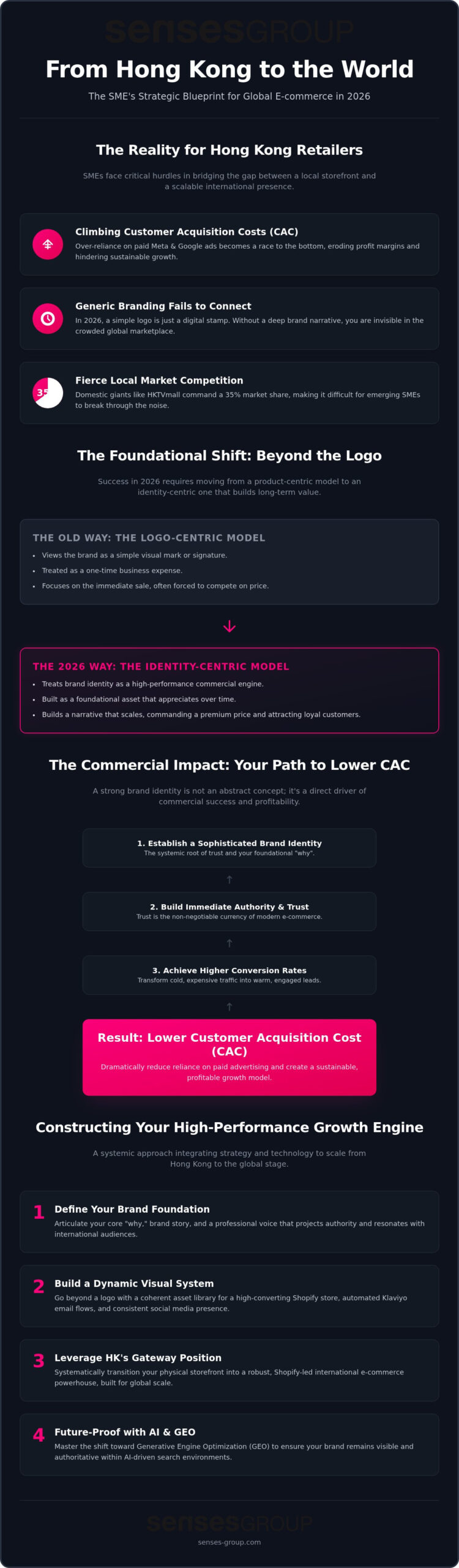
In 2026, a logo is no longer a brand; it’s merely a digital stamp on a package that global consumers are increasingly trained to ignore. You’ve likely felt the shift as your customer acquisition costs climb and a generic brand identity for retailers fails to break through the noise of a market where local giants like HKTVmall command a 35% share. It’s a common frustration for Hong Kong SMEs trying to bridge the gap between a successful local storefront and a scalable international presence. You know that simply existing online isn’t enough to drive sustainable growth.
This guide provides the strategic blueprint to construct a sophisticated brand foundation that functions as a high-performance commercial engine. We’ll move beyond aesthetics to focus on systemic integration and global market entry via Shopify. You’ll discover how to transform your local roots into a worldwide powerhouse by leveraging Generative Engine Optimization (GEO) and precise positioning. We’re outlining the exact roadmap to lower your CAC, differentiate your offering, and scale your operations from the streets of Hong Kong to the global stage.
Key Takeaways
- Learn why a sophisticated brand identity for retailers is the root of commercial success, moving beyond simple logos to create a foundational “why” that resonates globally.
- Understand the direct correlation between strategic positioning and lower customer acquisition costs, allowing you to reduce reliance on paid Meta and Google ads.
- Discover how to leverage Hong Kong’s unique position as a trade gateway to scale your physical storefront into a robust, Shopify-led international ecommerce powerhouse.
- Master the shift toward Generative Engine Optimization (GEO) to ensure your brand remains visible and authoritative within AI-driven search environments in 2026.
- Identify the components of a high-converting growth engine that integrates brand strategy, automated Klaviyo email flows, and AI-driven visual production.
Beyond the Logo: Defining Brand Identity for Modern Retailers in 2026
A logo is a signature, not a strategy. For many business owners, the concept of a brand is often reduced to a visual mark. This is a costly misconception. In 2026, brand identity for retailers must be treated as a foundational commercial asset that dictates every interaction within your sales funnel. It’s the systemic root of trust. While a product-centric model focuses on the immediate sale, an identity-centric model builds a narrative that scales. It’s the difference between competing on price and commanding a premium. In a market as competitive as Hong Kong, where differentiation is the only path to survival, your identity is the engine that drives your commercial outcomes.
Transitioning from a traditional retail mindset to a digital-first approach requires a shift in how you view your business assets. Your brand isn’t an expense you pay for once; it’s a living system that needs to remain coherent across every digital touchpoint. In 2026, consumers don’t just buy products; they buy into identities that reflect their own values and aspirations. If your brand lacks a clear narrative, you’re essentially invisible in the global ecommerce landscape. A strong identity creates a sense of permanence and professional authority that outlasts any single marketing campaign.
The Core Components of a Brand Foundation
The foundation is your “why”. It’s the strategic core that ensures your business resonates with international audiences while maintaining its Hong Kong edge. Your brand story shouldn’t just describe what you do; it should articulate the problem you solve and the values you uphold. A professional brand voice projects authority. It tells the customer that you aren’t just a vendor, but a seasoned partner who understands their needs. This clarity builds the psychological bridge required for long-term loyalty. When your mission is clear, you stop chasing customers and start attracting them through shared values and perceived reliability.
Visual Identity Systems for the Digital-First Era
Visual identity is the “how”. It’s the sensory manifestation of your foundation. In the digital-first era, traditional brand guidelines are obsolete. You need a dynamic asset library that adapts to various platforms, from high-converting Shopify stores to automated email flows. Typography and color psychology aren’t just aesthetic choices; they’re conversion tools. For instance, selecting a palette that conveys stability is essential when targeting global markets from a Hong Kong base. Consistency across these touchpoints creates a coherent narrative that reduces friction. It ensures that whether a customer finds you on social media or your storefront, the experience remains polished and professional. This visual coherence is what allows a local brand to present itself as a global powerhouse. For a deeper understanding of how these systems command authority in international markets, explore our masterclass on visual identity for luxury brands and the psychological codes that drive premium positioning.
The Commercial Impact: How Identity Lowers Customer Acquisition Cost (CAC)
High customer acquisition cost is the silent killer of retail growth. In 2026, relying solely on paid traffic is a race to the bottom. A robust brand identity for retailers acts as a force multiplier for every dollar spent on Shopify. It transforms a cold visitor into a warm lead by establishing immediate professional authority. When trust is baked into the visual and narrative foundation, conversion rates rise. Higher conversion rates naturally lower the cost to acquire each customer. Trust is the currency of ecommerce. Without it, your ad spend is merely a donation to Meta and Google.
It’s not about the volume of traffic, but the quality of the connection. Strong identity creates an “organic pull.” Instead of chasing users with relentless ads, you become a destination they seek out. This positioning allows you to escape the commodity trap where price is the only differentiator. By defining your unique value, you can justify premium pricing in the saturated Hong Kong market. You aren’t just selling a product for HK$500; you’re selling a solution that a generic competitor cannot replicate. Brand equity is the compounded interest of customer trust that ensures long-term lifetime value.
Strategic Positioning vs. Traditional Advertising
Strategy must precede the sales funnel. If you haven’t defined who you are, your ads are just expensive noise. This is why strategic brand development is the prerequisite for scaling. It’s not enough to be seen; you must be remembered. Differentiation isn’t a creative choice; it’s a commercial necessity. When you differentiate effectively, you reduce your reliance on the ever-increasing costs of paid search. You move from a state of constant pursuit to a state of attraction. This shift is what separates a struggling storefront from a sustainable global powerhouse. Understanding how to select the right premium brand design agency is a critical part of ensuring your differentiation strategy is executed with the authority it demands.
Case Study Insights: Doubling Revenue Through Identity
Consider the transformation of Monchhichi Jewelry Atelier. Their revenue didn’t just grow; it doubled through a complete ecommerce rebuild rooted in identity. By integrating brand-consistent messaging into Klaviyo email automation, every touchpoint reinforced their authority. This “Brand Lift” is measurable. It shows up in higher open rates, lower churn, and a significant increase in repeat purchases. A critical component of this system is recovering lost revenue through a precisely engineered Klaviyo abandoned cart strategy that transforms incomplete checkouts into high-converting revenue. If you want to see similar results, you need a strategic partner who understands the deeper mechanics of growth. A high-performing funnel is built on a foundation of clarity, not just a collection of tactics.
Transitioning from Traditional Retail to a Global Ecommerce Presence
Hong Kong has long served as a gateway to the world, but in 2026, that gateway is digital. For local businesses, the transition from a traditional storefront to a global ecommerce presence isn’t just about moving inventory online; it’s about translating a local reputation into a global brand identity for retailers. You aren’t just selling to the 95% of Hong Kongers who are active online. You’re competing with every global player on their home turf. Shopify serves as the primary vehicle for this transformation, especially with the June 2026 expansion of Multi-Currency Payouts. This feature allows Hong Kong merchants to hold funds in various currencies, avoiding automatic conversion to HKD and reducing the friction of international trade.
We utilize the “Sales Atom” approach to manage this expansion. In this model, branding isn’t a secondary layer applied to your marketing; it’s the core component integrated into every stage of your digital funnel. Every Meta ad, Klaviyo email, and product description is a building block of your identity. This systemic integration ensures that your brand remains coherent even as you navigate the complexities of foreign VAT obligations and local consumer protection laws. It’s not about being everywhere at once. It’s about being consistently authoritative wherever you land. For a comprehensive technical and strategic breakdown of how to engineer a high converting Shopify store that functions as a relentless sales engine, our 2026 strategic guide for Hong Kong SMEs provides the definitive roadmap.
Traditional vs. Digital-First Retail Identity
Physical retail relies on location and shelf space. Digital retail relies on UX/UI and trust. While your physical store might rely on foot traffic, your Shopify store depends on a frictionless user experience that mirrors your brand’s authority. The concept of “packaging” has also evolved. It’s no longer just about catching a shopper’s eye on a shelf; it’s about the unboxing experience that bridges the gap between the digital screen and the physical product. Consistency across these omni-channel touchpoints is what cements your professional standing. It ensures that your brand feels as permanent on a smartphone in London as it does in a showroom in Hong Kong.
Building for Longevity and Scalability
A brand must be built to pivot, not just to persist. As you scale from a single product to a multimillion-dollar ecosystem, your identity must remain the anchor. This requires professional brand guidelines that empower decentralized teams to maintain standards without constant oversight. You aren’t building a static shop. You’re constructing a scalable growth engine. By establishing these systems early, you ensure that your business can expand its reach without diluting the core values that drove its initial success. It’s about building something that is both impactful and enduring.
Leveraging AI and GEO to Future-Proof Your Retail Brand
In 2026, the traditional concept of visibility is being rewritten. Visibility is no longer just about human eyes on a screen; it’s about machine comprehension in a Generative AI environment. A sophisticated brand identity for retailers must now be optimized for Large Language Models (LLMs) like Gemini and ChatGPT. This is the essence of Generative Engine Optimization (GEO). It ensures that when an AI agent is asked for a recommendation, your brand is not only mentioned but cited as a definitive authority. It’s not about being found; it’s about being understood. AI optimized metadata is the new ‘brand signage’ for 2026, acting as the digital beacon that guides AI models to recognize your business as the premier solution in your category.
AI isn’t just a tool for efficiency; it’s a system for personalization. By leveraging AI, you can adapt your brand experience for different demographics in real-time, ensuring that your narrative resonates with the specific psychological triggers of each audience. This capability allows a Hong Kong business to maintain a singular brand essence while speaking the diverse “languages” of a global customer base. It’s the difference between a static storefront and a dynamic commercial engine that evolves with the user’s intent.
AI Visual Production and Brand Consistency
AI is the catalyst for scaling your visual narrative without the prohibitive costs of traditional production. By utilizing AI-generated visual systems, you can produce high-quality product images and short-form video ads that maintain perfect alignment with your established identity. This isn’t about replacing creativity, but about amplifying it. For a Hong Kong SME, this means the ability to generate multi-market marketing collateral that feels localized for London, New York, or Tokyo, all while staying anchored to your core standards. It’s a system of efficiency that allows you to remain consistent across every digital touchpoint, ensuring that your brand presence is as polished as it is pervasive.
GEO: Branding for the Next Generation of Search
Your brand story must be more than just compelling; it must be “readable” by the systems that now mediate the customer journey. GEO requires a shift from keyword stuffing to the development of a comprehensive topical map. This system establishes your brand authority by creating a network of interconnected content that AI models can easily synthesize. You aren’t just selling a product; you’re owning a category. By optimizing brand mentions and citations across the digital ecosystem, you ensure your identity is woven into the very fabric of AI-driven search results. This strategic approach moves your business from a state of reactive marketing to one of systemic dominance.
To lead in this new era, you need a partner who understands the intersection of technology and strategy. Discover how our AI Engine Optimisation services can position your retail brand as a global leader in the age of generative search.
Constructing Your Growth Engine: The Senses Group Strategy
Standard marketing packages are not a solution; they are a compromise. For a Hong Kong business to scale internationally, a generic logo or a template-based website is a superficial fix for a systemic problem. At Senses Group, we don’t just provide services. We construct integrated growth engines. This requires a fundamental shift from a service provider mindset to a strategic partnership where every element, from the foundational brand identity for retailers to the technical infrastructure, is designed to scale. When your identity is disconnected from your ecommerce platform, you lose revenue through friction. Our approach eliminates that gap by ensuring your brand narrative and your sales funnel work as a single, unified system.
By combining Brand Strategy and Brand Identity Design with Shopify Development and Klaviyo Automation, we create a robust commercial framework. This isn’t just about aesthetics. It’s about building a revenue-generating machine that operates with surgical precision. With 18 years of expertise and having managed over HK$31.2 million in ad spend, we have the seasoned assurance to know exactly which levers drive growth and which are merely distractions. This is the difference between a website that simply exists and a platform that performs on the global stage. We turn your digital presence into a permanent commercial asset.
The Integrated Sales Funnel Approach
A high-performance Shopify site is only as effective as the narrative it carries. We integrate branding into every stage of the digital funnel, ensuring that your strategic content structures actually convert. Data-driven marketing isn’t just about tracking clicks; it’s about understanding the psychological impact of your brand. We use performance-based insights to build trust, showing you exactly how a refined brand identity for retailers correlates with sustainable profit. It’s a methodical process of identifying a core need and presenting a comprehensive, interconnected solution that reduces your reliance on expensive paid media. A sophisticated Klaviyo abandoned cart strategy is one of the most powerful tools within this funnel, capable of recovering a significant portion of lost international checkouts and driving up to 45% of total revenue for high-performing global stores.
Next Steps for Hong Kong Retailers
The path to international expansion begins with a critical assessment of your current foundation. Conduct a brand audit to identify where your identity is failing to support your commercial goals. Once these gaps are identified, you must define a roadmap that leverages Hong Kong’s unique role as a trade gateway. This isn’t a transition you should navigate alone. Contacting a strategic partner to build your long-term growth engine is the first step toward moving from a local storefront to a global powerhouse. Your business deserves a foundation that is both impactful and enduring. It’s time to stop thinking about marketing and start thinking about systems.
Scaling Your Retail Narrative for a Global Future
The transition from a local storefront to a global powerhouse requires more than just digital presence; it demands a systemic foundation. You’ve seen how a sophisticated brand identity for retailers functions as a commercial anchor that lowers acquisition costs and facilitates international expansion via Shopify. By integrating your narrative into every digital touchpoint, from automated Klaviyo flows to AI-optimized search, you turn your business into a high-performance engine. It’s about moving from reactive marketing to a state of permanent authority.
Success in this landscape isn’t accidental. With 18 years of expertise and over HK$31.2 million in managed ad spend, we understand the mechanics of ROI-driven growth. We’ve helped clients double their revenue by aligning their identity with their commercial goals. Now is the time to audit your foundation and build a brand that is both impactful and enduring. Let’s Build Your Growth Engine – Partner with Senses Group. Your global journey starts with a single, strategic decision.
Frequently Asked Questions
What is the difference between a logo and a brand identity for retailers?
A logo is a singular visual mark, while a brand identity for retailers is a comprehensive commercial ecosystem. It encompasses your strategic positioning, brand voice, and the psychological framework that drives customer trust. While a logo identifies your business, an identity defines your authority. It’s the difference between a signature on a page and the entire contract that governs a professional relationship.
How long does it take to develop a comprehensive brand identity system?
A robust system typically requires eight to twelve weeks of strategic development to ensure long-term stability. This timeline includes deep market analysis, narrative construction, and the creation of a dynamic digital asset library. Rushing this foundational phase often results in a superficial brand that fails to scale. It’s an investment in your business’s permanence rather than a temporary marketing fix.
Why is brand identity critical for Hong Kong SMEs expanding overseas?
International markets are highly competitive, and a local reputation doesn’t automatically translate into global trust. A sophisticated identity signals that your business meets international standards of professional authority. It helps you overcome the “commodity trap” where price is the only differentiator. Without a clear identity, navigating foreign regulations and consumer expectations becomes significantly more difficult and expensive.
How does a strong brand identity help lower Customer Acquisition Cost (CAC)?
Strategic identity establishes immediate credibility, which directly improves your conversion rates on platforms like Shopify. When visitors perceive your brand as a definitive expert, the friction to purchase decreases. This efficiency means you generate more revenue from the same amount of traffic. It’s a systemic way to reduce your reliance on increasingly expensive paid advertising on Meta and Google.
Can AI really help in maintaining brand consistency for retail brands?
AI visual production systems are essential for maintaining standards across multi-market collateral in 2026. These tools ensure that every generated image or video adheres to your established color palettes and typography. This technology allows decentralized teams to produce high-quality assets at scale without diluting the brand narrative. It’s a powerful way to ensure your presence remains polished across every digital touchpoint.
Is Shopify the best platform for building a retail brand identity?
Shopify is the premier vehicle for scaling a brand because it functions as a complete commercial infrastructure. Its seamless integration with tools like Klaviyo and its support for multi-currency payouts make it ideal for global expansion. As of June 2026, Hong Kong merchants benefit from expanded multi-currency features that reduce foreign exchange friction. It’s built for retailers who prioritize growth and professional standards.
What are the first steps to take when transitioning from traditional to digital retail?
Start with a brand audit to determine how your physical reputation translates to a digital-first environment. You must also ensure your legal foundation is secure; as of April 2026, a one-year Business Registration Certificate in Hong Kong costs HK$2,350. Once your registration is current, define your international roadmap and select a premium brand design agency to construct your Shopify storefront. Strategy must always precede technical execution.
How much should a startup invest in brand strategy vs. paid advertising?
Prioritize your brand identity for retailers before scaling your paid advertising spend. Investing in ads without a clear strategy is an inefficient use of capital that leads to high churn. A well-defined identity ensures that every dollar spent on advertising has a higher chance of converting. Establish your foundational narrative first to ensure your business is built for sustainable growth rather than short-term spikes.