A premium price tag isn’t justified by the product alone; it’s earned through the strategic architecture of your brand. Many Hong Kong businesses possess world-class craftsmanship but struggle with a visual presence that feels dated or disconnected from the global stage. This disconnect isn’t just an aesthetic flaw. It’s a commercial bottleneck that drives up customer acquisition costs and keeps average order values stagnant. If your brand looks generic, you’re forced to compete on price rather than prestige.
We understand that transitioning from a traditional model to a high-performance digital presence requires more than just a fresh logo. This masterclass reveals how a sophisticated visual identity for luxury brands acts as a scalable engine for growth. We’ll move beyond surface-level design to examine the psychological and systemic codes that command authority in international markets. You’ll discover a clear framework for using identity to lower CAC and increase AOV. We’re providing the roadmap to transform your brand from a local contender into a global commercial force that commands premium positioning by default.
Key Takeaways
- Learn how a systemic visual identity for luxury brands serves as the foundational architecture for building international trust and commercial authority.
- Discover the strategic use of bespoke typography and sophisticated color systems to move beyond generic aesthetics and establish a unique brand signature.
- Understand how to translate luxury visual codes into high-performance Shopify UX/UI designs that lower acquisition costs and increase average order value.
- Explore the role of AI visual production in creating premium content that maintains your brand’s prestige across global digital channels through 2026.
- Gain a clear roadmap for transitioning from a traditional business model to a scalable, global digital entity built for enduring market presence.
Defining the Visual Architecture of Luxury Brands
A visual identity for luxury brands is not a collection of aesthetic choices; it’s a systemic foundation for international trust. In the competitive Hong Kong market, many businesses mistake opulence for luxury. High-level branding is not about decorative excess, but about refined restraint. It acts as a psychological filter, signaling rarity and exclusivity to a global audience before a single word is read. At Senses Group, our philosophy centers on building a brand that is both impactful and enduring, ensuring that every visual element serves a clear commercial purpose.
The Role of Identity in the Modern Sales Funnel
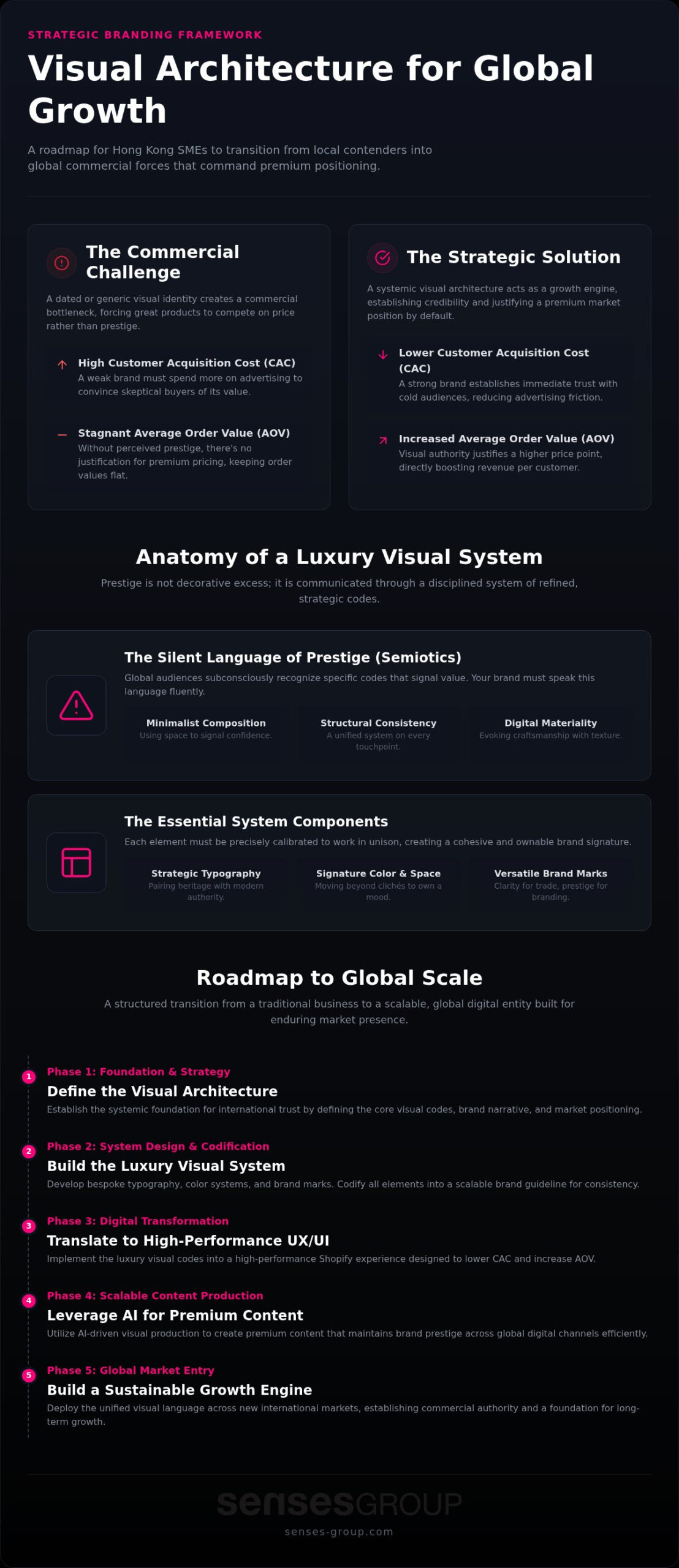
A strong visual foundation does more than look professional. It actively lowers customer acquisition costs (CAC) by establishing immediate credibility with a cold audience. When a Hong Kong SME transitions from a traditional model to a robust ecommerce presence, the brand perception must scale alongside the technology. A weak or dated identity forces you to spend more on advertising to convince skeptical buyers of your value. Conversely, a premium visual system justifies a higher price point and increases average order value (AOV). This authority is the key to long-term scalability and market retention in a crowded digital ecosystem. It’s the difference between being a temporary trend and a permanent market leader.
Semiotics: The Silent Language of Prestige
Prestige is communicated through specific codes that a global audience subconsciously recognizes. These semiotic markers include the deliberate use of white space, sophisticated color theory, and precise typography. Clarity and substance outshine superficial excitement in high-level branding. Instead of chasing fleeting design trends, we establish a definitive expert stance through strategic design. This disciplined approach ensures your brand resonates with international standards, positioning you as a peer to global giants rather than a local alternative. By understanding these silent signals, you can build a connection with your audience that is rooted in perceived value and systemic stability. We focus on the following core pillars:
- Minimalist Composition: Using space to suggest that the product doesn’t need to shout to be noticed.
- Structural Consistency: Ensuring every touchpoint, from social media to the Shopify checkout, feels like a single, unified system.
- Materiality in Digital: Using high-fidelity textures and lighting in visual assets to evoke a sense of physical craftsmanship.
This strategic application of design transforms your business into a commercial engine. It’s not just about looking better; it’s about building a foundation that supports global market entry and sustained growth.
The Essential Elements of a Luxury Visual System
A visual identity for luxury brands is not a collection of isolated graphics; it’s a cohesive system where every component works in unison to signal value. This system relies on the precise calibration of typography, colour, and space to build a narrative of permanence. Typography shouldn’t just be legible. It must convey heritage. We pair bespoke serifs that whisper history with high-contrast sans-serifs that declare modern authority. Luxury is not about the “gold and black” cliché, but about brand-specific signatures that own a particular psychological space, moving your brand away from generic tropes and toward a unique commercial identity.
Negative space is perhaps the most overlooked element of prestige. It signals confidence. By allowing your assets room to breathe, you tell the customer that your product doesn’t need to fight for attention. This restraint translates into a scalable brand guideline that ensures your identity remains intact whether it’s on a boutique shelf in Central or within a Brand Identity Design framework for a global audience. When these elements are codified, they provide the stability required for rapid scaling.
Logo vs. Brand Mark: A Strategic Distinction
A wordmark provides immediate clarity in international trade, while a symbolic monogram offers a layer of abstract prestige. The choice depends on your strategic objective. Designing for versatility is non-negotiable. Your identity must maintain its integrity from a 16px favicon on a mobile browser to large-scale corporate signage in a logistics hub. The brand mark serves as the commercial anchor for the business, grounding all marketing efforts in a singular, recognizable point of origin.
Visual Consistency and the Global Market Entry
Expanding from Hong Kong to overseas markets requires a unified visual language. Inconsistent brand assets create friction and erode trust with international stakeholders. A cohesive system ensures that your Shopify store, Meta ads, and email automations all speak with the same authoritative voice. This alignment isn’t just about aesthetics. It’s about building a predictable experience that converts. When your visual identity for luxury brands matches global standards, you bypass the hurdles of being seen as a local alternative and emerge as a serious international contender. Selecting the right premium brand design agency is a critical step in ensuring your visual system meets these international benchmarks.
Luxury Transformation in Practice: Strategic Analysis
Theory only gains value when it’s applied to complex commercial environments. We’ve seen how a refined visual identity for luxury brands acts as the silent architect of market expansion. It’s the difference between a business that survives locally and one that dominates globally. By examining real-world transformations, we can see the systemic impact of strategic design on the bottom line. These aren’t just aesthetic updates; they’re commercial realignments that position Hong Kong businesses for international trade.
Modernising Corporate Identity: The Shipping Sector
For a shipping leader, the challenge wasn’t a lack of scale, but a lack of clarity. We enhanced their global image by stripping away visual clutter and reinforcing their position as an industry authority. Professional, forward-looking marketing materials replaced fragmented assets. This overhaul wasn’t merely a facelift. It was a strategic realignment. By establishing rigid brand guidelines, we ensured their communication remained consistent across every international touchpoint. This clarity builds trust with global stakeholders who value stability and professional rigor over superficial excitement.
Retail Excellence: The Jewelry Atelier Transformation
Our work with Monchhichi Jewelry demonstrates the direct link between identity and income. We didn’t just redesign a logo; we rebuilt the entire ecommerce experience. By integrating high-performance brand strategy with automated email flows, we maximized every customer interaction. The result was a definitive commercial success: the brand doubled its revenue shortly after the digital launch. This wasn’t accidental. It was the logical outcome of aligning a premium visual system with a robust sales engine. It shows that when your visual identity for luxury brands matches the quality of your craftsmanship, the market responds with higher order values.
In the specialized field of digital art therapy, the goal was to blend clinical credibility with human accessibility. This required a delicate visual balance that signaled both expertise and empathy. Each of these brands shared a common trajectory. They transitioned from local players to global contenders by adopting the visual codes of their respective industries on a worldwide scale. They stopped looking like local alternatives and started looking like global standards. This transition is essential for any Hong Kong SME looking to scale. You must build a foundation that supports your vision for the next decade, not just the next quarter.
The Digital Evolution: Luxury Identity for Shopify and AI
The digital storefront is the new flagship. For a visual identity for luxury brands to remain effective, it must transcend static guidelines and adapt to high-performance environments. It’s not enough to have a beautiful brand book; your identity must function as a data-driven growth engine. This is where the ‘Bespoke Sales Atom’ becomes critical. It integrates your visual codes into a system that optimizes for both human desire and machine logic, ensuring your brand remains impactful and enduring as you scale.
Shopify as a Luxury Vehicle
Templates are the enemy of exclusivity. While standard themes might suffice for generic retail, luxury requires a unique digital home. Custom theme development allows for the precise translation of brand codes into high-performance UX/UI design. This isn’t just about aesthetics; it’s about conversion rate optimization (CRO). A bespoke digital environment signals that your brand is a global leader, not a local experiment. By aligning your visual identity with seamless functionality, you lower the friction of the purchase journey. You can explore these strategies in depth within our Mastering Retail Brand Identity: 2026 Digital Guide. This approach ensures your Hong Kong business commands the same respect as an established international atelier.
AI and the Future of Luxury Visuals
Looking toward 2026, AI visual production is the key to maintaining brand discipline at scale. High-end product images and videos can now be generated with consistent lighting and texture, ensuring your social media pillars remain prestigious across every channel. We don’t aim to replace creativity; we aim to scale it. Beyond the visuals, we must optimize for Generative Engine Optimization (GEO). This involves structuring metadata so that AI search results and Large Language Models (LLMs) recognize your brand’s authority. Automated scheduling and AI-driven posting maintain the rhythmic consistency required to build long-term trust with a global audience. If you’re ready to build a high-performance digital presence, our Ecommerce Shopify Store solutions are designed to bridge the gap between local tradition and global commercial success.
Scaling Your Heritage: Building a Sustainable Growth Engine
Transitioning from a traditional business model to a scalable digital entity is not a matter of chance; it’s a matter of architecture. For many Hong Kong enterprises, the heritage of their craft is their greatest asset, yet it often remains trapped in local silos. A robust visual identity for luxury brands serves as the bridge between this local history and a global future. It provides the systemic foundation required for long-term longevity, ensuring that as you scale, your brand’s prestige remains undiluted. We don’t just provide services. We act as an authoritative mentor, guiding you through the deeper mechanics of business transformation.
The Strategic Roadmap for Hong Kong SMEs
Navigating the competitive Hong Kong ecosystem requires a dual focus on local market retention and international trade expansion. The city is a gateway, but entering foreign markets requires more than just logistics. It requires a visual presence that commands immediate respect. Your roadmap begins with a comprehensive brand audit to identify where your current image creates friction. From there, we implement a global growth engine that aligns your identity with high-performance commerce. This involves moving beyond top-of-funnel awareness to focus on retention and lifetime value. For instance, understanding Why Email Marketing works better than Meta Ads? is crucial for building a sustainable community around your brand rather than just renting an audience. A deeper understanding of brand identity design hong kong strategies will further equip your SME to compete on the global stage with systemic precision.
Partnering for Sustainable Profit
Standard marketing packages often fail because they treat symptoms rather than roots. Sustainable profit is built on end-to-end, custom-crafted solutions that integrate brand strategy with technological precision. We turn your website into a revenue-generating machine by leveraging 18 years of expertise in the Hong Kong and international sectors. Our approach is disciplined and globally-minded, focusing on the systemic connection between your visual identity for luxury brands and your commercial outcomes. If you’re ready to move beyond generic digital presence and build something that is both impactful and enduring, Let’s build your growth engine with Senses Group. We specialize in transforming vision into a scalable, high-converting reality.
Architecting Your Global Commercial Future
Building a brand that scales globally requires more than just a digital presence; it’s a matter of creating a systemic foundation that commands prestige. We’ve explored how a refined visual identity for luxury brands transforms your business from a local contender into a global authority. By aligning your visual codes with high-performance Shopify systems and AI-driven optimization, you create a sustainable growth engine. This transition isn’t just about looking better. It’s about building a commercial architecture that lowers acquisition costs and justifies premium positioning.
At Senses Group, we bring 18 years of strategic expertise to every transformation. We’ve partnered with global leaders like LVMH, Sony, and Barclays to refine their market presence. Our methods have consistently delivered results, including doubling revenue for our ecommerce partners. Don’t let a dated identity hold your business back from its full international potential. Let’s Build Your Growth Engine: Consult Senses Group today and start your journey toward global market leadership. Your heritage deserves a future that is both impactful and enduring.
Frequently Asked Questions
What are the key elements of visual identity for luxury brands?
The key elements include strategic typography, sophisticated color signatures, and the deliberate use of negative space. These components function as a systemic language that signals rarity and authority to a global audience. Unlike generic retail, a visual identity for luxury brands relies on refined restraint rather than decorative excess to build international trust. This foundation ensures your brand remains impactful and enduring across all commercial touchpoints.
How can a strong visual identity help a brand scale internationally?
A strong identity establishes a universal standard of prestige that transcends local borders and cultural barriers. It ensures your business is perceived as a peer to global giants, removing the local alternative stigma that often hinders Hong Kong businesses. This alignment is essential for entering foreign markets where immediate credibility is the primary currency. By adopting global visual codes, you build a foundation for scalable, high-performance international trade.
Why is branding important for SMEs in the Hong Kong market?
Branding acts as a critical differentiator in a hyper-competitive ecosystem that serves as a gateway to international trade. For Hong Kong SMEs, a strong identity justifies premium positioning and protects against price-based competition from regional rivals. It facilitates the transition from traditional models to robust ecommerce platforms. This ensures long-term market retention and provides the stability required to expand your reach into overseas territories.
Can AI be used to create luxury brand visuals without losing exclusivity?
AI can scale high-end visual production when it’s used as a tool for consistency rather than a replacement for strategy. We leverage AI to generate high-fidelity product imagery and maintain a rhythmic content schedule that preserves your prestige. This ensures your brand discipline remains intact across global channels while maintaining the unique creative codes that define your exclusivity. It’s about scaling your vision, not automating away your soul.
How does visual identity impact customer acquisition costs (CAC)?
A premium identity lowers CAC by establishing immediate trust and reducing the friction of the purchase journey. When your visual identity for luxury brands matches the quality of your offering, you spend less on advertising to convince skeptical buyers. This authority increases conversion rates and average order values simultaneously. Consequently, your marketing spend becomes a more efficient engine for growth, allowing for sustainable scaling in competitive digital markets.
What is the difference between brand image and visual identity?
Visual identity is the intentional system of design elements you control, while brand image is the audience’s resulting perception. Identity is the root architecture, including logos, typography, and color systems. Image is the psychological outcome. A successful strategy ensures that your visual foundation directly builds a commercial image of permanence and expertise. You define the identity to influence and secure the desired image in the market.
How do luxury brands maintain consistency across digital and physical touchpoints?
Consistency is maintained through rigid brand guidelines that codify every visual interaction across all platforms. Whether a customer visits your Shopify store or a physical boutique in Central, the experience must feel like a single, unified system. This disciplined approach ensures that your prestige remains undiluted across diverse digital ecosystems and traditional retail environments. It builds the rhythmic familiarity that is essential for establishing long-term trust with high-net-worth stakeholders.
How long does it take to see the commercial impact of a brand identity overhaul?
Commercial shifts in conversion rates and average order values often emerge shortly after a strategic digital relaunch. While long-term brand equity builds over years, our partners have seen revenue double within months of aligning their identity with a high-performance Shopify sales funnel. The speed of these results depends on how deeply the new visual system is integrated into your data-driven marketing and email automation engines. To ensure you make the most informed decision for your business, review our strategic guide to choosing a premium brand design agency before committing to a transformation partner.