
A lifecycle flow is only as strong as the customer journey behind it. Klaviyo customer journey mapping connects the experience from first discovery to repeat purchase and advocacy. It shows how customer needs, actions and touchpoints shape the next relevant message. The journey is not always linear: customers may move between channels and stages before they buy or return.
If welcome, browsing and post-purchase emails operate as separate campaigns, it can be difficult to see where the overall experience loses momentum. For Hong Kong SMEs and startups expanding through ecommerce, a clear journey map helps align marketing with what customers need at each stage, whether they’re shopping locally or overseas.
This guide explains how to map lifecycle stages, define useful customer personas and organise journey phases in Klaviyo. It also shows how to spot missing or underperforming flows and refine the experience using customer behaviour and feedback. The aim is not simply to add more automation. It is to build a connected system in which every message has a clear role in moving the customer relationship forward.
Key Takeaways
- Map how customers move across your website, email, social media and other touchpoints, then use channel performance to understand where communication needs to connect.
- Track customer actions and emotional responses across lifecycle stages so each flow supports the relationship’s next step.
- Use customer personas and journey phases to make messages more relevant to different needs, from initial discovery to advocacy.
- Audit existing flows and their performance to reveal missing messages, transition gaps and inconsistent communication.
- Refine journeys with customer behaviour, feedback and flow testing, prioritising improvements that address the most meaningful friction.
What is customer journey mapping?
Customer journey mapping connects customer actions to the messages and experiences they encounter across channels. In Klaviyo, the map guides automation, while metrics such as conversion rates help show where journeys need refinement.
-
Identify Marketing Touchpoints
List each place a customer encounters your brand, including your website, physical store, email, SMS and social media. For a Hong Kong retailer selling locally and overseas, a shopper might discover a product on social media, compare it on Shopify, then purchase after an email reminder.
Distinguish the journey map from the tools that activate it. A map shows the whole experience; a campaign sends a planned message to an audience, while a flow automates messages after defined customer actions. Awareness, consideration and purchase can involve several touchpoints, so assess the hand-offs rather than judging email alone.
For marketing in Hong Kong, build in consent controls: record permission, explain how personal data will be used and suppress profiles that opt out. Treat these controls as part of the journey, not an afterthought to automation.
-
Integrate Cross-Channel Data
Connect useful signals from website analytics, CRM systems, social platforms and customer feedback. Map profiles to events, then use segments to group people by behaviour, such as viewing a product without purchasing. This gives each profile context beyond an email address.
Klaviyo can synchronise messaging across channels to support a unified brand experience. For a Shopify store, the integration can connect ecommerce activity with customer profiles and events. Other platforms depend on their available integrations and data connections. Map which source records each action, and avoid duplicate or conflicting events that distort channel metrics.
Review performance by touchpoint and journey stage. Compare engagement and conversion rates for a product-view email, a social interaction and a completed order. The goal is not to give every channel equal weight, but to identify which signals clarify intent and which channels move customers forward.
-
Connect Journeys With Automated Flows
Translate the map into a sequence of triggers, conditions and messages. For example, start with a product-view event, check whether the profile has purchased, then send relevant follow-up content only when appropriate. This step-by-step logic connects customer behaviour to automation without treating every visitor identically.
Flows respond to customer actions; campaigns deliver a planned message to a selected audience. Use that distinction to give each message a role, such as welcoming a new subscriber or supporting the post-purchase experience. Reserve exclusive offers for a clear strategic purpose rather than making discounts the default response.
Finally, review the path across email, SMS, social media and the store experience. Check that timing, message and destination align at every transition. Klaviyo customer journey mapping is useful when it links those touchpoints into one measurable experience, rather than leaving each channel to operate in isolation.
Customer lifecycle stages and journey maps
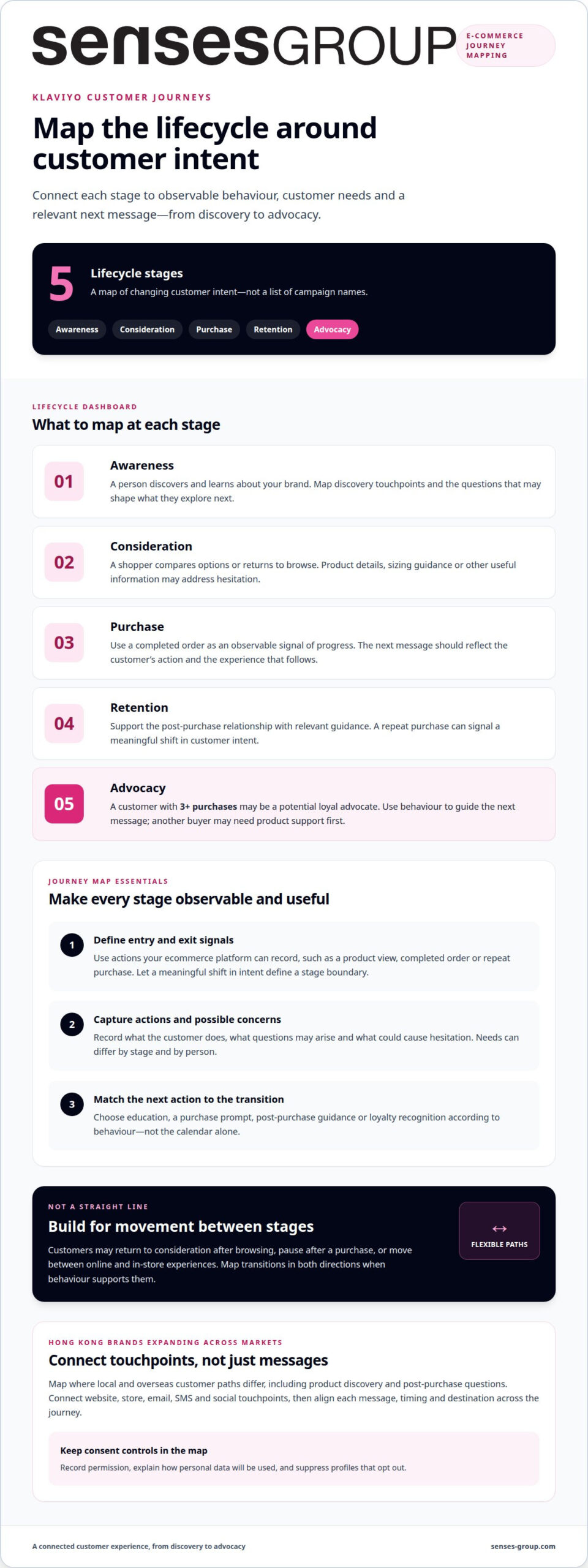
Build the lifecycle map around changes in customer intent, not a fixed sequence of messages. For a Hong Kong ecommerce brand, each stage should show what a person does, what they may need next, and how the business recognises progress.
- Define the lifecycle stages. Start with awareness, when someone discovers and learns about your brand. Continue through consideration, purchase, retention and advocacy. These stages describe the relationship, not campaign names. A first-time visitor, for example, may compare products over several visits before purchasing, while an existing customer may return directly for a new product launch.
- Set an observable entry and exit signal for each stage. Use actions your ecommerce platform can record, such as a product view, completed order or repeat purchase. A stage boundary should reflect a meaningful shift in intent. A subscriber who has not purchased is different from a first-time buyer, even if both receive the same campaign.
- Record customer actions and emotional responses. For each stage, document what the person does, what questions may arise and what could cause hesitation. During consideration, a shopper comparing sizes or product details may need clearer guidance. After purchase, delivery information may address a different concern. These notes connect the customer experience to conversion without assuming everyone feels the same.
- Map transitions, including non-linear movement. Customers may return to consideration after browsing, pause after a purchase or move between online and in-store experiences. Draw arrows between stages in both directions when behaviour supports them. If your business serves overseas markets, note where local and international customer paths differ, such as product discovery or post-purchase questions, rather than forcing both into one sequence.
- Assign a relevant next action to each transition. Decide whether the next step calls for education, a purchase prompt, useful post-purchase guidance or recognition of customer loyalty. A customer who has made 3+ purchases may be a potential loyal advocate, while another buyer may need product support first. Let behaviour determine the message, not the calendar alone.
- Review the map as customer needs change. Compare movement between stages with campaign engagement, conversion and repeat purchasing. If customers repeatedly browse without progressing, investigate the information or experience available at that point. Update the map when product ranges, market conditions or customer feedback change. A lifecycle model is a working tool for decisions, not a permanent diagram.
Customer journey maps should evolve as customer needs change. Revisit whether each stage still represents a meaningful shift in intent and whether its entry and exit signals remain observable in the available customer data. If the map no longer reflects how people move from discovery to purchase, back to consideration or onward to support and loyalty, revise the transitions and the next action attached to them. Keep relationship stages distinct from campaign names, so a change in messaging is not mistaken for a change in customer status. Use the updated map to guide relevant experiences across local and international paths, while allowing customers to progress at different paces.
Customer personas and journey phases
Personas make lifecycle stages actionable by connecting customer needs with relevant communication. For a Hong Kong ecommerce business, use observed behaviour and customer feedback to determine what each group needs, then adapt the message across awareness, consideration, purchase, retention and advocacy.
- Build personas from useful customer signals. Group customers by needs and behaviours, not assumptions about age or location. A skincare brand might distinguish first-time visitors seeking ingredient guidance from repeat buyers replenishing a familiar product. Use purchase and browsing history, sign-up preferences and customer feedback to decide whether those groups need different information or timing.
- Collect preferences that change the experience. During sign-up, ask about relevant interests, style preferences or experience level. A fashion retailer could use a style preference to tailor product selections, while a specialist equipment seller might ask about experience. Link each question to a clear communication decision, so the answer helps shape what the customer receives.
- Define awareness and consideration by customer intent. In awareness, a person discovers and learns about a brand. During consideration, they compare products to see whether they meet their needs. Map the questions at each phase: a new visitor may need a clear introduction, while someone comparing two products may need a useful explanation of their differences.
- Connect purchase messages to the decision point. Purchase is the phase when a person decides to buy. Identify information that supports that action, such as a product detail or a clear route back to an item viewed. Keep campaigns aligned with the customer’s latest behaviour. A buyer should not continue receiving messages that treat them as an undecided prospect.
- Separate retention from advocacy. Retention involves repeat purchases, while advocacy involves sharing information about a brand and recommending its products. After an order, useful product guidance can support the customer experience. Later, invite feedback or make sharing easy when behaviour suggests genuine satisfaction. Loyalty develops through relevant experiences, not simply by labelling every purchaser an advocate.
- Use behaviour to recognise high-value relationships. Customers with 3+ purchases are potential loyal advocates, while champions are customers with high recency, frequency and monetary values. Treat these as signals for thoughtful segmentation, not automatic proof of intent. For example, purchase history can guide a loyalty message, while recent customer feedback may show whether a service issue needs attention first.
- Refresh personas as evidence changes. Customer needs shift as products, markets and expectations evolve. Review whether each persona still explains observed actions across journey phases. If overseas shoppers repeatedly ask about product suitability before buying, use that pattern to inform clearer consideration-stage content. Update segments and messages using new customer feedback rather than preserving outdated assumptions.
A customer journey map can break the customer experience into phases from awareness to loyalty, helping organize those stages as a connected journey.
Identifying missing or underperforming flows
A useful audit compares existing flows with customer transitions, performance metrics and support needs. Common risks include overlapping messages, broad segments and gaps between customer actions and follow-up.
-
Find Missing Flows
Document every active flow, its trigger, audience, purpose and performance metrics. Then place each flow on the customer journey, from sign-up through purchase, retention and re-engagement. A product-view event without relevant follow-up, for example, may reveal a gap between browsing and conversion.
Check transition points, not just the number of flows. A new buyer may receive a welcome message but no post-purchase guidance. A returning customer may receive generic acquisition campaigns instead of communication suited to their order history. Record missing education, support and follow-up content as well as missing automation.
For a re-engagement segment, one useful example targets profiles whose last order was at least 60 days ago and who haven’t opened an email in the last 30 days. Treat this as a defined audience for review, not a universal rule for every product or buying cycle.
-
Review Underperforming Flows and Risks
Compare each flow’s results with its purpose and place in the journey. If a welcome flow attracts opens but few product visits, review its message and next step. If a post-purchase flow receives weak engagement, check whether its content arrives at a useful point in the customer experience.
Common mistakes include treating every profile as the same audience, sending conflicting offers and judging a flow by just one metric. These can undermine satisfaction: customers who have already purchased should not keep receiving messages aimed at completing that same purchase.
- Trace hand-offs between journey stages. Review what happens immediately before and after each flow trigger. A completed order should move a customer out of purchase reminders and into relevant post-purchase communication. Check suppressions and exit conditions so one event does not leave a profile in conflicting sequences.
Inspect the customer experience beyond email, too. If a campaign sends shoppers to a product page with different promotional information, the journey has a consistency gap. Compare message content, destination pages and customer support themes to find friction that flow metrics alone may not explain.
- Prioritise gaps by impact and effort. Rank missing-flow opportunities by potential impact and implementation difficulty. A post-purchase flow may address a clear support need, while a complex, low-priority branch can wait. Document the reason for each decision, the segment it targets and the journey transition it supports.
For Hong Kong SMEs expanding overseas, note whether the same gap appears across markets or only in a particular customer path. Differences in product questions or purchase behaviour may call for tailored content, rather than duplicating every flow for every audience.
- Turn findings into a focused improvement plan. Record the current flow, the observed issue, the proposed change and the metric that will indicate progress. Change one meaningful element at a time, such as timing, message or audience criteria. This makes it easier to assess whether a performance shift reflects the change or another journey condition.
A specialist can translate audit findings into Klaviyo flow planning that addresses the specific gaps in your customer journey.
Customer journey optimization
Optimise ecommerce journeys by combining behaviour data, customer feedback and focused testing. In Klaviyo, analytics can help identify friction, while messages and transitions can be refined around customer intent.
-
Apply Ecommerce Mapping Practices
Start with the customer’s intended outcome at each touchpoint, then map what supports the next action. For a product-view journey, connect browsing behaviour with relevant product information and a clear route back to the item. Check that each message reflects the customer’s latest activity, rather than repeating a generic promotion.
Bring customer service, sales and product teams into the mapping process. Their recurring questions can reveal missing guidance that engagement metrics alone may not show. Repeated questions about product use, for example, may point to useful educational content before purchase. Consider fulfilment, responsive support and consistent brand presentation as parts of the journey, not separate operational concerns.
-
Refine the Customer Journey
Review flow performance alongside customer behaviour, survey responses and feedback. If a message earns engagement but few follow-on product visits, assess its content, timing and place in the wider journey. Test one meaningful change at a time, then use A/B testing to compare alternatives in new or existing flows.
For example, test an abandoned-browse message at 1 to 3 hours after abandonment, then compare the resulting behaviour. Don’t treat a timing change as the only explanation for a result. Check whether the product recommendation, call to action or destination page also matches the shopper’s intent.
- Set a customer-centred measure. Choose a metric that matches the journey’s purpose. Customer lifetime value can help assess a retention goal, while purchase completion may suit a conversion flow. Klaviyo’s 2025 consumer marketing report says 66% of consumers expect brands they shop with to make them feel valued and understood. Use that expectation to assess relevance, not merely message volume.
Review feedback alongside the selected metric. A high click rate may still conceal confusion if customers contact support with the same question. Combining behaviour with customer comments gives a clearer view of the experience and helps determine whether a flow solves the intended problem.
- Respond to risk and changing trends. Klaviyo’s consumer marketing report says 20% of B2C buyers abandon a brand after one negative experience. Treat complaints, delivery concerns and repeated support questions as signals to examine the journey. Coordinate marketing messages with the customer’s actual experience, especially when an unresolved issue could make a promotional message feel disconnected.
Review trends across customer segments and markets. If overseas shoppers engage with product education but hesitate before purchasing, investigate whether the journey answers their questions. Avoid assuming that a message that works in one market will work unchanged everywhere.
- Keep the map current. Add new customer feedback and behaviour patterns to the journey map, then reassess flow priorities. A launch, product change or shift in customer questions can alter which touchpoints matter most. Use Klaviyo analytics to monitor results and refine the strategy as new evidence emerges.
For a connected approach to journey optimization, plan your Klaviyo email automation around customer behaviour, clear brand messaging and measurable flow goals.
Senses Group: Klaviyo Email Automation
Senses Group helps Hong Kong ecommerce businesses turn customer journey maps into connected Klaviyo Email Automation. This is a practical next step when lifecycle stages are clear, but the corresponding flows, segments and messages need to work as one system.
For a growing Shopify store, Senses Group can align customer events with welcome, purchase and retention communication, while keeping each flow consistent with the brand. When the wider experience needs attention, Brand Strategy, Brand Identity Design and an Ecommerce Shopify Store can provide a stronger foundation for customer communication.
Bring your journey priorities and current flow challenges into the discussion, and contact Senses Group to explore the next step.
Build the next stage of customer growth
As your business expands from Hong Kong into overseas ecommerce markets, each new campaign creates another chance to strengthen the customer relationship. The next step is to choose a journey priority that supports your commercial direction, then align the experience around it. A focused approach to Klaviyo customer journey mapping can help keep customer communication connected as your products, audiences and markets evolve.
That alignment extends beyond automation. Brand Strategy clarifies the position your business wants to own, Brand Identity Design makes that position recognisable, and an Ecommerce Shopify Store gives customers a place to experience it. Together, these foundations can help make lifecycle communication consistent from first interaction to ongoing engagement.
Turn your journey priorities into a more connected customer experience. Contact Senses Group to discuss your journey and take the next step with clarity.