
Better paid search performance comes from reaching people with relevant intent, not simply bidding on more keywords. A search engine marketing agency (SEM) can align keywords and ad messages with what people are looking for, refine targeting, and track conversions that matter to the business.
Paid search can bring visibility quickly, but visibility alone does not show whether a campaign is contributing to growth. Clicks and impressions show activity; conversion tracking connects that activity to enquiries or sales, helping businesses make decisions based on outcomes rather than traffic alone.
This article explains how SEM works and how semantic search, audience targeting, and conversion tracking can improve paid search campaigns. It also shows how these elements fit together, and why a clear view of your goals, products, and target markets matters when scaling an e-commerce business from Hong Kong into overseas markets.
Key Takeaways
- Match keyword themes to the meaning behind a search, so ads can reach relevant prospects beyond exact wording.
- Assess campaign performance through conversions as well as clicks and impressions to understand which activity supports business goals.
- Use paid search to gain visibility while recognising how it differs from organic search and can complement SEO over time.
- Refine audience targeting around factors such as location, device, and search intent to make campaigns more relevant to local and overseas markets.
- Connect search visibility with a clear brand and ecommerce experience so more qualified traffic has a stronger path to purchase.
How an SEM agency uses semantic search and broad-match keywords
Semantic search considers the meaning behind a query, while broad match can connect ads with related searches. An agency assesses intent, business priorities, and conversion evidence to determine which connections are relevant.
Keyword Selection and Search Intent: An Agency’s Approach
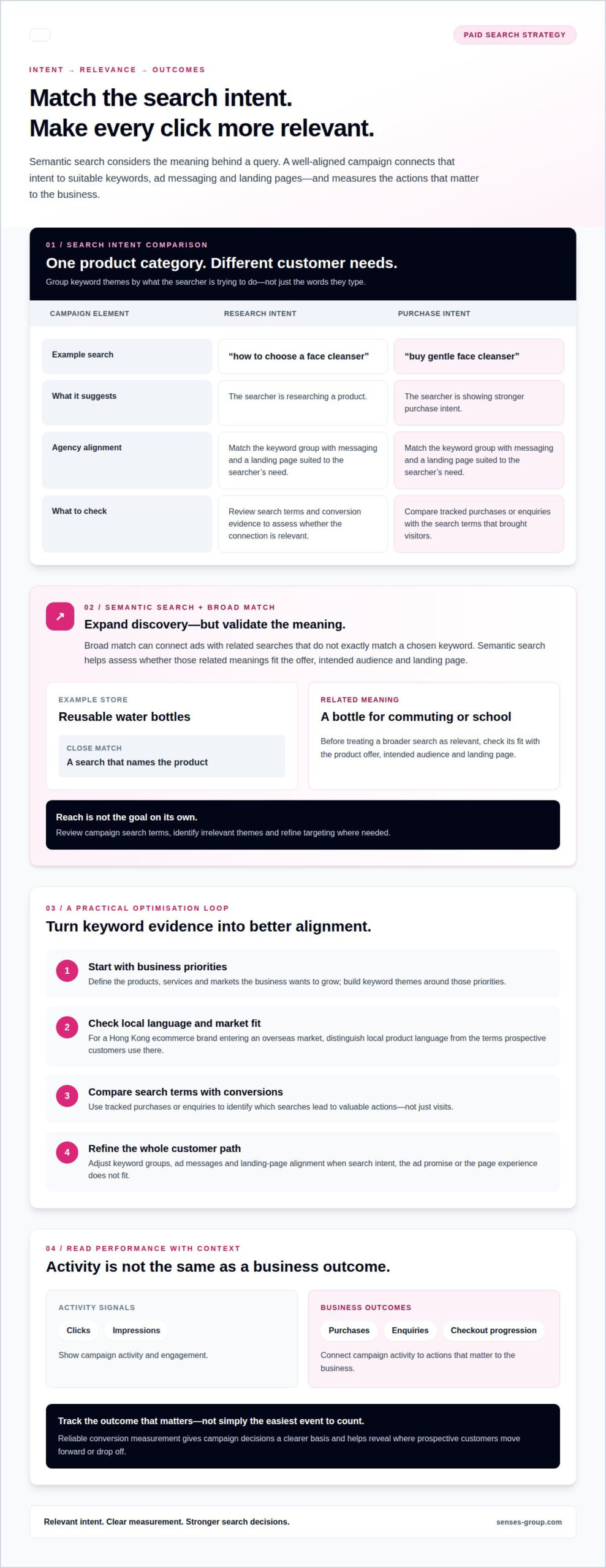
Search intent is the purpose behind a query, such as researching a product, comparing options, or preparing to buy. It matters because an ad should address the searcher’s need, not merely repeat the query. For example, “how to choose a face cleanser” suggests research, while “buy gentle face cleanser” signals stronger purchase intent. An agency groups keywords by intent, then matches each group with suitable ad messaging and landing pages.
Keyword Research and Analysis by an SEM Agency
Keyword research identifies searches relevant to a business; analysis assesses their intent, fit, and contribution to commercial goals. An agency starts with the products, services, and markets the business wants to grow, then builds themes around those priorities. For a Hong Kong ecommerce brand entering an overseas market, research should distinguish local product language from the terms prospective customers use there. The agency can also review search results and account performance to spot mismatches, useful variations, and themes to test.
Semantic Search and Broad Match in Practice
Semantic search helps an agency understand related meanings, while broad match can use those relationships to reach searches that do not exactly match a chosen keyword. Consider a store selling reusable water bottles. A close match might name the product, while a related query might focus on a bottle for commuting or school. Before treating that broader meaning as relevant, the agency assesses whether it fits the offer, intended audience, and landing page.
Broader matching can expand discovery, but reach alone is not the goal. An agency reviews the search terms associated with a campaign, identifies irrelevant themes, and refines targeting where needed. It can also compare paid search themes with organic performance. If relevant pages already appear in organic search, that context helps determine how paid visibility can support the wider search strategy.
How an SEM Agency Uses Keyword and Conversion Data
Keyword and conversion data show which searches lead to valuable actions, not just visits. An agency compares search terms with tracked conversions, such as a purchase or enquiry, and uses the findings to refine keyword groups, ad messages, and landing-page alignment. If a product-related query attracts clicks but few purchases, the agency can assess whether the query signals research, the ad sets the right expectation, or the landing page meets the shopper’s needs.
Over time, this analysis connects search language with business outcomes. An agency can prioritise themes associated with meaningful conversions, reduce emphasis on poorly matched queries, and apply useful keyword insights to organic search planning. Campaign decisions then rest on customer intent and commercial evidence.
Campaign analytics and conversion tracking
Campaign analytics connect ad activity with commercial outcomes. In Google Ads, an agency reviews clicks, impressions, and conversions to understand whether campaigns reach the right audience and contribute to sales or enquiries. A click shows engagement; a recorded purchase is a more direct business result. Tracking should reflect the outcome that matters, not simply the easiest event to count.
Before launch, the agency aligns campaign objectives with measurable website actions, such as completing checkout or submitting an enquiry. It checks that the relevant conversion events are recorded and that reports distinguish meaningful actions from incidental activity. For an ecommerce store, purchases and checkout progression can show where prospective customers move forward or drop off. Consistent measurement gives later campaign changes a reliable basis.
During monitoring, an agency compares performance across search terms, ads, audiences, and landing pages. If a campaign gets clicks but few conversions, it can investigate whether search intent, the ad’s promise, or the page experience is misaligned. If an audience generates valuable purchases, that evidence can inform targeting decisions. The aim is to optimise for relevant outcomes, not to increase traffic without context.
Google Ads offers campaign types beyond standard search ads. Performance Max can support campaigns across Google advertising inventory, while Demand Gen is designed to reach audiences through visual placements. An agency considers the product, target customer, creative assets, and conversion objective before recommending either format. For example, a visual consumer product may suit a campaign that introduces it to shoppers, while a search campaign can respond to active product queries.
Campaign controls shape what the advertising reaches and how it appears. An agency can assess location, device, audience, and search intent, then review performance against the intended market. For a Hong Kong business expanding overseas, separate market structures can help distinguish local results from international activity. Search ads appear in search engine results, while other campaign formats may display across different Google placements; reporting should preserve that distinction.
Which Hong Kong regulations and privacy rules affect SEM campaigns? Campaign measurement should account for how website tags collect and use personal data, and how the business explains that use to visitors. Tracking design should align with applicable Hong Kong privacy requirements and the company’s privacy practices.
Which SEM services do agencies typically provide? Common work includes campaign planning, keyword and audience targeting, ad setup, conversion tracking, ongoing optimisation, and performance reporting. Together, these activities connect campaign delivery with evidence about results.
What questions should you ask an SEM agency before signing a contract? Ask how it defines and reports conversions, what campaign controls it will manage, and how often it reviews results. Clarify account access, responsibilities, and how findings will guide decisions. For businesses connecting paid campaigns with long-term organic visibility, SEO and AI Engine Optimisation can support that wider search strategy.
SEM definition and paid search advertising
Search engine marketing (SEM) promotes a website through paid advertising in search results. For Hong Kong businesses, it can create visibility for products and services while organic search builds a longer-term source of discovery.
In a Google search, paid ads may appear above or below organic results. A business bids on keywords related to its offer, aiming to reach customers looking for relevant products or services. The strategy connects search demand with an ad and a suitable landing page. For example, a Hong Kong retailer entering an overseas market can use paid search to introduce a product to people searching for that category.
Paid Search and PPC
Paid search commonly uses a pay-per-click (PPC) model, where an advertiser pays when someone clicks an ad. Advertisers bid on relevant keywords, and search engines run auctions when users search for those terms. Because spending is tied to clicks, not simply ad display, businesses should consider the value of the visits they attract. A Shopify store, for example, might direct shoppers searching for a particular product to its product page.
Search Advertising Costs and Ranking
Search advertising costs depend on keyword auctions, advertiser bids, and campaign settings, so there is no single cost that applies to every Hong Kong business. A higher bid can affect an ad’s position, but ranking and spend should be assessed against the value of resulting visits. An agency considers the target keyword, available budget, and conversion evidence before adjusting a campaign, rather than treating the top position as the only measure of success.
That distinction matters for growing businesses. A Hong Kong ecommerce brand may need paid advertising to gain visibility for a new product or market, while established organic pages can already attract relevant customers. An agency can compare paid search and organic search performance, then direct advertising toward opportunities where paid visibility supports the wider strategy. A business appearing in both paid and organic results can occupy more search-result space, but each placement should serve a clear purpose.
Reducing reliance on paid advertising is a gradual strategic shift, not a reason to switch campaigns off without evidence. SEO can attract organic traffic without a direct cost per click, and SEM keyword and conversion data can inform SEO priorities. If campaign data shows that searches for a product feature lead to purchases, for example, the business can develop useful organic content around that need. Strong organic visibility can lessen long-term dependence on paid placements.
For an SME expanding beyond Hong Kong, paid search can test how customers respond to products and messaging in a target market. The agency can use those results to refine advertising and identify organic content opportunities. The balance changes as demand, search visibility, and conversion patterns develop. A considered strategy treats paid advertising as one growth lever, not the entire customer acquisition system.
Benefits of search engine marketing
SEM can put a business in front of people actively searching for relevant products or services. Its value depends on connecting that visibility with the right audience, offer, and next step.
Business Benefits of SEM
SEM gives businesses a way to pursue visibility in search results for specific products, services, and markets. For a Hong Kong ecommerce business, campaigns can help introduce a product to potential customers in a chosen overseas market while the brand builds recognition there. Search activity also provides evidence about which offers and messages attract interest, supporting more informed digital marketing decisions.
Paid advertising requires an ongoing budget and campaign management, and clicks alone do not establish business value. A business should assess whether search activity contributes to meaningful outcomes, such as purchases or enquiries. Search engine optimisation can support organic visibility over time, while SEM serves other priorities, including promoting a launch or testing demand.
Benefits of Hiring an SEM Agency
An SEM agency coordinates campaign planning, implementation, and performance analysis. For an SME with limited internal marketing capacity, this can connect keyword and audience choices with ad messaging, landing pages, and conversion measurement. The value is not simply outsourcing campaign tasks; it is making decisions through a consistent view of customer intent and business goals.
In Hong Kong, businesses expanding across markets also need to account for differences in search language, product positioning, and customer expectations. An agency can structure campaigns around those market distinctions and use performance evidence to guide refinements. The business still needs to supply clear commercial priorities, product information, and the markets it wants to reach.
How do SEM agencies compare with SEO agencies in Hong Kong? SEM agencies focus on paid visibility in search results, while SEO agencies work to improve organic search visibility. The disciplines can complement each other when paid campaign insights inform search content priorities.
What should businesses look for when choosing an SEM agency in Hong Kong? Look for a clear explanation of campaign strategy, conversion measurement, account access, reporting, and how decisions relate to commercial goals. For a business selling overseas, ask how the agency will distinguish target markets and evaluate performance in each.
What is the process for hiring and onboarding an SEM agency? It typically begins by agreeing on business objectives, target markets, products, and conversion goals. The agency then reviews the relevant accounts and website journey, establishes campaign structure and measurement, and sets a reporting rhythm with the business.
What are common risks and red flags when hiring an SEM agency? Be cautious of guaranteed sales or fixed rankings, unclear reporting, and recommendations focused only on clicks. Businesses should understand who controls the advertising accounts, how campaign decisions are explained, and how results will be assessed against agreed goals.
Audience targeting for search ads
Audience targeting makes search advertising more relevant by connecting campaign decisions with location, device, and search intent. For a Hong Kong ecommerce business, an agency defines who the campaign should attract before shaping its ads and traffic strategy.
Planning starts with the offer and the market. An agency identifies the product or service, the intended customer, and the action the campaign should encourage, such as purchasing a product or submitting an enquiry. A Hong Kong retailer entering an overseas market may need a distinct campaign for that audience, rather than assuming local messaging will resonate internationally.
Location helps align ads with the places a business can serve and wants to reach. Device can inform how the agency assesses the customer journey, since someone browsing on a phone may have a different page experience from a desktop shopper. Search intent adds another layer: a query about product features may signal research, while a query naming a product for purchase can indicate stronger buying interest.
Audience definitions should shape the ad itself. An agency aligns the message with the searcher’s likely need, then directs traffic to a relevant page. For example, an ad for a skincare product can highlight its intended use and lead to that product’s page, rather than sending every searcher to a general storefront. A clear connection between query, message, and landing page gives the audience a coherent next step.
Google Ads campaigns can use signals such as location, interests, and search history to help reach relevant audiences. An agency evaluates those signals alongside the business’s customer profile and campaign objective. A broad audience may suit discovery for a new product, while a campaign for a specific product category may need closer alignment with relevant searches. The choice depends on the offer, target market, and intended action.
For Hong Kong businesses expanding internationally, audience planning also means treating each market as a distinct commercial context. An agency can structure campaigns by target location and assess whether search language, ad messaging, and the destination page fit that audience. If traffic arrives but does not take the intended action, the agency can review those connections and refine the campaign rather than assuming more reach will solve the problem.
Targeting is not a substitute for a strong offer. It helps place that offer before a more relevant audience, while campaign evidence shows whether the message attracts meaningful activity. Plan audience-focused advertising around your target markets, customer intent, and desired actions.
Senses Group: SEO & AI Engine Optimisation
Senses Group helps businesses strengthen organic visibility through SEO & AI Engine Optimisation, complementing paid search with a longer-term approach to discovery. This can be a natural next step when campaign insights reveal what customers search for, or when a Hong Kong business wants to build recognition in overseas markets.
Search visibility works best when it connects with a clear brand and buying experience. Brand Strategy and Brand Identity Design can establish consistent positioning, while an Ecommerce Shopify Store gives customers a focused path from discovery to purchase. Together, these foundations align search presence with the business behind it.
Contact Senses Group to discuss how SEO & AI Engine Optimisation can support your growth plans.
Build your next stage of search growth
Make paid search part of a clear growth decision. Before expanding campaigns, define which market matters most, what action you want customers to take, and whether your online experience supports that goal. For SMEs entering overseas ecommerce markets, focus creates a stronger basis for allocating attention.
A search engine marketing agency (SEM) can turn that direction into a practical campaign strategy, with decisions tied to your commercial priorities. The broader foundation matters too: a distinctive brand and considered online store shape how customers experience your business after finding it through search.
When you’re ready to discuss a strategy for your next stage of growth, contact Senses Group about SEM. Clear priorities are a strong starting point for building lasting market momentum.
Frequently Asked Questions
How can an SEM agency improve results for a company?
An SEM agency can connect advertising activity to a company’s commercial priorities. For example, a retailer preparing to launch a product can distinguish campaign activity for the launch from ongoing promotion of established products. Clear objectives help shape account structure, reporting, and recommendations. The company should also provide accurate product information and timely feedback so campaign decisions reflect stock, priorities, and the customer experience.
How do companies balance SEM and SEO?
Companies can balance SEM and SEO by giving each a role in their growth plan. Paid campaigns can support a product launch or market test, while SEO develops useful content and organic visibility over time. Review campaign insights alongside organic performance to decide where paid support adds value and where content investment can build lasting discovery. The right balance changes with business priorities and market conditions.
Is SEM the same as Google Ads?
No. SEM describes marketing through paid placements in search results, while Google Ads is a platform businesses can use to run campaigns. The distinction matters when planning channels: strategy defines the audience, objective, and search opportunities, while the platform provides campaign tools. Businesses should assess platform choices against where their customers search and the markets they intend to serve.
What is SEM?
SEM, or search engine marketing, uses paid advertising to increase a website’s visibility in search results. A business can promote a specific offer to people searching for related products or services. For instance, a retailer might advertise a seasonal product category when customers are actively looking for it. SEM differs from earning organic visibility through search engine optimisation, though both can support a wider search strategy.
What is an SEM agency?
An SEM agency plans and manages paid search campaigns for businesses. Its work may include researching search opportunities, structuring accounts, writing ads, managing bids, setting audience controls, and reviewing performance. A search engine marketing agency (SEM) should connect these activities to commercial objectives, rather than treating account changes as an end in themselves. For a small business, clear reporting and defined responsibilities make the working relationship more useful.
What is the future of SEM?
SEM will continue to change as search engines evolve how they present information and advertising. Businesses need to consider how new search experiences affect ad placement, audience attention, and the customer journey. Automation may also influence campaign management, making clear objectives and accurate conversion measurement even more important. Companies with clear brand positioning and relevant landing pages can adapt as search behaviour and platforms evolve.
What does a search engine marketing (SEM) agency do?
A search marketing agency turns a business objective into paid search activity and ongoing campaign decisions. It can define campaign structure, create ads, manage targeting, and report on outcomes. The business provides priorities, product details, target markets, and input on what counts as a valuable customer action. For an ecommerce company, aligning an ad with its destination product page helps keep the shopping journey consistent.
How much do SEM agencies charge in Hong Kong?
SEM agency fees in Hong Kong depend on the work involved and are provided after a quote request. Cost factors include campaign scope, account complexity, the number of markets or products involved, and the level of ongoing management and reporting required. Advertising spend is separate from management fees, so businesses should understand how each is handled. A written scope helps clarify responsibilities, deliverables, and how campaign work will be reviewed.