
Why are you paying a premium to rent an audience you should already own? In the volatile Hong Kong market, relying solely on Meta Ads has become an expensive cycle of diminishing returns where rising customer acquisition costs (CAC) erode your margins. It’s frustrating to feel like a commodity, shouting into a crowded digital space while your brand messaging remains inconsistent across channels. You’ve likely noticed that simply increasing your ad spend no longer guarantees a proportional increase in stability or scale.
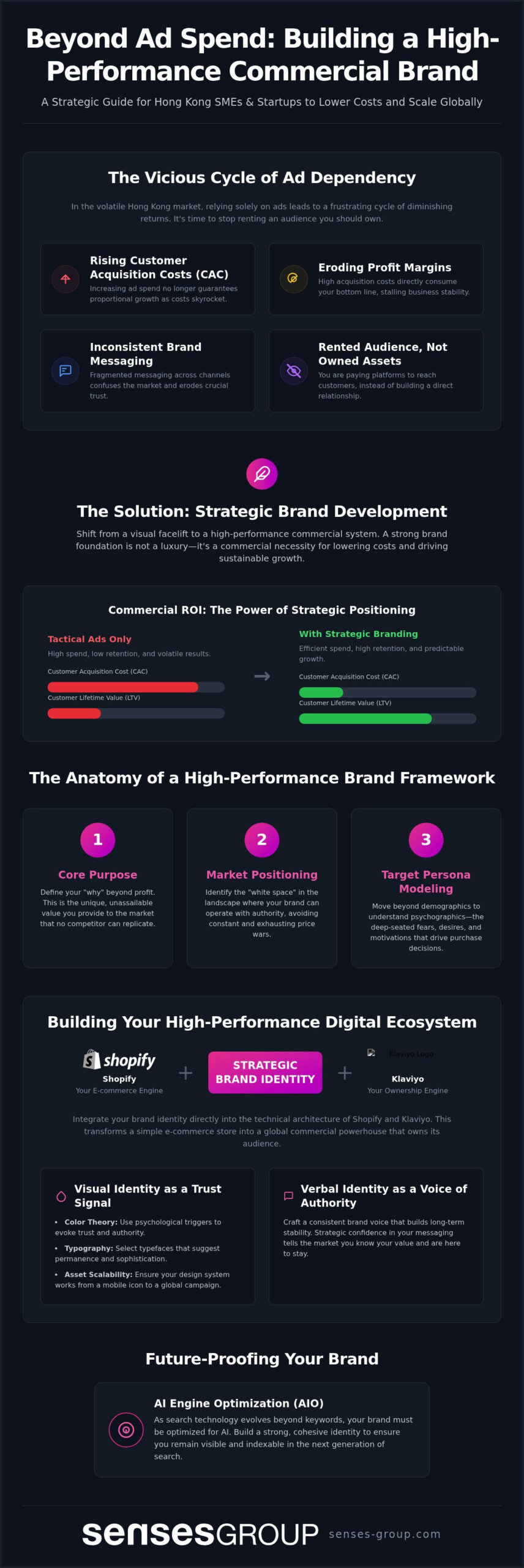
This is where strategic brand development moves from being a creative luxury to a commercial necessity. It’s not about a prettier logo, but about building a cohesive foundation that supports a high-converting sales funnel. You’ll discover how to transform your brand from a visual identity into a high-performance commercial system that drives sustainable growth and lowers acquisition costs. By shifting focus toward a scalable digital ecosystem powered by Klaviyo and Shopify, you’ll see why email marketing isn’t just an alternative to paid ads, but a superior engine for long-term recovery and international expansion.
Key Takeaways
- Shift your perspective from seeing a brand as a purely visual asset to treating it as a systemic commercial tool that aligns market psychology with business objectives.
- Implement strategic brand development to create a foundation that naturally lowers customer acquisition costs and improves the efficiency of every marketing dollar spent.
- Build a high-performance digital ecosystem by integrating your brand identity directly into the technical architecture of Shopify and Klaviyo.
- Transition your online presence toward AI engine optimization to ensure your brand remains visible and indexable as search technology evolves.
- Establish a distinct verbal and visual identity that positions your business as a market leader rather than a commodity in the competitive Hong Kong landscape.
What is Strategic Brand Development? Moving Beyond the Visuals
Many Hong Kong entrepreneurs mistake a visual facelift for a brand evolution. It’s a common error that leads to wasted capital and stagnant growth. Strategic brand development is the process of aligning business objectives with market psychology to create a distinct commercial advantage. It’s the architectural blueprint of your business. It’s the logic that dictates how you’ll win in a crowded market. A logo is simply the final expression of this strategy; it’s the result, not the starting point. In 2026, the marketplace has moved beyond passive identities. Your brand must function as an active commercial system that converts attention into equity.
Foundational research is the bedrock of this process. You can’t scale what you don’t understand. By identifying market gaps and deep-seated consumer desires, you move from being a commodity to a category leader. Effective Brand Management ensures that your identity isn’t just a static image but a living asset that guides every business decision from product development to customer service.
Strategy vs. Tactics: Why Most Brands Fail to Scale
Tactics are the tools you use to execute, such as Meta ads or social media posts. Strategy is the reason those tools exist. Most businesses fail because they’re tactical but not strategic. They’re running performance marketing on a weak brand foundation, which is a recipe for high acquisition costs and low retention. Without a clear “why” and “for whom,” your messaging becomes fragmented across digital channels. This lack of cohesion confuses the market and erodes trust. A robust strategic brand development plan prevents this fragmentation. It ensures that whether a customer sees a Google ad or opens a Klaviyo email, the brand experience remains singular and authoritative.
The Anatomy of a Strategic Brand Framework
A high-performance brand isn’t built on guesswork. It’s built on a structured framework that addresses three critical pillars. First, you must define your Core Purpose. This is your reason to exist beyond profit; it’s the value you provide to the Hong Kong market that no one else can. Second, you must establish your Market Positioning. You’re looking for the white space in a crowded landscape where you can operate without constant price wars. Finally, you need Target Persona Modeling. This goes beyond basic demographics. You’re looking for psychographic drivers—the fears, desires, and motivations that trigger a purchase decision. When these three pillars are aligned, your brand becomes a scalable engine for growth.
The Pillars of a High-Performance Brand Identity
A high-performance brand identity isn’t a collection of aesthetic choices; it’s a series of calculated trust signals. For Hong Kong SMEs and startups, the goal isn’t just visibility. It’s authority. Strategic brand development ensures that every visual and verbal touchpoint works to lower the psychological barrier to purchase. This systemic integration is what transforms a simple e-commerce site into a global commercial powerhouse. You aren’t just building a store; you’re building a reputation that precedes every transaction.
Visual Identity as a Trust Signal
Design is the first layer of commercial communication. In professional sectors, color theory and typography aren’t subjective; they’re functional. Deep navy tones or structured serif fonts communicate stability and seasoned experience. You aren’t designing for the current month’s trends. You’re designing for longevity. High-performance brands avoid fleeting aesthetics in favor of timeless authority. This ensures your assets remain effective from a tiny Shopify mobile icon to a large-scale international campaign. If your visual system can’t scale, your business won’t either. For retailers navigating this challenge, understanding how to build a robust brand identity for retailers in the digital era is essential to ensuring your visual system commands authority across every touchpoint. Consider these key components of a robust design system:
- Color Theory: Utilizing psychological triggers to evoke immediate trust and professional authority.
- Typography: Selecting typefaces that suggest permanence, clarity, and sophistication.
- Asset Scalability: Building a modular system that maintains its integrity across all digital resolutions and physical formats.
Crafting a Voice of Authority
Your verbal identity is the bridge between your strategy and your customer’s logic. It requires a shift toward strategic confidence. Consistency in your brand voice builds long-term stability. It tells the market you know exactly who you are and what you deliver. Verbal identity is the rhythmic interplay of punchy declarations and complex explanations. By mastering this rhythm, you move from being a subservient service provider to an authoritative mentor. When your voice resonates with commercial growth, you stop competing on price and start competing on value.
True differentiation happens when your identity is built for digital-first environments. Your assets must be optimized for the speed of modern commerce. Whether it’s a Klaviyo automation or a Shopify product page, the identity must feel integrated. It shouldn’t feel like a layer added at the end. It should be the foundation. This is “not this, but that” positioning in action: you aren’t just selling a product; you’re providing a solution rooted in expertise. A disciplined approach to strategic brand development ensures that your identity assets are built for this reality. To see how these systems integrate into a cohesive sales funnel, you can explore more about integrated brand and e-commerce strategy.
The Digital Ecosystem: Integrating Strategy with Shopify and Klaviyo
A brand strategy that remains confined to a slide deck is a wasted investment. For a Hong Kong business to scale or recover, that strategy must be hard-coded into its digital infrastructure. Your ecommerce store isn’t just a catalog; it’s the ultimate expression of your brand strategy. When strategic brand development is executed correctly, it dictates every pixel of the user interface and every line of the backend logic. It moves your business from a state of passive existence to one of active commercial momentum.
Building High-Converting Shopify Stores
Generic templates are for hobbyists. For a business looking to maintain its footing or expand into international markets, custom Shopify development is the only way to protect brand integrity. You must map the sales funnel to the psychological journey of your specific customer. This process moves the user from landing page discovery to checkout confidence by removing every point of friction. By integrating brand storytelling directly into the product page experience, you transform a simple transaction into a lasting relationship. Premium design and conversion rate optimization (CRO) aren’t opposing forces. They’re synergistic components of a high converting Shopify store that justifies your pricing and validates your authority.
Retention Marketing through Klaviyo Automation
The transaction doesn’t end at the checkout. In fact, that’s where the most profitable phase of the customer lifecycle begins. Klaviyo email flows allow you to extend the brand experience deep into the post-purchase phase. This is how you build an “owned” audience, effectively mitigating the rising costs of Meta and Google advertising. With email marketing delivering an average ROI of $36 to $45 for every $1 spent, the commercial logic for this integration is undeniable. It’s a far more efficient engine for growth than the $68 to $84 average customer acquisition cost (CAC) often seen in traditional ecommerce advertising.
Using data-driven insights, you can maintain a sophisticated brand voice while delivering personalization at scale. Automated retention isn’t just about generating repeat sales. It’s about building long-term brand equity and profit that isn’t dependent on the whims of a third-party algorithm. A disciplined approach to strategic brand development ensures that every automated touchpoint reinforces your positioning. This creates a scalable digital ecosystem that supports sustainable growth, whether you’re targeting the local Hong Kong market or expanding your reach overseas.
The Commercial ROI: Lowering CAC through Strategic Positioning
In the high-velocity Hong Kong market, many businesses treat rising advertising costs as an unavoidable tax on growth. This is a fundamental misunderstanding of commercial mechanics. High customer acquisition cost (CAC) is rarely a platform problem; it’s almost always a positioning problem. When your brand lacks clarity, you’re forced to overspend on Meta and Google to compensate for a lack of trust. Strategic brand development serves as a financial filter that removes this “commodity friction,” allowing you to attract higher-quality leads with less resistance. It’s the difference between chasing the market and leading it.
Measuring the health of your brand requires moving beyond vanity metrics like likes or impressions. You must focus on sustainable profit margins and the lifetime value of your customers. A brand with a clear “why” commands a premium because it solves a specific psychological need that competitors ignore. By shifting your focus from volume to value, you insulate your business against the volatility of ad auctions and global market shifts.
The Psychology of Lower Acquisition Costs
Trust acts as a commercial shortcut. In professional service and premium e-commerce sectors, a sophisticated brand identity reduces the time to purchase by providing immediate visual and verbal proof of authority. When your visual assets are distinctive and your messaging is precise, your click-through rates (CTR) naturally improve because you’re no longer blending into the digital noise. Strategic positioning eliminates the need for aggressive discounting by establishing a value proposition that transcends price. This shift in perception is what allows Hong Kong SMEs to scale effectively without eroding their margins in a race to the bottom.
Performance Marketing on a Strategic Foundation
Performance marketing is the fuel, but your brand is the engine. Meta and Google Ads perform significantly better when they’re backed by a cohesive funnel and a disciplined identity. With average e-commerce CAC rising by 40% over the past two years to between $68 and $84, you can’t afford to send paid traffic to a fragmented experience. Consistency in your messaging reduces “ad fatigue” and builds long-term recall, ensuring that your brand is the first one a customer remembers when they’re ready to buy. Strategy-led brands consistently outperform “growth-hacker” brands over a 24-month period because they’re building equity, not just buying temporary attention. For a deeper look at how integrated email systems serve as the ultimate lever for lowering customer acquisition costs, explore our dedicated guide on the subject. To audit your current positioning and identify gaps in your commercial system, you can consult with our strategic growth team.
Future-Proofing: AI Engine Optimization and Brand Evolution
The transition from traditional SEO to AI-driven engine optimization marks the definitive shift in modern digital trade. In a landscape where 88% of marketers already report using AI in their daily operations, your visibility no longer depends on keyword matching but on entity authority. AI search models prioritize businesses that demonstrate systemic clarity and deep market relevance. Through the lens of strategic brand development, we view search not as a game of technical manipulation, but as a reputation management system. It’s the process of making your brand “indexable” by ensuring its core purpose and commercial value are unmistakable to machine learning algorithms.
Maintaining authority in an era of AI-generated content requires a move toward substance. As the market becomes saturated with generic, low-value information, Hong Kong businesses must double down on data-driven, authoritative insights. Your brand must evolve from a passive participant in search to a primary source of truth. This evolution ensures that when AI engines synthesize answers for your potential customers, your brand is the one cited as the industry standard.
Dominating Search in the AI Era
Modern optimization focuses on brand “entities” rather than isolated keyword strings. AI models look for the relationship between your business, your products, and the problems you solve. To win, you must provide authoritative content that serves as a foundation for AI citations. Senses Group leverages advanced AI optimization to drive sustainable traffic by aligning your digital assets with these new search behaviors. We don’t just optimize for a page; we optimize for the entire brand ecosystem, ensuring your business remains visible as traditional search engines transform into sophisticated answer engines.
- Entity-Based Logic: Establishing your brand as a recognized authority within its specific commercial niche.
- Authoritative Citations: Creating high-fidelity, data-rich content that AI models use to validate their responses.
- Systemic Integration: Ensuring your Shopify and Klaviyo data feeds are structured for maximum AI visibility.
Building for Longevity: The Senses Group Approach
Building an enduring commercial asset requires moving from foundational strategy to functional execution as a single, unified system. Disciplined, globally-minded brands win in the Hong Kong market because they value logic over mere aesthetics. They understand that a brand is not a static logo, but a living commercial engine that must adapt to technological shifts. By partnering with a strategic agency, you ensure that your business isn’t just surviving the current transition but leading it. This is the hallmark of strategic brand development: it provides the stability needed for recovery and the scalability required for expansion. To move beyond temporary tactics and build a high-performance sales system, you must scale your business with a strategic brand development partner.
Securing Your Commercial Future Through Strategic Integration
The transition from renting attention on Meta to owning your audience through a high-performance ecosystem is a structural necessity for Hong Kong businesses. The evidence confirms that a brand must evolve from a passive visual identity into an active commercial system that lowers customer acquisition costs and drives sustainable growth. By integrating your brand logic directly into Shopify and Klaviyo, you create a foundation that resists market volatility and algorithm shifts. This isn’t about cosmetic upgrades; it’s about building a scalable digital trade engine.
Success in modern commerce requires more than tactical agility. It demands strategic brand development that aligns your business objectives with the evolving mechanics of AI-driven search and consumer psychology. As specialists in integrated Shopify and Klaviyo ecosystems with deep expertise in AI-driven search optimization, Senses Group provides the systemic brand strategy needed to lower CAC and secure long-term equity. It’s time to stop reacting to rising costs and start building for longevity. We’re ready to help you navigate this transition with clarity and precision.
Build an impactful and enduring brand with Senses Group
Your path to recovery and global scaling starts with a disciplined, systemic approach to growth.
Frequently Asked Questions
What is the difference between brand identity and strategic brand development?
Brand identity consists of the tangible visual and verbal elements like logos and colors, whereas strategic brand development is the underlying commercial logic that aligns those assets with market psychology. It’s the difference between looking professional and being profitable. Strategy dictates who you serve and why you win; identity simply communicates that decision. Without strategy, your identity is a passive ornament rather than a functional tool for scaling your Hong Kong business.
How long does the strategic brand development process typically take?
A comprehensive framework typically requires eight to twelve weeks of disciplined research and execution. This timeline allows for deep market analysis, persona modeling, and the creation of a systemic design language. We don’t rush the foundation because a flawed strategy leads to expensive tactical failures. It’s a methodical process that moves from identifying market gaps to building a functional digital ecosystem ready for international expansion and long-term stability.
Can strategic branding really lower my customer acquisition costs (CAC)?
Strategic positioning directly lowers customer acquisition costs by reducing the “commodity friction” that forces you to overspend on ads. When your brand communicates authority instantly, your click-through rates improve and your conversion windows shorten. You’re no longer competing on price alone. This efficiency allows you to extract more value from every marketing dollar spent, effectively insulating your profit margins against the rising costs of traditional advertising platforms.
Why should I invest in brand strategy before running digital ads?
Running ads without a brand strategy is like pouring fuel into a broken engine. Digital advertising is an amplifier; it scales your existing message. If that message is inconsistent or lacks differentiation, you’re simply scaling inefficiency. By establishing strategic brand development first, you ensure that every ad impression reinforces a cohesive narrative. This foundation prevents fragmented messaging and ensures your sales funnel is actually capable of converting the traffic you buy.
Is Shopify the right platform for a brand-focused ecommerce business?
Shopify is the definitive choice for brand-focused businesses because it balances technical stability with complete aesthetic control. It allows for custom development that protects your brand integrity while providing the infrastructure needed for global scaling. For Hong Kong SMEs, the ability to integrate seamlessly with Klaviyo and advanced AI tools makes it a superior commercial engine. To understand the full strategic potential of the platform, explore our 2026 strategic Shopify guide for Hong Kong SMEs. It’s not just a store; it’s a scalable system built for modern digital trade.
How does AI engine optimization differ from traditional SEO for my brand?
Traditional SEO focuses on keyword strings and backlink volume, but AI engine optimization prioritizes brand entities and authoritative citations. AI models look for the systemic relationship between your business and the solutions you provide. It’s about becoming a primary source of truth that algorithms can confidently cite. This shift requires a move toward high-fidelity, data-rich content that establishes your brand as a recognized leader in its specific commercial niche.
What are the first steps in rebranding an established national business?
The process begins with a rigorous audit of your current market position and customer perception. You must identify exactly where your existing identity is failing to support your commercial goals. This research phase uncovers the “white space” your business can occupy to differentiate from competitors. Once the foundation is clear, you move toward systemic execution, ensuring your new strategy is hard-coded into your Shopify store and automated email flows for maximum impact.