
In 2026, a visually appealing website is no longer a competitive advantage; it’s the bare minimum for survival in the Hong Kong market. You likely understand the frustration of rising customer acquisition costs and the disappointment of traffic that refuses to convert. Complexity is the enemy of conversion. It’s a common struggle for SMEs to feel technically overwhelmed by AI integration while trying to maintain local relevance and plan for overseas growth. Building a high converting Shopify store isn’t about chasing the latest aesthetic trends. It’s about engineering a strategic manifestation of your brand identity that functions as a relentless sales engine.
This guide provides a definitive roadmap to move beyond simple storefronts. You’ll discover how to utilize brand positioning to lower your CAC and implement AI-driven systems that ensure long-term stability. We’ll break down the transition from a traditional model to a robust e-commerce presence, covering everything from Shopify’s 2026 fee structures to leveraging the HK$600,000 Technology Voucher Programme. By the end, you’ll have the clarity needed to scale your business with confidence and precision.
Key Takeaways
- Learn why your digital presence must function as an active sales funnel rather than a passive catalog to drive sustainable growth.
- Understand how a defined brand identity acts as the foundational element for a high converting Shopify store by reducing friction in the buyer journey.
- Evaluate the technical frameworks necessary for international expansion and identify when to migrate to Shopify Plus for systemic scaling.
- Discover how to integrate Generative Engine Optimization and Klaviyo automation to create a unified, AI-driven sales ecosystem.
- Leverage Hong Kong’s strategic position as a gateway to transition from traditional retail models to a robust global D2C presence.
Beyond the Digital Storefront: Defining a High Converting Shopify Store in 2026
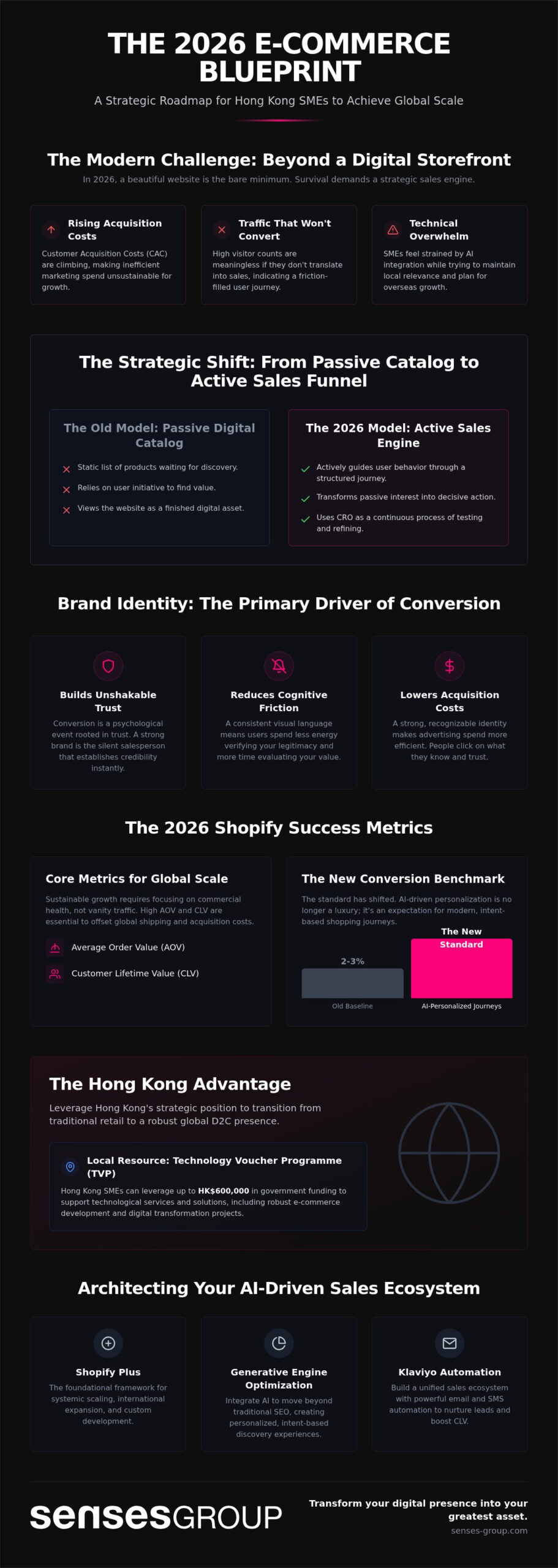
A high converting Shopify store is not a static digital asset. It is a dynamic growth engine. Many SMEs treat their website as a digital catalog, which is essentially a passive list of products waiting for a visitor to discover them. This is a fundamental misunderstanding of modern commerce. A true sales engine doesn’t wait; it actively guides user behavior, transforming passive interest into decisive action through a structured, psychological journey. It’s the difference between a storefront that looks good and one that works hard.
To achieve this, we must move away from the “passive website” model toward “active sales funnels.” This shift requires viewing every click as a data point in a larger system. At Senses Group, we refer to this integrated approach as the “Bespoke Sales Atom,” where brand identity, Klaviyo automation, and paid advertising orbit a central Shopify core. This isn’t a setup you finish and forget. Instead, Conversion rate optimization (CRO) must be viewed as a continuous strategic process. It’s a cycle of testing, learning, and refining that evolves alongside your customer’s expectations.
The Core Metrics of Shopify Success
Success isn’t measured by traffic alone. High volume is useless if your Average Order Value (AOV) remains stagnant. For Hong Kong SMEs eyeing international markets, the commercial logic is clear: you need high AOV and strong Customer Lifetime Value (CLV) to offset global shipping and acquisition costs. Sustainable scaling happens when your store doesn’t just win the first sale, but secures the tenth. We focus on these foundational metrics because they represent the health of your commercial system, not just the vanity of your visitor count.
The 2026 Conversion Benchmark
The standards have shifted significantly this year. In 2026, a 2% or 3% conversion rate is no longer the hallmark of a premium brand. It’s the baseline for survival. Modern users expect AI-driven personalization that anticipates their needs before they express them. Shopping journeys have moved from “browsing” to “intent-based” experiences. Your store must recognize this intent instantly, presenting the right solution at the exact moment of psychological readiness. If your interface doesn’t adapt to the individual user, you aren’t just losing a sale; you’re losing market relevance.
The Strategic Bedrock: Why Brand Identity is the Primary Driver of Conversion
Consumers don’t buy products; they buy the narratives those products represent. In the context of a high converting Shopify store, your brand identity is the silent salesperson that establishes credibility before a single line of copy is read. It’s a common misconception that conversion is purely a technical or functional achievement. In reality, conversion is a psychological event rooted in trust. Without a clear brand foundation, even the most optimized checkout process will fail to move the needle.
A rigorous set of brand guidelines does more than maintain aesthetic order. It actively reduces cognitive friction. When a user encounters a consistent visual language, they spend less energy verifying your legitimacy and more energy evaluating your value proposition. The psychological impact of professional brand identity for retailers is profound. It signals a level of permanence and systemic integration that generic templates simply cannot replicate. This is especially critical for high-ticket transactions where the perceived risk of a digital purchase is at its peak.
Positioning for Global Market Entry
For Hong Kong SMEs, the transition from local success to international trade requires a strategic re-calibration. Brand strategy acts as the bridge over the “foreign market” hurdle. It allows you to develop a brand voice that resonates across borders while maintaining the unique authority of your Hong Kong roots. This positioning is a commercial necessity. A strong identity effectively lowers your customer acquisition costs (CAC) by making your advertising spend more efficient; people click on what they recognize and trust. Success in global markets also demands an understanding of trade compliance for e-commerce, ensuring your brand promise is backed by operational reliability.
Visual Identity System (VIS) and UX
Your Visual Identity System is the technical execution of your brand strategy. It isn’t about choosing a “nice” color palette. It’s about understanding how typography and color influence conversion psychology. We move beyond generic templates to build custom interfaces that reflect unique brand authority. Consider the case of Monchhichi Jewelry Atelier. By implementing a strategic identity that aligned with their premium positioning, they doubled their revenue. This wasn’t a result of mere creativity. It was the result of a disciplined, commercial approach to design. If you’re ready to move beyond basic templates, exploring a tailored Brand Identity Design is the next logical step in your growth.
Architecting for Scale: Evaluating Shopify Frameworks and Custom Development
Technical architecture is the structural manifestation of your commercial strategy. It’s not merely a choice of code, but a decision on how your business will handle the stresses of growth. For a high converting Shopify store, the foundation must be built for speed and systemic flexibility. Many Hong Kong SMEs begin with Shopify Liquid, the reliable standard for most retail applications. However, as you pivot toward a performance-focused international model, evaluating Hydrogen (Headless Shopify) becomes a commercial necessity. Headless architecture decouples the front-end from the back-end, allowing for unparalleled site speed and a bespoke user experience that Liquid cannot always match.
The decision to migrate to Shopify Plus is often misunderstood. Competitors frequently claim Plus is reserved for massive enterprises, but for a scaling SME in Hong Kong, the ROI often lies in international expansion tools. Plus provides the ability to manage up to 50 localized markets from a single hub, offering automated currency conversion and advanced checkout customization. For a comprehensive breakdown of exactly when this investment makes financial sense, our Shopify Plus vs Shopify 2026 guide for HK brands outlines the precise revenue thresholds and technical advantages that justify the upgrade. A custom-built architecture ensures that your technical performance aligns with the high standards of Importance of Brand Management, where every digital touchpoint reinforces your market authority. In 2026, technical SEO is no longer a separate task; it’s an inherent quality of your store’s build.
Custom Theme Development vs. Premium Templates
Off-the-shelf templates are often “bloated” with unnecessary code that slows down your site and kills conversion rates. Every millisecond of delay increases the likelihood of a bounce. Custom-crafted UX outperforms generic “best practices” because it’s built around your specific customer journey. We focus on mobile-first architecture, ensuring that the experience is seamless for both the local Hong Kong commuter and the global shopper. This bespoke approach allows us to strip away the technical debt found in premium templates, resulting in a lean, high-performing sales engine. For a deeper understanding of how a dedicated Shopify store design agency Hong Kong can engineer this performance advantage, our 2026 strategic framework for custom development outlines the precise methodology behind building storefronts that convert at scale.
Integration Architecture
Sustainable ecommerce growth requires a tech stack that communicates. Your Shopify store must integrate seamlessly with ERP and 3PL systems to ensure operational reliability. This is particularly vital for Hong Kong businesses acting as global gateways. Managing multi-currency and multi-language storefronts shouldn’t be a manual burden. By architecting a unified system, you ensure that your inventory, shipping, and customer data flow through a single source of truth. This systemic integration is what transforms a simple website into a robust, high converting Shopify store capable of global competition.
The Conversion Ecosystem: Integrating AI, GEO, and Klaviyo Automation
Scaling a high converting Shopify store in 2026 requires moving past the fragmented “app-first” mentality. Most merchants fall into the trap of app fatigue, installing dozens of plugins that bloat code and dilute brand authority. A sophisticated ecosystem replaces these disjointed tools with integrated automation and artificial intelligence. This is where your store stops being a passive destination and starts being a proactive sales agent. Systemic integration is the only way to maintain a competitive edge as customer acquisition costs continue to climb.
We’ve entered the era of Generative Engine Optimization (GEO). Traditional SEO focused on search engine result pages; GEO focuses on being the preferred source for Large Language Models (LLMs). If ChatGPT, Gemini, or Claude doesn’t recommend your product when a user asks for a solution, your brand effectively doesn’t exist in the 2026 buyer’s journey. Dominating this space requires advanced topical maps and deep semantic relevance. It’s about building a digital footprint that AI engines recognize as the definitive authority in your niche. A comprehensive AI search engine optimization strategy for Hong Kong businesses is now essential to ensure your store is cited by LLMs during the conversational research phase of the buyer journey.
Klaviyo: The Retention Powerhouse
Email isn’t a broadcast medium. It’s a behavioral response system. The synergy between Klaviyo email automation and your Shopify storefront is what transforms a one-time buyer into a long-term commercial asset. We implement behavior-based flows, specifically Welcome, Abandoned Cart, and Post-Purchase sequences, that trigger based on real-time user intent. This data-driven segmentation is the secret to tripling your average order value over time. For global stores looking to recover lost revenue, a precisely engineered Klaviyo abandoned cart strategy can recover up to 11% of lost checkouts and drive up to 45% of total revenue through automated sequences. You aren’t just sending messages; you’re personalizing the sales funnel at scale. Retention marketing is the foundation of sustainable scaling because it’s always more profitable to retain a customer than to acquire a new one.
AI and GEO: Future-Proofing Traffic
Traffic in 2026 is driven by visibility within the AI ecosystem. We optimize your store’s metadata specifically for LLMs, ensuring your brand is cited as a trusted authority during AI-led research phases. Beyond search, AI-generated visual production now powers high-performance ad creative, allowing for rapid testing and iteration that was previously impossible for SMEs. By automating content pillars, you feed a “Follower Growth Engine” that consistently brings new users into your ecosystem. This isn’t about replacing creativity with machines. It’s about using systems to amplify your brand’s reach and authority across the global digital landscape. If you’re ready to modernize your traffic strategy, our SEO & AI Engine Optimisation services provide the strategic edge needed to dominate the market.
The Hong Kong Advantage: Scaling for International Trade
Hong Kong’s legacy as a gateway to international trade is evolving. It’s no longer just about physical logistics; it’s about digital infrastructure. A high converting Shopify store serves as the primary vehicle for this transformation. For SMEs, the shift from traditional retail models to robust digital presences isn’t a loss of heritage. It’s an expansion of reach. By leveraging integrated digital marketing, businesses can overcome geographic limitations that once dictated their growth potential. The local ecosystem, supported by initiatives like the HK$600,000 Technology Voucher Programme, provides the capital foundation needed to build these global sales engines with 75% project funding.
The roadmap from a local startup to a multimillion-dollar revenue engine is built on discipline and global insight. This journey requires a transition from being a “vendor” to becoming a “brand.” While the local market is competitive, Hong Kong’s territorial tax system provides a significant advantage for cross-border e-commerce. Profits derived from offshore sources may not be subject to local profits tax, creating a highly efficient environment for D2C brands to scale their international operations from a central hub. Understanding the structural differences between your current plan and an enterprise solution is essential at this stage; a detailed Shopify Plus vs Shopify comparison for scaling HK brands can clarify which infrastructure best supports your cross-border ambitions.
Navigating Global Market Entry
Scaling overseas requires more than just launching a site. It requires sophisticated Meta and Google Advertising management to find high-intent audiences in foreign jurisdictions. Senses Group has managed over $4M in ad spend, giving us the data-backed insight to know what triggers international consumer trust. Performance-based affiliate marketing can also provide a risk-free path to scaling by aligning costs with actual revenue. Your store’s architecture must adapt to these diverse markets. You must ensure that currency, language, and trust signals are localized for every visitor to maintain authority across borders.
Building Sustainable, Scalable Businesses
We don’t view ourselves as a subservient service provider. Senses Group operates as a strategic partner and authoritative mentor. Our 18+ years of expertise allow us to identify and avoid the common scaling pitfalls that often cripple growing brands. We focus on long-term systemic stability rather than short-term project delivery. This commercial mindset ensures that your growth is not only rapid but enduring. A high converting Shopify store is a manifestation of this stability. It’s time to stop treating your website as a digital business card and start using it as a revenue-generating machine. If you’re ready to scale, our Brand Strategy and development services are designed to build the foundation your business deserves.
Engineering Your Global Commercial Future
The transition from a local storefront to a global commercial power requires more than technical updates; it demands a systemic shift in how you perceive your digital presence. A high converting Shopify store is the result of aligning deep brand strategy with advanced AI-driven optimization. By moving beyond generic templates and embracing an integrated sales ecosystem, you create a foundation that is both impactful and enduring. You’ve seen how brand identity drives trust and how technical architecture supports scale. Now, you must execute.
Success in 2026 is reserved for those who can integrate complex automation while maintaining a clear, authoritative brand voice. Senses Group brings 18 years of strategic expertise and a history of managing over $4 million in ad spend to every partnership. We’ve scaled brands for global leaders like Sony and Barclays, and we’re ready to do the same for your SME. Don’t let technical overwhelm stall your expansion. It’s time to transform your digital presence into a high-performance sales engine that works across every border.
Let’s Build Your Growth Engine – Contact Senses Group
Your future in the global marketplace starts with the strategic decision to build something that lasts.
Frequently Asked Questions
What is a good conversion rate for a Shopify store in 2026?
A high converting Shopify store in 2026 should target a benchmark between 3.5% and 5%. While a 2% rate was once considered acceptable, the rise of AI-driven personalization and intent-based shopping journeys has significantly raised consumer expectations. Achieving these elite figures requires a disciplined integration of brand authority, site speed, and psychological triggers that guide the user seamlessly toward a decisive purchase.
How does brand strategy actually increase my Shopify sales?
Brand strategy increases sales by establishing the psychological trust necessary for a customer to move from interest to action. It defines the narrative that justifies your pricing and differentiates you from generic competitors. By aligning your visual identity with your commercial goals, you reduce the perceived risk of the transaction. This clarity effectively lowers your customer acquisition costs because your marketing spend attracts higher-quality, intent-driven traffic.
What is the difference between Shopify SEO and GEO?
SEO optimizes your storefront for traditional search engine results, whereas Generative Engine Optimization (GEO) ensures your brand is the preferred citation for AI models like ChatGPT and Gemini. In 2026, many consumers rely on AI for product discovery. GEO uses advanced semantic relevance to position your high converting Shopify store as the definitive authority, ensuring your products are recommended during the conversational research phase of the buyer journey. For Hong Kong SMEs looking to master this transition, a dedicated AI search engine optimization guide for Hong Kong businesses provides the strategic roadmap to dominate AI-synthesized answers.
Is Klaviyo better than Mailchimp for high-converting stores?
Klaviyo is the superior choice for high-performance stores because of its deep, native integration with e-commerce data. Unlike Mailchimp, Klaviyo allows for complex, behavior-based automation flows that trigger based on specific customer actions, such as viewing a product or abandoning a cart. This level of segmentation is vital for tripling average order value and building a sustainable, data-driven sales funnel that prioritizes long-term retention over constant acquisition.
How long does it take to build a custom high-converting Shopify store?
A custom high-performance Shopify build typically requires 12 to 16 weeks from the initial strategy phase to the final deployment. This period allows for comprehensive brand positioning, custom UX design, and the systemic integration of ERP and 3PL systems. We avoid rushed setups because a robust sales engine requires a foundation built for long-term stability. Rushing the build phase often creates technical debt that limits your future growth.
Can a Hong Kong SME really compete in the US and European markets using Shopify?
Hong Kong SMEs are uniquely positioned to compete globally due to the city’s status as a strategic trade gateway. By utilizing Shopify’s global infrastructure and localized marketing strategies, you can bypass traditional geographic limitations. Success in the US and European markets depends on your ability to project international brand authority and manage cross-border trade compliance effectively. With the right strategic partner, geographic distance becomes irrelevant to your success.
Do I need Shopify Plus for international multi-currency selling?
While standard plans offer basic multi-currency support, Shopify Plus is the definitive choice for systemic international scaling. Plus allows you to manage up to 50 localized markets from a single administrative hub, providing automated currency conversion and bespoke checkout customization. For Hong Kong SMEs pursuing multimillion-dollar global revenue, the ROI of Plus lies in its capacity to handle complex, high-volume transactions with minimal operational friction.
How much should I spend on ads to see a positive ROI on my new store?
A positive ROI depends on your ability to gather enough data for algorithmic optimization rather than a specific dollar amount. For Hong Kong SMEs, we recommend a strategic budget that supports consistent testing across Meta and Google Ads. This spend should be viewed as an investment in data that fuels your sales funnel. Success comes from directing high-intent traffic to a store built for conversion and retention.