
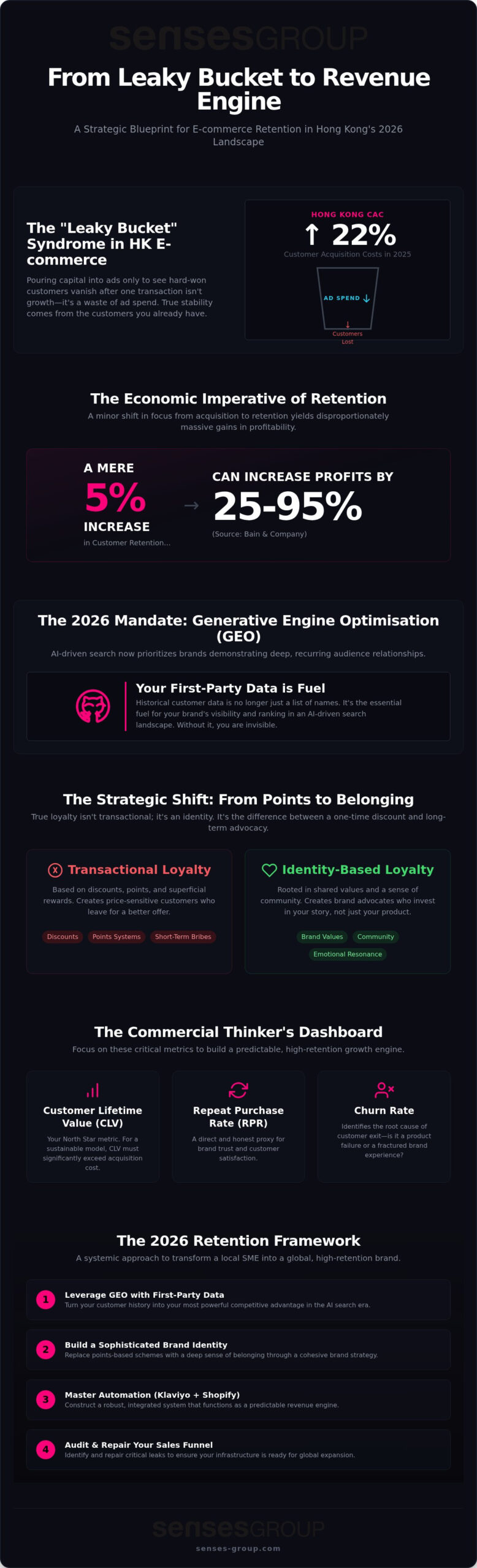
Customer acquisition costs in Hong Kong’s e-commerce sector surged by 22% in 2025. This isn’t just a temporary fluctuation; it’s a fundamental shift in the commercial landscape. You’ve likely realized that while driving traffic is expensive, watching those hard-won customers vanish after a single transaction is even costlier. The challenge isn’t just finding new buyers. It’s keeping them. Sustainable growth is not built on the volatility of ad spend, but on the stability of a loyal customer base.
This article provides the strategic blueprint to master ecommerce retention marketing. You’ll learn how to transform your Shopify store into a high-retention revenue engine by focusing on the mechanics of customer lifetime value. We’ll move beyond basic email tactics to explore a systemic approach that integrates Klaviyo automation and strategic brand identity. We’ll examine how to build a predictable growth engine that scales your brand from a local Hong Kong presence to a globally recognized leader.
Key Takeaways
- Understand how Generative Engine Optimisation (GEO) turns your first-party customer data into a definitive competitive advantage in the 2026 landscape.
- Discover why a sophisticated brand identity serves as the root of customer loyalty, replacing superficial points-based schemes with a deeper sense of belonging.
- Master the technical integration of Klaviyo and Shopify to build a robust ecommerce retention marketing system that functions as a predictable revenue engine.
- Learn to identify and repair critical leaks in your sales funnel through a professional audit, ensuring your infrastructure is ready for global expansion.
- Adopt the “commercial thinker” mindset required to transform a local SME into a high-retention brand capable of dominating international markets.
The Economics of Ecommerce Retention Marketing in 2026
Ecommerce retention marketing is not a series of desperate discounts; it’s the strategic system of turning one-time buyers into long-term brand advocates. As customer acquisition costs in Hong Kong rose by 22% last year, the commercial logic for customer retention has become undeniable. You can’t build a sustainable business on the shifting sands of ad platform algorithms. True stability comes from the “root” of your business: the customers you already have.
Generative Engine Optimisation (GEO) has redefined the value of first-party data in 2026. AI engines now prioritise brands that demonstrate deep, recurring relationships with their audience. This means your historical customer data isn’t just a list of names. It’s the fuel for your visibility in an AI-driven search landscape. If you aren’t capturing and leveraging this data, you’re invisible to the very systems designed to help you scale.
Hong Kong SMEs often suffer from the “leaky bucket” syndrome. They pour capital into Meta and Google ads to drive traffic, only to see customers vanish after the first purchase. Scaling a brand without a retention foundation isn’t growth; it’s a waste of ad spend. The commercial reality is stark. Research from Bain & Company shows that increasing retention rates by just 5% can increase profits by anywhere from 25% to 95%. For a brand looking to expand from the local market to a global stage, these margins represent the difference between struggling and thriving.
Acquisition vs. Retention: The Strategic Balance
Stop viewing Meta and Google Ads as the entire strategy. They’re merely the entry points. At Senses Group, we use the “Marketing Map” to identify exactly where your customers drop off in the sales funnel. For businesses transitioning from traditional models to a robust, digital-first ecommerce presence, this clarity is essential. You aren’t just selling a product. You’re building a system that captures and holds attention across international borders. Acquisition brings them to the door; ecommerce retention marketing keeps them in the room.
Critical Metrics for the Commercial Thinker
Commercial thinkers focus on depth rather than surface-level metrics. Customer Lifetime Value (CLV) is your North Star for 2026 growth. If your CLV doesn’t exceed your acquisition cost by a significant margin, your business model is fragile. We also track Repeat Purchase Rate (RPR) as a direct proxy for brand trust. Finally, we analyse Churn Rate to identify the root cause of customer exit. Is it a failure in the product, or a fracture in the brand experience? Identifying these triggers allows us to build a predictable growth engine that lasts.
Psychology and Identity: The Root of Customer Loyalty
Loyalty is not a transaction. It is an identity. While many brands attempt to bribe customers with points and discounts, the most successful enterprises in 2026 understand that true retention is rooted in psychology. Your brand identity is the secret weapon that lowers customer acquisition costs by creating an immediate, visceral connection. When a customer sees themselves reflected in your brand’s values, they don’t need to be re-acquired through expensive advertising. They have already decided that your business is their preferred choice in a crowded marketplace.
The “not this, but that” of loyalty is simple: it’s not about points; it’s about belonging. Humans are biologically wired to seek community and consistency. A cohesive brand guidelines system creates the subconscious trust required for repeat buys. From the choice of typography to the specific palette of your visual identity, every element must signal depth and permanence. This is the value of keeping the right customers through emotional resonance rather than just financial incentives. If your visual language is fragmented, your customer’s trust will be too.
The Role of Brand Strategy in Retention
For Hong Kong SMEs looking to scale globally, brand strategy must resonate across international borders. A localized story might work within the city, but a universal brand narrative is required to conquer the world. You should explore our Mastering Retail Brand Identity: 2026 Digital Guide to understand how foundational strategy influences long-term growth. A premium design does more than just look good. It reduces price sensitivity and naturally increases average order value (AOV). People don’t negotiate with brands they admire. They invest in them.
Visual Consistency Across the Sales Funnel
Your Shopify store must be a seamless extension of your initial marketing promise. If a customer clicks a high-end social media ad but lands on a cluttered or generic website, the trust is broken instantly. Professional Shopify development ensures the user experience (UX) matches the brand’s sophisticated identity. At Senses Group, we leverage AI visual production to create consistent, high-end imagery that speaks directly to returning customers. This systemic approach ensures that every touchpoint reinforces the same core identity. When the experience is unified, ecommerce retention marketing becomes an inevitable outcome of your brand’s presence. If you’re ready to build a brand that endures, we can help you refine your strategic identity today.
The Automation Engine: Klaviyo and the Shopify Ecosystem
Klaviyo stands as the definitive CRM for high-growth Shopify brands in 2026. It isn’t merely a platform for sending messages; it’s the central nervous system of your ecommerce retention marketing strategy. By consolidating customer behavior into a single source of truth, you gain the strategic clarity required for global scaling. At Senses Group, we implement the “Bespoke Sales Atom” framework. This system integrates email, SMS, and ManyChat into a unified, high-converting ecosystem that ensures your brand remains present at every critical touchpoint of the customer journey.
Predictive marketing is the new standard for the commercial thinker. Moving beyond basic sequences, behavior-based flows allow you to anticipate customer needs before they even arise. Whether it’s predicting the next restock date for a consumable or identifying when a high-value customer is showing signs of churn, the automation engine works silently to protect your margins. It’s not about reactive communication; it’s about systemic anticipation. Understanding how to implement email marketing automation for Shopify as a strategic “Sales Atom” is the key to bridging your brand identity with scalable international revenue.
Essential Klaviyo Flows for 2026
The Advanced Abandoned Cart is no longer just a reminder. It’s a strategic brand reinforcement. It serves to address specific objections and remind the customer why they chose your brand in the first place. You can explore the mechanics of this in our guide on Mastering the Klaviyo Abandoned Cart Strategy for Global Ecommerce. Similarly, post-purchase education flows turn a simple transaction into a lasting relationship. By providing value long after the credit card is charged, you build the foundation for the next purchase before the first one has even arrived.
Klaviyo vs. Legacy Tools: A Commercial Comparison
Generic tools like Mailchimp frequently fail to scale with the complexities of a modern Shopify store. They lack the deep, native integration required to trigger sophisticated, data-driven flows that resonate with a global audience. For a detailed breakdown of why this matters for your growth, see our analysis of Klaviyo vs Mailchimp: 2026 Ecommerce Strategy for Brands. The ROI of this deep integration is significant. By leveraging precise customer data, brands can effectively triple their average order value through automated cross-sells and upsells that feel helpful rather than intrusive. If you’re still using legacy systems, you’re leaving your most valuable revenue on the table.
The 2026 Retention Framework: From Local SME to Global Player
Transitioning from a local presence in Hong Kong to a global revenue engine requires a shift in infrastructure. It’s not about doing more; it’s about doing what works systematically. A predictable ecommerce retention marketing framework is built on five strategic pillars designed for international scale. First, you must audit your current sales funnel for “leaks”. A professional Shopify store audit reveals exactly where your capital is being wasted and where your customers are dropping off. Second, deploy AI-driven content pillars to maintain engagement between purchases. This ensures your brand remains a constant in the customer’s life, even when they aren’t actively buying. Third, implement RFM (Recency, Frequency, Monetary) analysis. This isn’t just data; it’s a commercial tool to identify and reward your most valuable advocates. Fourth, leverage a global influencer network for user-generated content (UGC). Social proof is the currency of international trade. Finally, use GEO (Generative Engine Optimisation) to ensure your brand is the definitive answer in AI-driven search results. If the AI doesn’t recommend you, you don’t exist.
Leveraging AI for Scalable Personalisation
In 2026, personalisation is no longer a luxury. It’s a technical requirement for survival. We use AI visual production for dynamic product recommendations that change based on user behavior in real-time. By automating social media posting with AI, your brand stays top-of-mind without draining your internal resources. Integrations with Gemini and ChatGPT allow you to personalise the customer journey at a scale previously reserved for multinational corporations. It’s about systemic efficiency, not just creativity. This technology allows a small team in Hong Kong to manage a brand that resonates in London, New York, and Tokyo simultaneously.
Subscription and Affiliate Models
Stability comes from predictable revenue. Transitioning from one-off sales to subscription models provides the cash flow necessary for aggressive expansion. It moves your business from a state of constant hunting to a state of consistent harvesting. Additionally, a performance-based affiliate system allows you to build a global sales force where you only pay for results. This is the foundation of a modern growth engine. For a deeper look at the technical execution of these systems, read our 2026 Ecommerce Email Automation: Strategic Guide. If you’re ready to transform your business model into a high-retention engine, Senses Group can help you scale your Shopify ecosystem today.
Building a Sustainable Growth Engine with Senses Group
Senses Group doesn’t just build websites; we build revenue-generating machines. Our methodology turns high-level strategy into tangible revenue through the systemic integration of branding and e-commerce. It’s not about visual aesthetics alone; it’s about the psychological and commercial impact of your business on a global scale. With over 18 years of corporate branding expertise and a track record of managing more than $4 million in ad spend, we understand the deeper mechanics of business success. We’ve seen what works and what doesn’t. This seasoned assurance allows us to guide Hong Kong SMEs through the complexities of ecommerce retention marketing with absolute clarity and strategic confidence.
Dominating foreign markets requires a “commercial thinker” mindset. It’s not enough to be creative. You must be disciplined. You must be globally-minded. We’ve transformed brands from zero to multimillion-dollar status, particularly within the home and family products sector, by focusing on foundations rather than fleeting trends. We build systems that are both impactful and enduring, ensuring that your transition from a local player to a global leader is supported by a robust, high-retention revenue engine. We prioritize substance over superficial excitement, creating an atmosphere of trust and long-term stability for every brand we partner with.
Our Methodology: Strategy, Execution, Scale
Our methodology follows a deliberate progression: Strategy, Execution, Scale. The “Marketing Map” serves as the foundational element of this process. It prevents wasted ad spend by focusing on sustainable profit rather than vanity metrics. High-performance Shopify development then acts as the functional vehicle for international expansion. It ensures your digital infrastructure can withstand the rigors of global competition and provides a seamless experience for customers across different time zones. For a comprehensive breakdown of this approach, read our 2026 Strategic Shopify Guide for Hong Kong SMEs. We ensure that every foundational element influences multiple outcomes, creating a sense of momentum and logical inevitability in your growth.
Let’s Build Your Growth Engine
Now is the time to transition. Moving from a traditional business model to a robust e-commerce presence is no longer optional; it’s the only path to survival in a landscape where acquisition costs continue to climb. You need a strategic partner who understands the unique hurdles of global market entry from a Hong Kong base. Senses Group isn’t a subservient service provider. We are your expert guide, committed to building something that is both impactful and enduring. Let’s transform your Shopify store into a sustainable engine of growth. Book a strategy session with Senses Group to scale your brand globally and secure your place in the 2026 market.
Architecting Your Global Revenue Engine
Success in the 2026 landscape demands a shift from short-term acquisition to systemic longevity. You’ve seen that the foundation of a high-growth brand isn’t just traffic; it’s the commercial execution of an identity that customers refuse to leave. By mastering ecommerce retention marketing, you transform your Shopify store from a simple storefront into a sophisticated growth engine capable of scaling across international borders. This transition requires more than just tools. It requires a strategic partner who understands the root of business transformation.
Senses Group brings over 18 years of branding expertise and a track record of managing more than $4 million in ad spend to your digital ecosystem. We’ve proven the power of this approach by doubling the revenue for clients like Monchhichi Jewelry Atelier through meticulous store rebuilds and lifecycle marketing. Your brand deserves a foundation that is both impactful and enduring. It’s time to stop chasing one-off sales and start building a sustainable future for your business.
Let’s Build Your Growth Engine – Partner with Senses Group
The global market is waiting for brands that offer substance and clarity. We’re ready to help you lead the way.
Strategic Insights: Frequently Asked Questions
What is the difference between customer acquisition and retention marketing?
Acquisition is the strategic cost of bringing a customer to your Shopify store; retention is the commercial execution of keeping them there. While acquisition relies on the volatility of ad platforms, retention focuses on the depth of the existing relationship. It’s the difference between a one-time transaction and a predictable revenue stream. For Hong Kong SMEs, acquisition is the entry point, but retention is the foundation of long-term stability and profit.
Why is Klaviyo considered the best tool for ecommerce retention?
Klaviyo is the definitive CRM because it provides a unified source of truth for customer data. Its deep integration with Shopify allows for predictive modeling that legacy tools simply cannot match. By automating behavior-based flows, it ensures your ecommerce retention marketing strategy is both scalable and personalized. It’s not just an email tool; it’s a strategic engine that turns raw data into actionable insights for global expansion.
How can AI visual production improve my customer retention rates?
Consistency creates the subconscious trust required for repeat purchases. AI visual production allows you to generate high-end, dynamic imagery that resonates with a customer’s specific past behavior. This level of personalization at scale was previously impossible for smaller brands. It’s about ensuring the visual experience remains premium across every touchpoint to reinforce the brand’s identity. This reduces the psychological barriers to the next transaction.
Is retention marketing effective for SMEs looking to expand overseas?
Retention is the primary vehicle for entering foreign markets. You cannot outspend global competitors on pure acquisition; however, you can out-retain them by building a superior brand connection. High retention rates provide the predictable cash flow necessary to navigate the hurdles of international trade. It’s about building a loyal base in Hong Kong that advocates for your brand globally, effectively lowering your overall scaling costs.
What are the most important retention metrics for a Shopify store?
The most critical metrics for a commercial thinker are Customer Lifetime Value (CLV), Repeat Purchase Rate (RPR), and Churn Rate. CLV acts as your North Star for long-term growth, while RPR serves as a direct proxy for brand trust. Identifying the root cause of churn allows you to repair fractures in the customer journey. These metrics provide the logical foundation for any successful ecommerce retention marketing framework in 2026.
How often should I send automated emails to avoid customer churn?
Frequency should be dictated by customer behavior, not a fixed schedule. Don’t over-communicate, as this leads to churn, while silence leads to irrelevance. Use the “Bespoke Sales Atom” framework to send messages when they provide the most value; think replenishment reminders or personalized education. The goal is to be helpful rather than intrusive. If the data shows a customer is disengaging, your automation should pivot to a re-engagement strategy immediately.
Can a strong brand identity really lower my customer acquisition costs?
A strong brand identity creates immediate trust, which significantly reduces the friction of the first purchase. When your visual and strategic identity is clear, you don’t need to rely solely on aggressive discounting to win customers. People are willing to pay a premium for brands they admire and belong to. This psychological connection naturally lowers your customer acquisition costs and increases your average order value (AOV) from the very first interaction.
What is Generative Engine Optimisation (GEO) and why does it matter for retention?
Generative Engine Optimisation (GEO) ensures your brand is the definitive answer provided by AI search engines. It matters for retention because AI models prioritize brands with high authority and deep customer engagement data. By maintaining a high-retention ecosystem, you provide the proof points these engines need to recommend your brand. It’s not just about being found; it’s about being the only logical choice the AI suggests.