
What if your ecommerce funnel could keep working without making your brand sound like a machine? For SMEs facing rising acquisition costs, uneven customer engagement and pressure to expand overseas, marketing automation for ecommerce can create consistency, but only when it reflects the brand behind every message.
The concern is understandable. Automation without a clear strategy can send generic emails, confuse customers and add technical complexity without supporting growth. The answer isn’t more triggers or another tool. It’s a connected system that carries your brand promise from first visit to repeat purchase.
This article explores how to build that system: align brand identity with customer journeys, connect Shopify and Klaviyo, and use thoughtful automation to support retention and customer value. You’ll also see how AI-driven search optimisation can help attract relevant traffic as customers discover products across local and overseas markets. The goal is a dependable growth engine, not a collection of disconnected campaigns.
Key Takeaways
- Use marketing automation for ecommerce to turn founder-led selling into a repeatable growth system, not a collection of disconnected tools.
- Map the customer journey from discovery to advocacy so each automated message has a clear role in building trust and guiding the next step.
- Connect Shopify and Klaviyo around shared customer and order data to make lifecycle marketing more relevant and coordinated.
- Use GEO to strengthen product discovery through AI-powered search and bring relevant audiences into your sales funnel.
- Align brand strategy, ecommerce and automation to build a growth engine that can support expansion into local and overseas markets.
Scaling Beyond the Manual: Why Automation is the Core of Modern Ecommerce
For a founder-led ecommerce business, personal attention can be a strength until every sale depends on the founder being present. Customer questions, follow-up messages and repeat-purchase reminders compete with product development and expansion. The answer is not to remove human judgement. It is to create a system that carries the brand’s value into more customer interactions without requiring the founder to manage each one individually.
Marketing automation is the bridge between brand strategy and sustainable revenue, using customer signals to deliver relevant experiences consistently as a business grows. That’s broader than scheduling emails. The marketing automation concept connects marketing activity with customer data and other systems. For an ecommerce business, the strategic question is what those connections should help customers understand, decide and do.
Well-designed marketing automation for ecommerce can also support more efficient acquisition. When potential customers receive useful follow-up and existing customers have reasons to return, a business can create more value from the attention and advertising spend it has already earned. This doesn’t make customer acquisition costs disappear. It helps ensure acquisition efforts are supported by a considered journey beyond the first click.
The Shift from Tactical to Strategic Automation
Broad promotional blasts treat every subscriber as if they share the same needs. A strategic journey responds to context: a new subscriber may need a clear introduction to the brand, while someone who has purchased may benefit from relevant product guidance or a timely invitation to return. The message still sounds like the brand because its voice, visuals and priorities are defined before the workflow is built. The shift is from completing tasks to making deliberate commercial decisions at scale.
Think like a commercial strategist, not only a service provider. Give each workflow a purpose, a defined audience and a useful next step. For example, a welcome flow can explain what makes the offer distinctive, while a post-purchase flow can provide relevant product information. This discipline prevents automation from multiplying irrelevant messages simply because the software makes them easy to send.
Foundational Elements of a Growth Engine
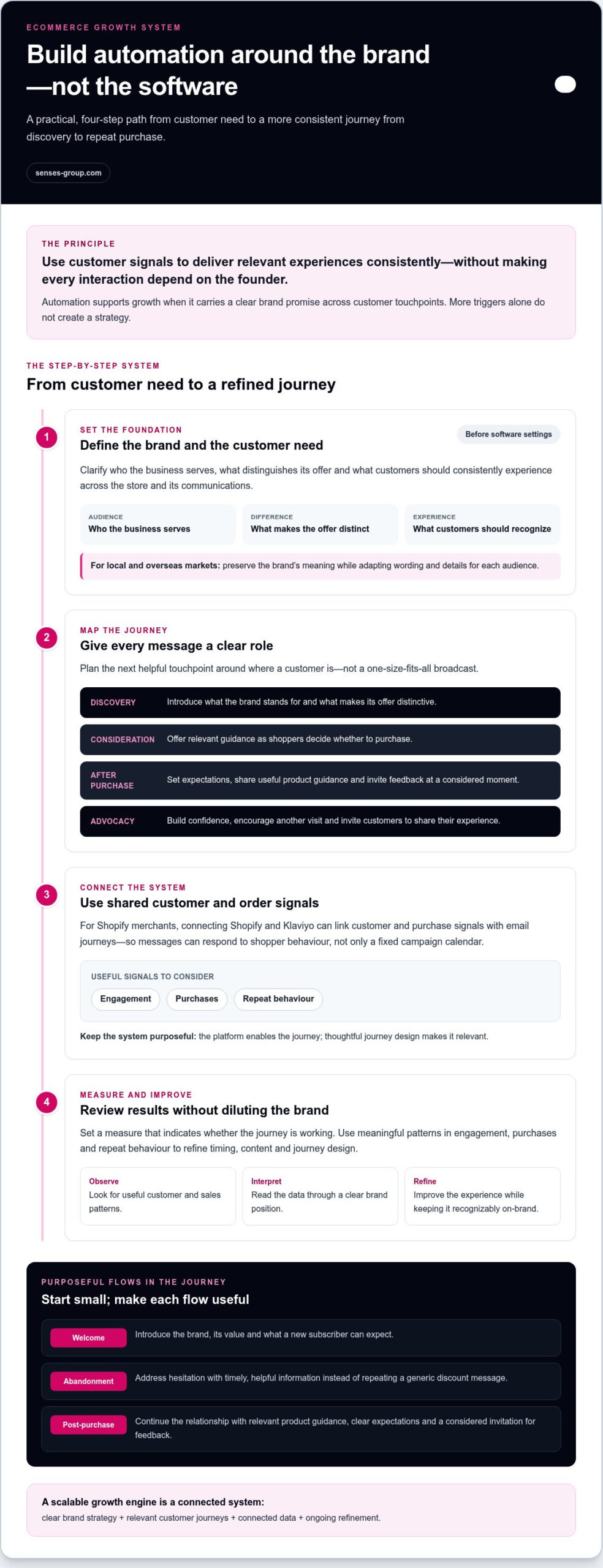
Start with brand strategy, not software settings. Define who the business serves, what distinguishes its offer and what customers should consistently experience across its store and communications. These foundations matter even more when adapting a message for local and overseas markets. Consistency should preserve the brand’s meaning, not force identical wording everywhere.
Then use customer and sales data to refine the system. Look for meaningful patterns in engagement, purchases and repeat behaviour, and use them to improve timing, content and journey design. A practical starting sequence is to:
- Identify a clear customer need or business objective.
- Map the journey and define the most helpful next message.
- Set a measure that shows whether the journey is working.
- Review results and refine the experience without diluting the brand.
Data provides direction, not strategy on its own. Interpreted through a clear brand position, it can help a growing business make consistent decisions, strengthen customer relationships and build a more scalable foundation for revenue.
The Architecture of Retention: Klaviyo and the Lifecycle Marketing Ecosystem
Retention doesn’t happen because a store sends more email. It grows when customers receive a relevant experience at the right point in their relationship with the brand. For Shopify merchants, Klaviyo can connect customer and purchase signals with email journeys, making it possible to respond to what shoppers do rather than relying only on a fixed campaign calendar. The platform matters, but the journey design matters more.
Think of the Bespoke Sales Atom as a connected path from discovery to advocacy. A visitor first learns what the brand stands for, then gets relevant guidance as they consider a purchase. After buying, they receive useful follow-up that can build confidence, encourage another visit and invite them to share their experience. Each touchpoint should have a purpose and sound like the same brand.
Essential Klaviyo Flows for Global Scale
Build a small number of purposeful flows before adding complexity. A welcome series introduces the brand, its value and what a new subscriber can expect. An abandonment flow can address hesitation with timely, helpful information instead of repeating a generic discount message. A carefully designed Klaviyo abandoned cart strategy can help recover purchase intent while keeping the tone consistent with the store.
Post-purchase nurture continues the relationship after checkout. Set expectations, share relevant product guidance and invite feedback at a considered moment. For a business serving customers across markets, keep the core brand promise consistent while tailoring details such as language and product relevance to each audience. Retention should feel personal, not like a sequence firing regardless of context.
Hyper-Segmentation and Personalization
Segments make communication more useful. Start with observable differences, such as first-time versus repeat customers, product interests or recent engagement. Zero-party data, information customers choose to share through preferences or responses, can add context that purchase history alone can’t provide. Ask only for details that help create a better experience, then use them to shape relevant content rather than simply collecting more fields.
Behavioral triggers respond to actions, while scheduled campaigns speak to a defined audience at a planned time. Both have a role: a seasonal announcement may suit a campaign, while a welcome or post-purchase message is often better prompted by an individual customer’s journey. Predictive analytics can help identify patterns that inform future communication, but it should guide thoughtful decisions rather than replace them.
Retention also changes the economics of growth. If more customers return and engage, the business can build greater value from customers it has already acquired. That’s one strategic route to lower customer acquisition costs, without treating repeat purchases as automatic. Strong flows earn attention by being relevant. A coherent Shopify and Klaviyo lifecycle system gives growing brands a practical foundation for that work. Senses Group’s Klaviyo email automation expertise connects the customer journey to the brand experience.
Strategic Integration: Why Shopify and Klaviyo are the Gold Standard
A storefront and an automation platform create stronger commercial value when they work as one system. Shopify captures the shopping journey; Klaviyo can use relevant store activity to shape follow-up. This connection gives an SME a practical foundation for managing customer experiences across markets without building an unnecessarily complex technology stack. The aim isn’t integration for its own sake. It’s continuity from product discovery to purchase and beyond.
A high-converting Shopify store makes the promise clear and the path to purchase straightforward. Automation can extend that experience, responding to meaningful customer actions and helping the next interaction feel connected to the last. This is the value of a closed-loop ecosystem: customer interactions inform follow-up, while the results of that follow-up can guide refinements to the store and its marketing.
Building a Revenue-Generating Machine
Start with a Marketing Map. Match each important store page and customer action to a relevant next step: a product view might inform follow-up content, while a completed order can shape post-purchase communication. Use Shopify data to distinguish high-intent behaviours from casual browsing, then build Klaviyo sequences around a clear purpose. Keep the experience consistent from ad click to landing page to email. If an advertisement promises a particular benefit, the destination and follow-up should reinforce that same message.
Conversion rate optimisation also depends on what shoppers see at decision points. Present genuine social proof where it can build confidence, and make related-product recommendations useful rather than distracting. Test one change at a time, such as product-page messaging or the placement of an upsell, and assess its effect on customer behaviour. Automation can support the journey, but it can’t compensate for unclear product information or a confusing checkout.
Scaling to International Markets
International growth calls for local relevance and operational clarity. Establish which markets you’re serving, then adapt language, currency presentation and product messaging to suit each audience. In March 2026, Klaviyo and Shopify expanded support for Shopify Markets with Locale Aware Catalogs, which sync market-specific product information, including translated content and regional pricing, into Klaviyo. That gives brands a more coordinated basis for localized communication.
Workflows can also support customer expectations after checkout. Where order or fulfillment information is available to connected systems, use it to keep relevant updates aligned with the customer’s purchase. Avoid promising delivery timing that the business can’t substantiate. Clear communication is especially important when customers are buying across borders, where uncertainty about order progress can undermine confidence.
Shopify Plus may suit businesses with more demanding scale requirements, but a platform tier alone won’t create an efficient operation. Map the customer journey first, identify where manual handoffs slow it down, and automate only the steps that improve clarity or consistency. A disciplined approach to marketing automation for ecommerce helps SMEs expand without adding needless complexity. Senses Group brings Shopify strategy and Klaviyo automation together through its ecommerce growth expertise.
Beyond Email: Leveraging AI and GEO for Automated Traffic Acquisition
Retention systems can only work with the people they reach. The next growth challenge is helping the right shoppers discover your brand, including through AI-powered search experiences. For businesses expanding into overseas markets, this means building discoverability around clear expertise, accurate product information and a brand story that remains coherent across channels.
Generative Engine Optimization (GEO) extends the visibility conversation beyond traditional search rankings. GEO is the strategic process of making your brand clear and credible to AI assistants responding to relevant customer questions. No tactic can guarantee a recommendation, but useful, well-structured information gives search systems a stronger basis for understanding what you offer and who it serves.
Generative Engine Optimization Mechanics
AI assistants such as ChatGPT, Gemini and DeepSeek draw on available information to generate answers. Help them interpret your business by explaining products, expertise and policies in direct, consistent language. Build a topical map around the questions customers ask at each stage of discovery: what a product does, how to choose between options, and what makes your brand distinct. This structure can support traditional SEO while making your content easier for AI systems to interpret.
Connect discovery to the next step. A useful guide should lead naturally to a relevant product or collection page; a sign-up offer should set clear expectations for subsequent email communication. AI search optimisation can therefore feed the automation funnel by attracting visitors through informative content, then directing them toward an experience designed to deepen interest. Review content across languages and markets so details stay accurate and the brand voice remains recognisable.
AI Visual Production and Social Automation
AI can assist with planning and adapting visual concepts, but speed is not the standard. A premium brand still needs consistent art direction. Create clear rules for composition, lighting, colour and product presentation, then review generated imagery for accuracy and brand fit before publishing. Use AI to develop variations for content themes, not to invent product details or replace authentic product photography where customers need an accurate view of what they’re buying.
A structured content pillar approach can also make Meta and Google advertising more coherent. Build themes around product education, brand point of view and customer questions, then adapt each into appropriate creative and landing-page content. Social proof and influencer outreach can support discovery when they reflect genuine customer experience. A follower-growth engine should measure meaningful attention and qualified interest, not promise a particular audience size.
Tools such as ManyChat can help structure social conversations and route common enquiries, while AI can support draft responses or content workflows. Keep answers aligned with approved brand information and provide a path to human support for questions that need judgement. Senses Group connects GEO, content and acquisition through AI-driven growth solutions.
Partnering for Scale: Turning Strategy into Sustainable Profit
A service provider completes a defined task. A strategic partner connects that task to a commercial outcome, then uses what the business learns to shape the next decision. That distinction matters when an ecommerce brand is moving beyond launch. A store, an automation platform and campaigns can each perform well in isolation, yet growth remains fragile if the brand promise, customer journey and measurement approach pull in different directions.
An integrated digital marketing solution brings these disciplines into one growth system. Brand identity shapes recognition, the ecommerce experience turns interest into action, and marketing automation helps sustain the relationship. For SMEs preparing to serve customers in local and overseas markets, this joined-up thinking makes it easier to identify what should stay consistent and what needs to adapt for each audience.
Custom-Crafted Solutions vs. Standard Packages
Templates can provide a starting structure, but they can’t define a brand’s positioning or customer promise. A premium audience expects communication that feels considered; generic copy and mismatched visuals can weaken trust, even when the workflow fires at the right time. Senses Group connects brand strategy and identity with Shopify development and Klaviyo automation, aligning the storefront and follow-up into a coherent funnel rather than treating design and technology as separate projects.
That partnership also requires commercial understanding. The right system reflects the realities of product discovery, customer expectations and market expansion, then evolves as the business gathers evidence. Monchhichi Jewelry Atelier’s revenue doubled shortly after Senses Group launched its new ecommerce system. The practical lesson isn’t that automation alone guarantees a result. It’s that connected strategy, brand experience and execution can support stronger commercial performance.
Next Steps: Building Your Growth Engine
Before investing in more tools or workflows, audit the path from first visit to repeat purchase. Look for breaks between the promise in an advertisement, the landing page, the checkout and the follow-up. Then prioritise gaps that create friction or leave customers without a useful next step. A simple review can establish a clear sequence:
- Map the main customer journey and identify where interest drops or follow-up stops.
- Check that messaging, visuals and offers remain consistent across touchpoints.
- Choose a small set of outcomes to track, such as qualified enquiries, completed purchases or repeat engagement.
- Review performance regularly and refine the system based on customer response.
Adopt a performance-based mindset: connect activity to measurable business objectives, whether you’re evaluating campaigns or considering an affiliate model. This keeps attention on commercial contribution, not just the number of tools or messages deployed. Strong marketing automation for ecommerce is not a one-time launch. It’s a system the business can learn from, improve and scale with discipline.
To connect brand strategy, ecommerce and automation, explore Senses Group’s integrated digital solutions.
Build the Next Stage of Your Ecommerce Growth
Your next move doesn’t need to be a complete system overhaul. Identify one point where promising customer journeys stall, set a clear measure for improvement, and build from there. That focused starting point helps turn marketing automation for ecommerce into a disciplined growth asset, rather than another layer of technology to manage.
Effective growth depends on joined-up thinking: the brand experience, customer journey and commercial decisions must reinforce one another. Senses Group brings more than 18 years of strategic branding expertise and experience managing over $4 million in advertising spend to help businesses shape that foundation.
Build with purpose, learn from customer response and give your brand room to grow into new markets.
Frequently Asked Questions
What is the best marketing automation tool for ecommerce in 2026?
For many Shopify-led brands, Klaviyo is a strong option, particularly when purchase and browsing data need to inform customer communications. The best choice still depends on your platform, list size, channel needs and team capacity. Compare how tools handle ecommerce events, segmentation, workflow testing, reporting and integrations. A smaller store with basic newsletter needs may reasonably prioritise ease of use over more advanced automation capabilities.
How does marketing automation help lower customer acquisition costs?
Automation can help a business earn more value from customers it has already acquired, reducing the pressure to rely solely on new-customer campaigns. Track acquisition spending alongside repeat purchases and customer retention by acquisition cohort. If a campaign brings in first-time buyers who rarely return, review the product promise, landing-page experience and post-purchase communication before increasing spend. The goal is to improve the return from acquisition, not assume automation alone lowers costs.
Can a small team manage complex ecommerce automation flows?
Yes, provided the team controls complexity instead of building every possible workflow at once. Assign one person to own each flow, document its trigger and purpose, and use a simple review checklist before publishing. Start with the customer moments that matter most to your business, then expand only when the team can monitor results and keep content current. A smaller, well-maintained system is more useful than a large set of neglected automations.
Is Klaviyo better than Mailchimp for Shopify stores?
Neither platform is automatically better for every Shopify store. Compare their current Shopify integrations, customer segmentation, automation controls, reporting and the channels your business actually plans to use. Also consider how easily your team can maintain templates and review results. If your needs are straightforward, a simpler setup may be enough; if customer purchase behaviour is central to your marketing, prioritise the platform that supports your required ecommerce workflows.
What is Generative Engine Optimization (GEO) in ecommerce?
GEO is the practice of structuring accurate, useful brand information so AI-powered search tools can interpret it and potentially reference it in generated answers. For an ecommerce business, this can include clear product descriptions, transparent brand information and helpful pages that address customer questions. Keep details consistent across your site and make important information easy to find. GEO supports discovery, but no content approach can guarantee that an AI assistant will recommend a particular brand.
How do I ensure my automated emails don’t feel like spam?
Make every message relevant to why the customer subscribed or what they did in your store. Set clear expectations at sign-up, keep promotional frequency considered, and remove inactive or invalid addresses from routine campaigns. Review messages from the customer’s perspective: does the email offer useful information, reflect the brand accurately and make the next step clear? If it exists only because a workflow can send it, reconsider whether it needs to be sent.
How much should I spend on marketing automation for my startup?
Set a budget around your store’s current needs, not an arbitrary industry benchmark. Account for the platform’s subscription, implementation work, connected apps and the time required to maintain the system. Klaviyo pricing is based on active profiles, so list quality and engagement can affect ongoing platform costs. Start with essential workflows, assess their contribution to business goals and expand investment only when the added complexity has a clear purpose.
Can automation help with international ecommerce expansion?
Yes. Automation can help coordinate market-specific communication, from language and product information to customer updates after an order. Before expanding, decide which markets the store is prepared to serve and make sure each audience sees relevant messaging and clear expectations. Then monitor engagement and purchasing patterns by market to identify where the experience needs refinement. This gives a growing brand a structured way to learn, rather than treating overseas customers as one uniform audience.