
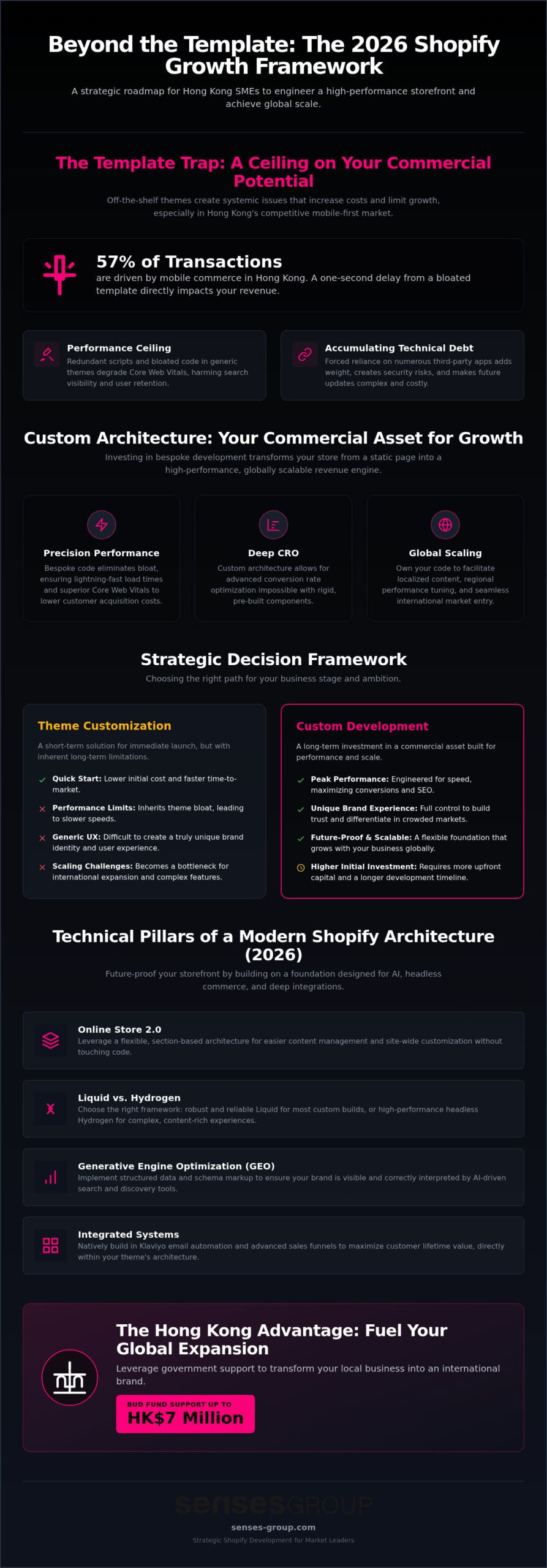
Your off-the-shelf Shopify template isn’t a shortcut to growth; it’s a ceiling on your brand’s commercial potential. While a pre-made layout offers immediate convenience, it often forces your business to inherit technical debt and generic aesthetics that dilute your authority. In a market as competitive as Hong Kong, where mobile commerce now drives 57% of all transactions, settling for “good enough” is a recipe for stagnation. Partnering with a strategic Shopify store design agency Hong Kong is not about buying a prettier website. It’s about engineering a high-performance storefront that converts at scale.
You understand that true differentiation requires more than just a new coat of digital paint. You need a system that balances lightning-fast performance with deep brand resonance. This article provides the definitive 2026 framework for custom development, shifting the focus from superficial design to structural excellence. We’ll breakdown how to strip away redundant apps, leverage Online Store 2.0 architecture, and utilize the HK$7 million BUD Fund to fuel your international expansion. By the end, you’ll have a roadmap to transform your store from a static page into a globally scalable revenue engine.
Key Takeaways
- Identify why custom architecture is the foundation for lowering customer acquisition costs and overcoming the limitations of generic templates.
- Discover how a specialized Shopify store design agency Hong Kong integrates brand identity with bespoke code to build trust across international markets.
- Master the technical choice between Liquid and Hydrogen frameworks to align your store’s performance with your business’s specific commercial complexity.
- Learn to leverage the active BUD Fund to support your global expansion while ensuring your site is optimized for 2026 Generative Engine Optimization.
- Integrate Klaviyo email automation and advanced sales funnels directly into your theme to maximize lifetime value and drive sustainable revenue growth.
The Template Trap: Why Custom Shopify Development is Non-Negotiable for Scaling
Many merchants view their online store as a simple digital storefront. This is a limited perspective that ignores the systemic requirements of modern retail. In the high stakes world of e-commerce, your website is your most important salesperson. Relying on a template is like asking that salesperson to read from a generic script written for a different industry. It creates a fundamental disconnect between your brand’s unique value and the user’s experience. Engaging a specialized Shopify store design agency Hong Kong allows you to bypass these structural limitations and build a foundation designed for growth.
The Performance Ceiling of Off-the-Shelf Themes
Off-the-shelf templates are engineered to be “good enough” for everyone, which inevitably means they’re perfect for no one. They arrive encumbered by redundant scripts and unnecessary features that you can’t easily disable. This bloat directly degrades your Core Web Vitals, a critical metric for both search visibility and user retention in 2026. When your site performance is throttled by a template’s rigid code, your customer acquisition costs (CAC) begin to climb. You’re effectively paying a “template tax” through lost conversions. In the Hong Kong market, where mobile users expect instant interactions, a one-second delay can be the difference between a completed checkout and a high bounce rate.
Templates also create a dangerous dependency cycle. Because they lack specific functionalities your business needs, you’re forced to install a dozen third-party apps. Each app adds its own weight to your site’s load time and introduces potential security vulnerabilities. This accumulation of technical debt makes future updates difficult and expensive. It’s a short-term saving that leads to long-term stagnation.
Custom Code as a Commercial Asset
Custom development isn’t a design luxury. It’s a commercial infrastructure investment. By utilizing bespoke Liquid architecture, you ensure that every line of code serves a specific business purpose. This transition moves your business away from a traditional, reactive model toward a strategic brand development framework. Your storefront becomes a revenue-generating machine rather than a static digital brochure. It allows for deep conversion rate optimization (CRO) that’s impossible with rigid, pre-built components.
When you own your code, you own your growth. Custom themes facilitate seamless global scaling by allowing for localized content structures and regional performance tuning without breaking the site’s core logic. This level of technical control is what separates market leaders from those who merely exist online. It isn’t about having a site that looks different; it’s about having a system that performs with a level of precision that your competitors can’t match. You stop fighting the software and start leveraging it as a primary vehicle for international market entry.
Technical Pillars of Modern Shopify Architecture in 2026
The technical landscape of 2026 demands a shift in how we perceive storefront architecture. It’s not about visual layout alone, but about creating a data-rich environment that satisfies both human users and artificial intelligence. As a premier Shopify store design agency Hong Kong, we recognize that your code is the silent driver of your commercial success. This requires a sophisticated cross-border ecommerce digital strategy that prioritizes structured data for Generative Engine Optimization (GEO). When AI search tools crawl your site to provide recommendations to shoppers, they ignore your visual flair in favor of your schema markup and entity relationships. If your technical foundation is weak, your brand becomes invisible to the very tools consumers use to discover new products.
Integration of AI visual production systems has moved from a novelty to a necessity for high-converting stores. These systems generate dynamic product imagery that can change based on the user’s location, browsing history, or even the current weather in Hong Kong. This level of personalization drives engagement far beyond what static assets can achieve. Simultaneously, our engineering focus remains on native-like mobile experiences. In a market where smartphone penetration is 99%, your store shouldn’t just “work” on a phone. It should feel like a dedicated app, utilizing micro-interactions and optimized touch targets to reduce friction at the point of purchase.
Liquid and Online Store 2.0: The Foundation
Liquid is the foundational language that allows for deep server-side customization of the Shopify environment. Since the shift to Online Store 2.0, JSON templates have become the standard for modular, section-based control. This architecture empowers merchants to manage complex brand storytelling without touching a single line of code. We utilize advanced meta-objects to create systemic connections between products, designers, and brand narratives, ensuring your data is as structured as your strategy. If you’re unsure which stack fits your growth stage, exploring a custom Shopify solution can clarify your technical roadmap.
Headless Commerce with Hydrogen and Oxygen
For brands with extreme performance requirements or highly complex commercial logic, headless commerce offers a path to absolute control. Hydrogen, Shopify’s React-based framework, allows for a decoupled frontend that can be deployed on Oxygen. This isn’t a choice for every brand, but for those scaling globally, it eliminates the trade-off between developer control and marketing agility. As an expert Shopify store design agency Hong Kong, we implement these decoupled architectures to integrate custom sales funnels that operate independently of the standard checkout flow. This provides a distinct competitive edge in the saturated digital markets of 2026.
Strategic Decision Framework: Custom Build vs. Theme Customization
Choosing between theme modification and a bespoke build is a pivotal commercial decision that dictates your brand’s long-term ceiling. It’s not a matter of budget alone. Many merchants fall into the trap of over-customizing a rigid template, resulting in a fragile ecosystem of conflicting scripts and fragmented user experiences. A strategic Shopify store design agency Hong Kong helps you evaluate whether your current technical debt is actively sabotaging your high converting Shopify store. If you’re fighting against your theme’s core logic to implement basic features, you’ve already outgrown your foundation.
The “Customization Spectrum” ranges from superficial CSS overrides to full-stack bespoke engineering. While theme customization might suffice for initial market testing, scaling brands require the depth of a custom build to minimize recurring app fees and maximize average order value (AOV). By adhering to best practices for ecommerce website design, we ensure your investment focuses on conversion rather than visual novelty. Custom builds offer superior protection and compliance for international trade. They provide a clean code environment that is easier to audit and secure against emerging digital threats. Before committing to a platform architecture, it’s worth understanding the broader Shopify vs Magento for scaling debate to ensure your infrastructure choice aligns with your long-term commercial ambitions.
The Build vs. Buy Audit
Your decision should be driven by three core requirements: logic, speed, and identity. If your business model requires unique logic, such as complex bundling or regional pricing rules that standard apps cannot handle, a custom build is essential. Speed is equally non-negotiable. If your current UX fails to convert high-intent traffic due to template bloat, the cost of lost sales will quickly exceed the cost of development. Your brand identity for retailers must be reflected in every touchpoint to maintain authority as you scale.
The Shopify Plus Factor
For high-volume merchants, moving to Shopify Plus introduces a new layer of custom theme flexibility. This tier unlocks Checkout Extensibility, allowing for bespoke, high-converting checkout flows unavailable on lower plans. When evaluating Shopify Plus vs Shopify, consider how API rate limits and advanced integration needs will impact your architecture. As a seasoned Shopify store design agency Hong Kong, we guide brands through this transition, ensuring the move to Plus is leveraged to build a more resilient digital asset.
Executing the Build: A Strategic Roadmap for Hong Kong SMEs
Building a high-performance store is a linear process that begins with strategy; it doesn’t start with software. Many businesses fail because they rush into aesthetics before defining their commercial objectives. A strategic Shopify store design agency Hong Kong ensures that every development phase serves a specific business outcome. This methodical approach eliminates waste and ensures your technical infrastructure supports long-term scaling rather than just immediate launch needs.
- Phase 1: Strategic Alignment. We begin by mapping technical requirements to your Brand Strategy and Marketing Map. This ensures the site architecture can handle your specific sales funnels and customer journeys.
- Phase 2: UX/UI Engineering. Design is focused on strategic content structure and Conversion Rate Optimization (CRO). We don’t just build pages; we build conversion paths.
- Phase 3: Agile Development. This stage involves clean coding with seamless API integrations. We prioritize deep Klaviyo email automation connectivity to ensure your marketing stack is unified from day one.
- Phase 4: Rigorous QA. We conduct exhaustive speed auditing and internationalization testing. In Hong Kong’s competitive mobile market, performance isn’t optional.
- Phase 5: Launch and AI Optimization. Post-launch, we focus on traffic optimization through Generative Engine Optimization (GEO) and traditional SEO to ensure visibility in the 2026 search landscape.
Bridging Brand Strategy and Code
Translating a visual identity into a high-performance CSS framework requires more than technical skill. It requires an understanding of how design influences buyer psychology. We ensure your “Brand Story” is embedded in every touchpoint, from the micro-copy in the cart to the loading states of your product pages. A custom theme acts as the physical manifestation of a brand’s strategic commercial foundation. This alignment ensures that your store doesn’t just look like your brand; it performs like it. If you’re ready to move beyond generic templates, it’s time to implement a strategic Shopify roadmap designed for Hong Kong’s unique market conditions.
Engineering for Global Expansion
Scaling beyond Hong Kong requires a theme built for internationalization. This means more than just adding a currency switcher. It requires a multi-currency and multi-language architecture that respects regional UX nuances. Localization is not the same as translation; it involves adapting the user journey to fit the cultural and commercial expectations of different markets. As a specialized Shopify store design agency Hong Kong, we integrate global payment gateways and automated international shipping logic directly into the theme core. This systemic approach allows you to enter new markets with the confidence that your technical foundation is as global as your vision.
The Integrated Solution: Merging Brand Identity with Custom Architecture
In the 2026 digital ecosystem, the distinction between a brand’s visual identity and its technical infrastructure has effectively vanished. We don’t view development as a siloed technical task. Instead, as a leading Shopify store design agency Hong Kong, Senses Group treats every line of code as a strategic marketing tool. This integration ensures that your brand’s psychological impact is supported by a high-performance engine that eliminates friction and accelerates trust. It isn’t just about building a site; it’s about architecting a commercial asset that communicates authority through its speed, logic, and responsiveness.
A truly integrated solution requires more than just a custom theme. It demands that your marketing stack, particularly Klaviyo email automation, is woven directly into the custom theme architecture rather than tacked on as an afterthought. This allows for deep data synchronization that powers personalized shopping experiences and automated sales funnels. We leverage AI-driven systems for dynamic content and a 100k follower growth engine, ensuring your storefront acts as a self-sustaining revenue generator. This is the Senses Group promise: turning your website from a static expense into a high-velocity revenue engine.
The Senses Group Methodology
Our methodology is rooted in 18 years of expertise and a “commercial thinker” mindset. We provide end-to-end brand building that moves seamlessly from foundational strategy and brand identity design to a high-conversion Shopify site. We don’t just deliver a project; we build a living, evolving growth engine. This approach has proven its value time and again, such as our work with Monchhichi Jewelry Atelier, which resulted in a documented 2x revenue growth. We understand that your store needs to do more than look professional. It must be optimized to manage the millions in ad spend we oversee, ensuring every HK$ spent on Meta or Google Advertising returns maximum value.
Next Steps for Your Brand Transformation
Transforming your brand from a local player to a global leader starts with a clear-eyed assessment of your current infrastructure. You don’t need more apps; you need better architecture. The first step is conducting a comprehensive Shopify store audit services to identify the technical bottlenecks that are currently stifling your growth. By consulting with a strategic partner, you can begin the process of building a custom sales funnel that aligns with your long-term vision. This isn’t about a quick fix; it’s about a fundamental business evolution. Ready to triple your average order value? Let’s build your growth engine.
Architecting Your Global Commercial Future
Custom Shopify development is the definitive line between businesses that merely exist and those that dominate the 2026 digital marketplace. By prioritizing bespoke architecture over bloated templates, you eliminate technical debt and secure a foundation capable of limitless global scaling. We’ve explored how merging deep brand strategy with advanced technologies like Online Store 2.0 and AI-driven GEO creates a resilient revenue engine. Success in this competitive landscape requires more than just a store; it demands a system built by a partner who understands the mechanics of international trade.
With over 18 years of branding expertise and a track record of doubling revenue for our clients, Senses Group bridges the gap between visionary design and commercial performance. Partnering with a dedicated Shopify store design agency Hong Kong allows you to leverage integrated AI-driven marketing and SEO solutions to capture market share effectively. The path to business transformation begins with a single strategic decision. Let Senses Group build your high-converting Shopify growth engine and transform your storefront into a high-performance commercial asset. Your brand deserves a foundation as ambitious as your vision.
Frequently Asked Questions
How long does custom Shopify theme development typically take for a scaling SME?
Custom development for a scaling SME typically spans 12 to 20 weeks. This duration allows for a methodical transition through brand strategy, UX engineering, and internationalization testing. It’s not a race to launch, but a deliberate build of a commercial asset. A specialized Shopify store design agency Hong Kong ensures that the final architecture is robust enough to handle high-volume traffic and complex sales funnels without performance degradation.
What is the average investment required for a fully custom Shopify theme in 2026?
Defining a specific investment level requires a deep audit of your brand’s technical complexity and global market reach. Instead of viewing this as a fixed expense, consider the long-term ROI generated by lower app dependencies and significantly higher conversion rates. We focus on building systems that serve as permanent revenue engines. Your investment should align with your 2026 scaling goals and the necessity of a high-performance digital infrastructure.
Can I still use third-party Shopify apps with a custom-developed theme?
Yes, but the strategic goal of custom development is to minimize unnecessary app reliance. We integrate essential functionalities directly into the Liquid code to ensure superior performance and security. When an app is strictly necessary, we use clean integration methods to prevent the code bloat commonly found in generic templates. This approach maintains site speed while providing the specific tools your marketing team needs to drive growth.
Is a custom theme significantly better for SEO than a premium template?
Custom themes offer a structural advantage that premium templates cannot match. By eliminating redundant code and optimizing for Core Web Vitals, you improve your standing in both traditional search and 2026 GEO. Bespoke development allows for precise schema integration, ensuring AI search engines can accurately index your products. This clarity leads to higher organic visibility and lower reliance on paid traffic in the competitive Hong Kong market.
What is the difference between theme customization and bespoke custom development?
Theme customization involves modifying an existing template’s appearance; bespoke development is building a unique architecture from the ground up. Customization often leads to a fragile site where new features conflict with the original code. Bespoke development ensures every line of code is intentional and optimized for your specific business logic. It’s the difference between renovating a pre-built house and architecting a facility designed for specialized commercial operations.
How does a custom theme help in lowering customer acquisition costs (CAC)?
Lowering CAC is a direct result of superior user experience and higher conversion rates. When a Shopify store design agency Hong Kong optimizes your site’s performance, your return on ad spend (ROAS) increases because fewer visitors bounce due to slow speeds or generic UX. A high-converting storefront allows you to extract more value from every visitor, effectively making your marketing budget work harder across all channels. Brands that invest in professional Shopify store audit services often uncover hidden conversion leaks that, once resolved, dramatically reduce their cost per acquisition.
Do I need a Shopify Plus subscription to utilize a custom theme?
No, you don’t need a Shopify Plus subscription to deploy a bespoke theme. Custom Liquid architecture works seamlessly on Basic, Shopify, and Advanced plans. While Plus provides advanced tools like Checkout Extensibility and higher API limits, many scaling brands find that a custom build on a standard plan provides the necessary performance boost. We help you evaluate your transaction volume to decide if the Plus tier is a strategic requirement.
How do I maintain and update a custom Shopify theme after the initial launch?
Maintenance involves periodic performance audits and security reviews to ensure the code remains optimized as your business scales. Unlike templates that might break during platform updates, a well-engineered custom theme is built on Shopify’s foundational standards. We recommend an ongoing optimization strategy where data from user behavior is used to refine the code. This turns your storefront into a living growth engine that adapts to changing market conditions.