
More posts won’t fix an ecommerce social presence that gives shoppers no clear reason to stop, trust, or act. Effective social media content creation for ecommerce connects each product to a useful story, a credible reason to believe, and a clear next step, rather than filling feeds with disconnected promotions.
If you’re running an SME or startup in Hong Kong, it can be difficult to keep content consistent while managing the store and preparing to reach customers overseas. A balanced strategy makes the work more purposeful: it shows products in context, builds familiarity, and gives shoppers reasons to return without making every post a sales pitch.
This guide explains how to plan content around your products, use demonstrations and customer reviews to build confidence, and adapt repeatable formats for different social platforms. You’ll also learn how to balance education, brand storytelling, promotion, and customer loyalty so your content supports both immediate purchase decisions and long-term growth.
Key Takeaways
- Choose social platforms based on your shoppers, product, and business goals rather than trying to be everywhere.
- Use product demonstrations and customer content to help shoppers understand what they’re buying and build confidence.
- Turn each product into a set of repeatable content formats, making publishing more consistent without relying on constant new ideas.
- Balance education, brand storytelling, promotion, and customer loyalty so your feed serves more than one purpose.
- Connect social content to a clear ecommerce journey, especially when building recognition in Hong Kong and reaching overseas markets.
How do professionals create social media content for an ecommerce store?
Professionals start with the store’s audience, product range, and commercial goal. A Hong Kong skincare startup seeking local awareness may need a different platform mix from a homeware brand preparing to reach overseas shoppers. The partner maps customer interests and buying questions to platforms, then selects formats that fit each audience. Facebook is described as suitable for audiences aged 30-65, Instagram for 18-35, and TikTok for 16-30. These ranges are starting points, not a substitute for the store’s own customer data. A focused approach to social media content creation for ecommerce begins with that audience and platform fit.
Choosing platforms is only the first step. Define each channel’s role: introducing a product, explaining how it works, or guiding interested shoppers to your store. A demonstration filmed once can be adapted for TikTok, Instagram Reels, Pinterest, and Facebook Reels. Keep the core footage authentic, but adjust the opening, caption, framing, and call to action for each platform.
Formats must also reflect how people use each feed. A short TikTok video can open with a product in use, while an Instagram carousel can show details shoppers may want to compare. Facebook content can give more space to context, such as care instructions or answers to common questions. The 2024 guidance for Facebook prioritised meaningful interactions and engagement; Instagram’s 2024 guidance considered feed aesthetics, theme consistency, Stories, and Reels. A partner uses these signals to shape creative choices, not to make every post look identical.
Test publishing times against audience activity and each post’s purpose. Review engagement by platform and format, then adjust the schedule when specific publishing windows consistently draw stronger responses. Instead of relying on one universal “best time,” compare results across content types and markets. Audiences in different markets may be active at different times, so a cross-market calendar needs separate scheduling decisions.
Efficient production doesn’t have to make product content feel generic. Plan a compact shoot around existing products, natural light, and familiar settings, capturing close-ups, demonstrations, and packaging details in one session. The footage can supply several edits, while a consistent visual system keeps colours, framing, and product details recognisable. This reduces repeated setup work without requiring elaborate sets.
For Hong Kong ecommerce campaigns, publication checks should cover accurate product claims, clear identification of paid or gifted endorsements, and accessible offer terms. These checks help keep promotions transparent and reduce the risk of misleading shoppers. Professionals can build them into the approval process, so social media content creation for ecommerce remains grounded in clear product information as campaigns expand across platforms.
2. Product demonstrations, reviews, and user-generated content
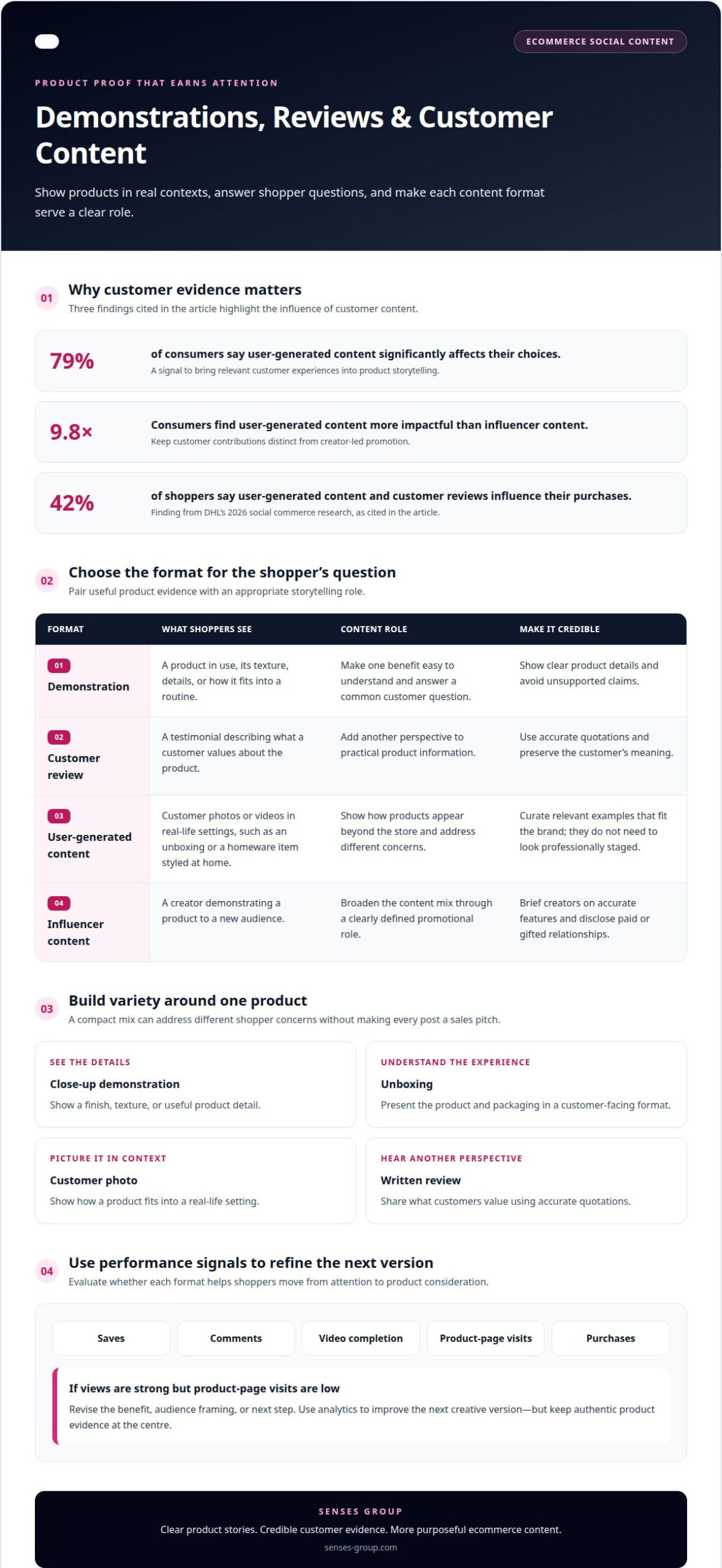
What social media content works best for ecommerce brands? Demonstrations, customer reviews, and user-generated content work well because they show products in real settings and address shopper questions. The strongest mix pairs practical evidence with brand storytelling instead of relying on promotional posts alone.
A product demonstration should make one benefit easy to understand. For a Hong Kong skincare shop, a short video might show the product’s texture and how it fits into a routine, without making unsupported claims. A professional shapes the opening around a common customer question, then captures clear product details and a useful conclusion. Reviews add another perspective: selected testimonials can explain what customers value, while accurate quotations preserve their meaning.
Customer-created photos and videos bring real-life settings into social media marketing. User-generated content can influence purchase decisions: 79% of consumers say it significantly affects their choices, and consumers find it 9.8 times more impactful than influencer content. DHL’s 2026 social commerce research found that 42% of shoppers say user-generated content and customer reviews influence their purchases. These signals make customer experiences a valuable part of product storytelling.
Variety keeps content credible and useful. Combine a close-up demonstration, an unboxing, a customer photo, and a written review, with each format addressing a different concern. For a homeware seller, one post might show an item’s finish, while another shares how a customer styles it at home. The goal isn’t to make every customer post look professionally staged, but to curate relevant examples that fit the brand.
Promotional content from influencers can broaden the mix when its role is clear. A creator may demonstrate a product to a new audience, while customers share their own experiences. Brief creators on accurate product features, the campaign message, and disclosure of any paid or gifted relationship. This helps shoppers distinguish promotion from a customer’s independent contribution.
AI can help draft caption options or adapt copy, but publishing decisions should still reflect performance and brand accuracy. Compare useful signals such as saves, comments, video completion, product-page visits, and purchases. If a caption attracts views but few product-page visits, revise its benefit, audience framing, or next step. Analytics can improve the next creative version, but they don’t replace authentic product evidence.
When product content feels inconsistent across customer reviews, creator campaigns, and store visuals, a coherent brand identity design can give each format a recognisable foundation.
3. Turning products into repeatable social content
Build a content system around product questions, not isolated posting ideas. For a reusable water bottle, shoppers may want to understand its design, everyday use, cleaning, or suitability as a gift. Turn each question into a distinct angle grounded in the product’s actual features. A single product can inspire many posts when demonstrations, tutorials, testimonials, and unboxing videos each serve a different purpose.
The partner then turns those angles into a working content plan. A launch could begin with a product introduction, continue with a demonstration, and follow with customer reactions after purchase. That sequence helps shoppers discover the item, understand its relevance, and find a reason to consider it. For commerce brands expanding beyond Hong Kong, the same plan can be adapted for channels with different audience interests, without changing the product facts or brand position.
Start product positioning with the customer benefit. Rather than repeating a feature in every caption, connect it to a practical use. For example, show a storage product’s compartments in a packing demonstration that makes its organisation benefits visible. Each short-form video should focus on one idea, such as how to use the item or what comes in the package. This keeps the message clear and gives every post a distinct role.
YouTube supports a range of product formats. A concise YouTube Short can highlight one visual feature, while a longer tutorial can explain setup or use in context. An unboxing can show what’s included, and a comparison video can clarify differences between products in the same range. Choose the format based on what the audience needs to understand, then guide viewers to an appropriate next step, such as exploring the product page.
AI-assisted production can help organise a growing catalogue. Use AI to draft caption variations, group products by shared themes, or adapt approved copy for different channels. Human review remains essential: check product details, tone, and claims against the source material before publishing. Performance data can then guide revisions, such as changing an opening line when viewers leave before the demonstration.
For repeatable production, batch related assets together: product footage, close-up details, benefit-led captions, and launch messages. Assign each asset a channel and purpose in a content calendar, while a consistent visual identity helps shoppers recognise the brand across formats. Scale through variation, not duplication. This gives each product several relevant ways to reach the audience without making every post feel like the same advertisement.
4. Benefits of social media marketing for ecommerce
For ecommerce brands, social media can connect product discovery with a store visit and a purchase. DHL’s ecommerce research found that 45% of global shoppers buy through social media platforms. For a Hong Kong retailer, that makes social channels useful for reaching local shoppers and introducing products to overseas audiences. A clear campaign gives each post a role, from building awareness to guiding interested customers towards a product page.
Organic and paid activity work best as connected parts of a marketing strategy. Organic posts establish the brand’s voice and show products in context; paid campaigns can extend selected messages to defined audiences. For example, publish a demonstration organically, then use the strongest creative in a paid campaign. Let the campaign objective guide the decision, whether it’s reach, product consideration, or conversion. Paid distribution amplifies a message, but can’t replace a clear product proposition.
Align social content with the store’s wider customer journey. A product post should lead to a page that explains the same benefit and makes the next step clear. If a campaign introduces a new kitchen item, use consistent language in the social creative, product description, and landing page. This helps shoppers move from interest to evaluation without encountering conflicting claims or a different offer.
Start by defining what work needs to be delivered. An ecommerce business expanding overseas may need market-specific creative, a publishing plan, campaign assets, or performance reporting. Connect each deliverable to a business objective and explain how results will be assessed. A practical brief identifies the audience, product priorities, brand guidelines, available assets, target markets, and approval process.
AI tools can support drafting, resizing, and organising content, but choose them to suit the actual workflow. A team writing product captions needs different capabilities from one adapting video for several channels. Review generated copy against product facts, brand voice, and campaign goals, then compare performance against outcomes such as qualified visits or sales. Human judgement remains central, especially when adapting messages for local and overseas shoppers.
How much does social media content creation cost in Hong Kong? The price depends on the case and is given after a quote request; key factors include the volume of content, production requirements, platform formats, and reporting scope. A plan covering simple product posts differs from one involving original video, multiple markets, and campaign variations, so the required work shapes the proposal.
For a more informed decision, assess whether the strategy connects content, distribution, and the store experience. Ask how campaign results will inform creative improvements and how brand details will stay consistent. A strong approach follows business priorities, not posting volume alone: every asset has a purpose tied to a measurable part of the ecommerce journey.
5. Building a balanced social media content strategy
A balanced strategy gives every post a job, so the feed builds preference instead of repeating sales messages. One useful starting framework allocates 40% of content to brand storytelling and education, 30% to edutainment, 20% to hard selling, and 10% to customer loyalty. Treat these proportions as a planning model, then adjust them to suit campaign goals, audience response, and the products being promoted.
Storytelling and education provide context for a product. A tea brand could explain how its products fit into a daily routine, introduce the people behind the business, or offer guidance on choosing a blend. Edutainment can make similar themes more engaging with a light quiz, short demonstration, or playful comparison. Both approaches give shoppers useful reasons to pay attention before a direct offer appears.
Hard-selling content still matters, but it works best when the offer is clear and supported by relevant information. A post for an 11.11 campaign, for example, can state the featured products, offer terms, and route to purchase. Loyalty content serves a different purpose: it recognises returning customers through useful after-purchase guidance, customer stories, or product-care reminders. Together, these roles connect discovery, purchase, and continued engagement.
A consistent visual system helps content feel like one brand across Instagram and other channels. That doesn’t mean every post needs identical colours, framing, or wording. Recurring design choices, a recognisable tone, and clear product presentation make different formats feel connected. For a business entering new markets, this foundation supports recognition while allowing captions, examples, and campaign details to reflect local audience interests.
Leave room in the calendar for relevant trends. A planned product launch can provide structure, while a timely cultural moment may offer a natural reason to publish a related post. Relevance is key: a trend should strengthen the product story, not distract from it. Review each idea against the brand’s audience, values, and campaign purpose before adding it to the schedule.
Quality matters more than filling every available slot. Prioritising 10 high-engagement posts over 30 mediocre ones keeps the team focused on useful creative and meaningful audience response. Review results by content role: saves may signal practical value, while comments can reveal questions or objections. Use those insights to refine the next plan, rather than judging every post by immediate sales alone.
For Hong Kong businesses balancing local relevance with overseas growth, a structured strategy can connect creative decisions to commercial priorities. Build a more connected marketing strategy around the audiences, products, and markets your store is ready to serve.
Senses Group: Ecommerce Shopify Store
Senses Group connects your brand foundation with the ecommerce experience shoppers meet after a social post. Its Ecommerce Shopify Store offering helps Hong Kong SMEs and startups build a store that supports product discovery and purchase across local and overseas markets.
Turn to Senses Group when your content is attracting attention but your brand positioning, visual identity, or online store needs a stronger connection. Brand Strategy clarifies your direction, while Brand Identity Design creates a consistent visual and verbal foundation. Klaviyo Email Automation can support customer communication beyond the initial store visit.
The result is a more connected path from brand recognition to ecommerce, with each element serving a clear role. Contact Senses Group to discuss the next step for your store.
Make your next content decision count
Your next step isn’t simply to publish more. Decide what your social presence should achieve for the business, whether that’s stronger brand recognition, clearer product discovery, or a more coherent path into new markets. Use that priority to guide your brief, creative direction, and the experience shoppers find after clicking.
Effective social media content creation for ecommerce depends on more than individual posts. It connects brand positioning, visual identity, and the store experience, giving every customer interaction a consistent foundation. As your business grows, that foundation helps new campaigns build on previous work instead of starting from scratch.
Senses Group brings Brand Strategy, Brand Identity Design, and Ecommerce Shopify Store development together for businesses shaping that foundation. If your content and store need a more connected direction, contact Senses Group to discuss your strategy.
Build deliberately, learn from your audience, and give every next step a clear purpose.
Frequently Asked Questions
Why are e-commerce brands struggling on social media?
Ecommerce brands often struggle when posts attract attention without connecting it to a clear customer need or store experience. A campaign may generate views, but unclear product information or a mismatched landing page can interrupt the path to purchase. If a video highlights convenience, for example, the linked product page should explain how the product saves effort. Better alignment makes social activity more commercially meaningful.
Ready to Scale Your E-Commerce Social Content with AI?
AI can help scale production when it supports, rather than replaces, creative judgement. Generate caption drafts from approved product information, then edit each version for tone, accuracy, and channel requirements. AI can also help organise a large product catalogue into themes for future campaigns. Review all output before publication and use audience responses to guide the next round of creative.
How does a social media partner create a content strategy for an ecommerce business?
A social media partner creates a strategy by connecting business priorities to audience needs, channel roles, and available resources. The partner can map upcoming product launches, seasonal promotions, and customer concerns into a campaign calendar. For a store entering a new overseas market, the plan should distinguish shared brand messages from locally relevant examples. Clear approval responsibilities and reporting measures help the team execute consistently.
How often should ecommerce businesses post on social media?
Posting frequency should match the team’s ability to produce useful, consistent content and maintain quality. A pattern of posting once a week, then going silent for two weeks, can reduce reach. A mid-sized ecommerce brand might need 20 to 30 social posts per week across platforms, while smaller teams should set a schedule they can sustain. Review engagement and workload together before increasing output.
What tools do professionals use for ecommerce social media content creation?
Use tools for planning, asset management, editing, scheduling, analytics, and adapting creative across channels. A content calendar coordinates campaign dates, while a shared asset library keeps approved product images and brand files organised. Scheduling tools support planned publishing, and analytics dashboards help identify formats that attract meaningful attention. The right setup depends on your workflow, platform mix, and reporting needs.
How do professionals use user-generated content and influencer marketing for ecommerce?
Use customer-created content to show products in real settings and creator partnerships to introduce products to relevant audiences. Set clear briefs, confirm permission to reuse customer material, and distinguish promotional creator content from independent customer experiences. A homeware brand, for example, might feature a customer’s room photo alongside a creator’s styling video. Each format adds a different perspective without making every message sound like an advertisement.
How do professionals measure social media content performance and ecommerce sales?
Professionals measure performance by connecting platform activity with meaningful store outcomes. They review engagement and video responses alongside product-page visits, add-to-cart activity, and purchases, using campaign tracking to connect the journey. For example, a post with strong comments but few store visits may need a clearer next step. Comparing results by creative format and campaign objective helps teams decide what to refine, continue, or stop.