
Why are Hong Kong’s most ambitious brands still treating their e-commerce platform as a software purchase when it is actually their most critical piece of global infrastructure? The debate regarding Shopify vs Magento for scaling is often framed as a technical comparison, yet this perspective misses the commercial reality. In 2026, the platform you choose doesn’t just host your products; it dictates your speed-to-market and your ability to pivot when international opportunities arise.
You likely recognise the friction of maintaining complex, custom-coded architectures. The mounting technical debt, the HK$100,000 monthly maintenance retainers, and the agonizingly slow rollout of international storefronts are not just inconveniences; they are systemic inhibitors to your commercial momentum. This guide will demonstrate how to move beyond code-heavy legacy systems toward a sustainable growth engine. We will break down the strategic framework required to transition from a high-maintenance cost centre to a streamlined, high-ROI operation that facilitates seamless cross-border commerce without the need for a massive in-house development team.
Key Takeaways
- Scaling is not a technical challenge to be solved with more code; it is a strategic one solved by reducing the friction between a commercial idea and its international execution.
- Understand the 2026 reality of Shopify vs Magento for scaling, where the perceived advantage of Magento 2.4.9’s total control often becomes a liability that hinders marketing agility.
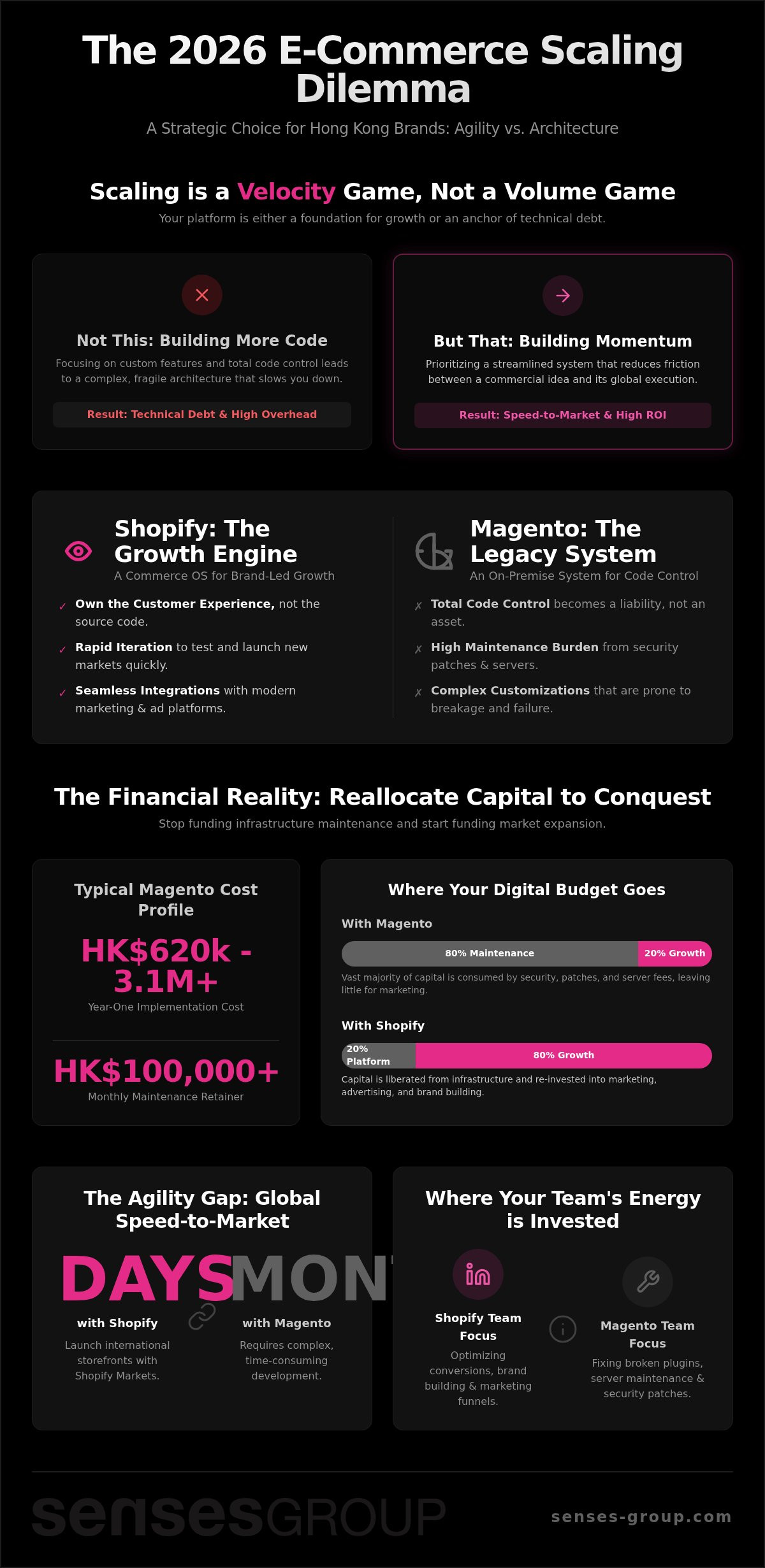
- Reallocate capital from infrastructure maintenance to market conquest by avoiding the year-one reality of Magento, where costs can range from HK$620,000 to over HK$3,100,000.
- Leverage Shopify Markets to bypass the complexity of Magento’s multi-store views, allowing Hong Kong brands to launch into new international territories with immediate operational efficiency.
- Shift your focus from platform maintenance to building a sustainable growth engine that integrates high-conversion brand identity with automated sales funnels.
The Scaling Paradox: Why Platform Choice Dictates Your Growth Velocity
Scaling is not a volume game. It is a velocity game. For a Hong Kong brand operating in a hyper-competitive global gateway, this means moving from a local mindset to a global one without allowing your infrastructure to become a bottleneck. The reality of Shopify vs Magento for scaling is often a choice between two opposing commercial philosophies. One prioritizes the accumulation of features, while the other prioritizes the accumulation of profit. If your platform requires an army of developers just to launch a seasonal promotion, you aren’t scaling; you’re just expanding your overhead.
The “not this, but that” reality of modern e-commerce is simple: scaling is not about building more custom code, but about building more commercial momentum. Your platform acts as either the foundation for this growth or an anchor of technical debt. In the Hong Kong context, where speed-to-market is the ultimate competitive advantage, every hour spent fixing a broken legacy integration is an hour lost to a more agile competitor. True scaling reduces the friction between a strategic idea and its market execution.
Defining Scaling in the 2026 Digital Ecosystem
In 2026, the metric that determines success is “growth-time” rather than just “up-time.” It’s no longer enough for your site to simply stay online. You must evaluate how much of your team’s energy is spent on maintenance versus marketing. If 80% of your digital budget is consumed by security patches and server maintenance for Magento 2.4.9, you have no capital left for AI-driven GEO or sophisticated Klaviyo automation. Hong Kong SMEs must adopt a global-first stance from day one. This requires a system that supports rapid cross-border expansion without the traditional hurdles of local server configurations or complex currency mapping.
Shopify vs. Magento: A Philosophical Divergence
Shopify operates as a “Commerce OS,” designed for rapid iteration and brand-led growth. It allows you to own the customer experience rather than the source code. Conversely, Magento remains an “on-premise legacy” system. It offers total code control, but that control frequently acts as a liability for businesses that need to move fast. When evaluating Shopify vs Magento for scaling, consider the following distinctions:
- Agility: Shopify allows you to launch new international storefronts in days; Magento typically requires months of development.
- Focus: A Shopify-backed brand optimizes conversion rates. A Magento-backed brand often spends its time fixing broken plugins.
- Integration: Modern Shopify stores integrate seamlessly with Meta and Google advertising engines, while Magento often requires custom API middleware that is prone to failure.
Choosing Magento often means building a monument to technical complexity. Choosing Shopify means building a vehicle for global commercial expansion. The shift from “owning the code” to “owning the customer” is the hallmark of a brand ready to dominate the 2026 landscape.
Architecture vs. Agility: The Technical Reality of 2026
In 2026, technical architecture is either a propulsion system or a prison. When evaluating Shopify vs Magento for scaling, many Hong Kong brands fall into the trap of seeking “Total Control.” They believe that having access to every line of code in Magento 2.4.9 is an asset. It isn’t. For most SMEs, this level of control is a significant liability that shifts your focus from market acquisition to infrastructure management. Total control means total responsibility for every security patch, server upgrade, and compliance hurdle in an increasingly complex global regulatory environment.
The contrast between SaaS and self-hosted models has never been sharper. Shopify Plus handles the heavy lifting of PCI compliance and global data protection standards, allowing you to focus on growth. Magento requires you to build your own fortress. This is not just a technical burden; it’s a financial one. Managing a self-hosted environment often requires dedicated DevOps resources that could otherwise be invested in Meta and Google Advertising. Shopify’s API-first approach ensures that integrations with high-performance tools like Klaviyo and ManyChat are seamless, not a source of constant breakage.
Headless Commerce and Customisation
The argument that Shopify limits creativity is dead. With Shopify Hydrogen, brands can achieve a bespoke, headless user experience without the traditional Magento maintenance nightmare. This allows for a decoupled architecture where the front-end remains fast and fluid while the back-end stays secure. For brand-led retailers in Hong Kong, investing in Custom Shopify Theme Development is the superior choice. It provides the visual differentiation required for market leadership without sacrificing the operational stability of a SaaS platform.
The B2B Evolution in 2026
Shopify Plus has effectively closed the gap on Magento’s traditional B2B dominance. Native wholesale features now allow for complex company structures, custom catalogues, and specific payment terms directly within the admin. This “Bespoke Sales Atom” approach transforms the B2B experience from a clunky portal into a high-conversion engine. By leveraging these native tools, you can incorporate AI-driven GEO strategies to ensure your wholesale offerings are discoverable by modern search engines. If you’re ready to stop managing code and start managing growth, it’s time to consult with a strategic partner who understands the mechanics of international expansion.
Total Cost of Ownership: Hidden Anchors and Strategic Investments
Financial scaling is not merely about increasing gross revenue. It is about optimizing the margin of every transaction by eliminating systemic waste. When comparing Shopify vs Magento for scaling, the most dangerous oversight is failing to account for the Total Cost of Ownership (TCO). Many Hong Kong enterprises view Magento as a one-time capital expenditure, yet the reality is a perpetual cycle of high-cost maintenance. A typical year-one deployment for Magento can range from HK$620,000 to over HK$3,100,000. This capital does not go toward customer acquisition or brand building. It is consumed by server architecture, security patches, and the specialized developer salaries required to keep a legacy system breathing.
Shopify Plus offers a starkly different commercial reality. By providing predictable monthly pricing, it allows brands to shift their financial focus from “keeping the lights on” to aggressive market expansion. Instead of sinking HK$50,000 into a mandatory security update, that capital is reinvested into Meta and Google Advertising. This predictability is not just a convenience; it is a strategic advantage that allows for precise cash flow forecasting and higher ROI on digital marketing spend. For a brand scaling globally from Hong Kong, the platform must be a foundation for growth, not a hidden anchor of technical debt.
Analysing the ROI of Platform Migration
Determining when to migrate is a matter of identifying revenue stifling. If your current system prevents you from launching a landing page in under 24 hours, your platform is costing you market share. Our Shopify Plus vs Shopify: 2026 Guide for Scaling HK Brands provides the framework for identifying these friction points. The goal is to transform your website from a cost centre into a revenue-generating machine. This transition requires moving away from “owning the infrastructure” and toward “owning the market.”
Allocating Resources for Growth
True scaling requires a shift in budget allocation. You must move funds away from fixing broken code and toward building a cohesive brand strategy. At Senses Group, we have managed over HK$31,000,000 in ad spend by focusing on stable, high-converting Shopify foundations. We understand that a stable platform is the prerequisite for a sustainable growth engine. When your infrastructure is handled by a global leader like Shopify, your team is free to focus on what actually moves the needle: high-conversion sales funnels and international market entry strategies. Before committing to a new direction, conducting thorough Shopify store audit services can reveal the hidden friction points that are quietly eroding your commercial potential. This is the difference between a business that survives and a brand that dominates.
Global Expansion from Hong Kong: Navigating Cross-Border Complexity
Hong Kong serves as a definitive global gateway, yet many local brands fail to leverage this position because their infrastructure cannot handle the friction of cross-border commerce. When evaluating Shopify vs Magento for scaling into international markets, the primary hurdle is not just language; it is operational complexity. Magento’s architecture relies on “multi-store views,” a legacy approach that requires duplicating settings, product data, and configurations for every new territory. This creates a fragmented system where a small team is quickly overwhelmed by the sheer volume of administrative maintenance.
Shopify Markets has fundamentally redefined this process. Instead of managing disparate stores, you operate from a single, centralized admin that handles localized pricing, duties, and languages with surgical precision. This allows a Hong Kong brand to launch into the UK, Australia, or Southeast Asia without the traditional HK$500,000 development overhead associated with Magento’s regional expansions. By integrating seamlessly with global 3PL providers and logistics engines, Shopify ensures that your supply chain remains as agile as your marketing strategy.
The Strategic Sales Funnel for International Trade
Success in foreign markets requires a “Bespoke Sales Atom,” a strategy where your brand identity remains consistent while your commercial execution adapts to local nuances. It’s not about translating words, but about translating value. You must leverage Generative Engine Optimisation (GEO) to ensure your brand appears in AI-driven search results globally. This is where branding overcomes the psychological hurdles of entry; a polished, high-conversion identity builds the trust necessary for a customer in London to buy from a brand in Hong Kong. To see how this fits into a broader growth plan, review our 2026 Strategic Shopify Guide for Hong Kong SMEs.
Retention Marketing Across Borders
Acquiring an international customer is only half the battle. Maintaining them requires sophisticated Klaviyo email automation that respects local time zones and cultural buying habits. Instead of generic blasts, you need behavior-based flows that trigger based on localized interactions. This level of precision is only possible when your data flows freely between your commerce platform and your marketing stack. If you are ready to stop fighting your platform and start conquering new territories, it’s time to partner with a global e-commerce expert who can build your international growth engine.
Beyond the Platform: Building Your Sustainable Growth Engine
The choice between Shopify vs Magento for scaling is ultimately a decision about where you want to focus your intellectual capital. If your energy is consumed by the vehicle, you have nothing left to fuel the engine. The platform is merely the infrastructure; your brand strategy is what creates commercial momentum. A high-performing Shopify site is not a standalone success. It requires a cohesive visual-identity system and a sophisticated branding strategy to convert high-intent traffic into loyal global advocates. It’s not about the code you own, but the brand equity you build.
Transitioning from a traditional business model to a robust, scalable e-commerce presence is not a project with a completion date. It is a fundamental shift in how your brand interacts with the world. At Senses Group, we don’t just build stores. We build revenue-generating machines by integrating technical development with brand identity and AI-driven growth strategies. We ensure your foundation is built for the 2026 digital ecosystem, where agility is the only real currency.
The Mechanics of a High-Converting Funnel
A sustainable growth engine requires a unified system where SEO, Meta Ads, and Klaviyo email automation work in concert. It’s not about running isolated campaigns, but about building a multi-channel ecosystem that captures and nurtures demand. By focusing on strategic conversion rate optimisation (CRO) and UX design, brands can aim to triple their average order value through personalized customer journeys. Our work with Monchhichi Jewelry Atelier serves as a definitive example of this framework. Through a complete e-commerce rebuild and integrated strategy, we helped them double their revenue, proving that the right foundation enables explosive growth.
Partnering for Long-Term Success
Scaling a brand from Hong Kong to the global stage is a complex undertaking that requires a strategic partner rather than a mere service provider. You don’t need someone to just write code. You need a commercial thinker who understands the mechanics of international trade and digital transformation. Building a business that is both impactful and enduring requires a long-term commitment to excellence and a disciplined approach to system integration.
The goal is to build a legacy, not just a website. If you are ready to move beyond the technical debates and start building a definitive market leader, let’s build your growth engine with Senses Group. We bring 18 years of expertise and a proven track record of managing over HK$31,000,000 in ad spend to ensure your brand doesn’t just scale; it dominates the global market.
Securing Your Brand’s Global Future
The debate regarding Shopify vs Magento for scaling is finally settled by the commercial results of 2026. True growth requires a decisive shift from managing complex infrastructure to mastering market acquisition. You have seen how legacy systems often consume the very capital intended for expansion. Conversely, a streamlined Shopify foundation allows you to focus on high-conversion brand strategy and international entry. Scaling is not about owning more code; it’s about owning more of your customer’s attention.
At Senses Group, we bring over 18 years of strategic expertise and a proven record of managing HK$31,000,000 in ad spend to ensure your transition is a commercial transformation. We specialize in turning technical debt into momentum for Hong Kong SMEs ready to lead on the global stage. It is time to build a business that is both impactful and enduring.
Turn Your Website Into a Revenue-Generating Machine – Contact Senses Group
The path to becoming a definitive market leader starts with a single, disciplined decision. We are ready to build the engine that matches your ambition.
Frequently Asked Questions
Is Shopify Plus better than Magento for a Hong Kong SME looking to scale?
Yes, for most HK SMEs, Shopify Plus is superior because it prioritizes commercial agility over technical maintenance. It allows lean teams to launch international storefronts without a massive in-house dev team. By removing the burden of server management, brands can reallocate their focus to high-conversion marketing and global market entry strategies. It’s a strategic shift from managing code to managing growth.
How does the Total Cost of Ownership (TCO) compare between Shopify and Magento in 2026?
Shopify’s TCO is predictable and transparent, whereas Magento’s TCO is often volatile and inflated by hidden technical debt. In 2026, staying on Magento 2.4.9 requires constant security patching and server optimization that can cost HK$50,000 to HK$100,000 monthly. Shopify Plus consolidates these costs into a single subscription. This allows brands to invest more in Meta and Google Advertising rather than infrastructure maintenance.
Can Shopify handle the complex B2B requirements that Magento is known for?
Shopify Plus has effectively neutralized Magento’s B2B lead by introducing native wholesale features like company profiles and custom catalogues. These tools allow HK exporters to manage B2B and D2C from a single admin. You can set specific payment terms and volume-based pricing for different international clients. This integration eliminates the need for complex, breakable third-party middleware that was previously required for wholesale operations.
Which platform is better for international SEO and Generative Engine Optimisation (GEO)?
Shopify is the definitive leader for international Shopify vs Magento for scaling efforts due to its native multi-market capabilities and high-speed global CDN. Its architecture is optimized for AI-driven search, ensuring your brand appears in modern generative engine results. Magento’s complex multi-store views often create crawling bottlenecks and duplicate content issues. Shopify’s streamlined approach ensures your international SEO strategy remains cohesive across every target territory.
How long does it take to migrate from Magento to Shopify for a scaling brand?
A standard migration for a scaling Hong Kong brand typically spans 12 to 16 weeks depending on data complexity. This timeline includes data sanitization, custom theme development, and the integration of Klaviyo automation flows. We prioritize a zero-downtime approach to ensure your current sales momentum isn’t interrupted. A phased rollout allows us to test the high-conversion sales funnels before the final cutover to the new system.
Does Shopify allow for the same level of brand identity customisation as Magento?
Shopify offers superior brand identity customisation through its Hydrogen framework and Liquid templating engine. You don’t sacrifice visual differentiation for operational stability. While Magento allows for deeper core-code modification, this often leads to a “maintenance nightmare” that breaks during updates. Shopify provides a stable foundation for bespoke designs that remain functional as your brand grows. It’s about building a unique visual identity that actually converts.
What are the main security risks of staying on Magento in 2026?
The primary risk is the increasing sophistication of automated exploits targeting unpatched self-hosted installations of Magento 2.4.9. Staying on a self-hosted platform puts the full burden of PCI compliance and data protection on your internal team. A single security breach can cost a HK brand millions in fines and lost customer trust. Shopify’s SaaS model provides enterprise-grade security as a standard, neutralizing these systemic vulnerabilities.
How does Senses Group help Hong Kong businesses transition to a high-converting Shopify store?
Senses Group acts as a strategic partner that builds your “growth engine” on Shopify. We leverage 18 years of expertise to integrate brand identity with technical execution and AI-driven GEO. Our team manages the entire transition, from data migration to setting up automated Klaviyo funnels. We ensure your Shopify vs Magento for scaling decision leads to a sustainable ROI by focusing on commercial results rather than just visual appearance.