
What if your next customer never clicks a Google result, but asks ChatGPT which brand to trust? For ecommerce businesses facing changes in organic traffic, AI SEO optimisation is no longer about publishing more pages. It is about structuring your brand’s expertise and product information so generative engines can understand, trust and cite you.
The shift can feel confusing. AI-written content and AI SEO are not the same: one uses a tool to produce copy, while the other builds the authority and site foundations that help your business appear in AI-generated answers. For SMEs competing with global brands on limited budgets, that distinction matters. You need a focused system, not an endless volume of content or a larger ad bill.
This guide sets out a practical roadmap for extending visibility from traditional search to AI search and large language models (LLMs), while keeping the fundamentals that support ecommerce growth. You’ll see how GEO, clear product data, credible brand mentions and conversion-focused content work together within Senses Group’s Bespoke Sales Atom framework. The goal is sustainable discovery that attracts better-qualified visitors and turns organic visibility into revenue.
Key Takeaways
- Build your brand’s authority for AI-generated answers, not just its position in a traditional search results page.
- Strengthen the signals that help language models understand and validate your business, including clear site structure and relevant schema markup.
- Use AI SEO optimisation to shift focus from backlink volume to trustworthy, relevant citations that reinforce your expertise.
- Audit your Shopify store’s entity health and citation presence, then map content to the questions customers ask across their buying journey.
- Connect GEO to your wider brand and sales strategy so visibility can support qualified traffic and sustainable ecommerce growth.
Beyond the Blue Link: Why AI SEO Optimisation is the New Standard for 2026
Search visibility is no longer measured only by where a page appears on a results page. People can ask AI tools for a recommendation, comparison or explanation and receive a synthesised answer before visiting a website. That changes the commercial question for an ecommerce business: not simply “Can customers find this page?” but “Does an AI system understand the brand well enough to include it in a useful answer?”
AI SEO optimisation is the strategic organisation of a website’s content, data and brand signals so search engines and large language models can interpret what a business offers, who it serves and why it is relevant. This is not the same as using AI to write product descriptions. Generating copy is a production task; optimisation builds connected evidence that helps systems interpret a brand. It draws on the foundations of Search engine optimization (SEO), adapted for search experiences that can generate answers as well as lists of links.
Google’s Search Generative Experience was an experiment; Google’s current terminology includes AI Overviews and AI Mode. When an answer appears directly on a results page, a customer may get useful context without clicking through to a store. If your brand is absent from that answer, you may lose a chance to shape consideration, even when you have invested in conventional rankings. The fundamentals of SEO still matter, but rankings alone may not cover every path customers use to discover a business.
The Rise of Generative Engine Optimisation (GEO)
GEO is the practice of making your brand’s information clear, relevant and credible enough to be understood and used by generative search systems such as ChatGPT and Perplexity. No optimisation can guarantee a mention or citation, but a well-organised body of useful information gives your brand a stronger foundation to be considered.
Traditional SEO focuses on helping pages rank for relevant searches; GEO also considers whether a brand’s information is clear, credible and usable in a generated response. A citation can connect an answer to the business behind it. For an online shop, that means explaining product categories, materials, uses and expertise consistently, rather than assuming a collection of keyword-heavy pages will communicate the full picture.
Why Keywords Alone No Longer Drive Revenue
Keywords still help reveal what customers want, but repeating the same phrase cannot establish expertise. Search systems need to interpret intent and relationships: a product, its attributes, the problem it addresses and the business that sells it. A retailer targeting overseas buyers, for example, should make product and category information precise enough to answer practical questions, not merely repeat a broad search term.
Build topical authority by covering the connected questions customers ask as they move from research to purchase. Clear, consistent information helps systems connect those answers to your brand. AI-generated summaries can also affect click-through behaviour by resolving some queries without a visit. Measure success beyond rankings: assess qualified organic visits, product engagement and conversions, then strengthen the pages that support both discovery and purchase.
The Mechanics of Generative Search: How LLMs Decide Which Brands to Cite
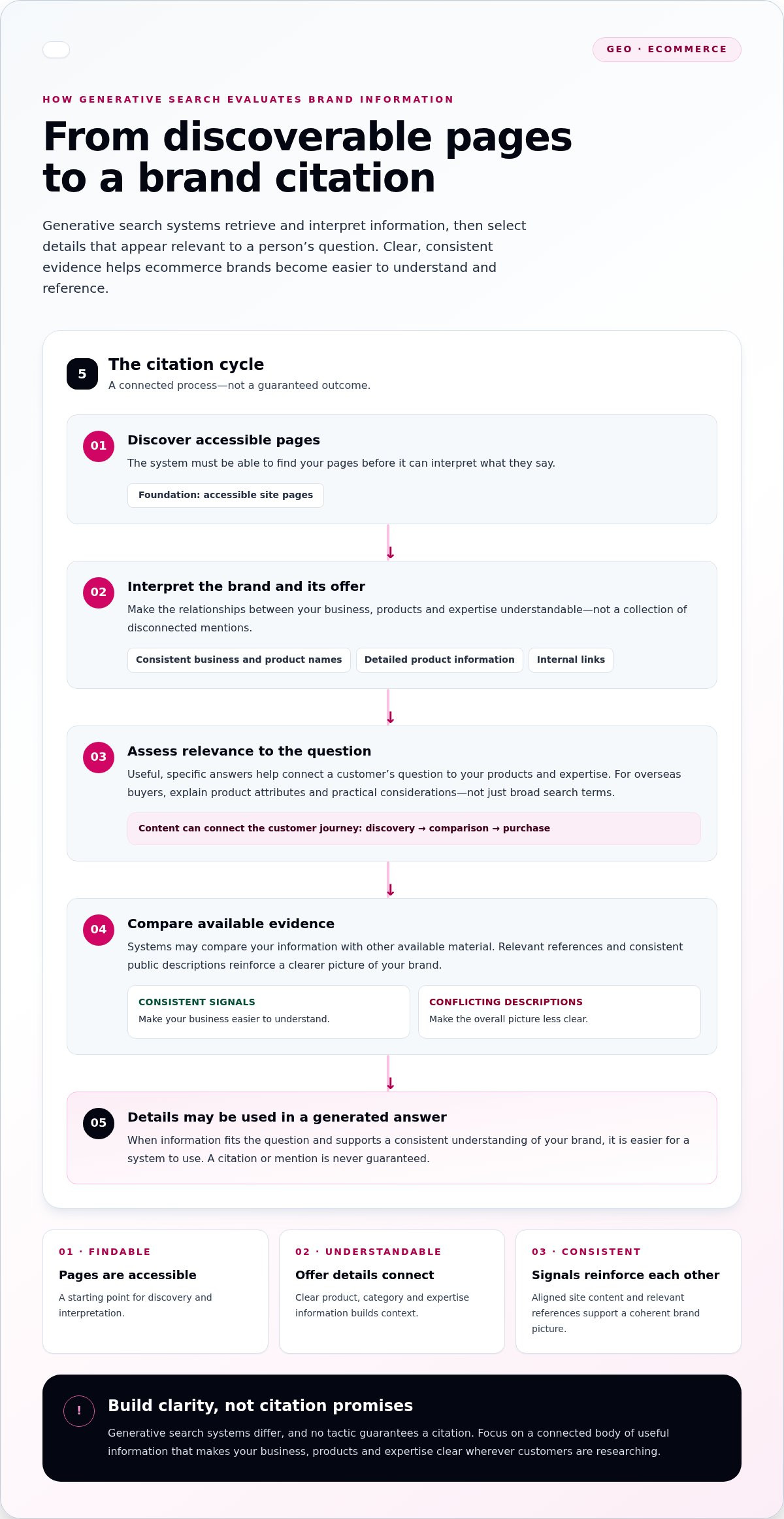
An AI-generated answer may sound like a single recommendation, but the information behind it can come from multiple sources. Generative search systems retrieve and interpret material, then select details that appear relevant to a user’s question. Their processes differ, and no tactic guarantees a citation. Still, clear, consistent evidence gives your brand a stronger foundation to be understood and referenced.
Think of this as a citation cycle. First, a system must be able to discover accessible pages and interpret their content. It can then assess whether the information fits the question and compare it with other available material. When sources support a consistent understanding of your brand, your information is easier to use. If your website says one thing and other public descriptions say another, the picture becomes less clear.
Understanding Entity Recognition and Topical Authority
Entity recognition means systems can distinguish your business, products and expertise as connected concepts, rather than treating every mention as unrelated text. They may infer those connections from consistent names, detailed product information, internal links and relevant references elsewhere. This is not necessarily a visible knowledge graph; it is the practical result of making relationships between your brand and its offerings understandable.
A topical map helps build that clarity. Instead of publishing isolated blog posts, plan a connected set of pages that addresses customer questions across discovery, comparison and purchase. For an ecommerce brand expanding overseas, that could mean connecting category pages with useful information about product attributes, selection considerations and care. Each page should add a distinct answer, while links and consistent terminology show how the subjects relate.
Structured Data, Engagement and Brand Governance
Structured data and schema markup label information in a machine-readable format. Appropriate product markup, for example, can help clarify which details describe a product, while organisation markup can identify the business behind the site. Use accurate, visible information and keep it aligned with the page. Markup can aid interpretation, but it does not guarantee a rich result or AI citation.
User engagement deserves attention, but not as a shortcut. A search system’s use of engagement signals varies and is not fully transparent. For your own business decisions, review whether visitors find relevant products, explore useful pages and take meaningful next steps. Weak engagement may point to a mismatch between the promise in search and the experience on your store, even if it does not prove a particular AI ranking factor.
Brand governance protects the evidence systems and customers encounter. Keep your business name, descriptions, product claims and expertise consistent across your website and public profiles. Review AI-generated descriptions before publishing or reusing them: errors can spread when unchecked copy is repeated. Brand identity design creates a coherent verbal and visual system that makes communications recognisable, while accurate content establishes what the business actually does. Senses Group brings AI search and brand strategy together to support these foundations.
Strategic Comparison: Traditional SEO vs. AI-Driven Search Optimisation
Traditional SEO and AI-driven search share the same foundations, but they now support a broader discovery journey. Many strategies once centred on matching a query to a page and earning a place in a list of links. Today, visibility can also mean being accurately represented in a generated answer. This is not a clean break from SEO; it is a shift from treating rankings as the whole outcome to building authority that works across different search experiences.
The distinction is strategic. A backlink can help people and systems discover your site, but raw link volume alone does not prove that your brand is a relevant source for a specific answer. Relevance, context and credibility matter. A detailed mention from a source closely connected to your category may reinforce your expertise more meaningfully than a large number of unrelated references.
Technical Foundations: LLM-Optimized Metadata
Metadata should summarise each page accurately for people and machines. Write a distinct title and description that state the page’s subject and value, then make sure the visible page delivers on that promise. Use descriptive headings, clear product details and appropriate structured data. Sitemaps help search engines discover URLs; clean navigation, crawlable content and sound site performance support access and usability. None of these technical elements guarantees inclusion in an AI answer.
For a deeper technical discussion, Senses Group’s AI SEO 2026: Strategic Guide for Hong Kong Business explores how these foundations fit into a wider optimisation approach.
Content Strategy: Volume vs. Semantic Depth
More pages do not automatically create more authority. Thin pages that repeat familiar advice without adding useful detail give customers little reason to trust or cite them. Build depth instead: clarify the customer question, provide a complete answer and connect that page to related topics across the site.
For a retailer preparing to sell overseas, original product knowledge can distinguish a page from generic category copy. Explain meaningful attributes, selection considerations or care guidance using information the business can stand behind. Keep the storytelling human, but make key facts easy to interpret through clear labels and consistent terminology. AI SEO optimisation is not a choice between brand voice and machine-readable information. It brings them together.
Reporting should evolve with the strategy. Alongside rankings, organic visits and sales, track whether your brand appears in relevant AI answers. Record the platform, question, cited source and accuracy of the description over time. This gives you a working view of AI share of voice, not a universal ranking score. Use the findings to identify missing topics, inconsistent claims or pages that need stronger evidence, then prioritise changes based on their likely value to customers.
Implementing a High-Performance AI SEO Framework for Your Shopify Store
A Shopify store needs more than optimised product copy. Its collections, product pages, navigation and supporting content must work together to make the brand and its offer easy to interpret. Use this sequence to build a practical foundation for AI SEO optimisation, then refine it using customer and search performance.
- Audit entity health and citations. Check that your business name, category, product details and expertise are described consistently across your Shopify store and public brand profiles. Review whether AI platforms mention your brand for relevant product questions, and note inaccuracies, missing context and cited sources. Treat this as a baseline, not a guaranteed ranking score.
- Map the customer journey. Choose seed topics that connect directly to your brand strategy and products. Expand them into useful questions customers ask while discovering, comparing and choosing products. A retailer could plan content around a core product category, then address selection criteria, use cases and care. This creates a connected content plan rather than a collection of unrelated posts.
- Strengthen product pages. Write distinct descriptions that explain what the item is, its relevant attributes, who it suits and how it meets a customer need. Keep product titles, descriptions and structured data aligned with visible page content. In Shopify, review product records and collection assignments as well as rendered pages, so key details are not lost among duplicated or inconsistent copy.
- Build purposeful internal links. Link relevant guides to collections and products, and connect related guides where they help customers take the next step. Use descriptive anchor text that tells readers what they’ll find. This makes the site easier to navigate and helps establish how your topics and offerings relate.
- Monitor and adjust. Track organic visits and conversions alongside a repeatable set of questions in AI search tools. Record whether your brand appears, which pages are cited and whether the answer represents your offer accurately. Google’s current language includes AI Overviews and AI Mode; do not treat the former SGE experiment as a separate current performance metric.
Build a Topical Map for Local and Overseas Reach
Prioritise seed topics that reflect what you sell and what customers need to know. Then develop focused subtopics for different stages of the buying journey and the markets you serve. Keep the brand’s core positioning consistent while answering market-specific questions with accurate, relevant information. Shopify architecture and store growth are explored in the 2026 Strategic Shopify Guide for Hong Kong SMEs.
Make Key Information Easy to Interpret
For product recommendation queries, provide clear category pages, accurate product attributes and helpful FAQs based on real customer questions. A concise question-and-answer format can make information easier to scan and extract, though it cannot guarantee a citation from ChatGPT, Perplexity or Google. A simple visual hierarchy, sometimes described as a Z-pattern, can place the main claim, supporting detail and next step where shoppers can find them quickly. Prioritise clarity over layout formulas.
To align Shopify structure, topical planning and AI search strategy, work with Senses Group on AI SEO optimisation.
Scaling Your Growth Engine with Senses Group’s AI SEO Solutions
AI search visibility creates commercial value when it connects to a complete customer journey. A citation may introduce your brand, but alignment between what customers see, what they learn and what your store enables them to do is what turns discovery into revenue. For SMEs expanding into new markets, GEO works best as part of an integrated growth system, not as a technical task operating in isolation.
The Senses Group Approach: Integrating GEO with the Sales Atom
Senses Group brings brand strategy, identity and AI optimisation together through the Bespoke Sales Atom, a framework for connecting AI SEO to a sales funnel. Brand positioning establishes what makes the business distinct; a topical map organises the subjects it should own; and LLM-optimised metadata helps clarify the meaning of key pages. Consistent product information and persuasive content then guide prospective customers from initial discovery towards a considered purchase.
Visuals also contribute to the brand experience. Product and lifestyle imagery can help shoppers understand the character and context of an offer, while descriptive alt text and accurate surrounding copy make the image’s subject clearer to people and search systems. AI-assisted visual production can support the creation of brand-aligned assets, but speed alone is not the objective. Every visual should feel consistent with the identity and promise customers encounter across the store and marketing channels. Senses Group’s integrated digital marketing scaling guide explores how connected disciplines can support a coherent growth strategy.
This integration matters because AI search does not operate separately from brand perception. If a business presents one promise in its identity, another in its product descriptions and a third in its campaigns, the customer journey becomes fragmented. Clear brand governance gives every touchpoint a shared foundation, making the brand easier to recognise and its offer easier to understand.
Realising Sustainable Growth Beyond the Algorithm
Visibility is an input, not the final measure of success. Senses Group connects discovery to business outcomes: relevant visits, meaningful product engagement and conversions. That means assessing which topics attract potential customers, whether landing pages answer their needs and where friction interrupts the move from consideration to purchase. Vanity metrics can show activity; connected measurement reveals whether marketing is helping the business grow.
For SMEs pursuing overseas ecommerce, a consistent brand foundation can travel while content adapts to the needs and questions of each market. Senses Group aligns branding, GEO and digital marketing so growth is built around a clear commercial proposition, not scattered tactics or dependence on rising ad spend. Priorities can evolve as customer behaviour, platform features and business goals change, while the underlying brand and sales system remains coherent.
For a strategy that connects brand foundations with AI search and ecommerce growth, explore Senses Group’s AI SEO solutions. In 2026, sustainable visibility and revenue depend on a unified strategy that aligns brand, content, technology and the customer journey.
Build a Search Presence That Compounds
The next step is not to chase every new platform or publish content for its own sake. Decide what your brand should be known for, then build a connected system that helps customers and AI search understand that value. For businesses looking to grow across markets, a clear strategy can turn emerging search visibility into a stronger foundation for ecommerce revenue.
Senses Group brings over 18 years of branding and digital marketing expertise, experience building and scaling a multimillion-dollar product brand, and capabilities in Shopify and Klaviyo integration. That combination connects brand positioning with the systems that support discovery, customer relationships and sales. AI SEO optimisation becomes more than a technical adjustment; it becomes part of a deliberate growth engine designed around your business.
Build for more than a temporary ranking. Build a brand that earns recognition, trust and consideration wherever customers discover it. Let’s build your growth engine with Senses Group, and take your next stage of growth forward with clarity and confidence.
Frequently Asked Questions
What is the difference between AI SEO and traditional SEO?
Traditional SEO focuses on helping pages become discoverable and perform in search results, while AI SEO also considers whether systems can interpret and use your brand information in generated answers. The two approaches share important fundamentals, including useful content and accessible pages. For a retailer, the practical difference is to assess not only whether a category page attracts visits, but whether its product information is clear enough to support an accurate recommendation.
How does Generative Engine Optimisation (GEO) work for ecommerce?
GEO helps ecommerce information become easier for generative search systems to understand and reference. Start by checking whether product pages clearly communicate the item’s category, defining attributes and intended use. Then ensure supporting guides answer real buyer questions and connect naturally to relevant products. For example, a comparison guide should explain meaningful differences between options, rather than simply repeat product descriptions, so shoppers can make a more informed choice.
Will AI search engines like ChatGPT replace Google in 2026?
There is no reliable basis to assume that AI search will replace Google in 2026. People may use traditional search, AI assistants or both, depending on the task and their habits. A business should therefore avoid putting its entire discovery strategy into one channel. Keep your site discoverable through sound SEO fundamentals, while making brand information clear enough to serve customers who begin their research in conversational AI tools.
Do I need to rewrite all my content for AI search engines?
No, a complete rewrite is rarely the best first move. Review existing pages for accuracy, clarity and usefulness, then prioritise content that drives business value or answers important customer questions. A product page may need clearer attributes, while a guide may need updated examples or a stronger explanation. Preserve content that already works, improve weak sections and remove duplication that adds little to the customer experience.
How long does it take to see results from an AI SEO optimisation strategy?
There is no dependable fixed timeline, because results depend on your site’s starting point, the changes made and how search platforms discover and use information. Track progress in stages rather than expecting an immediate citation: first check whether key pages are accessible and accurate, then monitor relevant AI mentions, referral visits and conversions. Establish a baseline before making changes so you can distinguish meaningful movement from normal fluctuations in traffic.
Can AI SEO help my Hong Kong business expand to overseas markets?
Yes. AI SEO can support overseas discovery when your site explains your products and brand in language prospective customers in each target market understand. Start by identifying the questions those customers ask, then create relevant pages with accurate, locally appropriate terminology. Avoid simply duplicating domestic copy: differences in customer needs may affect the examples, product context and information shoppers expect before they buy.
Is AI-generated content bad for my search rankings?
AI-generated content is not automatically harmful, but publishing unchecked or repetitive material can weaken trust and usefulness. Treat AI as a drafting aid, not an authority. Have someone with genuine knowledge verify product claims, correct errors and add insights that reflect the business’s experience. Before publishing, ask whether the page answers a real customer need and whether you would stand behind every statement if a buyer relied on it.
How do I track my performance in AI search results?
Create a repeatable set of questions that matter to your customers, then test them across the AI platforms relevant to your audience. Record whether your brand appears, which page or source is referenced, and whether the description is accurate. Separately monitor website analytics for visits from AI services where identifiable, then connect those sessions to meaningful actions such as product views, enquiries or purchases. Review trends over time rather than treating one answer as a definitive result.