
Scaling a brand from a local Hong Kong success to a global commercial powerhouse isn’t about working harder; it’s about the structural integrity of your digital foundation. You likely recognize that high transaction fees and rigid checkout flows eventually erode your competitive edge. The debate of Shopify Plus vs Shopify is no longer just a comparison of features. It’s a critical assessment of your brand’s readiness for systemic expansion.
This guide provides the definitive financial and technical roadmap for 2026 to determine exactly when the $2,300 monthly investment becomes a strategic asset rather than an overhead cost. We’ll dissect precise revenue thresholds, such as the $800,000 monthly turnover mark where variable fees shift, and explore how Plus facilitates seamless cross-border trade from Hong Kong. You’ll gain a clear justification for your digital transformation, ensuring your infrastructure supports a trajectory toward the projected $46.8 billion market peak by 2031.
Key Takeaways
- Identify the specific financial tipping points where reduced transaction fees transform the Plus subscription into a profit-generating asset for your Hong Kong operations.
- Navigate the technical architecture of Shopify Plus vs Shopify to understand how custom Shopify Functions can eliminate conversion bottlenecks in your checkout process.
- Master the strategy for international expansion by utilizing multiple storefronts to position your brand as a global competitor from a Hong Kong base.
- Recognize the operational friction points and manual workflow limitations that indicate your business has hit the “scaling wall” of standard commerce plans.
- Learn why a platform migration is the optimal moment to execute a brand identity overhaul and integrate AI-driven growth engines for long-term market dominance.
Beyond the Basics: Understanding the Scaling Wall for Hong Kong SMEs
Most Hong Kong brands reach a plateau where growth feels like a struggle against their own infrastructure. This is the “Scaling Wall.” It isn’t a lack of market demand; it’s the friction of manual workflows, technical ceilings, and fragmented systems. To move beyond this, a psychological shift is required. You aren’t just running a shop. You’re managing a global commercial engine. Understanding Shopify’s history and platform helps illustrate why these distinct tiers exist: one for validation, one for market dominance. For the ambitious merchant, the comparison of Shopify Plus vs Shopify is a strategic assessment of whether your tools facilitate growth or merely manage your current state.
The Limitations of Shopify Core Plans
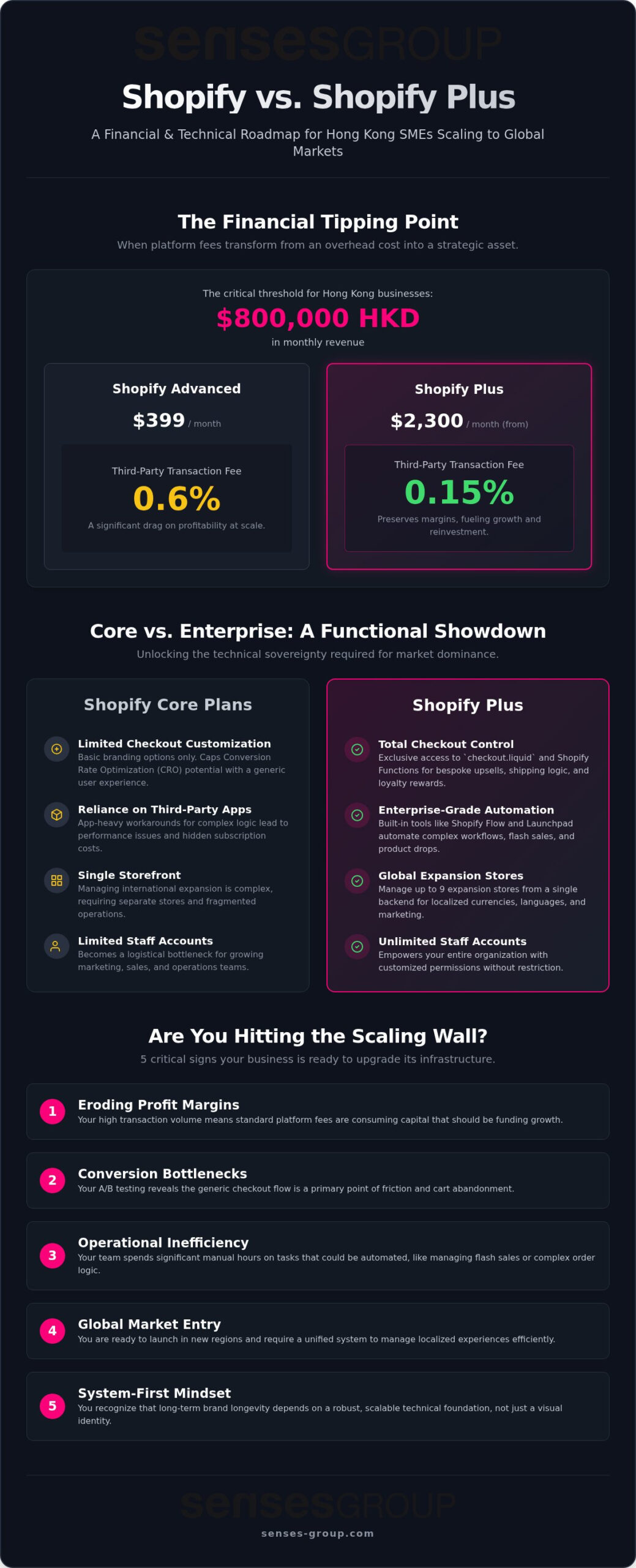
Standard plans are excellent for validating a product market fit. However, as your volume increases, the operational cracks begin to widen. Standard checkouts offer limited customization, which directly caps your Conversion Rate Optimization (CRO) potential by forcing a generic experience on a diverse global audience. Many brands find themselves stacking third-party apps to solve complex business logic. These app-heavy workarounds carry hidden costs in site performance and recurring subscription bloat. Additionally, limited staff accounts become a logistical bottleneck for expanding marketing and operations teams. The debate of Shopify Plus vs Shopify often resolves itself when the cost of these inefficiencies exceeds the investment of an upgrade.
The Strategic Role of Technology in Brand Longevity
True brand longevity requires moving from a “logo-first” mindset to a “system-first” model. Your visual identity is the face of the business, but your infrastructure is the spine. A high converting Shopify store in 2026 demands more than aesthetic appeal. It requires foundational stability that enterprise-grade systems provide. Infrastructure directly influences site speed, and site speed influences premium brand perception. For Hong Kong brands using e-commerce as a springboard to international markets, this technical reliability is the difference between a successful entry and a costly retreat. By investing in a robust system, you ensure that your brand remains impactful and enduring across every territory you enter.
Key Functional Differences: Shopify Plus vs Shopify Core Plans
The choice between Shopify Plus vs Shopify is fundamentally a decision about margin preservation and technical sovereignty. While the Advanced plan at $399 monthly serves growing businesses well, its 0.6% third-party transaction fee becomes a significant drag on profitability as volume increases. In contrast, Shopify Plus offers a base fee of $2,300 for a three-year term and slashes third-party gateway fees to a range of 0.15% to 0.30%. For brands exceeding the $800,000 monthly revenue threshold, the variable fee of 0.35% to 0.40% ensures the platform cost scales predictably with your success. This financial clarity allows you to reinvest saved capital into market acquisition rather than platform overhead. Brands evaluating their long-term platform strategy should also consider the broader Shopify vs Magento for scaling debate to understand how each architecture affects global commercial momentum.
Advanced Checkout Customization
Conversion Rate Optimization (CRO) reaches its zenith on the Plus tier through the exclusive ability to modify the checkout experience. Unlike standard plans that restrict you to basic branding, Plus allows you to build bespoke sales atoms directly within the checkout flow. You can implement custom logic for shipping rates, loyalty rewards, and upsells that feel native to the user journey. By June 30, 2026, all merchants must migrate from legacy Shopify Scripts to Shopify Functions, a transition that gives Plus users unprecedented control over backend logic without sacrificing site speed. This level of customization reduces friction, encourages the use of Shop Pay, and ultimately drives a higher Average Order Value (AOV).
Enterprise-Grade Automation
Operational efficiency is the cornerstone of global scaling. Shopify Flow and Launchpad empower your team to automate complex backend tasks that would otherwise require manual intervention. Launchpad, specifically, allows you to schedule flash sales and product drops, automatically adjusting themes and pricing at precise intervals. As highlighted in HKTDC research on cross-border trade, Hong Kong’s role as a logistics hub demands systems that can handle rapid, high-volume transactions across borders. Integrating Klaviyo email automation with Plus-exclusive data hooks ensures your marketing remains personalized and reactive to real-time customer behavior. Strategizing your migration with a partner like Senses Group ensures these automation tools are configured to act as a force multiplier for your strategic team.
Global Expansion and B2B: Leveraging Plus for International Trade
Hong Kong serves as a unique commercial conduit between Mainland China and the global market. For brands operating from this hub, the distinction between Shopify Plus vs Shopify is most evident in how they handle international scaling and B2B complexity. While standard plans offer Shopify Markets for basic cross-border selling, Plus provides the structural sovereignty required for true multi-regional dominance. It allows you to manage multiple storefronts and diverse buyer journeys from a single administrative interface, ensuring your operations remain lean even as your reach expands. This systemic approach transforms your e-commerce presence from a local storefront into a global commercial engine.
Expansion Stores and Multi-Regional Management
Managing up to 10 expansion stores is a cornerstone feature for brands that require distinct localized experiences. This capability allows you to tailor your brand identity for retailers across different territories while centralizing inventory and order management. It’s not just about language translation; it’s about localized marketing, region-specific product availability, and automated tax and duty calculations that remove the friction of global trade. This in-depth guide to Shopify Plus features highlights how these expansion stores prevent the dilution of your brand message in foreign markets. By maintaining regional relevance, you build the trust necessary for long-term international retention.
The B2B Revolution for HK Manufacturers
The traditional export model is being replaced by a digital-first wholesale approach. While foundational B2B commerce features became available on all paid plans as of April 2, 2026, the Plus tier remains the only viable solution for high-volume manufacturers. When evaluating Shopify Plus vs Shopify for wholesale, the ability to create custom catalogs and personalized pricing for high-value accounts becomes the deciding factor. It offers the advanced customization needed for net payment terms and bespoke procurement processes. By digitizing these operations, Hong Kong businesses can significantly reduce the cost of customer acquisition. You aren’t just selling a product; you’re providing a professional, self-service portal that mirrors the efficiency of your DTC store. This integration of B2B and DTC on a single platform eliminates fragmented systems, allowing your team to focus on strategic market entry rather than manual data entry.
The Upgrade Checklist: 5 Signs Your Business is Ready for Shopify Plus
Deciding to migrate is not merely a technical choice; it is a declaration of commercial intent. While standard plans serve the purpose of market validation, they eventually become a ceiling for brands with global ambitions. You must evaluate your infrastructure based on its ability to support your future, not just manage your present. If your team spends more time fighting the platform than executing strategy, you’ve likely hit the limit of standard commerce. This checklist identifies the precise triggers that signal your readiness to transition from Shopify Plus vs Shopify.
Step 1: The Transaction Fee Tipping Point
Profitability in a competitive market like Hong Kong depends on margin preservation. Standard plans carry higher transaction fees, specifically 0.6% on the Advanced plan when using third-party gateways. Shopify Plus reduces these fees to between 0.15% and 0.30%, creating a significant delta in your bottom line. At approximately $800k USD annual revenue, the fee savings often justify the upgrade. Beyond this point, the variable fee structure ensures your costs remain predictable as you scale toward the $800,000 monthly revenue threshold, where the percentage model takes effect.
Step 2: Assessing Technical Limitations
Site speed and custom logic are the silent killers of conversion rates. If your current theme is bogged down by a heavy app stack, your infrastructure is actively hindering your growth. Standard plans restrict your ability to modify the checkout backend, forcing you to use workarounds that increase latency. Shopify Plus allows for headless commerce and complex API integrations, giving you total control over the user experience. You need this technical sovereignty to implement bespoke shipping logic or advanced discount engines that “Advanced” simply cannot support. Working with a dedicated Shopify store design agency Hong Kong brands trust can help you strip away redundant apps and build a performance-optimized storefront from the ground up.
- Operational Friction: Your team is manually handling B2B orders or international currency adjustments.
- Expansion Goals: You have a multi-country or wholesale launch planned within the next 12 months.
- Brand Maturation: Your digital presence requires a strategic brand development approach to maintain premium positioning.
Scaling a brand requires a partner that understands the intersection of technology and commercial strategy. If your business meets these criteria, it’s time to build a foundation that facilitates, rather than restricts, your global trajectory. You can consult with Senses Group to audit your current performance and map out a strategic migration path that maximizes your ROI.
Strategic Migration: Building a High-Converting Growth Engine with Senses Group
Migrating to an enterprise tier represents a pivotal moment in a brand’s lifecycle. It’s the point where you stop patching technical holes and start building a definitive commercial infrastructure. When evaluating Shopify Plus vs Shopify, the most successful Hong Kong brands don’t just move their data; they reimagine their entire market position. At Senses Group, we view this transition as the ideal catalyst for a comprehensive brand strategy and identity overhaul. By addressing the root of your brand’s perception during the rebuild, you ensure that your new technical capabilities are supported by a powerful, resonant narrative.
End-to-End Brand and Commerce Integration
High-performance UX design is ineffective if it lacks a cohesive visual identity. We specialize in aligning these elements to create a seamless customer journey that drives conversion. Utilizing strategic brand development allows you to lower customer acquisition costs (CAC) by establishing immediate trust and clarity. Before any code is written for your Plus store, we develop a “Marketing Map.” This document serves as the strategic blueprint, ensuring every automated flow and design choice serves a specific commercial outcome. It’s the difference between a visual storefront and a system that generates revenue.
Future-Proofing with AI and Automation
The commerce landscape in 2026 is defined by how well your data interacts with artificial intelligence. Beyond traditional search, we implement Generative Engine Optimization (GEO) to ensure your brand remains visible in AI-driven discovery tools and Large Language Models (LLMs). Shopify Plus provides the robust API access and data structures necessary to feed these engines accurate, high-quality information. This approach transforms your store into a self-correcting growth engine that adapts to shifting consumer behaviors. Our 18+ years of expertise has shown that this systemic integration is what separates market leaders from those who merely exist online.
Our methodology is rooted in practical results. For our jewelry atelier clients, we’ve executed complete e-commerce rebuilds that didn’t just upgrade the platform but transformed the business model. By integrating advanced sales funnels and refining brand identity, we’ve successfully proven 2x revenue growth for brands in this sector. When you weigh the benefits of Shopify Plus vs Shopify, remember that the platform is only as effective as the strategy behind it. We act as a seasoned strategic partner, guiding you through the complexities of digital transformation to build something impactful and enduring.
Mastering Your Global Commercial Trajectory
The decision regarding Shopify Plus vs Shopify is ultimately a choice between managing a local shop and commanding a global commercial engine. You’ve identified the financial thresholds where reduced transaction fees become a profit driver. You’ve also seen how advanced checkout customization and B2B tools eliminate the scaling wall that holds back many Hong Kong SMEs. This transition isn’t merely a technical migration; it’s an opportunity to overhaul your brand identity and future-proof your growth with AI-driven discovery.
Senses Group brings 18+ years of branding and e-commerce expertise to this transformation. We’re specialists in AI-driven GEO and Shopify Plus with a proven track record of doubling client revenue through systemic, high-converting rebuilds. Don’t let legacy infrastructure dictate your brand’s ceiling in a market projected to hit $46.8 billion by 2031. Your brand’s international legacy starts with the foundation you build today.
Let’s Build Your Growth Engine – Contact Senses Group Today
Frequently Asked Questions
How much does Shopify Plus cost in 2026?
Base pricing in 2026 is $2,300 per month for a three-year term or $2,500 for a one-year term. For stores exceeding $800,000 in monthly revenue, the cost shifts to a variable fee of 0.35% to 0.40% of sales. This fee is capped at $40,000 monthly. These rates represent a strategic investment in infrastructure that reduces third-party gateway fees to as low as 0.15% for high-volume merchants.
Can I keep my existing theme when upgrading to Shopify Plus?
Yes, you can retain your existing theme, but an upgrade is the ideal time to optimize your technical architecture. While your front-end visuals remain, the migration allows you to replace heavy third-party apps with native Shopify Functions. This move improves site speed and brand perception. Most scaling brands use this transition to refine their brand identity design, ensuring their high-converting store is built on a clean, systemic foundation. Engaging a specialist custom Shopify theme development agency in Hong Kong during this phase ensures your storefront is engineered for performance from day one.
Is Shopify Plus better for B2B or DTC businesses?
Shopify Plus is designed for hybrid models that manage both DTC and B2B operations from a single admin. While foundational B2B features were added to all paid plans on April 2, 2026, Plus offers exclusive advanced customization for wholesale-specific pricing and net payment terms. This capability is essential for Hong Kong manufacturers looking to digitize their traditional export models and lower the cost of customer acquisition through a professional procurement portal.
How long does a typical migration to Shopify Plus take?
A standard migration typically spans 90 to 120 days, depending on the complexity of your existing data and integrations. This timeline includes auditing your current tech stack, refining your brand strategy, and configuring automation workflows like Shopify Flow. Rushing this process often leads to systemic friction. A methodical approach ensures your new growth engine is fully optimized for global market entry without disrupting your current commercial operations during the transition.
What are the main differences between Shopify Advanced and Shopify Plus?
The primary distinction lies in technical sovereignty and transaction costs. When evaluating Shopify Plus vs Shopify Advanced, Plus offers significantly lower third-party gateway fees, specifically 0.15% to 0.30% compared to 0.6% on the Advanced plan. Plus users also gain exclusive access to the checkout editor and can manage up to 10 expansion stores. These features provide the structural integrity required for brands transitioning from local retailers to global commercial engines.
Do I need a Shopify Plus agency to manage the upgrade?
While not mandatory, partnering with a seasoned strategic mentor ensures you maximize the platform’s advanced capabilities. A specialized agency handles the complex data migration, integrates AI-driven growth engines, and aligns your technical infrastructure with your commercial goals. This expertise prevents common pitfalls like broken redirects or inefficient app stacks. It turns a technical upgrade into a comprehensive business transformation, leveraging 18+ years of expertise to build a high-converting store that effectively scales revenue.
What are expansion stores and how do they work in Hong Kong?
Expansion stores are additional storefronts included in your Plus subscription, allowing you to manage up to 10 localized versions of your brand. In the Hong Kong context, this is vital for targeting distinct international markets with unique currencies, languages, and inventory. You can maintain a consistent brand identity while tailoring marketing strategies to local consumer behaviors. This systemic approach centralizes global management while providing the native experience necessary for long-term international retention.
How does Shopify Plus help with international SEO and GEO?
Shopify Plus provides the robust API access and structured data fields required for Generative Engine Optimization (GEO). By optimizing your product data for LLMs and AI discovery tools, you stay ahead of shifting search behaviors. The platform’s ability to host localized subfolders or domains for expansion stores also strengthens your international SEO. This ensures your brand remains visible and authoritative as search engines transition from traditional ranking models to next-generation AI-driven discovery.