
A visual redesign will never solve a structural conversion problem. When customer acquisition costs climb and cross-border expansion stalls, founders rarely suffer from weak graphic design; they suffer from commodity positioning. Partnering with the right brand positioning agency isn’t about buying a cosmetic facelift, but engineering the commercial leverage required to command premium pricing.
If you’ve ever poured hard-earned capital into creative agencies that delivered elegant slide decks without shifting your bottom line, your skepticism is entirely justified. In competitive e-commerce markets, generic messaging dilutes your value proposition, burning paid media budgets and reducing your product to an easily replaced substitute.
In this guide, you will discover how a dedicated brand positioning agency bridges the gap between market perception and measurable commercial growth. We provide an objective vetting framework to select the right partner, evaluate genuine positioning deliverables, and align your foundational strategy with high-converting funnels that scale sustainably across global channels.
Key Takeaways
- Understand why genuine market positioning serves as an economic foundation that protects gross margins and eliminates dependency on reactive discounting.
- Discover the objective vetting criteria to evaluate a brand positioning agency on commercial impact and revenue capability rather than aesthetic design portfolios.
- Learn how defining clear brand differentiation directly lowers customer acquisition costs across paid Meta and Google channels.
- See how operationalizing strategic positioning through custom Shopify stores and digital funnels drives scalable cross-border expansion.
- Explore how modern retention systems and search discovery integrate into brand strategy to generate sustainable commercial equity.
What Is a Brand Positioning Agency and Why Does Your Business Need One?
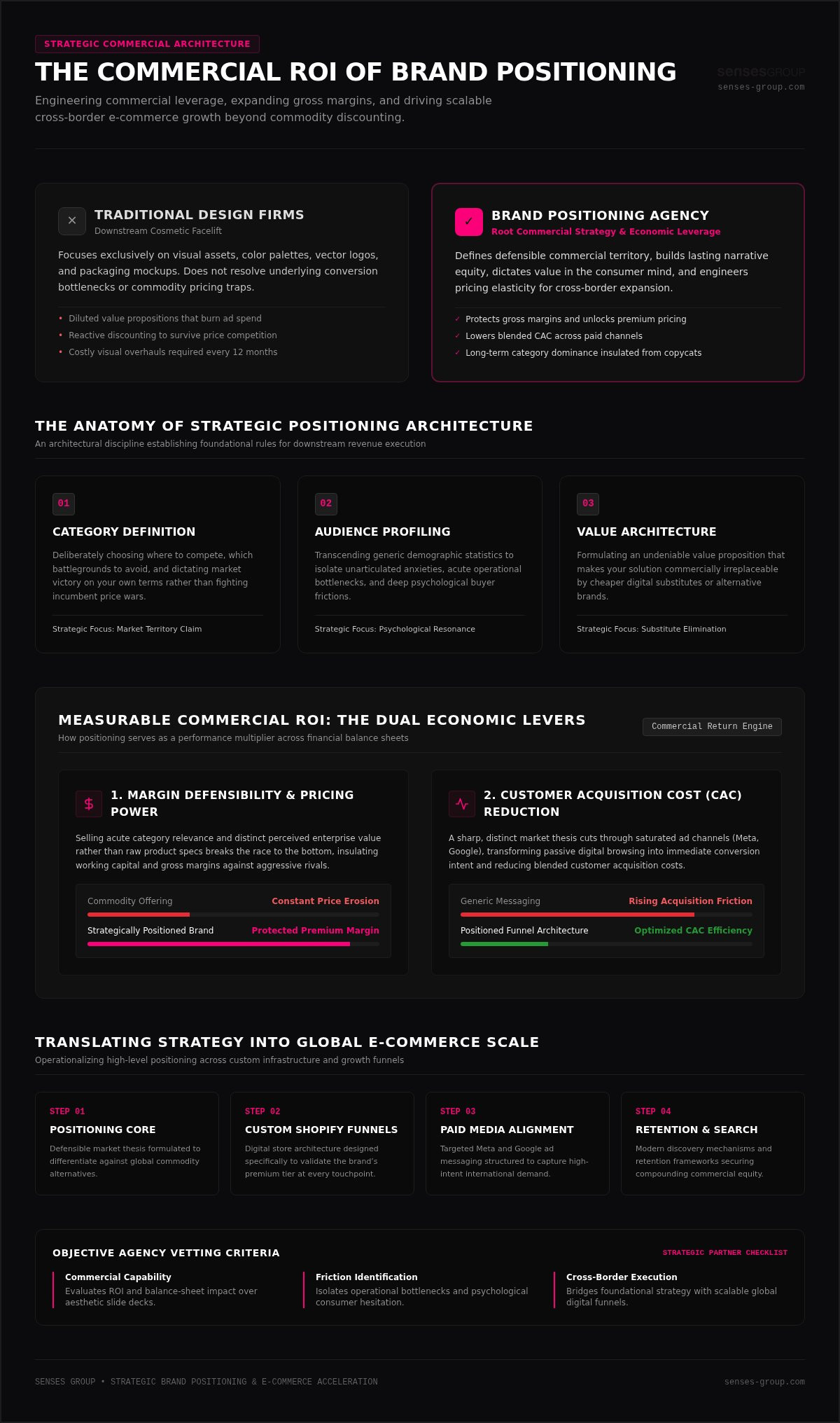
Most business failures trace back to indistinct positioning rather than bad products. A dedicated brand positioning agency does not simply design attractive marketing collateral; it defines the defensible commercial territory your company claims in the market. In classical marketing theory, brand positioning dictates how an audience differentiates your solution from alternatives, directly influencing pricing elasticity, buyer retention, and gross margins.
Weak positioning forces brands into reactive discounting. When customers view products as interchangeable commodities, pricing becomes the only visible differentiator. Strategic positioning breaks this cycle. It acts as an economic lever that transforms an operational business into a category leader, insulating profit margins against aggressive competitors.
The Anatomy of Strategic Brand Positioning
Strategic positioning is an architectural discipline rather than a creative whim. It establishes the foundations that govern all downstream commercial activity:
- Market Category Definition: Choosing precisely where to compete, which battleground to avoid, and how to define market victory on your own terms.
- Target Audience Profiling: Moving past high-level demographic data to isolate underlying psychological frictions, unarticulated anxieties, and operational bottlenecks.
- Value Proposition Architecture: Formulating an undeniable promise that makes your offering commercially impossible to replace with cheaper substitutes.
Positioning is not what you do to a product; it’s the commercial leverage you construct within the customer’s mind to dictate value.
Brand Positioning Agency vs. Traditional Design Firm
Traditional graphic design firms focus on downstream visual assets. They generate color palettes, render packaging mockups, and draw vector logos. While aesthetic polish has value, visual design cannot fix a broken business model or clarify a confusing offer.
A specialized brand positioning agency operates at the root level of commercial strategy. Instead of asking how your brand should look, a strategic partner determines why your brand must exist and how it will extract value from saturated channels. When founders skip foundational positioning to purchase rapid graphic production, they inevitably find themselves commissioning another costly brand overhaul twelve months later. Strategic market defensibility protects capital by building narrative equity that lasts decades.
The Measurable ROI of Strategic Positioning: Lowering CAC and Expanding Margins
Creative awards do not pay operating overhead. For scaling enterprises and Hong Kong founders expanding into international markets, brand strategy must demonstrate an uncompromising commercial return. When you hire an experienced brand positioning agency, the primary return on investment surfaces across two interconnected financial metrics: reduced customer acquisition costs and expanded gross margins.
Positioning provides an immediate performance multiplier. A distinct market thesis turns passive browsing into immediate consumer intent, insulating your balance sheet from volatile media costs and aggressive price wars.
Unlocking Premium Pricing and Margin Defensibility
Commoditized businesses operate under constant downward price pressure. When an offering looks identical to ten other options in a crowded digital marketplace, founders must slash margins or offer endless promotional discounts just to maintain conversion volume. This race to the bottom erodes working capital and starves long-term growth.
In contrast, deeply positioned brands sell distinct perceived enterprise value rather than raw product specifications. This strategic separation allows companies to set premium prices without customer friction. When positioning communicates acute category relevance, target buyers no longer treat your product as an interchangeable expense. As explored in our guide to Mastering Retail Brand Identity: 2026 Digital Guide, commanding pricing power requires harmonizing high-level commercial strategy with distinct customer touchpoints that validate that premium tier.
Slashing Paid Media Friction and Blended Acquisition Costs
Generic ad messaging is expensive. When paid campaigns target everyone with lukewarm claims, audience engagement stalls, ad platforms assign poor relevance scores, and customer acquisition costs surge across Meta and Google advertising channels. You burn ad spend trying to convince unprimed audiences to care about a generic solution.
Sharp positioning eliminates this media friction. By isolating your exact competitive angle and speaking directly to acute customer pain points, performance campaigns achieve faster click-through rates and significantly higher on-site conversion rates:
- Targeted Creative Hooking: Creative assets immediately resonate with qualified buyers, repelling unqualified clicks and preserving ad spend.
- Higher Landing Page Conversion: Messaging aligns perfectly from initial ad impression to checkout, reducing abandoned sessions.
- Compounded Lifetime Value: Buyers acquired through precise brand resonance demonstrate higher repeat purchasing behavior and brand loyalty.
Aligning strategic positioning with multi-channel funnels directly stabilizes unit economics, a framework detailed in our Integrated Digital Marketing: Scaling Guide for 2026. If your current customer acquisition costs are squeezing profitability, partnering with a commercial growth team at senses-group.com can help engineer the messaging defensibility your balance sheet requires.
How to Evaluate and Select the Right Brand Positioning Agency
Selecting a strategic partner requires looking past polished portfolios. Many design studios showcase striking visual treatments, yet few understand the unit economics required to scale an e-commerce enterprise. An effective brand positioning agency operates as a commercial ally, combining qualitative customer discovery with the technical mechanics of customer acquisition.
To avoid spending capital on decorative assets that fail to convert, founders must vet potential agencies through an objective framework focused on business viability rather than aesthetic preference.
The Five-Pillar Agency Vetting Framework
Evaluate candidate agencies against five structural criteria before signing an engagement:
- Deep Category Analysis: The agency audits competitor whitespace, market saturation, and structural vulnerabilities rather than simply mimicking industry visual trends.
- Psychological Customer Profiling: They uncover underlying emotional anxieties and buying friction, moving well beyond basic demographic data points.
- Funnel Integration: Strategic positioning must translate directly into customer journeys, storefront user experiences, and automated messaging architectures.
- Commercial Metric Accountability: Case studies demonstrate margin protection, customer acquisition efficiency, and revenue expansion rather than design trophies.
- Proprietary Brand Experience: A true growth partner has built, operated, or scaled proprietary consumer brands with their own capital. If an agency has never risked their own balance sheet, they cannot understand yours.
Red Flags That Signal a Cosmetic Studio Posing as a Strategic Partner
Spotting superficial agencies early protects your balance sheet from misallocated capital. Watch for these systemic warning signs during initial discovery calls:
First, beware of agencies that present color palettes, typeface recommendations, or aesthetic moodboards before conducting an audit of your customer economics. Visual styling without economic context is merely decoration. If an agency discusses typography before asking about your gross margins and repeat purchase rates, they are a design shop, not a positioning firm.
Second, avoid firms reliant on fill-in-the-blank positioning templates. Strategic differentiation requires bespoke market architecture, not standardized agency formulas. Finally, reject teams that isolate branding from technical execution. A credible brand positioning agency understands how positioning influences custom Shopify stores, email retention flows, and search visibility. When strategic consultants cannot explain how their messaging architecture converts on a product page, their theoretical frameworks will collapse upon market launch.
Bridging Strategy to Execution: Funnels, Ecommerce, and Modern Discovery
Positioning documentation sitting inside an unread strategy deck produces zero commercial value. To create enterprise value, strategic differentiation must be systematically engineered into every consumer touchpoint. A sophisticated brand positioning agency does not leave strategic frameworks to chance; it operationalizes them across your sales funnels, high-converting digital storefronts, and automated retention loops.
When positioning aligns with execution, marketing spend converts efficiently. Abstract ideas turn into compelling digital journeys that guide prospective buyers from initial curiosity to decisive transactions.
Translating Brand Identity into High-Performance Digital Commerce
A website shouldn’t simply look clean. It must systematically dismantle buyer hesitation while affirming category authority. E-commerce storefronts must reflect precise visual hierarchy, clear value propositions, and intuitive paths to purchase.
For cross-border merchants, establishing immediate credibility is non-negotiable. Digital touchpoints must balance aesthetic distinction with functional speed and frictionless checkout flows. As detailed in our 2026 Strategic Shopify Guide for Hong Kong SMEs, building on high-conversion infrastructure turns passive traffic into profitable, repeat-buying customers.
Positioning in the Age of AI Search and Discovery
Search behaviour has fundamentally evolved. Consumers increasingly rely on conversational generative AI platforms like ChatGPT and Gemini to evaluate purchasing options. These artificial intelligence engines do not evaluate surface-level design; they crawl digital entities, assess third-party context, and analyze topical authority to deliver definitive brand recommendations.
If your market positioning is vague, artificial intelligence engines will overlook your catalog entirely. Generative Engine Optimization requires establishing structured brand entities, authoritative industry citations, and undeniable subject matter leadership. We break down the technical roadmap for this shift in our guide to AI SEO 2026: Strategic Guide for Hong Kong Business.
Downstream execution completes this ecosystem. Once discovery funnels bring qualified consumers to your digital presence, automated Klaviyo email sequences reinforce your brand promise throughout post-purchase lifecycles, driving customer lifetime value without added ad spend. If you want to bridge the divide between theoretical market thesis and conversion-driven e-commerce execution, schedule a strategic consultation with Senses Group.
The Senses Group Approach: Engineering Sustainable Commercial Brand Advantage
Sustainable market growth is never accidental. It requires a deliberate operational model where high-level commercial strategy informs every line of code, ad campaign, and customer communication. Operating as an integrated brand positioning agency and e-commerce partner, Senses Group bridges the historical divide between strategic brand identity and conversion engineering.
Founded in 2008, our team brings over eighteen years of brand strategy and digital marketing expertise to modern direct-to-consumer merchants and scaling enterprises. Having engineered high-impact work for global industry leaders like Sony, Barclays, Panasonic, and LVMH, we apply enterprise-grade strategic discipline to ambitious business owners targeting domestic dominance and cross-border expansion.
Strategic Foundations Coupled with Conversion Engineering
Most agencies isolate strategic consulting from technical execution. Strategic consultancies hand over presentations and walk away; digital media shops run paid campaigns without questioning the core brand offer. Senses Group operates as a unified growth engine:
- Foundational Narrative & Identity Design: We construct defensible positioning strategies, authentic visual identities, and messaging architectures tailored to outmaneuver regional and global competitors.
- High-Performance Commerce Systems: Strategic narratives are integrated directly into custom Shopify storefronts designed to maximize conversion rates and average order values.
- Scalable Funnel Execution: We align market positioning with targeted performance advertising across Meta and Google, backed by automated Klaviyo lifecycle sequences and advanced Generative Engine Optimization.
Building Scalable Business Assets for Long-Term Growth
We are commercial operators, not an asset production line. Our methodologies are informed by having founded, built, and scaled our own proprietary consumer product brands from zero to multimillion-dollar valuations. We understand the pressure of protecting margins, managing cash flow, and achieving capital efficiency because we have risked our own capital doing it.
With over $4 million in managed performance advertising across Meta and Google, our strategic frameworks consistently prove themselves in live, competitive marketplaces. We have demonstrated 2x revenue acceleration for specialized retail rebuilds by realigning fundamental positioning with technical funnel performance. When you eliminate fragmentation between strategy and execution, your brand stops relying on margin-eroding discounts and begins commanding legitimate category pricing power. Ready to redefine your market space? Partner with Senses Group to engineer your growth engine.
Executing Your Strategic Market Advantage for 2026 and Beyond
Commoditisation is an operational choice, not a market inevitability. Expanding an e-commerce enterprise across local and cross-border channels requires moving far beyond superficial aesthetic redesigns to build structural defensibility. Choosing a dedicated brand positioning agency determines whether your customer acquisition costs continually climb or whether your company commands lasting pricing power and margin protection.
True commercial advantage emerges only when sharp positioning directly informs high-converting Shopify storefronts, automated lifecycle retention, and paid acquisition funnels. Backed by over 18 years of corporate branding and digital marketing expertise, more than $4 million in performance advertising managed across global channels, and the trust of industry leaders including Sony, Barclays, Panasonic, and LVMH, we transform strategic differentiation into sustained bottom-line acceleration. Don’t settle for decorative branding that fails to convert. When you’re ready to secure your category leadership, partner with Senses Group to engineer your growth engine.
Frequently Asked Questions
What is the primary difference between a brand positioning agency and a general marketing agency?
A general marketing agency executes tactical campaigns, whereas a brand positioning agency architects the underlying commercial territory that makes those campaigns profitable. Marketing firms focus on executing media spend, writing ad copy, and posting visual content. A positioning agency solves root-level commercial strategy, defining why your company exists, how your value proposition beats category substitutes, and why buyers should pay a premium over competing alternatives.
How long does a comprehensive brand positioning engagement typically take to complete?
A strategic brand positioning initiative generally requires six to twelve weeks to complete properly. This timeline accommodates thorough category research, competitor whitespace mapping, and qualitative audience analysis before narrative synthesis begins. Rushing this foundational phase leads to superficial slogans. Taking adequate time ensures the positioning strategy integrates seamlessly into downstream Shopify architectures, paid acquisition channels, and automated customer retention funnels.
How does strategic brand positioning directly reduce customer acquisition costs across paid media?
Positioning cuts acquisition costs by eliminating message ambiguity that drives paid ad bounce rates. When an ad addresses an acute consumer pain point with a distinct angle, click-through rates climb and platform algorithms award higher relevance scores. This lowers cost-per-click metrics across Meta and Google advertising. Highly targeted positioning ensures qualified traffic converts on the landing page rather than bouncing away confused.
Why do digital ecommerce brands need brand positioning before investing in paid advertising?
Deploying paid ad spend without clear positioning is the fastest way to burn working capital. If your digital storefront cannot instantly articulate what makes your products distinct and necessary, prospective buyers will treat your catalog as an easily replaced commodity. Positioning creates an immediate rationale to purchase at full retail price, protecting your margins before you spend a single dollar on performance media.
Can brand positioning help our company expand successfully into overseas and international markets?
Positioning provides the strategic foundation required to establish immediate credibility in unfamiliar overseas territories. When entering international markets, foreign buyers lack prior brand recognition and naturally default to domestic competitors. A dedicated brand positioning agency constructs a universal value proposition that resonates across cultural nuances, validating buyer skepticism and establishing authority without relying on endless price discounting.
What tangible deliverables should an enterprise expect from a brand positioning agency?
Enterprises should expect an exhaustive commercial framework rather than a simple visual style guide. Core deliverables include a category definition blueprint, detailed customer psychological profiles, competitive whitespace analysis, and an overarching messaging matrix. These strategic assets are accompanied by comprehensive brand guidelines and actionable conversion roadmaps for custom Shopify development, Generative Engine Optimization, and automated lifecycle marketing flows.
How do you measure the commercial return on investment from brand positioning?
Commercial return on investment surfaces directly within your financial and conversion statements. Key performance indicators include an expansion in gross product margins, reduced blended customer acquisition costs, and higher initial conversion rates on direct-to-consumer storefronts. Long-term measurement reflects increased average order values, accelerated repeat purchase frequency through retention automation, and sustained pricing power during volatile market downturns.