
A polished Shopify store isn’t the same as a growth-ready business. Choosing a Shopify agency Hong Kong founders can trust means looking beyond attractive portfolios to the strategy behind the work: how the brand earns preference, how the store turns visits into purchases, and how marketing supports growth after launch.
Agency options can look similar at first. Yet a store can attract attention without converting it, and selling to customers in new markets adds decisions about positioning, customer journeys, campaigns, and email follow-up. The right partner should understand your business stage and build around its commercial priorities, not simply deliver a standard package.
This guide will help you assess strategic fit, brand and Shopify capabilities, conversion thinking, and the systems that support ongoing growth. You’ll learn what to ask about Klaviyo email automation, SEO and AI Engine Optimisation, and Meta and Google advertising, and how to judge whether an agency can connect these disciplines into a coherent plan. That’s the difference between launching a store and building a foundation for scale.
Key Takeaways
- Choose a Shopify agency Hong Kong businesses can work with by assessing how it connects commercial strategy, brand, store experience, and marketing, not just visual design.
- Use five practical checks to compare agencies: strategic discovery, relevant Shopify work, UX and conversion thinking, integrations, and measurement.
- Match the type of support to your needs. A self-managed store, developer, specialist agency, or integrated partner each suits a different scope and level of complexity.
- Plan for growth in stages: clarify goals, map customer journeys, scope the store, launch, and use what you learn to guide improvements and expansion into new markets.
- Assess whether an agency can connect branding, Shopify development, and ongoing marketing into a tailored system rather than a standard package.
What a Shopify Agency in Hong Kong Should Actually Help Your Business Build
Launching a Shopify store is a milestone. Building a system that can attract the right customers, convert interest into orders, and support future growth is a different task. A Shopify agency Hong Kong businesses work with should help plan, build, and improve the complete commerce experience, not treat launch as the finish line.
That distinction matters for businesses balancing brand development, day-to-day operations, and ambitions to reach new customers. Hong Kong’s free-market economy is part of the business context, but commercial opportunity alone doesn’t define a store’s direction. Customer needs, brand position, product offer, and marketing must reinforce one another. Depending on the brief, an agency’s scope may connect brand strategy and identity with user experience, Shopify development, and marketing systems such as email automation, SEO, and paid advertising.
When does a business need a Shopify agency?
A first-time launch may call for help turning a business concept into a coherent storefront and customer journey. An established store may face a different challenge: visitors aren’t converting, the brand no longer reflects the business, or expansion into new markets raises questions about how customers discover, evaluate, and purchase products. When internal capacity is limited, coordinated expertise can connect these decisions rather than leaving each discipline to work in isolation.
Broader support isn’t always necessary. If the strategy and design are settled and the brief is a clearly defined technical change, a developer may be the more suitable fit. Match the scope to the underlying problem.
What should the agency align before development begins?
Before design or development starts, establish who the store serves, what makes the offer distinctive, how the brand should be perceived, and what the store needs to achieve. Then map the customer journey: what helps a customer trust the brand and complete a purchase, and what may need to change for someone in a different market? These answers shape the structure, content, and functionality the project should prioritise.
An effective Shopify agency connects commercial strategy to brand, customer journey, store execution, and the marketing systems that support growth. Ask how the agency will translate your goals into decisions, who is responsible for each part of the work, and how the store can be improved after launch. Clear alignment upfront gives development a purpose and gives future marketing a stronger foundation.
Evaluating a Shopify Agency: Five Capabilities to Assess
A strong proposal should explain how its work serves your business objectives, not simply list pages, features, or design deliverables. Use these five checks to compare a Shopify agency Hong Kong businesses are considering and test whether its thinking fits your growth priorities.
- Strategic discovery: Does the agency ask about your customers, product offer, brand position, sales goals, and barriers to growth before recommending a solution?
- Relevant Shopify work: Can it show projects with challenges similar to yours and explain the decisions made, rather than relying on attractive screenshots alone?
- UX and conversion: Does the proposed experience make it easy for customers to understand the offer, find products, and take the next step, especially on mobile?
- Integrations: Can the agency explain how Shopify will connect with the systems you need, including Klaviyo email automation, SEO and GEO, and Meta or Google advertising?
- Measurement: Does the plan identify what will be monitored after launch and how that information will guide improvements?
For broader platform and planning context, read this 2026 strategic Shopify guide for Hong Kong SMEs. The International Trade Administration’s overview of Hong Kong’s e-commerce market can also help frame questions about serving customers and preparing for demand in new markets.
How can you judge Shopify and conversion expertise?
Ask an agency to walk you through relevant store work: what business or user-experience problem did the project address, and how did the proposed structure respond? Discuss navigation, product discovery, mobile usability, and the agency’s approach to conversion-rate optimisation. Look for a clear process, reasoned decisions, and a willingness to explain trade-offs. Treat performance claims as a prompt to ask for evidence, not a substitute for understanding the work.
Which marketing and measurement capabilities matter?
Store development shouldn’t sit apart from customer acquisition and retention. Ask how Shopify will work with Klaviyo, SEO and GEO, and paid media, and which team members own each decision. Find out what reporting connects visitor behaviour with outcomes such as product interest, completed purchases, or repeat engagement. Clarify who handles approvals, what’s included after launch, and how changes are prioritised.
Launch-day delivery is a starting point, not a complete growth plan. As you compare options, use the same questions to assess whether the proposed scope fits your goals and the support your store needs.
Shopify Developer, Specialist Agency, or Integrated Partner: Which Fits?
Not every business needs a full-service agency. The right model depends on what you need solved, what your team can manage, and whether your growth plans require several disciplines to work together. A Shopify agency Hong Kong businesses consider should be judged by fit, not by how many services it can list.
Self-managed Shopify: Suits a business with the time and skills to handle strategy, design, setup, marketing, and ongoing improvements in-house.
Shopify developer: Suits a defined technical brief, such as implementing an agreed feature or making a specific store change. Brand and marketing decisions remain with you or other partners.
Specialist agency: Suits a focused need, such as Shopify development or a particular marketing discipline, where the wider strategy is already established.
Integrated partner: Suits a business that needs brand strategy, identity, store experience, development, and marketing coordination aligned within one broader plan.
Compare the models across the work your business actually needs:
Strategy: Self-managed by your team; supplied in-house or separately with a developer; focused on a particular discipline with a specialist; connected across brand and commerce with an integrated partner.
Design and development: Built by your team; development-led with a developer; covered within the specialist’s scope; coordinated as part of the wider store experience by an integrated partner.
Marketing coordination and optimisation: Managed internally; not usually owned by a developer; limited to the specialist’s area; potentially connected across acquisition, retention, and ongoing store improvements by an integrated partner.
When is a Shopify developer enough?
If your brand position, store design, and customer journey are already clear, a developer may be the right choice for a well-defined technical task. But don’t assume development includes ownership of positioning, customer acquisition, retention, or conversion improvements. Before work begins, confirm who manages integrations, tests the changes, and prioritises post-launch updates.
When does an integrated Shopify agency make sense?
An integrated partner can be useful when the brand, store experience, and marketing need to be brought into alignment, for example when an existing store is being repositioned while the business prepares to reach customers in new markets. A connected plan can reduce hand-offs and conflicting decisions between providers. It doesn’t guarantee stronger commercial results; the scope, execution, and fit with your business still matter.
Choose the lightest model that can solve the real problem. If your team has a strong strategy and needs one defined capability, keep the scope focused. If important decisions span multiple disciplines, assess whether a coordinated partner can make responsibilities and trade-offs clearer.
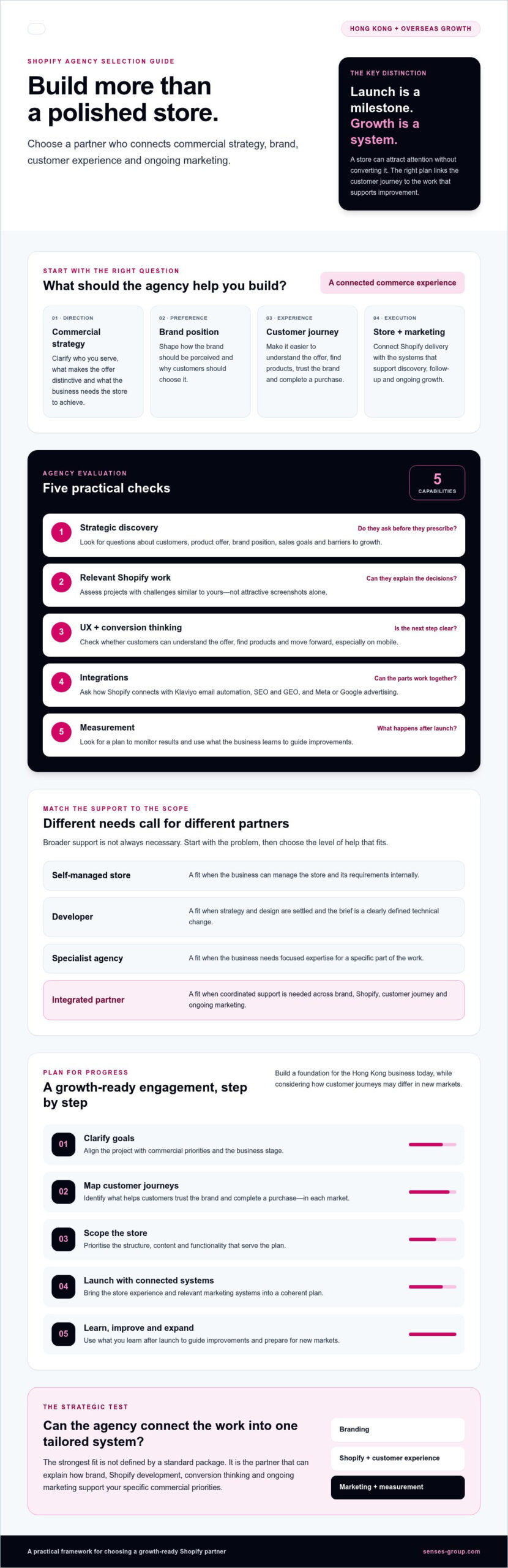
Plan a Shopify Agency Engagement for Hong Kong and Overseas Growth
A well-scoped Shopify project moves through a clear sequence: define the growth goal, understand the customer journey, agree on the store requirements, launch, then use what you learn to guide improvements. This keeps the build anchored to business priorities rather than allowing a list of features to become the strategy.
What should an agency discovery process establish?
Discovery should turn broad ambitions into decisions the team can act on. Align on the audiences you want to reach, the products that deserve priority, the brand position you want to strengthen, and the constraints shaping the project. Those constraints may include internal time, existing systems, content readiness, or the capacity to coordinate marketing and store operations.
Before development begins, agree who makes decisions, who supplies and approves content, which responsibilities sit with the agency, and how progress will be reviewed. Separate what the store needs at launch from improvements that can be tested later. That distinction helps protect essential priorities while keeping the initial scope manageable.
- Define the goal: State the business outcome the store should support and which products or audiences matter most.
- Map the journey: Identify what customers need to understand, trust, and do from discovery through purchase and follow-up.
- Scope the work: Prioritise essential store requirements, integrations, and launch content, then record later opportunities separately.
- Launch and learn: Review customer behaviour and business measures, then use the findings to guide optimisation.
How should the plan support expansion beyond Hong Kong?
Growth into new markets calls for more than making the same storefront visible to a new audience. Ask how product priorities, brand messaging, content, customer communication, and the shopping journey may need to adapt for each intended market. Clarify which channels will help customers discover the brand and how owned communication, such as email, can support the relationship after a visit. Integrated digital marketing planning can help show how paid and owned channels work together.
Readiness also depends on coordination beyond the website. Confirm that the business can support the customer experience it intends to offer, and identify who owns the decisions that affect fulfilment, customer enquiries, and ongoing store updates. Avoid assuming one market’s expectations or content will transfer unchanged to another.
Expansion planning starts with customer understanding and operational readiness, then shapes the store and marketing around the market you intend to serve. Consider how brand, Shopify, and marketing priorities can be aligned in a tailored plan.
How Senses Group Connects Branding, Shopify, and Marketing
Once you’ve clarified what your business needs from an agency, the next question is whether its capabilities connect into a plan. Senses Group is a branding and e-commerce agency founded in 2008. Its work brings together brand strategy and identity, Shopify development, and marketing, with the scope tailored to each business rather than built around a standard package.
What makes a connected agency engagement different?
A connected engagement starts with commercial goals and customer understanding. Those foundations can inform brand identity, the structure and experience of the Shopify store, and the channels used to attract and retain customers. The point isn’t to add every possible service. It’s to make sure the selected work supports a coherent customer journey.
Senses Group’s approach can be understood across three connected areas:
- Branding: Brand strategy and identity design establish how the business is positioned and expressed.
- High-converting website: Shopify store development turns that positioning into a customer-facing commerce experience, shaped around the store’s objectives.
- Marketing and sales funnel: Klaviyo email automation, SEO and AI Engine Optimisation, and Meta and Google advertising can connect discovery, customer communication, and ongoing engagement with the Shopify store.
Each capability should have a defined role. For one business, brand and store development may be the priority; another may already have a functioning Shopify store and need to strengthen acquisition or email communication. Senses Group develops custom solutions, so assess whether the proposed scope reflects your priorities, internal capacity, and intended markets. The agency reports managing more than $4 million in advertising spend; consider that experience alongside the specific process and responsibilities proposed for your project.
What should you bring to an initial agency conversation?
Come prepared to discuss where the business is going and what is getting in the way. A concise brief helps establish fit before anyone defines a scope of work:
- Your current business goals, store status, and the changes you hope to make.
- What you know about your customers, product priorities, and brand position.
- The obstacles affecting growth, such as conversion concerns, limited internal capacity, or an unclear route to customers in new markets.
- Your intended markets, existing marketing activity, and capabilities already available within the team.
Use the conversation to explore priorities, dependencies, and what should happen first. A good fit should be able to explain why certain work matters for your business and what can wait. That’s a stronger basis for choosing a Shopify agency Hong Kong businesses can rely on than selecting by service list alone.
Learn more about Senses Group’s Shopify and marketing services and consider how they fit the goals, customer journey, and capabilities your store needs next.
Build a Shopify Foundation for What Comes Next
The right Shopify agency Hong Kong businesses choose should fit the challenge in front of them and the growth they’re preparing for. Look beyond launch deliverables: assess strategic discovery, relevant Shopify experience, conversion thinking, integrations, and how the agency will measure and support improvement after the store goes live.
Choose the engagement model that matches your team’s capabilities. A developer may be enough for a defined technical task, while broader needs can call for coordination across brand, store experience, and marketing. Before committing, align on customer priorities, intended markets, responsibilities, and what success should mean for your business.
Senses Group has worked in branding and e-commerce since 2008, with more than 18 years of expertise as of 2026. Its Monchhichi Jewelry Atelier case reports that revenue doubled shortly after a new e-commerce system launched. This is a specific reported client outcome, not a promise of typical results.
Ready to connect your brand, Shopify store, and marketing priorities? Build your Shopify growth engine with Senses Group. Start with clear goals, a defined customer journey, and the capabilities your store needs next.
Frequently Asked Questions
What does a Shopify agency do?
A Shopify agency helps plan, build, and improve a Shopify commerce experience around business goals. Depending on the brief, its work may include brand strategy and identity, store structure and user experience, Shopify development, and connected marketing such as Klaviyo email automation, SEO and AI Engine Optimisation, or Meta and Google advertising. Before engaging an agency, clarify which disciplines are included, who owns each decision, and what support continues after launch.
How do I choose a Shopify agency in Hong Kong?
Choose a Shopify agency Hong Kong businesses can assess by looking for strategic fit, relevant work, and a clear delivery process. Ask how the agency researches your customers, approaches mobile usability and conversion, handles integrations, and measures progress. Request examples that show the problem addressed and the reasoning behind the solution. A credible proposal should connect specific deliverables to your business objectives, not rely on a portfolio or performance promises alone.
Should I hire a Shopify developer or an agency?
Hire a developer when you have a defined technical task and your brand strategy, design direction, and marketing plan are already established. An agency may be a better fit if several needs must be coordinated, such as store development, brand identity, and marketing integration. Compare the options against your internal capability and the problem to solve. Confirm who manages integrations, approvals, and post-launch improvements before deciding.
Can a Shopify agency help my business sell overseas?
Yes, an agency can help prepare the store and marketing for intended overseas audiences, but expansion requires more than making a website accessible abroad. Ask how customer research will inform product messaging, content, the shopping journey, and customer communication for each market. You’ll also need to coordinate the operational capabilities that support the experience you plan to offer. Avoid assuming that existing content or customer expectations will transfer unchanged.
What should a Shopify agency proposal include?
A useful proposal should define the business objectives, project scope, deliverables, responsibilities, decision-makers, milestones, and measures of progress. It should explain how the recommended work addresses your needs, including relevant Shopify development, user experience, integrations, or marketing capabilities. Ask the agency to distinguish essential launch requirements from later optimisation opportunities, and clarify what post-launch support covers. This makes it easier to compare proposals on value and fit, not feature lists alone.
Can an agency improve an existing Shopify store, or only build a new one?
An agency can assess and improve an existing Shopify store; a complete rebuild isn’t always necessary. The right starting point depends on the issue, whether that’s unclear brand messaging, difficult navigation, a weak customer journey, or marketing that isn’t connected to the store. Ask for a diagnosis before agreeing on major changes. A focused improvement plan may address the underlying problem more directly than replacing the entire experience.
Should Shopify development and marketing be handled by the same agency?
They can be handled by the same agency when your business needs coordinated decisions across the store and marketing. Shared planning can help align brand messaging, customer journeys, Shopify development, Klaviyo email automation, SEO and AI Engine Optimisation, or paid advertising. Separate specialists may suit a business with strong internal coordination and clearly divided responsibilities. Choose based on the capabilities you need and how effectively the work can be connected, not on the number of services offered.