
A polished Shopify store can still be the wrong investment. Choosing a Shopify development agency by portfolio alone may show you its design style, but not whether the team can connect your brand, customer journey and commercial goals. For SMEs and startups, that distinction matters: your store needs to serve customers in your home market while providing a sound foundation for overseas growth.
It’s reasonable to expect an agency to build a store that looks credible, works smoothly and reflects your brand. But launch is only the beginning. Conversion, customer retention and acquisition also depend on how the store connects with your wider marketing system, including email automation, SEO and paid advertising.
This guide will help you assess agencies against business objectives, not visuals alone. You’ll learn what to ask about strategic fit, conversion thinking and the systems that support growth after launch, as well as how to consider the added complexity of selling across markets. The aim is to choose a partner that builds more than a storefront: it builds a stronger platform for sustainable growth.
Key Takeaways
- Choose a Shopify development agency by how it connects strategy, customer experience and commercial goals, not by portfolio visuals alone.
- Assess an agency’s discovery, delivery and post-launch approach, and ask how its case studies document the challenge, contribution and outcome.
- Check how brand positioning informs store navigation, content hierarchy and product presentation, and how marketing supports growth after launch.
- Before expanding overseas, clarify your target customers, markets, offer and internal capabilities rather than assuming one storefront suits every audience.
- Look for a partner whose experience and integrated capabilities match your growth priorities, while treating past results as evidence, not a promise of future outcomes.
Why a Shopify Development Agency Should Build More Than a Storefront
A commerce website is not a growth strategy by itself. A Shopify development agency should translate business goals into a clear, usable shopping experience, then build a store the business can learn from and improve after launch. That means looking beyond the theme and asking how the store will express the brand, guide customers and support the business’s next stage.
Shopify is a commerce platform with an ecosystem that includes apps and other capabilities, as outlined in this neutral overview of the Shopify platform. The opportunity is not simply to assemble features. It is to make deliberate choices based on the business: who it serves, what customers need to understand before buying, and what the team can operate effectively.
A polished design may earn attention, but clarity builds confidence. Brand positioning should shape product presentation and content. The customer experience should make the path to purchase understandable, while marketing brings relevant audiences to the store and encourages ongoing relationships. If these elements are disconnected, a business may launch an attractive site without resolving the barriers that matter to its growth.
A successful launch is a foundation for testing, learning and refinement, not a guarantee of revenue. Results also depend on the offer, audience, execution and continued marketing. Set objectives and decide how you’ll assess progress before work begins.
What does a Shopify development agency actually do?
Core project work can include discovery, store structure, UX design, development, integrations, testing and launch planning. The agency should understand the business requirements before recommending a design or technical approach. For example, a business preparing to sell overseas should clarify its target customers, customer journey and operational capabilities before assuming a single store experience will suit every audience.
Marketing and ongoing optimisation are related to development, but they’re not automatically included. SEO, email automation, paid advertising and post-launch testing may be separate services or handled by the business’s internal team. Confirm responsibilities in writing: what will be delivered, what’s excluded, who supplies content, and what support is available after launch. Clear scope prevents assumptions from becoming project gaps.
When should an SME or startup bring in an agency?
Consider outside expertise when the current store no longer reflects the brand, customer needs are difficult to serve, requirements exceed the team’s technical capacity, or expansion calls for a more considered commerce experience. The right time depends on the gap, not a fixed stage of company growth.
Routine tasks such as updating product descriptions or publishing campaign content may be manageable internally when the team has the time and confidence. Bring in an agency when the work requires capabilities the business lacks or competes with higher-priority responsibilities. Weigh the project’s importance against available internal resources, then choose a scope that addresses the real need rather than adding complexity for its own sake.
How to Evaluate a Shopify Development Agency Before You Commit
A persuasive portfolio is a starting point, not proof of strategic fit. Assess how an agency approaches discovery, user experience, technical delivery, communication and post-launch support. If you plan to serve customers in different markets, ask how the team will turn their needs into clear store requirements rather than assuming one experience will work everywhere.
Compare proposals on equal terms. Give each agency the same project brief, then review the proposed scope, deliverables, assumptions, responsibilities and measures of success. Clarify how progress will be reported, who approves decisions, and how changes to scope will be discussed and documented. A proposal that explains its reasoning is more useful than one that relies on broad promises.
Questions to ask during an agency discovery call
Use the conversation to test how the team thinks, not just what it can build. Ask:
- How will you translate our business objectives into store requirements and customer journeys?
- Who is responsible for strategy, design, development, testing and launch coordination?
- What will be included at launch, and what would require separate ongoing work?
- How do you approach future changes, maintenance and performance review?
Listen for clear ownership and practical explanations. If the agency can’t connect your goals to its proposed work, ask for more detail before agreeing to a scope.
How to assess Shopify agency case studies
Relevant case studies should explain the business context, the challenge, the agency’s contribution and the documented outcome. Look for specifics about the work, and distinguish evidence from general capability statements. A Shopify development agency should be clear about what a past result does and doesn’t demonstrate. No case study can guarantee the same outcome for your business.
For example, Senses Group reports that Monchhichi Jewelry Atelier’s revenue doubled shortly after its ecommerce system launched. Treat this as a specific client result, not a forecast: your audience, offer, implementation and wider marketing conditions may differ. Ask agencies how they define and substantiate outcomes, and whether an example reflects work relevant to your priorities.
Finally, check whether the partner’s capabilities align with the work you need. If brand strategy, Shopify development and digital marketing need to connect, review Senses Group’s Shopify and growth capabilities as one reference point while comparing shortlisted agencies against the same criteria.
Shopify Development Scope: Brand, UX, CRO, and Marketing Integration
A well-scoped project connects the store’s foundations to its growth priorities. Brand positioning should shape more than colours and imagery: it can guide navigation, establish the order of information, and help customers understand why a product suits them. Product pages, collection structure and supporting content should make evaluation easier, whether customers arrive through search or advertising.
Use a scope comparison to distinguish what’s being built from the strategy and ongoing work that support it. A Shopify development agency should clarify which capabilities are included, which are separate, and who owns each part.
| Area | Typical scope | Questions to confirm |
|---|---|---|
| Development deliverables | Discovery, information architecture, UX, development, integrations, quality assurance and launch support | Are content entry, migration, team training and ongoing maintenance included or separately scoped? |
| Strategic inputs | Brand positioning, customer priorities, product hierarchy and the intended buying journey | How will these inputs shape navigation, messaging and product presentation? |
| Ongoing growth services | Conversion rate optimisation (CRO), Klaviyo email automation, SEO and GEO, and Meta or Google advertising | Which services are available, who will deliver them, and what does each involve? |
Which Shopify development services belong in the project scope?
Agree on the core delivery before work begins, then document assumptions and responsibilities. Ask the agency to explain the platform plan and feature requirements it recommends for your needs, and confirm those requirements directly with the agency. The right scope depends on your store’s objectives and capabilities, not a generic checklist.
UX and CRO should address avoidable friction in the buying journey. Clear categories, useful product information and a coherent route from discovery to checkout can make decisions easier. They can’t guarantee a particular conversion result, but they create a stronger basis for observing customer behaviour and refining the experience.
How should a Shopify store connect with marketing?
Marketing brings people to the store; the store must carry the same promise through product evaluation. Consistent messaging between an advertisement, search result, landing page and product page helps customers recognise the offer and assess it with confidence. For relevant context, readers can refer to a strategic Shopify guide for SMEs and explore integrated digital marketing solutions as connected but distinct topics.
Klaviyo flows can support retention through planned customer communications, but setup, content, triggers and ongoing management should be confirmed in scope. SEO and GEO, advertising, and email automation are not automatic parts of Shopify development. Treat each as a deliberate capability with clear ownership, so the store and its marketing work toward the same commercial priorities.
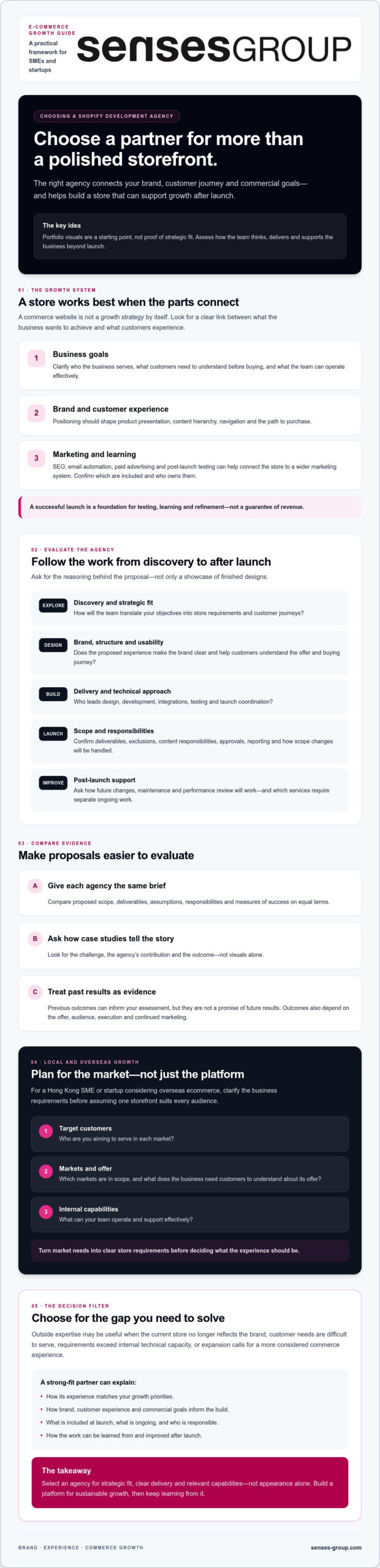
Choosing a Shopify Agency for Local and Overseas Ecommerce Growth
Expansion is not a matter of copying a storefront into another market. Customer expectations, buying questions and responses to a brand can differ, so the store and its campaigns need to reflect the audiences you intend to reach. A Shopify development agency should help turn those ambitions into a considered scope, while distinguishing what it can deliver from questions that require other expertise.
Before approaching agencies, work through this readiness sequence:
- Define target customers. Identify who the store serves and what they need to understand before purchasing.
- Select priority markets. Name the initial markets you want to explore, rather than treating overseas growth as one uniform audience.
- Clarify the offer. Document the product range and the value customers should recognise.
- Assess your capabilities. Note available team capacity, content and operational constraints that may shape the customer experience.
- Set agency requirements. Separate the capabilities you need from the outcomes you hope to pursue, and ask how each recommendation will be evaluated.
What should a growth-ready Shopify brief include?
Give agencies a useful foundation: your business model, customer segments, product range, current priorities and known constraints. State which markets are under consideration and list the customer experience questions that still need research. For example, you may need to learn what information customers require to compare products or what content will make the brand’s value clear to a new audience.
Then divide requirements into launch essentials and later improvements. This keeps the first phase realistic without losing sight of future needs. A clear brief helps an agency explain what belongs in the initial scope, what depends on further research and what can wait until the business has learned from its first-stage experience.
How can an agency support expansion without overpromising?
Ask how research will inform market-specific content, user experience and campaign planning. A sound recommendation should connect an identified customer or business need to proposed work, explain what evidence supports the approach, and define how progress will be assessed. Be cautious of assurances that one storefront or campaign will perform equally well across audiences.
Confirm responsibilities early. Brand strategy, Shopify development, SEO and GEO, Klaviyo automation and paid advertising may be relevant capabilities, but they aren’t automatically part of every project. Ask which work the agency will deliver and which questions require other specialist providers. Evaluate the proposed scope against your objectives and team capacity, not ambition alone.
If you’re preparing to expand, explore Shopify and growth support as you shape a market-specific brief and assess which capabilities your business needs.
When Senses Group Is the Right Shopify Development Agency Partner
Senses Group may suit SMEs and startups that want brand strategy, Shopify development and digital marketing to work as a connected system. That can be valuable when the challenge isn’t simply launching a store, but building a coherent customer experience and connecting it with activity that supports growth in the home market and overseas.
The fit depends on your priorities. Businesses looking for a custom-crafted strategic partner, rather than a universal package or a template-only build, may value an approach that considers brand foundations alongside the ecommerce experience. Senses Group’s capabilities include brand strategy and identity design, Shopify stores, Klaviyo email automation, SEO and AI Engine Optimisation, and Meta and Google advertising. Confirm which capabilities belong in your project scope and which are separate engagements.
How Senses Group connects brand strategy with Shopify development
Brand foundations help define what the store needs to communicate. Shopify development turns that direction into a customer-facing experience, while marketing funnels can connect the storefront with wider marketing activity. When these elements are planned together, the brand promise can carry consistently from discovery through product evaluation and follow-up.
Senses Group reports that, since 2018, it has built and scaled a multimillion-dollar home-family product brand from zero. That experience offers relevant context for businesses considering a longer growth journey. It is evidence of past work, not a guarantee that another business will achieve the same outcome. Your results will depend on your own audience, offer, resources and execution.
What to prepare before speaking with an agency
A focused first conversation starts with clear inputs. Bring your business goals, current store challenges, target customers and expansion priorities. Note known platform and content requirements, integrations to consider, and the internal capacity available to make decisions and manage work. You don’t need every answer. Distinguish what’s known from what needs investigation.
Ask for a recommendation that connects proposed work to your priorities. It should make scope, responsibilities, assumptions and success measures clear, including what is not included. This gives both sides a practical basis for deciding whether the partnership fits your stage of growth.
If an integrated approach matches what your business needs, discuss your Shopify growth requirements with Senses Group.
Build Your Next Stage of Ecommerce Growth
The right Shopify development agency should do more than deliver a polished storefront. It should connect your business goals with brand, customer experience and the marketing capabilities needed to support growth. If you’re considering overseas expansion, choose a partner who will help clarify market priorities and scope the work around your actual capabilities, rather than assume one store or campaign fits every audience.
Compare agencies on strategic fit, delivery responsibilities, relevant case evidence and the plan for learning after launch. Senses Group, founded in 2008, reports more than 18 years of expertise as of 2026 and has managed more than $4 million in advertising spend. It also reports that Monchhichi Jewelry Atelier’s revenue doubled shortly after its ecommerce system launched. These are examples of experience, not guarantees of future results.
If an integrated approach to branding, Shopify development and marketing aligns with your priorities, discuss your Shopify growth requirements with Senses Group. Start with clear goals, ask focused questions and build a foundation you can keep improving.
Frequently Asked Questions
What does a Shopify development agency do?
A Shopify development agency plans and builds an ecommerce experience around a business’s goals. Work may include discovery, store structure, user experience, development, integrations, testing and launch planning. Some agencies also offer brand strategy, email automation, SEO and advertising, but these aren’t automatically included in a store build. Confirm the deliverables, responsibilities and post-launch arrangements in writing so you know what the agency will handle and what remains with your team.
How do I choose a Shopify development agency?
Choose a Shopify development agency by assessing how well it understands your objectives, not just how attractive its portfolio looks. Ask how it translates business needs into customer journeys, what each team member owns, and how it reports progress or handles scope changes. Review case studies for the business challenge, agency contribution and documented outcome. Compare proposals against the same requirements, including deliverables, assumptions, responsibilities and success measures.
How much does it cost to hire a Shopify development agency?
The cost depends on the project’s scope, requirements and included services, so ask shortlisted agencies for proposals based on the same brief. Check whether the work covers discovery, design, development, integrations, content entry, migration, testing and launch support. Also ask which platform plan, app costs or ongoing marketing services are separate. There’s no reliable single price for every business; compare the work and assumptions behind each proposal, not only the quoted total.
Can a Shopify agency help my business expand overseas?
Yes, an agency can help shape the store and marketing around the markets you plan to explore. Ask how it will research customer needs and inform market-specific content, user experience and campaign planning. Don’t assume one storefront or campaign will suit every audience. Clarify which work the agency provides and which questions require other specialists, then prioritise markets and launch requirements according to your business goals and internal capabilities.
Should I hire a Shopify agency or an in-house developer?
Choose based on the capabilities and capacity your business needs. An in-house developer may suit ongoing technical work when you can support the role and manage priorities internally. An agency can bring a defined range of expertise for a project, such as strategy, UX and Shopify development, without requiring your team to cover every discipline. Some businesses use both: an agency for a scoped build and internal staff for routine store updates.
Does a Shopify development agency also provide marketing after launch?
Some agencies provide marketing, but don’t assume it’s part of Shopify development. Confirm whether services such as Klaviyo email automation, SEO and AI Engine Optimisation, or Meta and Google advertising are included, offered separately or outside the agency’s scope. Ask who will manage each activity, what the work involves and how progress will be assessed. Planning these responsibilities before launch can help connect the store with customer acquisition and retention activity.
What should a Shopify development proposal include?
A useful proposal sets out the project objectives, scope, deliverables, timeline assumptions, responsibilities and exclusions. It should clarify what the client must provide, which integrations or features are included, and how testing, launch coordination and post-launch support will be handled. Ask how progress is reported and how changes are reviewed. The proposal should also explain how success will be assessed, without presenting projected performance as a guaranteed result.