
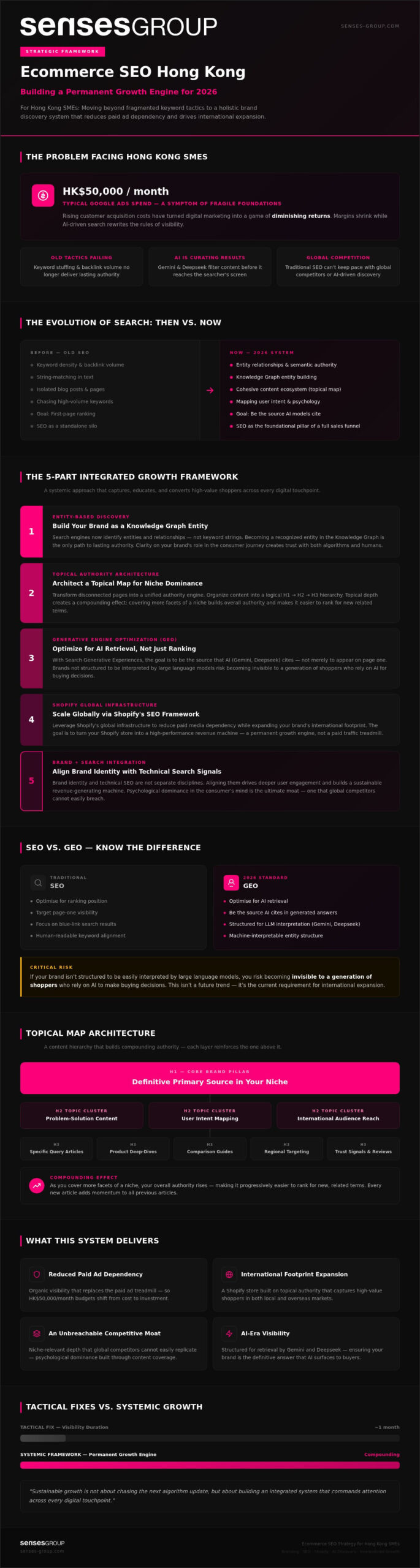
What if the HK$50,000 your business allocates to Google Ads every month is actually a symptom of a fragile foundation? For many Hong Kong SMEs, the rising cost of customer acquisition has turned digital marketing into a game of diminishing returns. You’ve likely noticed that traditional ecommerce SEO Hong Kong strategies are no longer enough to keep pace with global competitors or the rapid shift toward AI-driven search. It’s frustrating to watch your margins shrink while trying to decode how engines like Deepseek or Gemini are reshaping the way customers find your products.
We understand that the transition from standard search results to generative AI discovery feels like moving targets in a storm. This article provides the strategic framework you need to move beyond reactive tactics and build a permanent growth engine. Sustainable growth is not about chasing the next algorithm update, but about building an integrated system that commands attention across every digital touchpoint. You’ll learn how to secure top rankings in both Google and the new AI generative engines, reducing your reliance on paid ads while expanding your brand’s international footprint. We’ll break down the shift from keyword-stuffing to systemic brand authority, ensuring your Shopify store becomes a high-performance revenue machine by 2026.
Key Takeaways
- Understand why you shouldn’t rely on fragmented keyword tactics and instead build a holistic system for brand discovery in 2026.
- Learn to architect a topical map that establishes niche dominance and builds systemic trust with modern search algorithms.
- Master Generative Engine Optimization (GEO) to ensure your brand is cited as a primary source by AI models like Gemini and Deepseek.
- Implement a framework for ecommerce SEO Hong Kong that leverages Shopify’s global infrastructure so you don’t have to overspend on paid media.
- Align your brand identity with technical search signals to drive deeper user engagement and build a sustainable revenue-generating machine.
The Evolution of Ecommerce SEO in 2026
The traditional view of search engine optimization has long been reduced to a series of technical maneuvers. You’ve likely been told that ranking is a matter of keyword density or backlink volume. By 2026, this perspective is not just incomplete; it’s commercially dangerous. For a business looking to scale, ecommerce SEO Hong Kong must be viewed as a holistic discovery system that spans every digital touchpoint where a customer might encounter your brand. It’s the difference between a temporary spike in traffic and a permanent growth engine. Tactical fixes might offer a month of visibility, but a systemic framework ensures your products are found wherever intent is expressed. Search is no longer a standalone silo. It is the foundational pillar of an integrated sales funnel that captures, educates, and converts high-value shoppers.
From Keywords to Entities: The Semantic Shift
Search engines have evolved from simple indexers to sophisticated semantic engines. They no longer search for strings of text; they search for entities and the relationships between them. This shift means building your brand as a recognized entity in the Knowledge Graph is the only way to achieve lasting authority. Mapping user intent has become far more valuable than chasing high-volume keywords that don’t convert. When you align your content with the specific psychological needs of your audience, you signal to algorithms that your brand is the definitive solution in its niche. It’s not about how many times you say a word, but how clearly you define your brand’s role in the consumer’s journey. This clarity creates a sense of trust that influences both machines and humans alike.
The Role of AI in Modern Search Discovery
AI now acts as a high-level filter, curating information before it ever reaches the searcher’s screen. With the rise of Search Generative Experiences, the goal isn’t just to be on the first page; it’s to be the source that the AI cites. For Hong Kong SMEs, remaining visible in this curated landscape requires a radical shift in strategy. You must optimize for retrieval, not just ranking. If your brand isn’t structured to be easily interpreted by large language models, you risk becoming invisible to a generation of shoppers who rely on AI to make buying decisions. This isn’t a future trend; it’s the current requirement for anyone serious about international expansion. Adapting to this curated landscape is the only way to maintain a competitive edge in a global market.
Architecting a Topical Map: The Foundation of Search Authority
Establishing niche dominance is not a result of chance. It is the outcome of a deliberate architectural process. A topical map serves as the blueprint for this dominance, transforming a collection of disconnected pages into a unified authority engine. For brands pursuing ecommerce SEO Hong Kong, this means moving away from isolated blog posts toward a cohesive content ecosystem. This systemic approach builds trust with both users and algorithms by demonstrating a mastery of the subject matter. When search engines recognize that you provide exhaustive answers to a user’s query, they reward you with sustainable organic growth. Topical depth creates a compounding effect; as you cover more facets of a niche, your overall authority rises, making it easier to rank for new, related terms. Our agency specializes in creating these AI-enhanced content ecosystems for retailers, ensuring that every piece of information serves a specific commercial purpose.
Building Content Pillars for Consumer Brands
Consumer brands must identify the specific problems their products solve for international audiences. This is the root of your pillar strategy. Once these problems are identified, the information must be organized into a logical hierarchy using H1, H2, and H3 tags. This structure helps search engines understand the relationship between different topics on your site. It creates a chain of cause-and-effect where a well-optimized H3 supports an H2, which in turn strengthens the H1 pillar. Topical authority is the cumulative weight of niche-relevant content that establishes your brand as a definitive primary source. By providing depth across a spectrum of related queries, you build a moat around your brand that global competitors cannot easily breach. This isn’t just about visibility; it is about psychological dominance in the consumer’s mind.
Technical SEO as a Performance Enabler
Authority requires a high-performance foundation. Technical SEO is the enabler that allows your content to reach its full potential. For high-converting Shopify stores, site-speed optimization is a critical requirement. Slow load times don’t just frustrate users; they signal poor quality to search engines. According to recent ecommerce retail growth statistics, the competition for digital attention is intensifying, making every millisecond of performance vital for retention. Beyond speed, you must implement LLM-optimized metadata. This helps AI engines categorize your brand accurately, ensuring you appear in generative search results. For Hong Kong entrepreneurs, mobile-first design is a non-negotiable standard. If your mobile experience is secondary, your brand is effectively invisible to the majority of the market. If you are looking to build a more resilient digital presence, a strategic SEO & AI Engine Optimisation plan is the first step toward long-term stability.
SEO vs. GEO: Navigating the Shift to Generative Engine Optimization
The shift from traditional search to AI-driven discovery is not a mere trend. It’s a fundamental restructuring of how consumers interact with information. Generative Engine Optimization (GEO) has emerged as the necessary evolution of ecommerce SEO Hong Kong, focusing on how Large Language Models (LLMs) like Deepseek, Gemini, and ChatGPT retrieve and synthesize brand data. These engines don’t just list websites; they provide answers. If your brand isn’t structured to be cited within these answers, you’re effectively excluded from a significant portion of the modern buyer’s journey. This isn’t the death of search. It’s the professionalization of brand authority within the ecommerce SEO Hong Kong ecosystem.
The “citation game” is the new battlefield for retailers. When an AI model recommends a product, it relies on a specific set of trust signals and structured data points. Your goal is to ensure your brand is the recommended solution, not just another entry in a database. According to global ecommerce market statistics, the digital economy continues to expand at a rate that demands more sophisticated discovery methods. To capture this growth, you must move beyond simple ranking and start building systemic relevance that AI engines can’t ignore. It’s about becoming a verified source of truth in a sea of unorganized data.
Optimizing for Large Language Models (LLMs)
Appearing in AI-generated summaries requires a technical and content-led approach. Structured data, or Schema, acts as the primary language for AI engines, helping them parse product facts, prices, and availability with precision. Without robust Schema, your brand is just a collection of pixels. You should also leverage AI-driven visual production to capture traffic on lifestyle platforms where visual search is dominant. This ensures your products are recognizable to both human eyes and machine vision algorithms, creating a multi-dimensional presence that drives conversions. It’s not enough to be searchable; you must be interpretable.
The Trust Factor: Building Brand Citations
High-quality backlinks have evolved. They’re no longer just bridges between sites; they’re trust signals that validate your brand’s authority to AI engines. Digital PR and influencer networks play a crucial role in generating natural brand mentions that LLMs use to determine credibility. At Senses Group, we utilize a global influencer network to fuel our ‘Follower Growth Engine,’ creating a cycle of authentic engagement that signals authority to search engines and AI models alike. This systemic approach ensures your brand is not just seen, but respected and cited by the engines that now gatekeep the global consumer market. Trust is the currency of the AI era.
Scaling Globally: A Strategic SEO Framework for Shopify Merchants
Expanding into Western markets is a commercial necessity for brands that have outgrown the local landscape. It requires a systemic approach to ecommerce SEO Hong Kong that accounts for different cultural search behaviors and technical requirements. Shopify’s infrastructure is uniquely positioned to handle this complexity, but it’s only as effective as the strategy behind it. Before you launch, you must develop a comprehensive Marketing Map to ensure every dollar of effort aligns with your commercial goals. This prevents the common mistake of entering new territories with a fragmented digital presence. For a deeper dive into these technical foundations, explore our 2026 Strategic Shopify Guide for Hong Kong SMEs. By lowering customer acquisition costs through organic search, you build a resilient business model that isn’t at the mercy of rising ad prices.
Step 1: International Keyword and Intent Research
Analyzing search behavior in target Western markets reveals nuances that a local perspective might miss. For example, while a Hong Kong audience might focus on specific brand names, a US-based consumer might search for broader lifestyle solutions. Identifying these low-hanging fruit where global giants have neglected content depth allows you to capture market share quickly. Mapping these keywords to the specific stages of the international buyer’s journey ensures you’re present from initial discovery to the final transaction. It’s about understanding the psychological root of the search, not just the string of text itself.
Step 2: Shopify Optimization for Scale
Shopify’s native tools for internationalization are powerful, but they require careful configuration. Managing multi-currency and multi-language SEO requires precise implementation to avoid ranking cannibalization across different regions. Beyond technical settings, your product pages must bridge the gap between organic visibility and persuasive brand storytelling. Integrating Klaviyo email automation ensures that the traffic you gain through SEO is nurtured into repeat customers, reinforcing your organic gains through systemic retention. This creates a chain of cause-and-effect that maximizes the value of every visitor.
Step 3: Measuring Growth with Data-Driven Metrics
Success is measured by sustainable profit margins, not just vanity rankings. You must move beyond simple traffic reports to track organic revenue and the lifetime value of customers acquired through search. Use AI-driven analytics to determine which content pillars drive the highest average order value. This data-driven approach transforms your site into a high-performance revenue-generating machine. When your decisions are rooted in hard data, your growth becomes predictable and scalable.
If you’re ready to scale your brand globally, our team can help you build a high-performance Ecommerce Shopify Store that dominates search results.
Integrating Search with Brand Strategy for Sustainable Profit
Technical performance and topical depth are the engines of visibility, but they cannot compensate for a weak brand foundation. Many businesses treat search as a technical silo, yet the reality is that ecommerce SEO Hong Kong fails when the underlying brand strategy is inconsistent. If your brand does not possess a clear identity, your search traffic will remain a vanity metric rather than a commercial asset. We don’t view SEO as an isolated tactic; we see it as the digital expression of your brand’s authority. A site that ranks but fails to resonate will always suffer from high bounce rates and low conversion. True growth is found at the intersection of search intent and brand trust.
The ROI of Premium Brand Design in Search
User engagement signals like dwell time and click-through rates are now primary ranking factors. A professional visual identity is not a luxury, but a strategic necessity that increases trust and reduces immediate exits. When a user lands on a site that lacks a cohesive story, they don’t just leave; they form a permanent association between your brand and a lack of professionalism. This is why lifestyle-oriented imagery with specific pink brand accents consistently outperforms generic stock photos. Authentic visuals create an emotional connection that keeps users on the page longer, signaling to search engines that your content is valuable. For a comprehensive look at how aesthetics drive commercial outcomes, see our Mastering Retail Brand Identity: 2026 Digital Guide. High-quality design is the silent closer of every search-driven interaction.
Building a Long-Term Sustainable Growth Engine
Sustainable profit requires a balanced, risk-mitigated marketing mix. Relying solely on one channel is a vulnerability, which is why we combine SEO, GEO, and strategic paid advertising into a single, unified system. Our approach utilizes the Bespoke Sales Atom to capture and convert search intent with surgical precision. This system ensures that your brand is not just a participant in the market, but a dominant player across all digital touchpoints. Partnering with a strategic agency allows you to transition from a local SME to a global competitor by building systems that scale. It’s about moving from a state of frantic acquisition to one of seasoned, predictable growth. When your search strategy is rooted in a deep understanding of brand psychology, your website becomes a permanent revenue-generating machine.
Dominating the Future of Digital Commerce
The transition from reactive keyword targeting to proactive entity building is the only path to sustainable profit in a generative search era. By 2026, your brand’s visibility will depend on its ability to serve as a primary source for both human shoppers and AI algorithms. Implementing a systemic ecommerce SEO Hong Kong framework ensures your business moves beyond the cycle of rising ad costs and into a state of predictable, global growth. It’s about building a foundation that converts intent into long-term loyalty through sophisticated content and technical precision.
Success in this landscape requires a partner who understands the deeper mechanics of commercial scaling. With 18+ years of strategic expertise and over HK$31 million in managed advertising spend, we’ve delivered results for global leaders like Sony and Panasonic. We don’t just build websites; we engineer revenue-generating machines that stand the test of time. Let’s Build Your Growth Engine – Partner with Senses Group. Your journey to international dominance starts with a single, strategic decision.
Frequently Asked Questions
What is the difference between traditional SEO and AI-driven GEO?
Traditional SEO focuses on achieving high rankings within standard search engine results pages. In contrast, Generative Engine Optimization (GEO) prioritizes being cited and recommended by AI models like Gemini and Deepseek. While SEO targets visibility, GEO targets retrieval. You must structure your brand as a primary source of truth so that Large Language Models synthesize your data into their answers. This shift represents the next generation of ecommerce SEO Hong Kong strategies.
How long does it take for a Hong Kong SME to see results from a strategic SEO campaign?
Most Hong Kong SMEs begin to see measurable shifts in organic traffic and engagement within three to six months. However, building a permanent growth engine that reduces your reliance on paid ads typically requires a six to twelve month horizon. This timeline allows for the accumulation of topical authority and the establishment of trust signals. Results are cumulative; the foundation you build today creates a compounding return on your investment.
Can Shopify handle the SEO requirements for a global ecommerce brand?
Shopify is a high-performance platform capable of supporting the most complex international SEO requirements. It offers robust tools for managing multi-currency transactions and multi-language content without cannibalizing your existing rankings. When paired with a strategic Marketing Map, Shopify becomes a revenue-generating machine. The key is in the technical execution, such as implementing LLM-optimized metadata and ensuring site-speed optimization meets the rigorous standards of global markets.
Is it better to focus on Google Ads or SEO when scaling a new consumer brand?
A balanced marketing mix is the most risk-mitigated approach to scaling. Google Ads provides immediate visibility and cash flow during the launch phase, while SEO builds the long-term equity needed for sustainable profit. Relying solely on paid media creates a fragile business model vulnerable to rising costs. By integrating both, you capture immediate demand while simultaneously constructing an organic engine that lowers your average customer acquisition costs over time.
How does brand strategy impact my website’s search engine rankings?
Brand strategy is the root of all high-performance search signals. A clear brand identity design influences user engagement metrics like dwell time and click-through rates, which search engines use to determine your relevance. If your brand story is weak, users will bounce, signaling to algorithms that your site is not a quality destination. Strategy ensures that the traffic you earn through ecommerce SEO Hong Kong actually converts into loyal, repeat customers.
What are the most common SEO mistakes Hong Kong businesses make when expanding overseas?
The most frequent error is assuming that local search behavior translates directly to international markets. Many businesses fail to account for cultural nuances in intent or ignore the technical requirements of multi-regional URL structures. Another common pitfall is treating SEO as a technical silo rather than an extension of brand strategy. Without a cohesive content ecosystem that addresses the specific problems of a global audience, your expansion efforts will likely struggle to gain traction.
How do I optimize my Shopify store for AI search engines like ChatGPT and Gemini?
Optimization for AI search requires a shift toward structured data and authoritative citations. You must implement robust Schema markup to help AI engines parse your product facts with precision. Additionally, your content must be architected into a topical map that establishes your brand as a definitive source in your niche. Building natural brand mentions through digital PR and global influencer networks also provides the trust signals that LLMs use to recommend your products.
Why is topical authority more important than individual keyword rankings in 2026?
Search engines now prioritize entities and the depth of your niche expertise over simple strings of text. Ranking for a single keyword is a tactical win, but topical authority is a strategic victory. By covering every facet of a specific subject, you demonstrate systemic mastery that algorithms reward with higher visibility across a broad spectrum of related queries. This approach creates a more resilient presence that is less susceptible to individual algorithm updates or competitive shifts.