
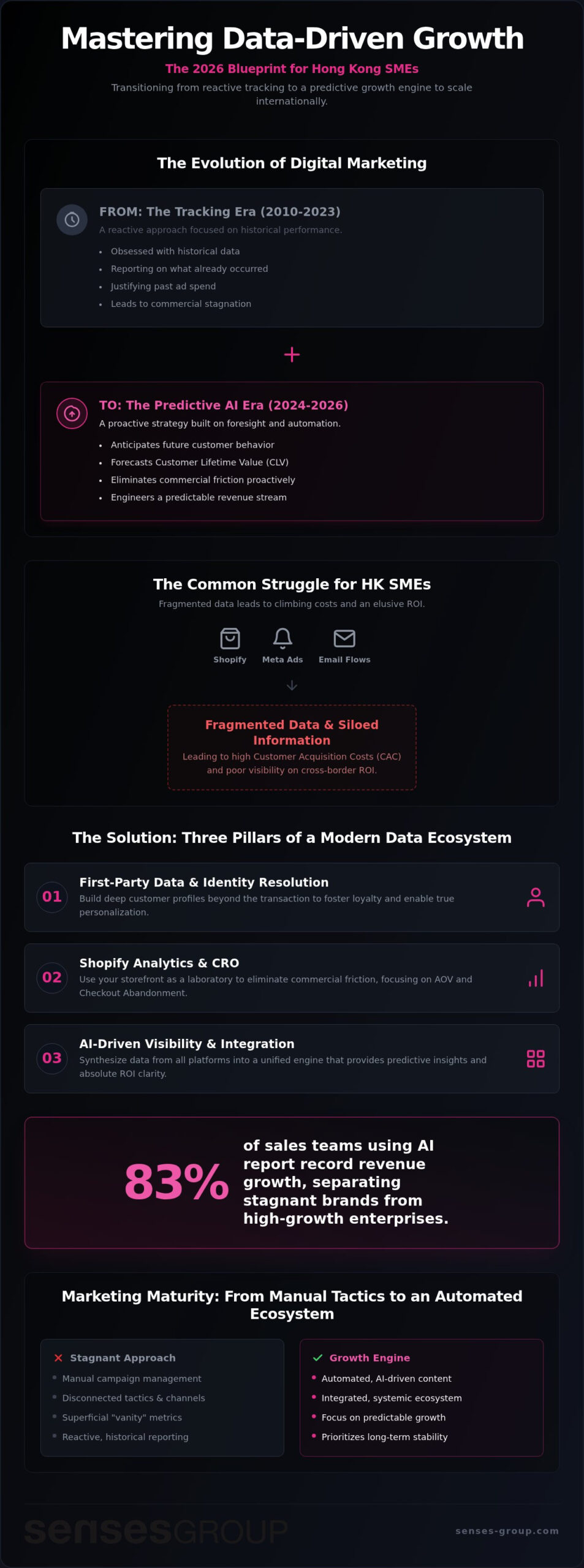
Why are your customer acquisition costs in Hong Kong still climbing when 83% of sales teams using AI report record revenue growth? You’ve likely felt the exhaustion of managing fragmented data across Shopify, Meta Ads, and email flows, only to find your ROI remains an elusive target. It’s a common struggle for brands trying to interpret the shift toward Generative Engine Optimization (GEO) in a market that demands both local precision and global reach. We understand that the pressure to scale often clashes with the reality of siloed information. Data is the foundation.
This article provides the blueprint to master data driven digital marketing by transitioning your operations from reactive tracking to predictive growth. You’ll learn to build a scalable sales funnel that leverages AI-enhanced strategies to eliminate commercial friction and lower your CAC. We’ll breakdown the strategic framework for 2026, moving from foundational brand identity to the functional deployment of an integrated content ecosystem that ensures long-term stability. This is not just about collecting numbers, but about building an integrated growth engine that predicts revenue instead of just reporting it.
Key Takeaways
- Understand the definitive shift from historical tracking to predictive AI, a transition that separates stagnant brands from those achieving commercial growth in 2026.
- Learn how to unify fragmented data across Shopify and Meta into the “Bespoke Sales Atom” framework to gain absolute visibility into your cross-border ROI.
- Discover the “not this, but that” approach to marketing maturity, moving away from manual campaign management toward automated, AI-driven content ecosystems.
- Follow a structured 5-step roadmap designed for the Hong Kong business ecosystem to transform traditional models into robust, international e-commerce engines.
- Establish a foundation for data driven digital marketing that prioritizes systemic integration and long-term stability over superficial metrics and disconnected tactics.
The Evolution of Data-Driven Digital Marketing in 2026
In 2026, data driven digital marketing is no longer a peripheral tactical advantage; it’s the central nervous system of any scalable enterprise. It represents a systemic approach to commercial growth where every decision is rooted in verifiable logic rather than creative intuition. Data-driven marketing is the systemic integration of foundational brand strategy and granular behavioral analytics. This synergy ensures that while numbers drive the direction, the brand identity provides the momentum. For the modern business owner, this is the difference between guessing at market trends and engineering a predictable revenue stream.
The “tracking era” (2010 to 2023) was characterized by a reactive obsession with historical performance. Marketers looked backward to justify spend, often trapped in a cycle of reporting on what had already occurred. Today, the “predictive AI era” (2024 to 2026) demands foresight. It is not enough to know what happened yesterday; you must anticipate what your customer will do tomorrow. Within the broader context of digital marketing, this shift enables businesses to eliminate commercial friction before it impacts the bottom line. It’s not about more data, but about better insights that lead to decisive action.
From Reactive Reporting to Predictive Insights
Looking at past metrics is a recipe for stagnation. High-growth brands now utilize AI to forecast customer lifetime value (CLV) with surgical precision, allowing for aggressive yet safe acquisition strategies. This predictive capability identifies specific friction points within the Shopify sales funnel, such as abandoned carts triggered by technical latency or misaligned messaging. When 83% of sales teams that have adopted AI see revenue growth, the cost of sticking to manual, reactive reporting becomes an unsustainable burden on your margins. Predictive insights allow you to scale your ad spend with the confidence that the return is already mathematically probable.
The Hong Kong Market: A Gateway for Data-Led Expansion
Hong Kong SMEs face a uniquely hyper-competitive landscape where customer acquisition costs are among the highest globally. To survive, local businesses must use their domestic data as a laboratory for international market entry. A robust e-commerce presence isn’t built on luck; it’s built on a foundation where branding informs the data and data validates the brand. Leveraging local behavioral data allows you to refine your “Bespoke Sales Atom” before introducing it to foreign markets. This strategic approach ensures that when you scale from Hong Kong to the world, your brand identity remains resilient and your growth remains disciplined.
The Three Pillars of a Modern Data Ecosystem
A sustainable ecosystem requires three distinct yet interconnected pillars. These components form the structural integrity of the “Bespoke Sales Atom,” ensuring that your brand identity isn’t just a visual asset but a performance driver. Data driven digital marketing in 2026 functions through the systemic synthesis of owned data, platform performance, and AI-driven visibility. It’s not about isolated tactics, but about a unified engine where each pillar reinforces the others to lower customer acquisition costs. When these foundations are secure, your business moves from chasing trends to commanding market share.
First-Party Data and Identity Resolution
The era of third-party cookies has ended. Brands that rely on external signals are building on sand. You must prioritize identity resolution through first-party data. By utilizing Klaviyo, you can build deep customer profiles that extend beyond the immediate transaction. Your brand strategy should dictate which data points matter. It’s not about tracking every click; it’s about identifying the psychological triggers that lead to loyalty. This shifts the focus from generic audiences to individual relationships, allowing for a level of personalization that traditional models can’t match. It’s the difference between shouting into a void and engaging in a meaningful, revenue-generating dialogue.
Shopify Analytics and Conversion Rate Optimization (CRO)
Your storefront is a laboratory for behavioral science. Building a high converting Shopify store requires more than a clean design; it requires a data-led feedback loop that eliminates commercial friction. We focus on Average Order Value (AOV) and Checkout Abandonment as the primary indicators of system health. High abandonment isn’t just a technical failure; it’s often a failure of trust or clarity in the UX design. When your visual identity aligns with performance data, you create a seamless path to purchase that works for both local and international markets, turning visitors into long-term assets. A structured approach to ecommerce conversion rate optimization ensures every element of your storefront is engineered to convert interest into measurable revenue.
GEO: Generative Engine Optimization for 2026
Search has evolved into a conversation. Traditional keyword targeting is being superseded by AI search engine optimization, where visibility is determined by how AI LLMs interpret your brand’s authority. Effective search engine optimization for brands now requires a comprehensive topical map system rather than a list of disconnected keywords. This ensures your brand is the definitive answer provided by ChatGPT or Gemini. AI visual production and search visibility must work in synergy to capture attention in an era where AI summarizes the web. If you’re ready to integrate these pillars into a unified growth engine, our team can help you refine your strategic framework for the 2026 landscape.
Traditional vs. AI-Enhanced Data Strategies
Evaluating your marketing maturity is the first step toward systemic growth. Many businesses remain trapped in the “Manual” stage, where data is collected but rarely utilized to predict behavior. High-performance data driven digital marketing requires a shift from manual campaigns to automated flows. It’s not about sending more emails; it’s about sending the right email at the exact moment of intent. This transition moves your team from tactical execution to strategic oversight. You can leverage AI-driven scheduling to ensure your brand remains visible without constant manual intervention. Performance-based affiliate models further enhance this by aligning your growth with verifiable data outcomes. Every dollar spent must be a dollar that performs.
Manual Segmentation vs. AI Behavioral Flows
Static email lists are failing in 2026. They lack the real-time context necessary to convert a modern consumer. Implementing behavior-based triggers in Klaviyo ensures your messaging is always relevant. It’s not a broadcast; it’s a response. Monchhichi Jewelry Atelier provides a definitive example of this shift. By moving away from manual segmentation and embracing automated behavioral flows, they doubled their revenue. This was not a creative accident. It was the result of a disciplined, data-led system that recognized customer intent and acted on it instantly. Automation allows you to scale the human element of your brand without increasing your headcount.
SEO vs. GEO: The New Search Paradigm
Traditional keyword density is a relic. In the predictive era, you must optimize metadata for Large Language Models (LLMs) to ensure your brand is cited by AI agents. This is the new frontier of data driven digital marketing. A content pillar strategy is the foundation of this authority. It builds the topical map that AI engines use to categorize your expertise. This systemic approach extends to social media. By using AI-automated social pillars, you can build a 100k follower growth engine that maintains consistency across international markets. Your search visibility and social growth are no longer separate silos; they are two sides of the same data-led coin. Consistency is now managed by systems, allowing you to focus on high-level strategy and market expansion.
Implementing a Data-Driven Framework for Scaling
Modernizing a marketing stack in Hong Kong requires a disciplined departure from legacy thinking. It’s not about adding more tools; it’s about creating a “Marketing Map” that aligns your commercial goals with your technical infrastructure. This roadmap ensures that every team member understands how individual actions contribute to the systemic growth of the enterprise. You don’t just need a website; you need a revenue-generating machine. Commercial logic must always precede creative execution, for a beautiful storefront without a data-led engine is merely a digital ornament. By following a structured 5-step roadmap, HK SMEs can transition from traditional, localized models to robust, international e-commerce presences that command attention on the global stage.
Step 1: Auditing the Brand Foundation
A successful data driven digital marketing strategy is only as strong as the identity it promotes. You must ensure your brand identity for retailers is optimized for a digital-first world. This means aligning your visual assets with the specific stages of the customer journey. If your brand guidelines don’t support rapid digital scaling, your data quality will suffer from inconsistent messaging and fractured consumer trust. A data-rich brand begins with a rigorous audit that ensures your foundation is built for permanence and systemic integration.
Step 2: Integrating the Sales Funnel
True scaling occurs when your Meta and Google Ads are connected directly to your Shopify and Klaviyo ecosystems. Having managed over $4M in ad spend, we’ve identified that the highest ROI comes from seamless attribution. It’s not enough to drive traffic; you must track that traffic through every touchpoint. Lead magnets and ManyChat automations act as the intake valves for your data engine, ensuring that every prospect interaction is captured, categorized, and converted. This creates a feedback loop where performance data informs your next strategic move, eliminating commercial friction across the entire funnel. Applying a rigorous ecommerce conversion rate optimization checklist at this stage ensures your funnel converts traffic into sustainable profit rather than simply accumulating visitors.
Step 3: Scaling into International Markets
Hong Kong serves as the ultimate gateway for global expansion. By leveraging GEO, you can enter foreign markets with significantly lower overhead than traditional methods. AI visual production allows for rapid market testing, enabling you to adapt your brand strategy for global cultural resonance without the bloated costs of traditional production. This speed is your primary advantage when moving from a local hub to an international leader. Executing a robust cross-border ecommerce strategy for Shopify ensures your brand infrastructure is built to handle international duties, logistics, and cultural nuances at scale. The final stages of our roadmap involve Step 4: Continuous Optimization through AI-led insights and Step 5: Full-Scale International Deployment. If you are ready to modernize your stack, partner with a strategic guide to build your 2026 growth engine.
Building Your Growth Engine with Senses Group
Senses Group is not a service provider. We are a strategic partner for businesses ready to command the 2026 landscape. With 18 years of expertise in turning high-level strategy into measurable revenue, we’ve navigated every shift from basic tracking to the predictive AI era. We provide end-to-end, custom-crafted solutions that address the root of your commercial stagnation. Standard packages often fail because they ignore the unique interplay between your brand identity and your performance data. We prioritize systemic integration over superficial excitement. Our role is to act as an authoritative mentor, guiding you through the transition from a traditional model to a robust, data-led ecommerce presence. Effective data driven digital marketing requires a partner who understands the deeper mechanics of business success.
The Bespoke Sales Atom Approach
The Bespoke Sales Atom represents our proprietary framework for unifying brand strategy, high-converting Shopify development, and AI-driven marketing. It’s a systemic solution designed to eliminate commercial friction. We don’t just aim for traffic; we’re committed to tripling average order values for our partners. This focus on depth and sustainability ensures your growth isn’t a temporary spike but a permanent market position. We’ve managed over $4M in ad spend, refining our methods until they became a science. By integrating Klaviyo automation and AI-driven SEO/GEO, we ensure your sales funnel remains a revenue-generating machine. We build for the long term, ensuring your infrastructure is resilient enough to handle global scaling.
Partnering for Global Success
Our track record includes collaborations with global entities like Sony, Barclays, and LVMH. These partnerships have refined our ability to scale brand identities across diverse cultural landscapes. Being a Hong Kong-based agency provides us with a unique advantage; we understand the local competitive pressures while maintaining a clear international vision. We’ve helped brands double their revenue by applying these global standards to local expertise. If you’re tired of fragmented data and high acquisition costs, it’s time to build a growth engine that works. Let’s move beyond the struggle and start scaling your business for the world. Reach out today to build your growth engine and secure your market position for 2026 and beyond.
Commanding the Future of Digital Commerce
The transition toward 2026 demands a fundamental shift in how you perceive your commercial infrastructure. It is not enough to merely exist in the digital space; you must dominate it through a system that predicts revenue rather than just reporting it. By unifying first-party data, Shopify performance, and Generative Engine Optimization, you build a resilient foundation for international scaling. This strategic framework for data driven digital marketing ensures your brand identity drives every data point, turning fragmented insights into a unified growth engine. Success in the Hong Kong gateway is not a result of reactive tactics, but of disciplined, systemic integration.
We’ve spent over 18 years mastering these deeper mechanics of business success. Having managed more than $4M in digital ad spend for global brands like Panasonic and LVMH, we understand what it takes to scale with professional authority. It’s time to leave behind the uncertainty of rising acquisition costs and embrace a future of stability. Turn your website into a revenue-generating machine; contact Senses Group today. Your transformation from a traditional model to a global leader starts with a single, strategic decision. Let’s build something enduring together.
Frequently Asked Questions
What is the first step in becoming a data-driven business?
The first step is conducting a rigorous audit of your brand foundation to ensure your visual identity aligns with the customer journey. You must establish a “Marketing Map” that defines how your commercial goals connect to your technical infrastructure. Before collecting data, you need a clear strategy that dictates which metrics actually drive revenue. This foundational work prevents the common mistake of building a complex system on a fractured brand identity.
How does GEO (Generative Engine Optimization) differ from traditional SEO?
Traditional SEO focuses on keyword density and search engine rankings, while GEO (Generative Engine Optimization) prioritizes visibility within AI Large Language Models like ChatGPT and Gemini. GEO requires a topical map system and LLM-optimized metadata so AI agents cite your brand as an authority. In 2026, data driven digital marketing requires balancing these two disciplines to capture both traditional search traffic and the growing volume of AI-generated answer traffic.
Can small businesses in Hong Kong afford data-driven marketing?
Small businesses in Hong Kong can’t afford to ignore these strategies because they directly lower customer acquisition costs in a hyper-competitive market. Data-driven initiatives are an investment in efficiency that replaces expensive, broad-based guessing with precise, automated targeting. By utilizing custom-crafted solutions instead of generic packages, SMEs can build scalable systems that grow alongside their revenue. Efficiency is the primary driver of profitability for businesses transitioning from traditional models to e-commerce.
How does brand strategy impact customer acquisition costs?
A disciplined brand strategy reduces commercial friction by establishing trust and clarity before a customer even reaches your checkout page. When your brand identity is cohesive, your Meta and Google advertising campaigns become significantly more effective, leading to a measurable decrease in CAC. Strong branding ensures that your data driven digital marketing efforts resonate with the right audience, preventing wasted ad spend on low-intent visitors who don’t align with your core values.
What tools are essential for a data-driven Shopify store in 2026?
A modern Shopify store requires an integrated ecosystem featuring Klaviyo for behavioral email automation and AI-driven tools for Generative Engine Optimization. You also need a robust analytics setup to monitor Average Order Value and checkout abandonment in real time. These tools must work in synergy to create a “Bespoke Sales Atom” where every interaction is tracked and optimized. Systems like ManyChat can further fuel this data engine by capturing leads through automated messenger conversations.
How do you measure the ROI of brand identity design?
ROI is measured by tracking improvements in conversion rates, customer lifetime value, and Average Order Value. While identity design is a visual asset, its impact is commercial; we’ve seen revenue double for clients like Monchhichi Jewelry Atelier after a complete brand and e-commerce rebuild. If your identity design doesn’t lead to a more efficient sales funnel or higher margins, it isn’t serving its strategic purpose. We focus on building enduring assets that drive long-term profit.
What is the role of Klaviyo in a data-driven sales funnel?
Klaviyo acts as the central hub for identity resolution and behavioral marketing within your sales funnel. It allows you to move beyond static email lists by implementing real-time triggers based on specific customer actions, such as browsing a particular collection or abandoning a cart. This level of automation ensures your brand stays relevant to each individual user without manual intervention. It’s a critical component for scaling a Shopify store into international markets while maintaining high engagement.
How can AI-generated content improve digital marketing performance?
AI-generated content allows for rapid market testing and high-volume production at a fraction of the cost of traditional media relations. You can use AI visual production to create product images, short videos, and ad visuals that are tailored for global cultural resonance. This technology enables Hong Kong businesses to maintain a 100k follower growth engine through automated posting and scheduling. It’s about using technology to scale your brand’s reach while keeping your internal team focused on strategy.