
What if rising ad costs aren’t just a media-buying problem, but a sign that your brand and sales system aren’t working together? For businesses expanding through e-commerce into home and overseas markets, more budget alone won’t create sustainable growth. A capable Meta and Google ads agency connects advertising with the positioning, customer journey and measurement that turn attention into revenue.
It’s understandable to expect clear returns from Meta and Google. Yet rising customer acquisition costs, fragmented agency teams and privacy-first attribution can make performance harder to judge. Meanwhile, platform AI is taking on more campaign mechanics, making strategic direction, strong creative and useful first-party data even more important.
This article explores how to build advertising into a dependable growth engine, not a standalone channel. You’ll learn how integrated brand strategy can strengthen campaign inputs, how AI can support smarter optimisation, and how to assess performance beyond platform-reported metrics. We’ll also look at the foundations of a scalable sales funnel that can support your next stage of e-commerce growth.
Key Takeaways
- Build brand recognition before the click so your ads have a stronger foundation for earning attention and converting customers.
- Use a unified Meta and Google ads agency approach to connect platform activity to business outcomes, not just clicks and impressions.
- Apply the Bespoke Sales Atom framework to align campaigns across channels and create a more coherent path to purchase.
- Strengthen your Shopify store and Klaviyo email journeys before scaling traffic, so more visitors can progress from first visit to repeat purchase.
- Assess an agency by how well it connects brand strategy, creative and performance into a growth system, not by reporting volume alone.
The Evolution of Paid Media: Why Clicks No Longer Equal Profit
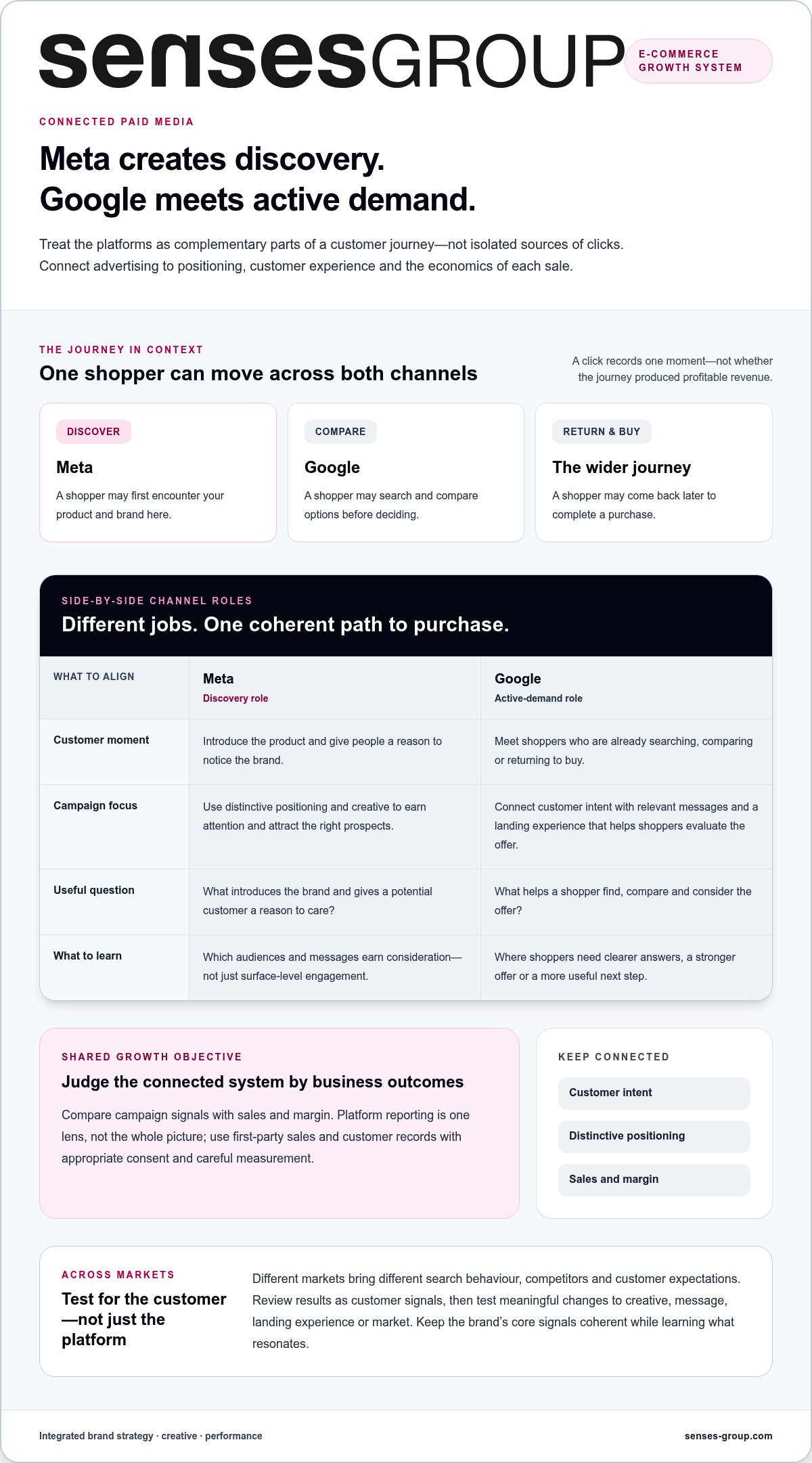
Paid media has moved beyond placing an offer in front of as many people as possible. The History of Advertising shows how each new medium has changed the way brands reach customers. In 2026, the shift is from interruption marketing towards intent-based ecosystems. A customer might discover a product on Meta, compare options through Google, then return to buy later. A click records one moment in that journey, not whether the journey produced profitable revenue.
That distinction matters as competition for attention intensifies. A campaign can generate traffic without giving shoppers a reason to choose your brand, trust your offer or complete a purchase. For businesses selling locally and overseas, the same creative or message may also fail to resonate across different markets. The answer isn’t simply to spend more. It’s to connect customer intent, distinctive positioning and the economics of the sale.
Modern advertising brings AI optimisation together with human-centred brand storytelling. Automation can help optimise delivery, while a clear brand gives people a reason to care. A standard ad account organises campaigns, budgets and reporting. A revenue-generating system connects those campaigns to business decisions: which audiences respond, what messages earn consideration, where shoppers drop off, and whether sales justify continued investment.
The Death of the Set-and-Forget Campaign
Automated bidding and delivery can adjust how ads reach people, but algorithms can’t resolve a weak offer or unclear brand promise on their own. Treat creative as part of targeting: the product, message and visual choices help attract the right prospects and discourage poor-fit clicks. Review results as customer signals, then test meaningful changes to the message, landing experience or market. Avoid technical tweaks without a clear hypothesis.
Privacy changes make that discipline more important. The end of dependable, universal third-party cookie tracking is better understood as a loss of easy cross-site visibility, not a reason to abandon measurement. Platforms may report only part of the customer journey, so compare campaign data with first-party sales and customer records, using appropriate consent and careful measurement. Meta’s March 2026 attribution update, for example, distinguishes link-click conversions from engagement-related actions. Treat platform reporting as one lens, not the whole picture.
Understanding the SME Struggle in Global Markets
For a business entering overseas e-commerce, each new market brings different search behaviour, competitors and customer expectations. Boosted posts may create reach, but they don’t establish a system for capturing shoppers who are already searching, comparing or returning to buy. Align Meta’s discovery role with Google’s ability to meet active demand, then assess the journey against sales and margin, not surface-level engagement alone.
A practical starting point is to map the customer path: what introduces the brand, what answers purchase questions, and what brings a visitor back. This gives your Meta and Google ads agency a strategic basis for testing creative, campaign intent and landing pages together. The aim isn’t to make every click look valuable. It’s to understand which combinations of message, channel and customer experience contribute to sustainable growth.
The CAC Secret: How Brand Strategy Lowers Your Advertising Costs
Customer acquisition cost (CAC) isn’t determined by media buying alone. It also reflects how readily people recognise your brand, understand its value and trust what they see after clicking an ad. A distinct identity can build mental availability, the tendency for a brand to come to mind when a customer is considering a relevant purchase. That familiarity gives advertising a stronger starting point than an offer from an unfamiliar business.
This is the trust dividend: when brand signals feel clear and consistent, potential customers have less uncertainty to resolve before buying. That doesn’t guarantee a lower CAC, but it can reduce avoidable friction across the journey and help your campaigns make better use of the attention they earn. At Senses Group, branding is the foundation of the sales funnel, not a decorative layer added after the advertising plan.
Beyond the Logo: Building a Commercial Foundation
A logo alone can’t explain why a product matters. Brand story gives shoppers context, while typography, colour and imagery establish a coherent impression across ads, product pages and checkout. In high-consideration retail, these details can help communicate quality and build credibility, especially when an overseas customer has no prior experience with the brand. Strong retail brand identity connects visual choices to buyer confidence and commercial purpose.
The shift is from asking whether a brand looks polished to asking whether it resonates with the intended customer and helps them make a decision. A cohesive system also makes testing more meaningful: the team can compare messages and creative directions without changing the brand’s core signals every time. For a Meta and Google ads agency, that consistency provides a clearer foundation for evaluating which ideas attract qualified prospects.
Lowering CAC via Strategic Positioning
Strategic positioning starts with deciding who is most likely to value the offer and why they should choose it. Senses Group’s Marketing Map framework helps organise those decisions into a practical view of audiences, brand messages and marketing priorities. Rather than targeting broadly and relying on budget to find customers, businesses can develop campaigns around audience needs and the reasons their product is relevant.
Monchhichi Jewelry Atelier provides a concrete example: Senses Group reports that the client achieved 2x revenue growth through work spanning brand identity and conversion rate optimisation. That result illustrates how a clearer presentation and a more considered buying experience can support commercial performance. It is a client outcome, not a universal promise.
Brand guidelines extend that foundation as a business grows. They help keep advertising, product pages and customer communications recognisably aligned across campaigns and markets, so each new execution reinforces rather than dilutes the brand. If your current creative feels disconnected from your positioning, brand strategy for ecommerce growth can bring those decisions into one system.
Integrated Meta and Google Ads Management: The AI-Driven Framework
Meta and Google should not operate as separate budgets with separate definitions of success. Together, they can support different moments in one buying journey: Meta can introduce a product and build consideration, while Google can meet shoppers actively researching a need or brand. The Bespoke Sales Atom is Senses Group’s framework for connecting these roles around a shared commercial objective, so campaign decisions relate to the customer journey rather than platform silos.
That integration starts with a common view of the offer, audience, creative and conversion goal. A retailer expanding overseas, for example, can use discovery-focused creative to introduce a product, then align search messaging and landing-page content with the questions shoppers ask before purchasing. Performance signals from each channel can inform the next test, while sales data helps keep optimisation tied to business outcomes.
Senses Group has managed over $4 million in ad spend. That experience is not a promise that past patterns will predict every result. It provides a broader evidence base for forming hypotheses, planning tests and interpreting performance. A disciplined Meta and Google ads agency combines that learning with AI tools, brand judgement and ongoing measurement.
Meta Ads: Creative as the New Targeting
As automated delivery takes on more audience and placement decisions, creative variations give the system distinct signals to test. Product images, short-form video and lifestyle-led concepts can express different benefits or use occasions while keeping the brand recognisable. Senses Group uses AI visual production to develop product images, ad visuals and short videos. Influencer-style UGC can also offer a more personal, social-commerce feel, provided it fits the brand and represents the product clearly.
Build tests around a purpose, not volume. Vary one meaningful element at a time, such as the opening message, product context or call to action, then assess results against qualified visits and purchases. Keep core identity cues consistent. Performance creative should sharpen the brand story, not replace it.
Google Ads: Capturing Intent in the LLM Era
Search strategy now needs to account for more than a list of exact-match phrases. Organise content around the topics, questions and comparisons that matter to customers, then ensure page titles, product information and supporting content describe the offer clearly. Generative Engine Optimisation (GEO) extends that work by structuring useful, authoritative information so it can be understood and surfaced in AI-assisted search experiences. Visibility is never guaranteed, so track meaningful visits and conversions alongside presence in search results.
For brands serving overseas customers, this means building market-relevant pages and language around actual buyer needs, not simply translating existing campaign copy. A considered AI SEO strategy can connect paid search with the wider content architecture. The result is a more coherent system: Meta creates and develops demand, Google responds to intent, and shared learning guides the next investment decision.
The Full-Funnel Architecture: Integrating Shopify and Klaviyo
Paid campaigns can bring shoppers to your store, but traffic alone doesn’t create a profitable funnel. Sending visitors to a confusing, slow or unpersuasive site is like pouring water into a leaky bucket: the advertising earns attention, yet too many potential customers leave before buying. For businesses expanding into overseas e-commerce, the store must also make product information, pricing and the path to purchase clear for each intended market.
Conversion rate optimisation (CRO) is part of advertising strategy, not a separate finishing touch. A Meta and Google ads agency should consider what happens after the click, from the landing page’s message to product discovery and checkout. Improving the customer experience can help more of the traffic you already pay to attract progress towards purchase, although results depend on the offer, audience and site.
Shopify as a Revenue-Generating Machine
A Shopify store should answer a visitor’s key questions without making them work for it. Organise navigation around how customers shop, give product pages a clear hierarchy, and connect ad promises directly to relevant landing-page content. Review the experience on mobile as well as desktop, remove unnecessary distractions, and test changes against completed purchases rather than page views alone. A considered strategic Shopify store structure gives paid traffic a more purposeful destination.
Speed matters because waiting can interrupt the shopping journey, particularly on mobile. Keep pages focused and evaluate performance as part of ongoing CRO. A smoother experience supports customer confidence, while a slow or inconsistent landing page can undermine the promise made in an ad. Don’t assume that more clicks will compensate for a store that makes buying difficult.
Retention: Why Email Marketing Works with Meta Ads
Not every visitor is ready to buy on the first visit. With an appropriate value exchange, Meta campaigns can direct interested shoppers to a useful lead magnet, such as a product-selection guide, and invite them to join a Klaviyo email list. A ManyChat flow can support an automated conversation after a social interaction, helping guide a prospect towards relevant information. Keep each step connected to the brand and make the next action clear.
Once a customer or subscriber has opted in, Klaviyo can use behaviour to shape timely, relevant follow-up. For example, someone who browses a category may receive related product guidance, while a first-time buyer can receive post-purchase information suited to their journey. These flows help extend the value of the original ad visit and support repeat engagement. They don’t replace a useful offer or a strong store experience. This is the practical relationship between email marketing and Meta Ads: one can attract and capture interest, while the other helps nurture it over time.
A strong funnel connects store experience, paid acquisition and retention. Shopify and Klaviyo growth strategies align each touchpoint around the customer’s next decision.
Choosing Your Meta and Google Ads Agency: The Senses Group Advantage
Choosing an agency is a growth decision, not simply a way to outsource campaign tasks. A service provider may focus on platform activity; a strategic partner connects that activity to brand positioning, customer experience and commercial goals. For SMEs expanding into new markets, that wider view helps keep local knowledge, overseas customer expectations and channel decisions working in the same direction.
Senses Group brings more than 18 years of branding and digital marketing expertise to this work, combining brand foundations with AI-informed marketing. The approach starts with the business problem, then builds the system around it: define the audience, clarify the value proposition, align the customer journey and use performance signals to guide decisions. AI can support analysis and execution, but strategic judgement sets the direction.
A Performance-Based Partnership
Some businesses explore affiliate or performance-based arrangements to align payment with outcomes. The model matters less than a shared definition of success, transparent measurement and a clear understanding of which factors each party can influence. Track revenue quality alongside acquisition metrics, including average order value (AOV), repeat purchases and contribution to sustainable growth. A target to triple AOV should never be treated as a guaranteed result; it needs a credible strategy and evidence from the business.
View your brand not as a cost centre, but as a growth engine that shapes demand, strengthens trust and gives advertising a more durable foundation.
Building Your 2026 Growth Engine
The Marketing Map provides a strategic starting point: clarify the business objective, identify priority audiences and map the role of each marketing touchpoint. From there, execution can be organised around specific tests and measurable outcomes. An account audit can examine campaign structure, creative, landing pages, conversion tracking and reporting, then distinguish immediate issues from longer-term opportunities. For overseas expansion, assess whether market-specific messaging and customer journeys support the same commercial goal.
A useful partnership also makes decisions legible. You should be able to see what is being tested, why it matters and how the learning will inform the next step. That creates a disciplined cycle of strategy, execution and refinement, rather than a stream of disconnected optimisations. A capable Meta and Google ads agency should help your team understand the growth system, not just deliver platform reports.
For SMEs ready to strengthen their advertising foundations, Senses Group connects brand strategy, paid media and e-commerce into a coordinated growth approach. Learn about Senses Group’s growth services.
Make Your Next Growth Move With Clarity
Your next step doesn’t need to be a larger budget. Start by identifying the constraint holding growth back: are the right customers discovering your brand, are interested visitors completing purchases, or are existing customers returning? Choose one priority, define how you’ll measure progress, and align your next marketing decisions around it. That gives your team a clear basis for deciding what to test, what to improve and where to invest.
The right Meta and Google ads agency will help connect that priority to a coherent commercial plan, not just keep campaigns running. For businesses preparing to grow in existing markets or reach new overseas customers, this clarity can turn expansion from a series of disconnected experiments into a deliberate next stage of business development.
Take the next step with a plan grounded in your brand and ambitions. Build your growth engine with Senses Group.
Frequently Asked Questions
What is the difference between a standard ad agency and a growth marketing agency?
A growth marketing agency typically plans work across more of the business journey, while a standard ad agency may be engaged for a defined advertising scope. When assessing a Meta and Google ads agency, look at how it sets priorities, who reviews results with you, and whether recommendations connect to business decisions. For example, a campaign review should clarify what to continue, pause or investigate, not just present performance figures.
How does brand strategy actually lower my Meta and Google ad costs?
Brand strategy can help prevent spending on messages that attract the wrong customers. Start by defining the audience your product is genuinely suited to, the value it offers and the objections buyers may have. Then review whether ad copy, product pages and campaign targeting reflect those choices. If a campaign generates enquiries but few suitable purchases, compare the audience and offer before assuming that raising the budget is the answer.
Is AI visual production better than traditional photography for ad performance?
Choose the production method based on what customers need to see to make a confident decision. For a product with distinctive materials or precise details, photography may communicate the real item more faithfully. AI visuals can help explore campaign concepts, but outputs need human review for accuracy and brand fit. Test comparable assets against the same objective, and document which creative is being tested so the result informs the next production decision.
How much should a Hong Kong SME budget for Meta and Google Ads in 2026?
Set a test budget from your business limits, not a generic industry figure. Work out the maximum acquisition cost your margins can support, choose a defined testing period, and decide what evidence would justify continuing or scaling. Keep enough flexibility to test both platforms without assuming they will contribute equally. Include separate allowances for campaign management and creative production in your internal forecast, rather than treating media spend as the full marketing cost.
What is GEO (Generative Engine Optimization) and why does my agency need to know it?
GEO is relevant because potential customers may encounter brand information through AI-assisted search interfaces as well as conventional results. Ask how your agency will monitor whether your product information is accurate and consistent across the pages it can influence. A useful working process includes reviewing priority questions, checking that pages answer them clearly, and noting where brand details need updating. Treat GEO as an additional visibility consideration, not a guaranteed placement.
How long does it take to see a real ROI from integrated digital marketing?
Meaningful ROI timing depends on the amount and quality of sales data, your product’s purchase cycle and the changes being tested. Before launch, agree on the financial measure, attribution window and reporting cadence. Separate early indicators, such as qualified enquiries, from realised revenue and margin. If results fluctuate, compare periods with similar conditions and record campaign changes. This helps distinguish a genuine trend from normal variation or an isolated sale.
Can Senses Group help with international ecommerce expansion from Hong Kong?
Yes. Senses Group supports ecommerce growth through brand strategy, Shopify development, digital marketing and email automation. For an overseas launch, prepare a market brief covering the customer, product range, brand positioning and content requirements. This gives the team a practical basis for shaping the online experience and marketing activity around the intended audience. Businesses can then prioritise expansion decisions in a planned sequence instead of adapting every campaign independently.
Why is Shopify the preferred platform for high-converting ad campaigns?
Shopify is not automatically the right platform for every company, but it can suit product businesses that need a dedicated ecommerce store connected to marketing activity. Assess the platform against your catalogue structure, checkout needs, internal workflows and the tools your team already uses. Before choosing or redesigning a store, map a common customer task, such as finding a product variant or locating care details, and check that the proposed setup supports it clearly.