
Relying on paid ad spend to scale an online storefront isn’t a viable growth plan; it’s a margin trap. As acquisition costs across Meta and Google advertising networks continue their relentless climb, building an authoritative brand strategy for ecommerce has shifted from a cosmetic visual choice to an urgent commercial necessity.
You likely feel that squeeze every quarter. Severe product commoditisation triggers brutal price wars, transactional storefronts bleed repeat revenue, and customer acquisition eats away at unit economics. Treating brand building as mere aesthetic decoration won’t repair these structural cracks. Lasting pricing power requires a defensible commercial architecture that commands customer preference long before the checkout click.
In this guide, discover how to build an authoritative ecommerce brand strategy that lowers acquisition costs, shields your gross margins, and drives sustainable enterprise value. We examine the exact framework needed to transition from discount-dependent retailing to category leadership, showing you how to compound retention revenue and scale seamlessly across domestic and international markets.
Key Takeaways
- Strategic brand positioning acts as a commercial operating system rather than a cosmetic facade, establishing defensible pricing power against discount-driven competitors.
- Building a cohesive brand strategy for ecommerce shifts growth economics from unstable paid traffic reliance to predictable customer lifetime value.
- Distinctive brand assets and rigorous customer archetypes protect product margins by eliminating customer hesitation across both local and cross-border touchpoints.
- A structured five-phase implementation roadmap ensures foundational market research translates smoothly into multi-channel market execution.
- Abstract strategy converts into measurable enterprise value when operationalised through high-converting storefront architecture, automated lifecycle retention, and generative AI search visibility.
What Is Brand Strategy for Ecommerce in 2026?
Brand strategy is not graphic ornamentation. It is the commercial architecture that dictates how an enterprise positions its offerings, communicates its value, and captures margin in competitive markets. For digital retail leaders, a comprehensive brand strategy for ecommerce operates as an underlying operating system. It governs messaging hierarchies, defines audience resonance, and shapes the entire customer trajectory from initial impression to long-term advocacy.
Many founders dismiss branding as a secondary cosmetic upgrade or a luxury reserved for legacy multinationals. That perspective is commercially fatal. Without structural brand differentiation, online storefronts collapse into commodity status, forced to compete exclusively on discounting and spiralling promotional budgets. Strategic clarity gives a business defensible pricing power. It transforms arbitrary traffic acquisition into durable equity that shields margins across both domestic operations and competitive cross-border channels.
The Mathematical Link Between Brand Equity and Customer Acquisition Cost
Brand equity directly governs advertising economics. A distinct market positioning elevates ad creative relevance, which drives higher baseline click-through rates and lowers upfront media acquisition costs on Meta and Google networks. When your market knows precisely what you stand for, your organic search baseline expands. Customers search for your company name rather than generic product terms, converting at significantly higher rates and driving down your blended acquisition spend.
Trust compounds every balance sheet metric:
- Higher Conversion Efficiencies: Established credibility resolves buyer hesitation quickly, lifting storefront conversion percentages above median benchmarks.
- Elevated Basket Values: Respected positioning justifies premium pricing tiers, encouraging shoppers to purchase complete collections rather than single discounted items.
- Compressed Payback Windows: Strong brand recognition accelerates the timeline required to recoup initial paid media investments.
Moving Beyond Aesthetics: Strategic Positioning vs Graphic Design
A polished visual identity cannot salvage an undefined value proposition. Graphic design delivers visual consistency, but strategic positioning determines commercial viability. Sustainable growth requires mastering retail brand identity by anchoring creative execution in deep consumer psychology, competitive white space, and distinct market needs.
Modern consumers overlook detached corporate visuals. They align with authentic lifestyle brand narratives that reflect their personal aspirations and daily routines. When an online brand integrates clear positioning with genuine lifestyle imagery, it creates cultural resonance. That emotional resonance transforms indifferent browsers into dedicated brand advocates, cementing an enduring position that technical ad algorithms cannot dismantle.
The Core Pillars of Modern Digital Brand Architecture
A resilient digital brand is an interconnected system, not an assortment of creative files. While competitors treat design assets and platform features as isolated tasks, an enduring brand strategy for ecommerce binds consumer psychology directly to commercial execution. Every touchpoint, from social discovery to unboxing, must reinforce a singular value proposition.
Constructing this framework requires codified brand guidelines. These operating rules ensure consistent positioning across local retail channels, third-party marketplaces, and cross-border digital storefronts. When operational execution aligns with market positioning, customer loyalty transitions from an unpredictable outcome into a repeatable business asset.
Target Audience Segmentation and the Ideal Customer Profile
Broad demographic data fails to predict digital buying patterns. High-growth retail merchants dissect psychographic drivers, pinpointing exact customer anxieties, lifestyle aspirations, and unstated purchasing hesitations. By mapping these friction points, catalog merchandising can be tailored to solve specific lifestyle problems rather than pushing generic inventory.
Structured customer profiling sharpens operational focus:
- Core Motivation Mapping: Pinpoint the emotional transformation your consumer expects after purchase.
- Objection Preemption: Address pricing, durability, and regional shipping concerns directly within product messaging.
- Catalog Alignment: Bundle complementary SKUs based on actual consumer routines to lift average order value naturally.
Brand Voice, Verbal Identity, and Narrative Messaging
Category leaders communicate with quiet authority. Instead of resorting to exaggerated promotional language, establish structured copy frameworks that articulate genuine product craftsmanship and brand heritage. This consistent verbal identity must govern every customer contact point, including storefront headlines, product descriptions, checkout microcopy, and post-purchase transactional updates.
Visual Identity Systems and Lifestyle Creative Direction
Visual architecture must captivate the consumer instantly. Ditch staged, sterile corporate office stock imagery; it alienates modern digital shoppers and weakens commercial credibility. Modern direct-to-consumer brands demand authentic lifestyle visual assets, highlighting products within natural, aspirational daily settings using bespoke typography and deliberate color palettes.
Establishing these foundational assets protects profit margins as paid ad auctions grow increasingly saturated. For businesses scaling their digital footprint across regional and international territories, collaborating with a dedicated team like Senses Group bridges the gap between high-level brand strategy and high-performing digital commerce.
Performance-Only Marketing vs Brand-Led Ecommerce Growth
Performance marketing alone can generate initial sales spikes, but it cannot secure commercial longevity. Relying solely on direct-response ad spend creates an unstable enterprise vulnerable to every media auction spike and policy revision. By contrast, an authoritative brand strategy for ecommerce creates intrinsic balance-sheet resilience. It builds recognizable enterprise equity that retains value even when paid campaigns are switched off.
Pure media arbitrage leads to diminishing marginal returns. As digital ad markets become more saturated, bidding aggressively on cold traffic without brand recall erodes contribution margins. Long-term commercial expansion requires a unified operational model: algorithmic precision to capture current transactional intent, backed by systemic brand architecture that commands genuine market preference.
The Vulnerability of Paid Traffic Arbitrage and Discount Traps
Operating without brand insulation exposes online storefronts to rapid commoditisation. When your commercial proposition relies strictly on basic feature lists and aggressive discounting, low-cost competitors can easily replicate your offerings and undercut your catalog overnight.
Discounting is a race to the bottom that damages unit economics:
- Margin Erosion: Slashing prices to meet top-line turnover targets damages profitability and trains shoppers to wait for sitewide sales.
- Auction Sensitivity: Escalating ad auction costs quickly transform once-profitable cold acquisition campaigns into loss-making ventures.
- Fragile Customer Relationships: Bargain hunters switch storefronts the moment a rival cuts their price by five percent, depressing lifetime value.
How Brand Equity Compounds Customer Lifetime Value and Retention
Durable enterprise valuation stems from retention, not single transactions. Brands with established market affinity generate a consistent stream of direct, organic, and branded search traffic that requires zero marginal media cost. This organic baseline safeguards operating profit against platform volatility.
Modern retention engines scale effectively when supported by integrated digital marketing solutions that align post-purchase email workflows, targeted loyalty incentives, and tailored remarketing across every touchpoint. This cohesive operational approach elevates average order values, increases repurchase frequency, and shields pricing power, allowing you to maintain healthy gross margins even amid fierce market competition.
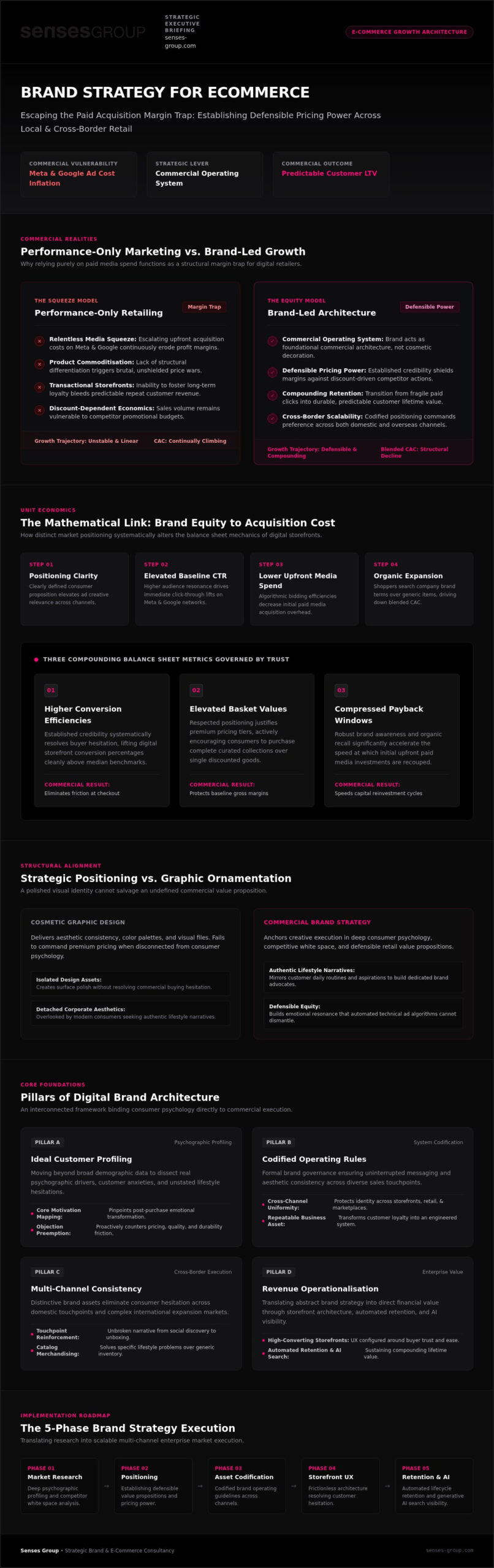
How to Build an Ecommerce Brand Strategy: The 5-Phase Roadmap
Execution without diagnostic clarity burns working capital. True digital brand architecture doesn’t start with Shopify templates or color swatches; it starts with deep market diagnostics. Developing a resilient brand strategy for ecommerce follows a sequential trajectory where every phase directly shapes the technological stack, creative direction, and media deployment that follow.
Skipping foundational phases leads to fragmented marketing efforts. When merchants rush straight to visual styling or ad creative without resolving their core market position, their storefronts fail to convert traffic sustainably. A disciplined five-phase roadmap bridges strategic insight with commercial execution.
Phase 1 and 2: Market Intelligence and Defensible Positioning
Begin by dissecting category conventions. Map out what competitors say, identify their visual clichés, and isolate underserved customer segments. This rigorous audit reveals your proprietary category point of view; it dictates what makes your business impossible to replicate.
Your positioning framework must address three commercial fundamentals:
- Competitive White Space: Identify unmet functional or psychological needs competitors ignore.
- Proprietary Angle: Formulate an uncompromising category stance that repels bargain-hunters and attracts dedicated brand loyalists.
- Value Articulation: Distill your customer transformation into clear, benefit-driven messaging that requires zero deciphering.
Phase 3 and 4: Identity Systems and Digital Storefront Architecture
Transform your validated positioning into tangible digital assets. Develop cohesive verbal guidelines alongside authentic lifestyle visual assets that showcase products in natural settings. This creative foundation informs your digital storefront layout, structuring collections and navigation paths into intuitive narrative journeys that guide visitors toward high-value conversions. Packaging guidelines must also carry this premium aesthetic into the unboxing experience, confirming product value the moment an order arrives.
Phase 5: Retention Modeling and Multi-Channel Activation
A strategy proves its worth in customer retention metrics. Configure segmented lifecycle communication paths that continuously reinforce brand authority after the first transaction. Recovering revenue requires specialized frameworks like the Klaviyo abandoned cart strategy to recapture high-intent shoppers through timely, tailored touchpoints.
Monitor clear indicators: track expanding branded search volume, monitor repeat purchase cadences, and measure your customer lifetime value ratio against acquisition spend. If you want to replace ad reliance with an integrated commercial engine, partner with Senses Group to build your scalable ecommerce brand architecture today.
Translating Strategy into Revenue: Storefront, Retention, and AI Search
Strategic positioning holds no enterprise value until it is operationalised across customer touchpoints. Without precise technical execution, sophisticated market narratives remain theoretical concepts that never reach the balance sheet. Executing an authoritative brand strategy for ecommerce requires a unified infrastructure where storefront architecture, lifecycle flows, and modern search indexing reinforce one another seamlessly.
Brand-led digital retail demands custom technology. When visual identity, site performance, and transactional journeys are engineered to remove friction, your storefront stops being a passive product directory. It evolves into a high-converting asset that captures margin and insulates your business against platform fluctuations.
Engineering High-Converting Custom Shopify Storefronts
Stock themes dilute brand positioning. Generic, off-the-shelf templates force your unique market narrative into rigid layouts shared by thousands of competing storefronts. This creates visual sameness, erodes consumer trust, and depresses purchase conversions.
Balancing aspirational presentation with commerce demands deliberate technical planning:
- Narrative Merchandising: Blend rich lifestyle visuals with clear product benefits to validate price points before buyers reach the cart.
- Frictionless Cart Progression: Streamline mobile checkout flows to reduce abandonment rates and accelerate first-time completions.
- Modular Architecture: Adopt scalable structural frameworks from the strategic Shopify guide to support catalog growth without slowing page performance.
Lifecycle Automation and AI-Driven Omnichannel Discovery
Customer acquisition is only half the battle. Driving predictable lifetime value requires automated email journeys that deliver tailored messaging based on actual purchase behavior. Triggered post-purchase workflows, replenishment reminders, and VIP tier incentives ensure your brand identity remains central long after the initial package arrives.
Discovery mechanics are shifting fundamentally. Optimizing for traditional keywords alone no longer guarantees digital dominance. Digital retailers must structure their online footprint for generative search engines and artificial intelligence discovery models, ensuring algorithms index their products as category-defining recommendations.
Aligning paid media with organic authority turns marketing spend into permanent market share. If you are ready to scale a defensible digital commerce brand across domestic and international markets, connect with the team at Senses Group to translate your market positioning into a lasting commercial engine.
Architecting Your Brand for Sustainable Category Leadership
Scaling a digital enterprise requires moving past short-term advertising arbitrage. True market resilience happens when you replace reactive discounting with defensible positioning, turning casual browsers into committed advocates. A rigorous brand strategy for ecommerce doesn’t just lower acquisition friction; it compounds customer lifetime value across every channel your business touches.
Bridging conceptual identity with technical commerce execution demands proven insight. Backed by over 18 years of branding, advertising, and digital commerce expertise, more than $4 million in managed ad spend, and a track record of scaling consumer brands from zero to multimillion-dollar revenue, Senses Group aligns creative architecture with high-converting infrastructure.
The path toward lasting pricing power and margin stability is clear. Partner with Senses Group to build your high-converting ecommerce brand strategy and turn your online storefront into an enduring, market-leading enterprise.
Frequently Asked Questions
What is the primary difference between branding and brand strategy for an ecommerce business?
Branding encompasses the sensory assets customers encounter, such as your logo, typography, color palette, and packaging design. Brand strategy is the foundational business blueprint that informs those design choices. It defines your competitive positioning, customer psychology, pricing rationale, and market messaging. While branding dictates how your business looks, an authoritative brand strategy for ecommerce determines why customers choose your store over alternatives and preserves your commercial margin.
How long does it take to see measurable commercial returns from an ecommerce brand strategy?
Initial conversion and paid acquisition efficiency gains typically emerge within 60 to 90 days after launching updated positioning and storefront architecture. Compounding equity metrics, such as expanded direct traffic, elevated repurchase frequency, and organic branded search volume, usually mature across six to nine months. Strategic positioning delivers immediate validation through higher average order values while building the compounding retention assets that protect enterprise margins over the long run.
Can an established ecommerce store rebrand without losing existing customer momentum or search rankings?
Yes, provided the transition adheres to strict technical migration and customer communication protocols. Maintaining search equity requires mapped 301 redirects, structured schema preservation, and careful content indexing. Simultaneously, existing customers should receive transparent narrative messaging that clarifies why the brand evolution benefits their experience. When executed methodically, a strategic rebrand enhances customer momentum, lifting engagement metrics rather than disrupting historical sales volume.
Why is custom Shopify store development essential for executing a high-level ecommerce brand strategy?
Off-the-shelf templates enforce generic layouts that constrain your narrative flow and dilute perceived product value. Custom Shopify development aligns technical site architecture directly with your strategic positioning. It enables tailored conversion funnels, immersive lifestyle merchandising, and fast page load speeds. This custom build eliminates checkout friction, supports regional currency localization, and provides the specialized infrastructure required to convert discerning shoppers effectively.
How does an authoritative brand strategy directly lower customer acquisition costs across paid media?
Clear positioning sharpens creative relevance, which elevates ad engagement rates across Meta and Google advertising networks. When prospective buyers immediately understand your value proposition, algorithmic ad relevance scores improve, lowering front-end cost per click. Simultaneously, stronger brand recognition increases downstream conversion rates on your storefront. This dual efficiency reduces overall customer acquisition costs while driving up baseline branded search traffic that requires zero ongoing media spend.
What role does lifecycle email automation play in supporting an overall ecommerce brand strategy?
Lifecycle automation translates strategic brand positioning into persistent customer lifetime value. Utilizing Klaviyo-driven behavioral flows, such as segmented onboarding, tailored post-purchase education, and replenishment triggers, ensures that your narrative stays relevant well beyond the initial sale. These automated touchpoints build emotional rapport, reduce buyer remorse, and systematically increase repeat purchase rates without forcing you to reinvest in expensive paid advertising channels.
How should an ecommerce brand strategy adapt when expanding into competitive international markets?
Expanding into overseas consumer markets requires balancing global brand identity with local market relevance. While your core purpose and visual standards remain uniform, your tactical execution must adapt to regional consumer habits. This involves localizing currency displays, offering region-specific digital payment methods, and tailoring value propositions to address local cultural expectations. An adaptable brand strategy for ecommerce provides the governance needed to enter new territories without fragmenting brand perception.