
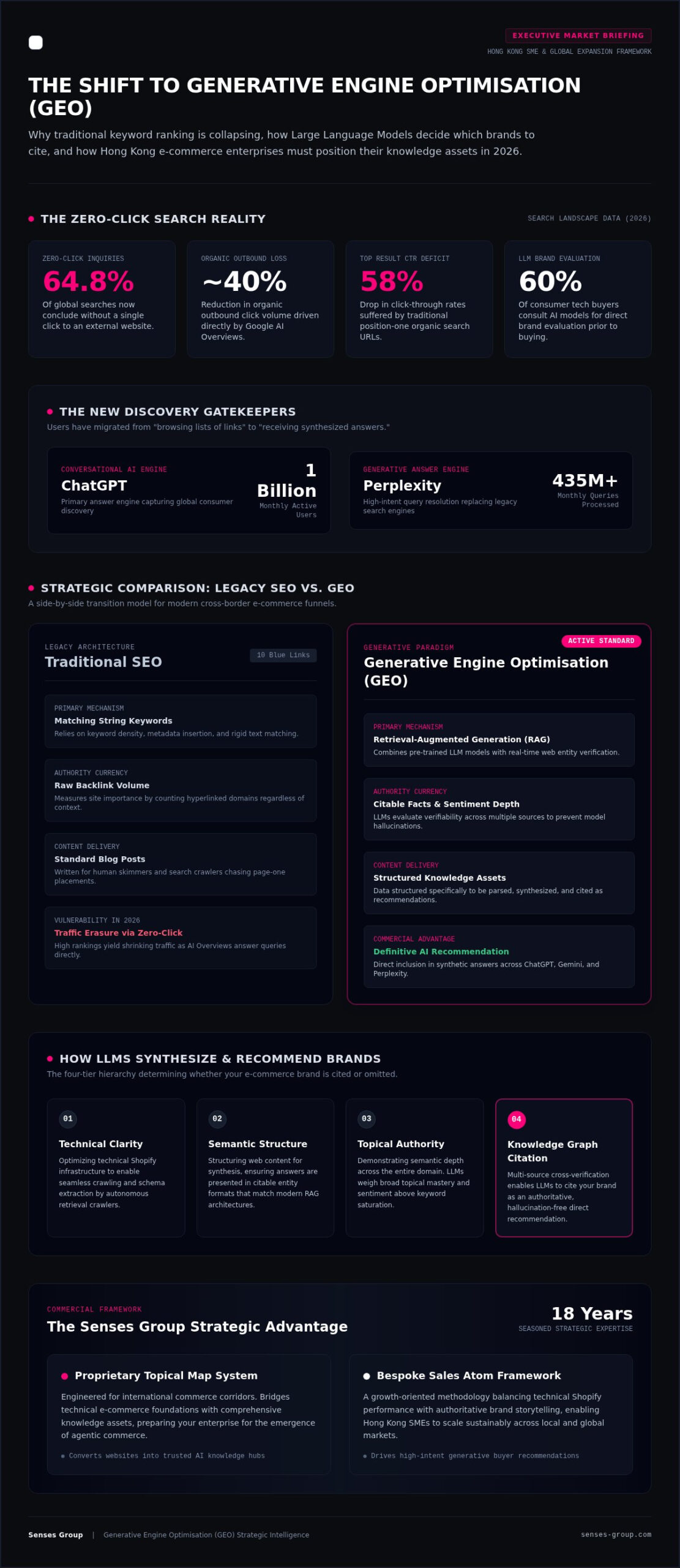
The presence of Google AI Overviews has slashed click-through rates for the top organic search result by nearly 58 percent. For a Hong Kong SME aiming for global growth, this shift represents a fundamental disruption to how customers discover your brand. You aren’t just competing for keywords anymore; you’re competing for the trust of Large Language Models. Partnering with a specialized AI engine optimisation agency is no longer a luxury for the forward-thinking few. It’s a strategic necessity to ensure your business remains visible in an era where 64.8 percent of global searches now end without a single click to an external website.
You’ve likely felt the frustration of declining organic traffic despite maintaining your traditional rankings. It’s common to feel confused by the transition from legacy SEO to Generative Engine Optimisation, but the fear of being left behind is a rational response to a changing market. This article will show you how to master the shift to GEO so your brand becomes the definitive recommendation for ChatGPT, Gemini, and Perplexity. We’ll break down the mechanics of citation authority and how our proprietary Topical Map System builds the foundation for sustainable, AI-driven e-commerce growth across international corridors.
Key Takeaways
- Understand the fundamental shift from keyword-based ranking to Generative Engine Optimisation to preserve your brand’s visibility as traditional search traffic declines.
- Discover how a specialized AI engine optimisation agency uses Retrieval-Augmented Generation to position your brand as a citable authority within the knowledge graphs of ChatGPT and Gemini.
- Learn to implement a hybrid search strategy that balances technical Shopify performance with the citable facts required to dominate the 2026 generative landscape.
- Master the transition from producing standard blog content to building structured Knowledge Assets that feed AI models and drive high-intent recommendations.
- Explore how the proprietary Bespoke Sales Atom framework leverages 18 years of strategic expertise to scale your e-commerce brand across local and international markets.
The Evolution of Search: From Keywords to AI Engine Optimisation (GEO)
The digital landscape has fundamentally shifted. For nearly two decades, businesses relied on keyword density and backlink volume to secure visibility. Today, that foundation is crumbling. In 2026, search is defined by Generative Engine Optimization (GEO), a discipline that prioritizes how Large Language Models (LLMs) synthesize and recommend your brand. Traditional SEO, while still relevant for technical health, is no longer sufficient to capture global e-commerce traffic. We’ve moved from a “list of links” to “synthesized answers.” Users don’t want to browse; they want solutions delivered instantly. Platforms like Perplexity, processing over 435 million monthly queries, and ChatGPT, with its 1 billion monthly active users, are aggressively capturing market share from legacy search engines. If your brand isn’t integrated into their knowledge graphs, you simply don’t exist in the new discovery funnel.
The Death of the 10 Blue Links
The era of clicking through a dozen websites to find an answer is over. Research confirms that Google AI Overviews reduce organic outbound clicks by nearly 40 percent. This creates a zero-click environment where the user gets everything they need directly on the search page. SMEs in Hong Kong must pivot. It’s not enough to rank; you must be cited. AI recommendation algorithms now weigh brand sentiment and topical authority over raw traffic. If the LLM doesn’t perceive your brand as a trusted entity, it won’t mention you in its synthesized response. This shift represents a 58 percent drop in click-through rates for traditional position-one URLs. To survive, you must move beyond the blue links and become the primary source for the AI’s summary.
Why an AI Engine Optimisation Agency is Essential
Partnering with a dedicated AI engine optimisation agency is the only way to navigate the non-transparent weights of modern LLM retrieval systems. Optimizing for these engines requires a sophisticated interplay between structured technical data and authoritative brand storytelling. At Senses Group, we apply 18 years of seasoned branding expertise to this new frontier. Our approach utilizes a proprietary Topical Map System to ensure your e-commerce infrastructure is ready for agentic commerce. We don’t just repair your technical SEO; we transform your website into a comprehensive knowledge hub that AI models trust. For a Hong Kong business owner looking to scale internationally, this strategic alignment is the foundation of long-term commercial stability. We bridge the gap between complex data and the human narratives that drive conversions.
How LLMs Rank Your Brand: The Mechanics of Generative Visibility
Understanding the logic behind AI recommendations is the first step toward commercial dominance. Large Language Models don’t rely on simple backlink counts or keyword frequency. Instead, they utilize Retrieval-Augmented Generation (RAG) to pull real-time data from across the web and combine it with their pre-trained knowledge. This process makes citable facts the most valuable currency for your brand. If an LLM cannot verify a claim about your product through multiple sources, it will likely omit your business to avoid the risk of hallucination. It’s not about being the loudest; it’s about being the most verifiable.
The 2026 search environment has evolved into a complex hierarchy of signals. Technical clarity ensures the AI can parse your site, while brand sentiment determines if it should recommend you. High-intent buyers are increasingly consulting these engines during discovery, with research suggesting that up to 60 percent of consumer tech buyers use LLMs for brand evaluation. According to foundational research on Generative Engine Optimization, the ability of a model to cite a source is directly tied to how well that source’s content is structured for synthesis. This is where a professional AI engine optimisation agency provides the necessary technical edge to ensure your brand is not just seen, but cited.
The Role of Topical Authority
Narrow keyword targeting is a relic of the past. LLMs look for semantic depth rather than matching strings of text. To capture this traffic, you must build a comprehensive ecosystem of information that covers the entirety of your subject matter. A Topical Map is the blueprint for AI comprehension that organizes your brand’s expertise into an interconnected web of verified entities. By establishing this map, you provide the context the AI needs to understand your niche. It allows the model to see your brand as a foundational authority in its category, which is essential for becoming a preferred recommendation.
Data Sources and Knowledge Graphs
For e-commerce brands, the AI’s knowledge graph is fed by structured Shopify product data, customer reviews, and third-party mentions. Digital PR is no longer just for human readers; it’s a critical trust signal for the model. If a reputable source mentions your brand alongside specific consumer benefits, the AI adds that relationship to its internal knowledge graph. Optimizing your schema markup ensures that every product attribute is ingested accurately by the engine. This systemic integration is why many Hong Kong founders choose to work with an AI engine optimisation agency like Senses Group to future-proof their digital footprint and ensure their brand remains at the root of the AI’s decision-making process.
SEO vs. GEO: A Strategic Framework for Modern Ecommerce Funnels
The 2026 e-commerce landscape demands a shift from isolation to integration. Traditional SEO focuses on capturing existing demand through specific keyword matching. Generative Engine Optimisation focuses on creating demand by positioning your brand within the AI’s logic. For a Hong Kong SME, relying solely on one is a recipe for stagnation. You need a hybrid strategy that leverages the high converting Shopify store you’ve built while ensuring it feeds the LLMs correctly. This isn’t just about traffic; it’s about managing your customer acquisition costs (CAC). Research indicates that brands cited in AI-generated answers experience a 39 percent boost in paid advertising conversion performance. By working with a seasoned AI engine optimisation agency, you can allocate your budget effectively between intent-based search and AI-mediated discovery.
Winning in this environment requires understanding the future of AI search optimization, where the goal is to be the definitive choice in a dynamic conversation. It’s not about ranking first on a static list, but about being the most trusted answer in a synthesized summary. This transition directly impacts your bottom line. Brands that fail to adapt see their CAC rise as traditional organic visibility erodes, while those cited by AI engines capture high-intent users who convert up to 23 percent better.
The Convergence of Branding and Search
In the generative era, brand identity for retailers is no longer just a visual asset; it’s a technical SEO requirement. LLMs synthesize a narrative about your business based on every digital touchpoint. If your brand story is inconsistent, the AI’s recommendation will be weak. You must ensure your visual identity and technical metadata align perfectly to present a unified front to the engines. This alignment transforms your brand from a mere vendor into a trusted entity within the AI’s knowledge graph. It’s a systemic approach where visual storytelling supports the technical data the AI retrieves.
Shopify-Specific AI Optimisation
Dominating the AI discovery funnel requires specific technical adjustments to your Shopify infrastructure. You should optimize product descriptions for “Product Discovery” modes where AI agents evaluate items based on utility and sentiment. We use Klaviyo data to identify the high-value attributes your customers actually care about, then integrate those citable facts into your site’s schema. This systemic approach ensures faster AI bot crawling and more accurate indexing. A professional AI engine optimisation agency doesn’t just look at keywords; it looks at how every piece of data connects to drive revenue. We ensure your technical Shopify tweaks facilitate seamless AI ingestion, turning your store into a machine for both humans and bots.
Building an AI-Ready Content Ecosystem for Global Expansion
Global expansion isn’t just about shipping; it’s about being discoverable in the digital ecosystems of your target markets. For the 46 percent of Hong Kong SMEs already engaged in cross-border e-commerce, the challenge is no longer just local competition. It’s about establishing authority in the eyes of global LLMs. You must move away from disposable blog posts and toward “Knowledge Assets.” These are structured, citable documents designed to be ingested by AI engines. By building a content ecosystem that functions as a database of expertise, you ensure your brand is cited by ChatGPT or Perplexity when a user in London or New York asks for a recommendation.
The Topical Map System
We don’t just write articles; we build a Topical Map System. This proprietary framework allows us to map your brand’s expertise across the entire spectrum of potential LLM queries. It’s a foundational exercise that identifies the root of your commercial value. Internal links establish the semantic hierarchy and logical proximity between entities that allow AI models to map your brand’s authority. This structure guides AI crawlers through your funnel, ensuring they don’t just see a collection of pages, but a unified system of knowledge. It’s a strategic shift from being a retailer to being an authority.
AI-Enhanced Metadata and Schema
Traditional meta titles are insufficient for the 2026 landscape. You need LLM-optimized metadata that explicitly defines the relationships between your products and consumer needs. This involves implementing advanced schema for “Generative Search Results” to ensure your Shopify product data is parsed correctly by AI agents. For brands with thousands of SKUs, we use AI to automate these updates, ensuring consistency across your entire inventory. This technical precision is what allows a professional AI engine optimisation agency to scale your brand’s visibility without the need for massive manual overhead.
If you’re ready to secure your place in the global AI search landscape, partner with Senses Group to build your brand’s knowledge ecosystem.
Partnering with an AI Engine Optimisation Agency: The Senses Group Advantage
Senses Group isn’t a subservient service provider; we are a strategic partner and an authoritative mentor for Hong Kong SMEs. Our proprietary growth framework, the Bespoke Sales Atom, ensures that every element of your digital presence works as a single, unified system. While many see AI as a technical checkbox, we view it as the natural evolution of our 18-year branding legacy. Integrating AI search engine optimization with a robust brand strategy is the only way to ensure your business isn’t just visible, but trusted by both human buyers and Large Language Models. This systemic integration is what transforms a standard website into a revenue-generating machine.
Our authority is grounded in practical experience and global insight. We’ve managed over $4 million in ad spend across Meta and Google, giving us a deep understanding of how to drive high-intent traffic in competitive markets. This seasoned assurance allows us to guide founders through the complexities of the 2026 search landscape with calm, disciplined expertise. We’ve seen what works and what doesn’t. For instance, our integrated approach doubled the revenue for Monchhichi Jewelry Atelier by aligning their brand story with technical e-commerce excellence. Partnering with a specialized AI engine optimisation agency like Senses Group means building something impactful and enduring.
Strategic Partnering for Long-Term Growth
We don’t offer generic packages because we know that every business requires a custom-crafted solution to scale effectively. As an authoritative mentor, we focus on the psychological and commercial impact of your brand rather than just its visual appearance. Our commitment is to build sustainable, scalable businesses that can transition from a heavy reliance on paid media to a dominant organic AI presence. We help you manage this shift systematically, ensuring that your customer acquisition costs remain controlled as you expand into overseas corridors. It’s about building a foundation that survives the next decade of digital disruption.
Getting Started with GEO
The journey begins with a comprehensive audit to assess your brand’s current visibility within the knowledge graphs of major AI engines. We look for the root of your visibility issues and provide a clear roadmap for improvement. This process isn’t about superficial excitement; it’s about building a foundation of citable facts and topical authority. We prioritize clarity and substance over common marketing buzzwords to ensure your brand is the definitive answer in the generative landscape. If you’re ready to move beyond the status quo and future-proof your revenue, Let’s Build Your Growth Engine.
Securing Your Brand Authority in the Generative Era
The shift from traditional search to generative synthesis is not a temporary trend but a permanent restructuring of global commerce. Winning in 2026 requires a systemic transition from keyword volume to citable authority. By transforming your digital presence into a network of knowledge assets, you ensure your brand is the preferred recommendation for both human users and Large Language Models. This is the foundation of sustainable international growth for Hong Kong SMEs aiming to capture high-intent traffic across local and overseas corridors.
Partnering with a specialized AI engine optimisation agency provides the strategic edge needed to navigate this non-transparent landscape. Senses Group leverages over 18 years of branding expertise and the management of $4 million in ad spend to secure your market position. Our proprietary Bespoke Sales Atom framework ensures your e-commerce infrastructure is both visible and trusted by the engines that now dictate consumer discovery. Success is no longer about being found; it is about being the definitive answer.
Build Your AI Growth Engine with Senses Group and secure your commercial future today.
Frequently Asked Questions
What is the difference between SEO and AI Engine Optimisation (GEO)?
SEO focuses on ranking in traditional search engine results pages by optimizing for keywords and backlinks. In contrast, GEO prioritizes how Large Language Models (LLMs) synthesize and cite your brand within conversational answers. While SEO targets a list of links, GEO targets being the preferred recommendation. Senses Group integrates both strategies to ensure your sales funnel remains robust across all major discovery platforms in the 2026 landscape.
How long does it take to see results from an AI engine optimisation campaign?
Visibility shifts typically begin within three to six months as LLMs update their knowledge graphs and crawl your new content ecosystem. This timeline depends on your brand’s current authority and the complexity of your Topical Map. For a Hong Kong SME, GEO can yield high-intent traffic quickly once an AI engine begins citing your Knowledge Assets as a definitive source. It’s a methodical process that prioritizes long-term commercial stability over superficial spikes.
Will my traditional SEO rankings drop if I focus on GEO?
No, focusing on GEO actually strengthens your traditional SEO foundation. Both disciplines rely on high-quality content, technical site health, and authoritative backlinks. By building a comprehensive Topical Map, you enhance your site’s relevance for both Google’s algorithms and LLM retrieval systems. A professional AI engine optimisation agency ensures these strategies work in tandem to increase total organic visibility rather than cannibalizing existing rankings. This dual approach future-proofs your digital footprint.
How do LLMs like ChatGPT and Gemini choose which brands to recommend?
LLMs prioritize brands that demonstrate high topical authority, verifiability, and positive sentiment across the web. They retrieve information using Retrieval-Augmented Generation (RAG) and look for citable facts within your structured data and third-party mentions. If your brand is consistently referenced by reputable sources and provides clear, structured information, the model is more likely to synthesize your business as the primary solution. This systemic trust is the root of generative visibility.
Is AI engine optimisation suitable for B2B or only B2C ecommerce?
GEO is highly effective for both sectors, especially as nearly 60 percent of high-intent B2B buyers now consult generative AI during brand evaluation. In B2B, the focus shifts to long-form Knowledge Assets and technical whitepapers that provide the citable facts LLMs need for complex evaluations. For B2C e-commerce, it drives discovery by placing your products directly into conversational shopping summaries. It’s an essential tool for any business looking to scale into global markets.
How does Senses Group measure the success of a GEO strategy?
We track success through a combination of citation frequency, referral traffic from LLMs, and conversion rates from AI-driven recommendations. Our Bespoke Sales Atom framework monitors how these citations influence your overall customer acquisition cost and average order value. We don’t just look at visibility; we measure the commercial impact on your bottom line. Partnering with an AI engine optimisation agency ensures your data is analyzed through a lens of sustainable profit and growth.
Do I need a Shopify store to benefit from AI engine optimisation?
You don’t strictly need a Shopify store, but our agency specializes in the Shopify ecosystem because of its superior technical structure for AI ingestion. Shopify’s clean schema and metadata capabilities make it the ideal foundation for building an AI-ready content ecosystem. If you use another platform, we can still implement GEO, but we often recommend Shopify to maximize the performance of your global sales funnel. It’s about using the best tools for scalability.
What is a Topical Map and why is it important for AI search?
A Topical Map is a strategic blueprint that organizes your brand’s expertise into an interconnected web of semantic relationships. It’s essential for AI search because it allows LLMs to understand the depth and breadth of your authority on a specific subject. By mapping out every relevant query and entity, you provide the context necessary for the AI to trust your brand. This structure guides AI crawlers through your funnel and establishes your business as a leader.