Your brand is not a logo; it’s a commercial infrastructure that either accelerates your growth or acts as a silent tax on every transaction you process. Many Hong Kong founders treat their brand identity for ecommerce like a cosmetic finish, yet they wonder why their customer acquisition costs on Meta and Google continue to erode their margins. It’s a common struggle to feel trapped in a local perception while competing against global players who command higher prices with less effort. It’s not a lack of quality in your product, but a lack of authority in your presentation.
You likely recognize that the digital environment is shifting, especially as government subsidies sunset in mid-2026 and mobile commerce dominance reaches 82%. We promise to show you how to transform your visual identity from a superficial cost into a strategic commercial system that lowers CAC and drives international scale. We’ll break down the exact framework for building a professional, global-standard identity that doesn’t just look better, but functions as a high-converting growth engine. You’ll learn how to align your brand signals with AI-driven search and local payment expectations to finally see your average order value reflect your true market worth.
Key Takeaways
- Understand how a strategic brand identity for ecommerce functions as a commercial system that reduces customer acquisition costs by establishing immediate trust and authority.
- Learn to build a visual identity system and a professional brand voice that resonates with international buyers, allowing you to move beyond local standards to compete on a global stage.
- Discover why conversion-focused UX design and a custom Shopify infrastructure are more critical for long-term revenue than simple aesthetic appeal.
- Identify the specific strategies needed to position Hong Kong consumer brands in premium and luxury sectors across both Western and Asian markets.
- Explore the “Sales Atom” methodology to integrate your brand strategy with performance marketing, turning your online presence into a sustainable growth engine.
Beyond the Logo: Why Brand Identity is Your Ecommerce Growth Engine
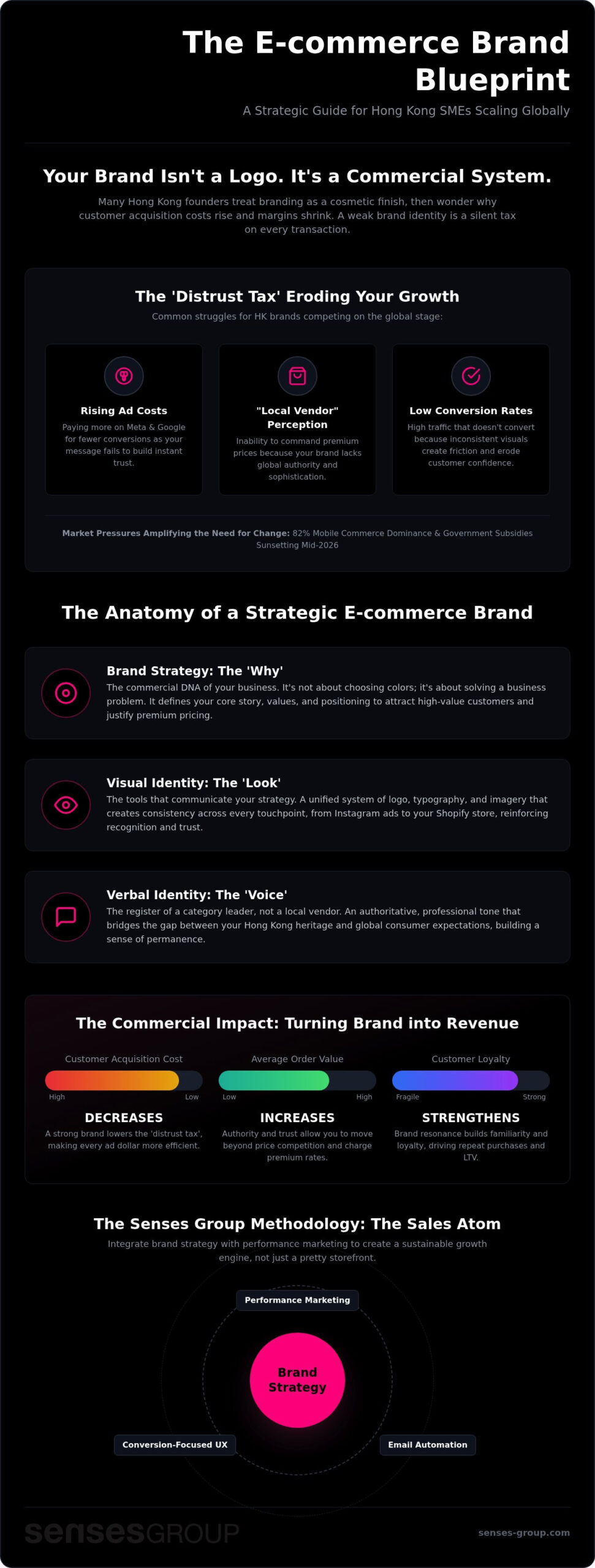
Your brand is not a decorative layer; it’s a commercial infrastructure. Many Hong Kong entrepreneurs view brand identity for ecommerce as a superficial cost, yet they struggle with rising customer acquisition costs (CAC) on platforms like Meta and Google. A strong identity functions as a trust-accelerator. It bridges the gap between a stranger seeing an ad and a customer clicking ‘buy’ without hesitation. When your identity is weak, you pay a ‘distrust tax’ in the form of lower conversion rates and higher ad spend.
Branding is the strategic ‘why’ that justifies your price point. In the competitive Hong Kong landscape, simply having a functional product isn’t enough to scale. A robust identity provides the psychological framework that allows you to charge premium prices. It moves your business from a ‘local vendor’ perception to a ‘global brand’ authority, ensuring that your international customers see a partner they can trust rather than a risky overseas supplier.
The Commercial Impact of Brand Strategy
Brand strategy is the invisible foundation of your entire sales funnel. It’s not about choosing a favorite color; it’s about solving a specific business problem. If your data shows high traffic but low repeat purchase rates, the root cause is often a lack of brand resonance. A strategic identity builds recognition, which leads to familiarity, which ultimately drives loyalty. This cycle is what transforms a fragile startup into a sustainable growth engine.
Visual consistency is the prerequisite for high-performing digital advertising. If your Instagram aesthetic doesn’t match your Shopify store’s landing page, you create cognitive dissonance. This friction kills sales. By maintaining a unified system, you reinforce your brand’s presence at every touchpoint, making every HK$ spent on advertising work harder for your bottom line. A logo is a mark. A brand is a logic.
Brand Identity vs. Visual Identity
It’s vital to distinguish between a visual identity and a comprehensive Corporate Identity system. Visuals are the tools, but the brand identity is the message. It includes your tone of voice, your core story, and the values that differentiate you from the crowd. For Hong Kong SMEs scaling overseas, this distinction is critical. You aren’t just selling a product; you’re selling a perspective.
Effective positioning uses a ‘not this, but that’ approach to sharpen your market standing. You aren’t just another discount retailer; you’re a premium lifestyle curator. You don’t just provide fast shipping; you offer a seamless, high-end experience. This clarity prevents a ‘leaky’ sales funnel by attracting the right audience and repelling the wrong one. A cohesive brand identity for ecommerce ensures that every element of your business, from your Klaviyo email automations to your Shopify checkout, speaks with a single, authoritative voice.
The Anatomy of a Strategic Ecommerce Brand Foundation
A high-converting brand identity for ecommerce is built on structural integrity, not artistic whim. It’s the difference between a storefront that looks “nice” and one that commands authority. For Hong Kong businesses looking to scale, this foundation requires a precise blend of visual assets, verbal register, and systemic consistency. Every element must serve the ultimate goal of commercial growth. It’s not about winning design awards; it’s about winning market share.
Developing a professional, authoritative brand voice is non-negotiable for HK brands targeting Western or premium Asian markets. It avoids the passive tone of a subservient service provider and adopts the register of a category leader. This verbal identity is what bridges the gap between your Hong Kong heritage and global consumer needs. It’s about presenting your local efficiency as a global advantage. When your voice is consistent, you build a sense of permanence that reassures high-value customers.
Defining Your Brand Pillars
Your brand pillars are the root values that differentiate your product from a sea of generic competitors. They aren’t just words on a wall; they are the filters through which every business decision passes. Brand Foundation is the commercial DNA of a business. By crafting a narrative that resonates with high-level international standards, you shift the conversation from price to value. It’s not about being the cheapest option in the market, but about being the most trusted one. This narrative must be deep enough to support years of scaling, ensuring your brand identity for ecommerce remains relevant as you expand into new territories.
Visual Assets for the Digital Shelf
In the 2026 landscape, your visual identity must be optimized for a mobile-first Shopify experience. With 82% of Hong Kong ecommerce purchases occurring on mobile devices, your typography and color palette must maintain legibility and impact on small screens. We utilize a “pink brand” palette strategy to inject energy and modern lifestyle appeal into consumer-facing brands. This approach uses specific visual components to drive engagement:
- Typography that balances distinct character with high-speed mobile legibility.
- A color system that leverages the pink brand strategy to stand out in crowded social feeds.
- Lifestyle photography that focuses on consumer products in natural settings rather than staged office environments.
- AI-generated visual content systems that allow for scalable asset production while maintaining strict brand standards.
This seamless transition between visual assets is what converts a casual browser into a loyal customer. When your visual system is integrated correctly, it ensures that your Meta ads look like your Shopify store, which looks like your Klaviyo emails. This consistency is what prevents “leaky” funnels and builds long-term trust. If you’re ready to move beyond basic design, our team can help you develop a comprehensive brand strategy that serves as a true growth engine.
Aesthetics vs. Conversion: Building for the Shopify Ecosystem
Visual appeal alone is a vanity metric. Many “pretty” sites fail because they lack a strategic content structure that leads the user toward a transaction. A brand identity for ecommerce must be integrated into the User Experience (UX) to function as a commercial tool. It’s not enough to have a beautiful Shopify store; you need a store that understands the psychological triggers of your specific audience. If your design doesn’t facilitate a purchase, it’s not a brand identity; it’s an expensive art project.
Custom Shopify theme development allows us to tailor the identity to the buyer journey rather than forcing your brand into a generic template. This isn’t just about color choices. It’s about how the navigation reflects your brand’s authority and how product pages communicate value through a specific visual hierarchy. This strategic alignment directly impacts your Return on Investment (ROI). Premium brand design isn’t a luxury. It’s a calculated move to increase Average Order Value (AOV). When a customer perceives a brand as premium and stable, they’re more willing to invest more per transaction.
We’ve seen the power of this systemic approach firsthand. For Monchhichi Jewelry Atelier, we implemented a strategic rebuild that focused on aligning their brand identity with a high-performance Shopify infrastructure. The result wasn’t just a more polished site. It doubled their revenue by transforming their digital presence into a credible, high-converting commercial asset that resonated with their target demographic.
CRO and Brand Cohesion
Strategic brand development is the secret to high-performance Shopify sites. Brand elements should serve as visual cues that guide the user through the conversion funnel. Every button, font choice, and spacing decision should reinforce the brand’s position. When your identity is cohesive, it reduces the friction that leads to cart abandonment. For a deeper look at how to structure your store for the coming year, see our 2026 Strategic Shopify Guide for Hong Kong SMEs.
Retention through Identity
Customer acquisition is only half the battle. True growth comes from retention. By integrating your Klaviyo email flows with your brand’s unique tone of voice, you create a seamless experience that extends beyond the initial purchase. Building long-term loyalty requires behavior-based automation that speaks like your brand, not a generic robot. It’s about maintaining a consistent register that reinforces why the customer chose you in the first place. Learn how to recover lost sales with our guide on Mastering the Klaviyo Abandoned Cart Strategy for Global Ecommerce.
Scaling Globally: Adapting Brand Identity for International Markets
Expanding a Hong Kong consumer brand into international territories requires more than just logistical readiness; it demands a psychological transition. Many local businesses fail to scale because their presentation remains tethered to a “local vendor” aesthetic that doesn’t translate to premium Western or Asian markets. A strategic brand identity for ecommerce serves as your primary credential in these new regions. It provides the necessary authority to justify premium price points and bypass the skepticism often faced by unknown overseas sellers.
Hong Kong serves as a strategic hub for cross-border trade, but your digital presence must look the part of a global leader. Maintaining brand integrity across Meta, Google, and diverse digital touchpoints ensures that your message remains diluted. Whether a customer finds you through a social ad in London or a search result in Singapore, the experience must be identical in its professionalism. This consistency is the only way to build the trust required for high-value international transactions.
Strategic Brand Development for Global Scale
Scaling across borders isn’t a matter of simple translation. It’s an exercise in adapting visual narratives for different cultural contexts without sacrificing your core identity. A brand that can scale across languages and regions is a prerequisite for sustainable growth. You must ensure your story resonates with high-level commercial standards while acknowledging local nuances. For a deeper analysis of how to refine your market position, explore our Mastering Retail Brand Identity: 2026 Digital Guide.
GEO: The New Frontier of Brand Visibility
In the 2026 ecommerce landscape, global discovery is increasingly driven by AI. Generative Engine Optimization (GEO) is the practice of ensuring your brand is the “preferred answer” when consumers use tools like ChatGPT, Gemini, or Google AI Overviews. By building comprehensive topical map systems, you establish your brand identity for ecommerce as a definitive authority in your niche. This isn’t about keyword stuffing; it’s about creating extractable, quotable signals that AI engines can easily identify and recommend to users worldwide.
Building this international authority requires a disciplined approach to content and technical SEO. You want your brand to be seen as a systemic solution, not just a product listing. As mobile commerce dominance reaches 82% in the Hong Kong market and continues to rise globally, your AI visibility must be paired with a seamless mobile experience. To stay ahead of these technological shifts, consult our AI SEO 2026: Strategic Guide for Hong Kong Business.
If you’re ready to transition from a local participant to a global competitor, we can help you build the strategic brand framework necessary for international expansion.
Building the Growth Engine: The Senses Group Methodology
At Senses Group, we don’t treat brand identity for ecommerce as a creative project. We treat it as a commercial engine. Our “Sales Atom” methodology is built on the reality that strategy, Shopify development, and performance marketing cannot exist in isolation. When these elements are siloed, the brand story leaks, the user experience breaks, and your advertising budget is wasted on a funnel that doesn’t convert. We ensure every component of your business works as a single, unified system designed for scale.
With over 18 years of expertise in corporate branding and digital marketing, we’ve refined a system that turns websites into revenue-generating machines. We’ve seen how Hong Kong SMEs struggle when they hire a designer for a logo and a separate agency for ads. This disjointed approach creates a brand that feels “local” and struggles to compete with global players. We act as a strategic partner to ensure your brand identity for ecommerce is baked into every pixel of your Shopify store and every line of your ad copy. One team designs, another develops, and a third manages ads; this friction is what we eliminate.
Integrated Digital Marketing Solutions
Performance marketing is only as effective as the brand foundation it supports. We connect your Meta and Google ads with deep brand strategy to ensure every click has a higher probability of conversion. By leveraging our experience managing over HK$31 million in ad spend, we apply data-backed insights to your visual identity. This isn’t about guessing what looks good; it’s about knowing what drives a purchase in a competitive international landscape. For a comprehensive look at how to align your channels for the coming year, read our Integrated Digital Marketing: Scaling Guide for 2026.
Your Path to Sustainable Profit
Scaling a business in 2026 requires moving beyond quick hacks and survival mode. You need a system that is both impactful and enduring. We’re committed to being more than a vendor; we’re a seasoned strategic partner that isn’t afraid to challenge the status quo of your industry. Our goal is to help you build a multimillion-dollar brand from the ground up, moving from the foundational to the functional with disciplined precision. If you’re ready to audit your current identity for commercial viability and finally scale your business, let’s build your growth engine – contact Senses Group.
Engineering Your Brand for Global Scale
Building a high-converting brand identity for ecommerce is a commitment to structural excellence rather than aesthetic preference. It requires a fundamental shift from viewing your online presence as a local storefront to treating it as a global commercial engine. By integrating deep strategy with Shopify Plus development and Klaviyo automation, you create a seamless buyer journey that justifies premium pricing and reduces reliance on expensive, short-term hacks. This isn’t just about looking better; it’s about functioning better at every level of your sales funnel.
Senses Group brings over 18 years of strategic branding expertise to help Hong Kong entrepreneurs transition from market participants to category leaders. We specialize in building systems that have proven to double revenue for our clients by aligning visual authority with technical performance. Whether you’re expanding across Asia or entering Western markets, your success depends on a foundation that commands trust at first glance. It’s time to stop paying a distrust tax on your ads and start building a legacy that scales naturally. We are ready to help you navigate this transition with seasoned, strategic precision.
Turn Your Brand Into a Revenue-Generating Machine – Book a Strategy Session
Frequently Asked Questions
What is the difference between brand strategy and brand identity for ecommerce?
Brand strategy is the commercial foundation that defines your market position and unique value proposition. Brand identity is the visual and verbal execution of that strategy, encompassing your logo, typography, and tone of voice. A cohesive brand identity for ecommerce requires strategy to act as the blueprint. Without it, your visuals are just a cosmetic layer that fails to solve deep-seated business problems or drive long-term growth.
How does a strong brand identity help lower my customer acquisition costs?
A strong identity establishes immediate authority, which reduces the psychological friction cold traffic feels when discovering your store. When your Meta or Google ads align perfectly with a professional landing page, conversion rates increase. This efficiency means you spend less HK$ to acquire each customer. You essentially stop paying a “distrust tax” caused by a fragmented or “local” brand perception that scares away international buyers.
Can Senses Group help migrate my current store to a high-converting Shopify site?
Yes, we specialize in rebuilding ecommerce experiences into revenue-generating machines. Migration is more than a technical shift; it is an opportunity to optimize your UX design and content structure for maximum conversion. We’ve proven this approach by doubling the revenue of clients like Monchhichi Jewelry Atelier. Our team ensures your brand’s commercial DNA is integrated into every pixel of the Shopify ecosystem for sustainable scalability.
Why is Klaviyo automation essential for a brand identity system?
Klaviyo automation ensures your brand voice remains consistent throughout the entire customer lifecycle. It allows you to maintain a professional register in every behavior-based flow, from welcome sequences to abandoned cart recovery. By automating these touchpoints, you build long-term loyalty without manual intervention. This systemic integration turns one-time buyers into repeat customers, which is the root of a profitable, scalable ecommerce business in the Hong Kong market.
How long does a complete brand identity and ecommerce rebuild take?
A comprehensive brand and Shopify rebuild typically requires 8 to 16 weeks to complete. This timeline allows for a methodical process that includes defining brand pillars, designing visual assets, and executing a custom technical build. We prioritize substance over superficial speed to ensure your foundation is enduring. Rushing this strategic work often results in “leaky” sales funnels that require expensive and time-consuming corrections after the site goes live.
What is Generative Engine Optimization (GEO) and why does my brand need it?
GEO is the practice of optimizing your digital presence to be recommended by AI engines like ChatGPT and Google AI Overviews. As consumer search habits shift toward generative AI, your brand must provide extractable signals that establish you as a category authority. We use topical map systems and LLM-optimized metadata to ensure your brand identity for ecommerce is the preferred answer. This visibility is critical for international discovery in 2026.
Does Senses Group work with startups or only established SMEs?
We partner with both ambitious startups and established SMEs looking for a strategic growth partner. While we have managed over HK$31 million in ad spend for major corporations, we also enjoy building brands from zero to multimillion-dollar status. Our criteria is not just the size of the business, but the owner’s commitment to building a disciplined, scalable system. We act as an authoritative mentor for those ready to challenge their industry.
How do I ensure my brand identity remains consistent across Meta and Google ads?
Consistency is maintained through a unified brand guidelines system that governs every digital touchpoint. We manage Meta and Google advertising alongside your core strategy to prevent the messaging silos that kill conversion. By using identical color palettes, lifestyle-oriented imagery, and a professional tone across all channels, you reinforce your market position. This rhythmic repetition builds the trust necessary for high-performing campaigns and a stable, long-term brand presence.