
What if the most effective way to neutralize skyrocketing customer acquisition costs in 2026 isn’t a larger Meta budget, but a more disciplined ethical foundation? For many Hong Kong brands, the pressure to adopt eco-friendly practices feels like a direct threat to the bottom line rather than a commercial opportunity. You understand the necessity of evolution, yet the path from a local HK$500,000 monthly turnover to international trade is often blocked by the friction of inefficient systems and fading consumer trust.
Achieving true sustainable ecommerce growth is not about choosing between profit and purpose; it’s about engineering a system where they reinforce each other. You need a model that replaces the frantic hunt for new clicks with a predictable, AI-driven engine that fosters deep brand loyalty and commands premium pricing. This isn’t a creative experiment, but a structural shift toward commercial longevity and global relevance.
In this guide, we’ll break down the strategic framework for building a high-performance Shopify presence that leverages Klaviyo automation and advanced SEO to scale beyond the local market. You’ll discover how to integrate environmental responsibility into your core brand identity without sacrificing the operational efficiency required to compete on the world stage.
Key Takeaways
- Transition from the obsolete “growth at all costs” mindset to a framework that secures commercial longevity through environmental responsibility.
- Use strategic brand positioning to create a defensive moat, reducing your dependence on volatile ad platforms and lowering long-term customer acquisition costs.
- Implement circular packaging and carbon-conscious logistics to transform ethical operations into a high-performance competitive advantage.
- Future-proof your digital presence for 2026 by adopting Generative Engine Optimisation (GEO) and AI-driven automation to ensure sustainable ecommerce growth.
- Integrate disciplined brand strategy with high-performance Shopify development to successfully scale your Hong Kong business into an international trade entity.
Redefining Sustainable Ecommerce Growth for 2026
The era of “growth at all costs” is officially over. In the mid-2020s, the combination of rising privacy restrictions, saturated ad markets, and the end of cheap capital forced a commercial reckoning. Real sustainable ecommerce growth in 2026 is no longer a choice between environmental ethics and commercial longevity; it is the deliberate synthesis of both. If your business model relies on burning cash to buy temporary attention, it isn’t a business. It’s a subsidy. True sustainability means building a brand that can endure market volatility while actively contributing to the ecosystem it inhabits.
We are seeing a profound shift from mindless consumerism to conscious commercialism. Modern buyers, especially in high-density markets like Hong Kong, don’t just evaluate a product by its price or aesthetics. They analyze the systemic impact of their purchase. To survive, brands must move beyond surface-level “green” marketing and integrate ethical operations into their foundational DNA. This isn’t about charity. It’s about securing a competitive advantage in a world where transparency is the new currency.
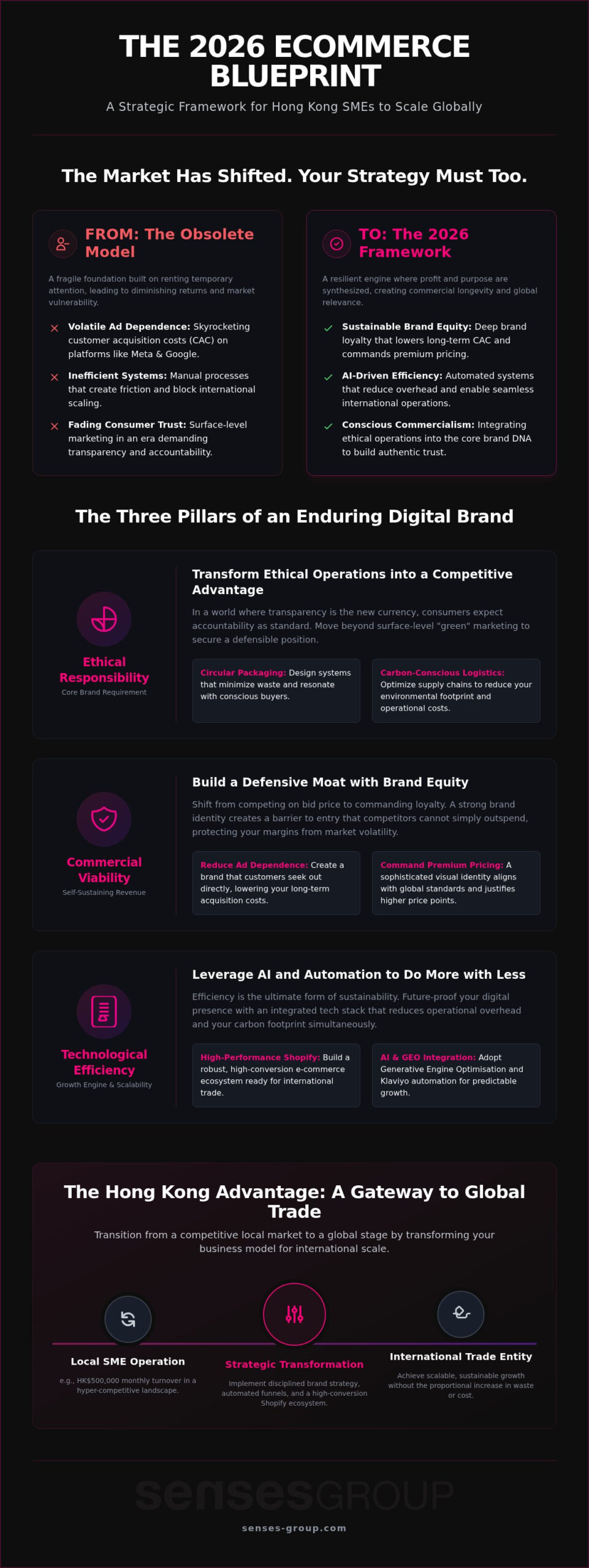
The Three Pillars of an Enduring Digital Brand
Building a brand that lasts requires a three-dimensional approach to stability. You cannot focus on one at the expense of the others without risking structural failure.
- Ethical Responsibility: This is no longer a “nice-to-have” feature. Environmental and social impact are now core brand requirements. Consumers expect circularity and accountability as standard.
- Commercial Viability: You must build a self-sustaining revenue engine. This involves moving away from platform dependency and toward owned channels that resist external market shocks.
- Technological Efficiency: Efficiency is the ultimate form of sustainability. By leveraging AI and automation, you can do more with fewer resources, reducing both your carbon footprint and your operational overhead.
Why Hong Kong SMEs Must Pivot Now
Hong Kong brands face a unique challenge. You are navigating a hyper-competitive local landscape while simultaneously eyeing global expansion. The “small market” hurdle is real, but it’s not insurmountable. It’s a strategic prompt. Using Hong Kong as a sustainable gateway for international trade requires a shift from traditional retail mentalities to robust, high-conversion Shopify ecosystems.
The transition isn’t just about moving sales online. It’s about a fundamental transformation of how you reach and retain customers. By adopting a disciplined brand strategy and automated sales funnels, local SMEs can scale internationally without the proportional increase in waste or cost that traditional expansion once required. The goal is a business that grows because it is efficient, not because it is loud.
The Commercial Pillar: Lowering CAC through Brand Equity
The reliance on Meta and Google advertising has reached a critical tipping point. While these platforms remain necessary for visibility, they are no longer viable as standalone growth strategies. In the competitive Hong Kong landscape, where ad costs fluctuate wildly, a brand that competes solely on bid price is inherently fragile. True sustainable ecommerce growth is built on brand equity; it’s the psychological moat that protects your margins when the cost per click inevitably rises.
Strategic brand positioning for startups transforms your product from a commodity into a destination. When a consumer identifies with your brand story, the price becomes secondary to the value proposition. This shift from buying a product to joining a brand narrative is the most effective way to resist the price wars that decimate local SMEs. It creates a barrier to entry that competitors cannot simply outspend.
From Transactional to Relational: The Power of Identity
A sophisticated visual identity system does more than look professional; it commands premium pricing. In 2026, your visual assets must align with global standards, especially if you intend to scale from the local HK market into the international luxury or lifestyle sectors. A polished, cohesive identity reduces the cognitive load on the consumer, making the decision to purchase feel inevitable rather than calculated. This reduction in friction is the root of lowering customer acquisition costs.
When your brand resonates at a foundational level, your organic traffic increases and your conversion rates stabilize. We’ve seen this strategic alignment deliver results for brands like Monchhichi Jewelry, where a disciplined identity and automated funnel resulted in 2x revenue growth. It’s about creating a system where every ad dollar works harder because it’s backed by a compelling, credible brand promise. Identity isn’t just decoration; it’s a commercial tool for conversion.
Direct-to-Consumer (DTC) as a Scalable Foundation
Owning your platform is the ultimate sustainable asset. Transitioning from third-party marketplaces to a proprietary Shopify growth engine allows you to capture and control your own customer data. This data is the fuel for predictable, recurring revenue, providing the insights needed to refine your product offering and marketing spend. It’s the difference between renting an audience and owning a community.
The mechanics of direct to consumer brand building rely on this integrated approach. By bypassing intermediaries, you retain higher margins and build direct relationships that ad platforms cannot take away. If you’re looking to build a resilient business, establishing a bespoke Shopify ecosystem provides the structural independence required to scale internationally from a Hong Kong base. This independence is what separates enduring brands from temporary digital trends.
The Environmental Pillar: Ethical Operations as a Competitive Edge
Ethical operations are frequently misclassified as a burden on the balance sheet. In reality, they represent the most sophisticated form of risk management available to a modern brand. Achieving sustainable ecommerce growth requires moving beyond superficial “green” marketing to a model where every operational decision reduces waste while increasing customer lifetime value. It’s not about being “less bad” but about being strategically better. When your operations are efficient, they are inherently more sustainable.
Packaging is the first physical touchpoint for your brand. While plastic-free initiatives were the baseline for 2024, the 2026 standard is circularity. Implementing “return-and-refill” models transforms a one-time purchase into a recurring service, securing the customer relationship through the logistics of the container itself. This is particularly effective in the high-density Hong Kong market. Localized fulfillment can turn a shipping challenge into a community-based circular economy, reducing the carbon footprint of the “last mile” while fostering deep brand loyalty.
Transparency has evolved into a technical requirement. The “Digital Product Passport” (DPP) provides a verifiable record of ethical sourcing and carbon impact. For HK businesses scaling internationally, this isn’t just a compliance hurdle; it’s a badge of quality that justifies premium pricing in European and North American markets. Furthermore, reducing your return rate is a critical environmental strategy. High-quality UX and accurate product visuals prevent the waste associated with failed expectations. A returned item doubles the carbon footprint and erases the profit margin, making precision the ultimate green initiative.
Implementing Eco-Friendly Logistics without Sacrificing Margin
Logistics shouldn’t erode your profit. By selecting Shopify integrations that prioritize carbon-conscious delivery, you offer customers a choice that aligns with their values. The “Slower but Greener” shipping trend is gaining momentum among conscious consumers. It works because it reframes a logistics delay as a conscious ethical choice, reducing the pressure on your supply chain while lowering costs. You can also offset footprints through performance-based affiliate systems that fund restoration projects only when a sale is finalized, ensuring your margins remain protected.
Circular Ecommerce Models
Your Shopify store should be the hub for the entire product lifecycle. Integrating resale or trade-in programs directly into your storefront keeps your brand relevant long after the initial sale. It prevents your products from entering landfills while creating a secondary revenue stream. AI tools now allow for hyper-accurate inventory forecasting, which prevents the overproduction waste that historically crippled SME margins. This is how you build a community around “conscious consumption” that stays loyal to your brand for the long term, rather than just the next transaction.
The Technological Pillar: AI and Automation as Growth Engines
Technology is the connective tissue between ethical intent and commercial reality. In 2026, sustainable ecommerce growth is achieved by those who replace brute-force marketing with automated precision. We are moving away from a world where brand visibility is purchased by the highest bidder. Instead, we are entering an era where visibility is earned through systemic efficiency and technological sophistication. Technology doesn’t just support growth; it defines the limit of your scalability.
Modern strategic brand development now mandates the use of Generative Engine Optimisation (GEO). If your brand isn’t being cited by Large Language Models like ChatGPT, Gemini, or DeepSeek, it effectively doesn’t exist for a growing segment of the market. This isn’t just about keywords. It’s about building a topical authority map that AI engines can parse, understand, and recommend. By optimizing your metadata for LLM search intent, you capture high-intent traffic that traditional SEO often misses.
AI also offers a solution to the high carbon and financial costs of traditional content production. Instead of organizing expensive, resource-heavy photoshoots that can cost upwards of HK$60,000 for a single campaign, brands are leveraging AI for visual production. This reduces the carbon footprint and operational overhead while allowing for hyper-personalized creative at scale. You can now test hundreds of visual variations without the waste of a physical set, making your creative process as lean as your logistics.
Klaviyo and the Science of Retention
Retention is the most sustainable form of revenue growth. It’s significantly more efficient to retain a customer than to acquire a new one in the hyper-competitive Hong Kong market. By implementing behavior-based Klaviyo flows, you create a self-sustaining cycle of engagement. Lifecycle marketing ensures that every customer acquired is a long-term investment rather than a one-off transaction. You can deploy automated sequences to maximize impact:
- Welcome Flows: Introduce brand values and ethical commitments immediately.
- Abandoned Cart Recovery: Use AI-driven timing to recover lost HK$ without human intervention.
- Post-Purchase Education: Turn buyers into advocates by teaching them how to use, maintain, or recycle your products.
GEO: The New Frontier of Sustainable Traffic
The shift from traditional SEO to GEO marks the new frontier of digital discovery. You must optimize for AI search engines to maintain relevance in a world where users ask questions rather than type keywords. This involves building an AI-enhanced content ecosystem that establishes your brand as the definitive authority in your niche. By creating content that machines can easily categorize and trust, you drive long-term organic traffic without the recurring tax of ad spend. To implement these automated systems in your business, explore our AI-driven growth engines and start scaling your efficiency today.
Building Your Sustainable Growth Engine with Senses Group
Achieving sustainable ecommerce growth requires more than a functional website; it demands a unified commercial system. At Senses Group, we don’t provide isolated marketing services. We engineer integrated growth engines that bridge the gap between local Hong Kong operations and global market dominance. Our methodology moves beyond the superficial to address the foundational mechanics of your business, ensuring that every design choice and automated flow serves a clear commercial purpose. We don’t sell cookie-cutter marketing packages; we craft proprietary sales funnels designed for long-term profit.
The transition from a traditional local model to a multimillion-dollar international presence is a structural challenge, not just a creative one. It involves dismantling inefficient legacy systems and replacing them with robust, automated architectures. By applying our internal brand-building expertise, we help HK SMEs navigate this digital transformation, turning the city’s role as a gateway into a scalable competitive advantage. This is about building a business that grows because it is fundamentally better, not because it is spending more.
Proven Results: The Monchhichi Jewelry Case Study
The effectiveness of this integrated approach is best demonstrated through our work with Monchhichi Jewelry. By executing a complete ecommerce rebuild, we transitioned their presence from a traditional model to a high-performance Shopify ecosystem. We didn’t just update the visuals; we integrated AI-driven content systems and sophisticated web design that reduced user friction at every touchpoint. The result was a documented 2x revenue growth, driven largely by the implementation of automated Klaviyo email flows that maximized total order value without increasing manual workload. This case study proves that when brand strategy and technological efficiency align, the commercial impact is immediate and enduring.
Your Roadmap to a Sustainable 2026
Your transition to a resilient, international brand follows a deliberate three-phase roadmap designed for stability and scale. This process ensures you build a foundation that supports your vision without collapsing under the weight of expansion.
- Phase 1: Brand Foundation and Identity Audit. We analyze the root of your market positioning and refine your identity to command premium pricing.
- Phase 2: Shopify Optimization and AI Integration. We build your proprietary growth engine, implementing AI visual systems and automated sales funnels.
- Phase 3: Scaling via GEO and Performance-Based Affiliates. We establish your authority in AI search engines and scale your reach through low-risk, high-reward partnerships.
Let’s build your growth engine-Contact Senses Group today.
Mastering the Future of Commercial Longevity
The evolution of digital trade in Hong Kong requires a move from temporary tactics to systemic integration. You’ve seen how brand equity serves as a defensive moat against rising costs and how ethical operations can become a distinct competitive advantage. It’s not about choosing between profit and purpose; it’s about building a model where one fuels the other. Achieving sustainable ecommerce growth in 2026 is a matter of strategic discipline.
By leveraging AI-driven automation and high-performance Shopify architectures, you transform your business from a local player into a global contender. Senses Group brings over 18 years of expertise to this transformation, maintaining Red Dot award-level design standards and managing over HK$31 million in ad spend with proven ROI. As specialists in Shopify Plus and Klaviyo integration, we provide the architectural foundation for your expansion.
Turn your website into a revenue-generating machine, Consult with Senses Group. Your path to a resilient, international presence starts with a single strategic pivot.
Frequently Asked Questions
What is the difference between green ecommerce and sustainable ecommerce growth?
Green ecommerce focuses primarily on the environmental footprint of products and logistics. In contrast, sustainable ecommerce growth represents a holistic business model where ethical operations, commercial longevity, and technological efficiency converge. It isn’t just about being eco-friendly; it’s about building a system that generates predictable revenue without depleting your financial or environmental resources over the long term.
How can I reduce my customer acquisition costs (CAC) sustainably?
You reduce customer acquisition costs by investing in brand equity rather than just bidding on keywords. When your brand positioning is clear, you attract higher-intent traffic organically. Focusing on retention through automated lifecycle marketing ensures that the cost of acquiring a customer is amortized over a much longer period, effectively lowering your blended CAC as your brand authority matures.
Is Shopify the best platform for building a sustainable ecommerce business in 2026?
Shopify remains the premier choice for 2026 because of its robust infrastructure and seamless integration with advanced AI tools. For Hong Kong businesses, it provides the necessary agility to manage local sales while scaling into international markets. Its ecosystem supports everything from circular trade-in programs to LLM-optimized metadata, making it a foundational tool for long-term scalability and efficiency.
How does Generative Engine Optimisation (GEO) differ from traditional SEO?
Traditional SEO optimizes for search engine algorithms based on keywords and backlinks. Generative Engine Optimisation (GEO) focuses on making your brand the definitive authority that Large Language Models cite in their responses. It requires a topical map approach that establishes credibility across a broad subject area, ensuring your brand appears in AI-generated answers on platforms like ChatGPT and Gemini.
Can a small Hong Kong SME really compete in the global ecommerce market?
A small Hong Kong SME can absolutely compete globally by leveraging the city’s strategic position as a trade gateway. Success depends on moving away from generic models toward a high-conversion, automated digital presence. By focusing on niche brand identity and operational efficiency, local businesses can outperform larger competitors who lack the agility to adopt new AI-driven growth engines quickly.
What role does email automation play in sustainable business scaling?
Email automation is the backbone of lifecycle marketing and retention. By using tools like Klaviyo to create behavior-based flows, you generate recurring revenue from your existing audience at a fraction of the cost of paid ads. This creates a self-sustaining sales funnel that rewards loyalty and increases the lifetime value of every customer, which is essential for sustainable ecommerce growth.
How do I balance eco-friendly packaging with high shipping costs?
You balance these costs by reframing logistics as a value proposition. Implementing circular models, such as returnable packaging, can build customer loyalty and recurring touchpoints. Offering “slower but greener” shipping options allows you to optimize logistics routes, reducing both your carbon footprint and your operational expenses. This approach protects your margins while meeting the ethical demands of modern consumers.
Why is brand strategy more important than ad spend for long-term growth?
Brand strategy is the structural foundation of your business, whereas ad spend is a temporary accelerant. Without a clear strategy, your growth is entirely dependent on the fluctuating prices of ad platforms. A disciplined brand identity creates a psychological moat, allowing you to command premium pricing and maintain customer loyalty even when market conditions in the Hong Kong ecosystem become volatile.