Most founders treat branding as a visual exercise in aesthetics, but in a market where 5,221 startups are competing for the same digital real estate, a pretty logo is a liability, not an asset. You’ve likely felt the sting of rising customer acquisition costs (CAC) or the frustration of being compared to cheaper competitors on price alone. It’s exhausting to build a business that feels like a commodity when you know your value is premium. Effective brand positioning for startups isn’t about looking better; it’s about being fundamentally different in a way that the market finds undeniable.
You’ll learn the exact methodology to define your market space, lower your acquisition costs, and build a high-converting brand foundation that scales from Hong Kong to global markets. We’ll examine how to transform your Shopify store into a growth engine by moving from local relevance to international authority using a framework that prioritizes commercial logic over mere creativity. This is the blueprint for turning a local venture into a defensible, global brand.
Key Takeaways
- Understand why brand positioning is the commercial foundation of your business, acting as a “Bespoke Sales Atom” that dictates every customer interaction and marketing outcome.
- Learn the exact methodology for brand positioning for startups to identify underserved “white space” in the Hong Kong market and significantly lower customer acquisition costs.
- Discover how to translate your unique market position into a high-converting Shopify ecosystem that bridges the gap between brand identity and conversion rate optimization.
- Explore advanced strategies for global scaling, including Generative Engine Optimization (GEO) to ensure your brand remains visible and authoritative within AI-driven search results.
- Identify the root causes of stagnant growth and implement a strategic recovery framework designed to build a defensible, multimillion-dollar brand that scales internationally.
Beyond the Visuals: Why Brand Positioning is a Startup’s Commercial Foundation
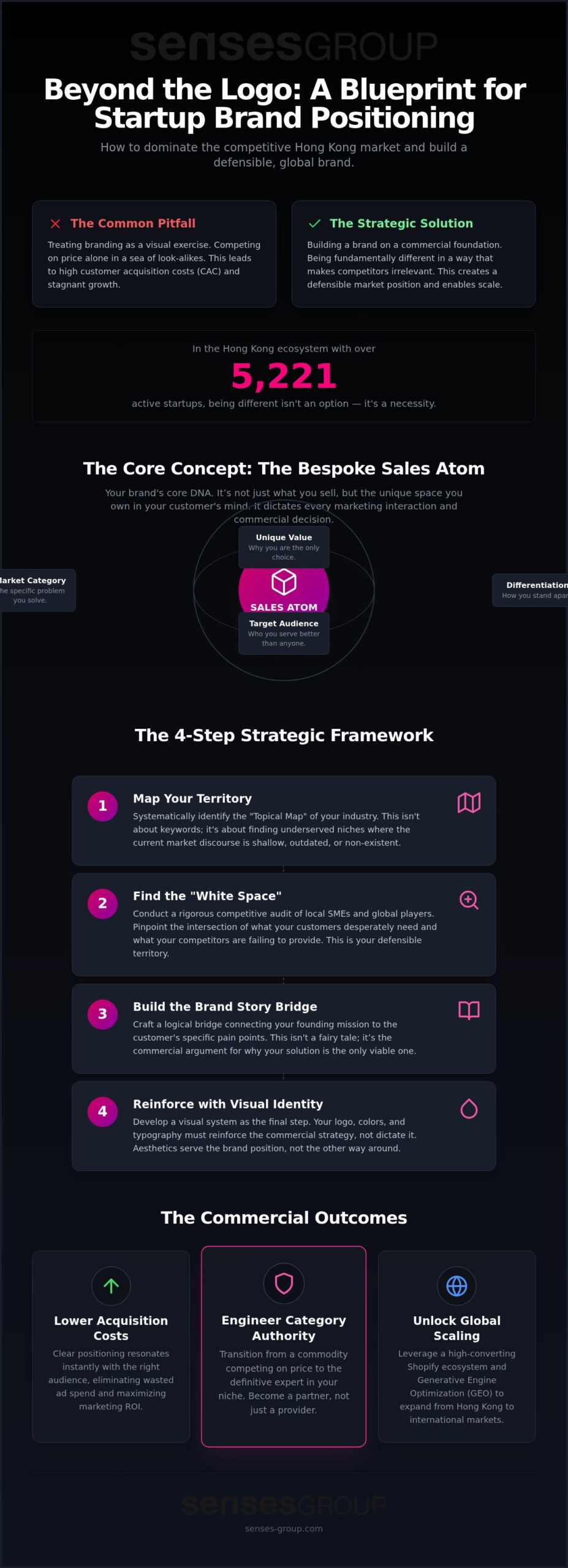
Positioning is the “Bespoke Sales Atom” of your enterprise. It’s the core DNA that dictates every marketing interaction and every commercial decision you make. Many founders mistake a sleek logo for a brand; however, aesthetics without strategy are merely expensive decorations. True brand positioning for startups represents the difference between a business that competes on price and one that dominates its category.
We utilize a “not this, but that” framework to sharpen this focus. Your startup is not a generic solution provider; it’s a specific architect of a desired outcome. This brand positioning isn’t about being marginally better than the incumbent. It’s about being fundamentally different in a way that makes the incumbent irrelevant. This strategic clarity addresses the root of business stagnation, replacing superficial fixes with a permanent foundation for scale.
The Psychology of Market Differentiation
To survive in Hong Kong’s dense ecosystem, you must transition from being a service provider to a category authority. Authority isn’t granted; it’s engineered through strategic confidence. When you position your startup as the definitive expert in a niche, you bypass the race to the bottom. Consumers and investors don’t just look for products; they look for stability and insight. Moving from commodity pricing to premium value requires a shift in perceived authority. If you’re seen as one of many, you’re a commodity. If you’re seen as the only choice for a specific problem, you’re a partner.
Positioning as a Growth Engine
Your brand strategy is the blueprint for your entire sales funnel. It determines who enters the top of the funnel and why they stay until the bottom. When your brand positioning for startups is clear, it naturally lowers customer acquisition costs because your messaging resonates instantly with the right audience. You aren’t wasting capital shouting at a crowd; you’re speaking directly to a qualified segment.
For struggling SMEs, recovery doesn’t start with more ad spend. It starts with a root-cause audit of your positioning. If your growth has plateaued, it’s likely because your foundation can no longer support the weight of your ambitions. Repositioning isn’t a pivot; it’s an alignment of your commercial reality with market needs, ensuring long-term, sustainable, and scalable growth.
The Strategic Framework: Mapping Your Startup’s Unique Market Space
Mapping a market space is not a creative whim; it’s a systematic process of elimination and selection. It isn’t about guessing where customers are. It’s about identifying exactly where your competitors are not. For brand positioning for startups to be effective, it must be grounded in the commercial reality of the Hong Kong ecosystem, where 5,221 startups were active as of 2025. You cannot afford to be a “me-too” brand in such a dense environment.
The first phase involves identifying the “Topical Map” of your industry. You aren’t just looking for keywords. You’re looking for underserved niches where the current discourse is shallow or outdated. By finding these gaps, you can claim a territory that you can own entirely.
Next, we conduct a rigorous competitive audit. In Hong Kong, this means analyzing both local SMEs and the global giants entering the hub. We look for the “white space”-the intersection of what your customers desperately need and what your competitors are failing to provide. This is the stage where crafting a brand positioning statement becomes the anchor for your entire commercial operation.
This leads to the brand story. This isn’t a fairy tale; it’s a logical bridge. It connects your founding mission to the customer’s specific pain points. Finally, we develop a visual identity system. Most agencies start here. We end here. Your visuals must reinforce the commercial strategy, not dictate it.
The Bespoke Sales Atom Methodology
Our proprietary methodology breaks your brand down into its most fundamental, high-converting components. We don’t build generic narratives. We craft a “Sales Atom” that resonates with the sophisticated logic of a Hong Kong business owner while maintaining the polish required for international scaling. Every touchpoint, from your Shopify header to your Klaviyo flows, must reflect a commercial thinker’s discipline. This ensures that your brand positioning for startups remains consistent as you move from local entry to global expansion.
Building a Defensible Competitive Advantage
Growth is fragile without a moat. Defensibility comes from integrating direct to consumer brand building principles that give you total control over your data and customer relationships. Leveraging an 18-year history of strategic expertise allows startups to build trust rapidly, even when competing against established players. If you’re struggling to find your edge, a strategic partner can help you reveal the hidden leverage points in your current model to ensure your brand is both impactful and enduring.
Translating Positioning into a High-Converting Shopify Ecosystem
A Shopify store is not just a catalog; it’s the physical manifestation of your commercial DNA. In the Hong Kong market, where operational costs like the HK$230 monthly Basic plan and transaction fees of 3.3% + HK$2.35 impact margins, every click must be intentional. Effective brand positioning for startups is realized through the architecture of your digital storefront. It’s the bridge between a visitor’s problem and your specific solution. By utilizing a brand strategy mapping framework, you can ensure your store’s navigation, product hierarchy, and messaging reflect your chosen market space rather than a generic template. This alignment ensures that your conversion rate optimization (CRO) efforts are grounded in strategy, not just testing.
Designing for Revenue, Not Just Aesthetics
Pretty sites fail because they prioritize visual noise over strategic clarity. Your UX design should mirror the brand’s authoritative persona. It must lead the customer through a logical progression toward purchase. We utilize AI visual production to create high-end imagery that justifies premium pricing. This isn’t about decoration; it’s about systemic trust. If your visuals don’t match your positioning, you create a psychological friction that kills conversion. A commercial thinker understands that a website is a sales tool first and a gallery second. Every design element must serve the goal of tripling average order value through perceived authority.
The Role of Lifecycle Marketing
The sale doesn’t end at the checkout. Integrating Klaviyo email automation allows you to reinforce your brand positioning post-purchase. You aren’t just sending receipts. You’re telling a story at every stage of the customer journey. This retention marketing acts as the sustainable growth counterpart to paid ads. It’s the difference between a one-time buyer and a lifetime advocate. In an environment where acquisition is expensive, building loyalty that transcends a single transaction is the only path to a multimillion-dollar brand. By automating this narrative, you ensure your positioning remains consistent across all digital trade channels.
Scaling Globally: Leveraging AI and GEO for Market Visibility
Scaling from a local hub like Hong Kong to a global stage requires a fundamental shift from keyword matching to entity authority. Traditional SEO is now merely a baseline; Generative Engine Optimization (GEO) is the new frontier. To maintain brand positioning for startups in 2026, you must ensure Large Language Models (LLMs) like Gemini and ChatGPT recognize your brand as a definitive source. This involves optimizing brand metadata and structured data to feed the “AI Engine” the correct commercial context. It’s about being the answer the AI provides when a user asks for a solution in your niche.
Dominating international search results requires an AI-driven content ecosystem. You aren’t just producing blogs; you’re building a network of authority signals that span multiple regions. This includes leveraging a global influencer network, or what we call a “100k follower growth engine,” to create social proof that scales across borders. By connecting your brand to a web of recognized authorities, you accelerate the trust-building process in new markets where your name is not yet established.
Dominating the Digital Trade Hub
Hong Kong serves as a strategic “two-way gateway” between mainland China and global markets. Startups must leverage this unique position by using digital trade to enter overseas markets with surgical precision. Shopify provides the logistics and payment framework for this expansion, but the strategy must remain consistent. Whether you’re selling in London or Tokyo, your brand must speak with the same authoritative voice. Maintaining brand consistency across diverse geographic regions is the only way to prevent your identity from becoming diluted as you scale.
AI Production and Performance
Global scale requires operational speed. Utilizing AI for short videos and ad visuals allows you to test hundreds of creative variations without the traditional production costs that usually drain a startup’s budget. We manage Meta and Google ads using a performance-based model to ensure every HK$ spent contributes directly to the bottom line. This “Marketing Map” approach ensures omni-channel dominance by connecting every digital touchpoint into a single, unified system. If you’re ready to move beyond local boundaries, our integrated brand strategy can help you build a scalable framework for international growth.
Navigating Market Recovery and Sustainable Growth with Senses Group
Recovery for a struggling startup is rarely a matter of simply increasing ad spend. It’s a matter of auditing the core logic of the business. If your customer acquisition cost is rising while your conversion rate remains stagnant, the issue is likely a misalignment between your offer and the market’s perception. A root-cause audit of your brand positioning for startups reveals exactly where the friction lies. By identifying these systemic flaws, you can pivot from a position of weakness to one of defensible strength. This isn’t a cosmetic change; it’s a structural realignment designed to restore commercial momentum.
Senses Group acts as the strategic partner that converts abstract strategy into measurable revenue. We don’t just build websites; we build commercial systems. Our integrated digital solutions aim to triple average order value by focusing on high-intent customer segments and premium brand perception. This isn’t about superficial excitement. It’s about a disciplined, systemic approach to growth that is sustainable, scalable, and enduring. Brands that prioritize sustainable ecommerce growth by aligning commercial longevity with ethical impact are consistently better positioned to command premium pricing and foster deep brand loyalty. We help you build a growth engine that operates with mathematical precision, ensuring your brand positioning for startups translates into long-term market leadership.
The Senses Group Advantage
With over 18 years of experience serving both global giants like Sony and LVMH and emerging local SMEs, we understand the mechanics of success at every scale. Our approach combines commercial logic with AI innovation and deep Shopify expertise. We’ve seen the results firsthand. Our strategies doubled revenue for Monchhichi Jewelry Atelier and have built multimillion-dollar home brands from zero since 2018. We use a proprietary “Marketing Map” to ensure every HK$ spent on Meta or Google ads is an investment in long-term authority, not just a temporary spike in traffic. This seasoned assurance is what allows our clients to scale with confidence.
Your Next Strategic Step
The most dangerous position for a Hong Kong startup is the middle ground. To achieve global scale, you must be willing to challenge the status quo of your industry. This requires choosing a partner that values commercial logic over mere creativity. You need a guide who isn’t afraid to tell you when your current path is a dead end. If you’re ready to stop treating your business like a commodity and start building a high-converting foundation, it’s time to take the next step. Let’s build your growth engine today and secure your place in the global market.
Engineering Your Commercial Future
Success in Hong Kong’s dense ecosystem isn’t a matter of chance; it’s a result of systemic design. We’ve established that branding is not a creative luxury, but a commercial necessity that dictates the efficiency of your entire sales funnel. By moving from a commodity mindset to a category authority, you create a defensible moat that protects your margins and accelerates global growth. Effective brand positioning for startups is the fundamental root of this transformation, ensuring every marketing dollar spent contributes to a permanent foundation rather than a temporary spike.
Senses Group offers the seasoned assurance of 18 years in strategic branding and Shopify development. We’ve managed over HK$31 million in ad spend and consistently delivered 2x revenue growth for our ecommerce partners. We don’t just provide services; we build enduring growth engines tailored for international scale. Partner with Senses Group to build your startup’s growth engine. It’s time to stop navigating the noise and start leading the market.
Frequently Asked Questions
What is the difference between brand identity and brand positioning for a startup?
Brand identity refers to the visual and verbal assets of your business, such as logos and typography. brand positioning for startups is the strategic logic that dictates why those assets exist. Identity is the “how,” while positioning is the “where” and “why.” It’s the difference between having a recognizable face and having a defensible market territory that competitors cannot easily invade.
How long does it take to see the ROI of a new brand positioning strategy?
You can observe a reduction in customer acquisition costs almost immediately through improved ad resonance. Full commercial ROI typically matures over six to twelve months as your brand equity compounds. Positioning is a long-term asset, not a short-term campaign. It creates a cumulative effect where every subsequent marketing dollar becomes more efficient because your foundation is finally stable.
Can a startup reposition itself if the first launch failed to gain traction?
Repositioning is often the most effective path for a startup that has failed to gain traction. Failure usually indicates a mismatch between your value proposition and market needs. By conducting a root-cause audit, you can identify the “white space” you missed initially. This isn’t a retreat; it’s a strategic realignment that transforms a struggling commodity into a premium category authority.
How much should a Hong Kong startup budget for professional brand positioning?
Investment levels for professional strategy vary based on the complexity of your market and the depth of the audit required. Startups should view this as a foundational capital expenditure rather than an operational expense. While we don’t provide fixed pricing here, a strategic partner typically scales their involvement to match your growth stage. It’s an investment in lowering your future marketing waste.
Why is Shopify the recommended platform for startups scaling from Hong Kong?
Shopify provides the global infrastructure necessary to manage international trade from a Hong Kong hub. It offers native support for multi-currency transactions and localized checkout experiences. For startups, it’s the most efficient tool for realizing a brand positioning strategy because it integrates seamlessly with advanced automation and performance marketing tools. It’s the engine that supports your international ambitions.
What is GEO and how does it affect my brand’s visibility in 2026?
Generative Engine Optimization (GEO) is the process of optimizing your brand so that Large Language Models (LLMs) like ChatGPT and Gemini recommend you. In 2026, visibility isn’t just about ranking on page one of Google; it’s about being the cited authority in AI-generated answers. Your brand metadata and structured data must be engineered to feed these models the correct commercial context.
Do I need a local agency if I want to scale my brand to international markets?
You need a partner that understands the unique logistics of the Hong Kong market while possessing a global strategic mindset. A local agency with international experience provides the bridge between your current operations and overseas expansion. They understand local regulations and funding schemes while building a brand foundation that resonates with consumers in London, New York, or Tokyo.
How does brand positioning help in lowering customer acquisition costs (CAC)?
brand positioning for startups lowers acquisition costs by increasing the precision of your messaging. When your position is clear, your ads resonate instantly with the right audience, which improves click-through rates and lowers bid costs. You aren’t wasting budget on broad appeals; you’re speaking directly to a qualified segment that recognizes your specific value. This efficiency turns your ad spend into a growth engine.