
A polished Shopify storefront can still leave shoppers unsure what to do next. For growing businesses, that gap can widen as they expand into overseas markets and need to keep product discovery, brand messaging and checkout clear for different audiences. The right Shopify UX design services address more than appearance: they connect the customer journey to the brand and the store’s technical foundations.
If visitors browse but don’t move confidently towards purchase, the cause may involve usability, content, branding or implementation. Often, these elements work together. A confusing product page, inconsistent messaging or friction on mobile can weaken the whole experience. Reviewing the journey step by step helps identify what to address first.
This guide shows you how to assess the UX issues that matter to shoppers and your business, compare service scope and agency approaches, and choose a partner with a clear growth perspective. You’ll see how brand strategy, customer journey design, Shopify development and conversion rate optimisation can work as one system, creating a more coherent experience today and a stronger foundation for growth across markets.
Key Takeaways
- Assess Shopify UX by how well shoppers can discover products, understand the offer and move through the buying journey, not by visual polish alone.
- Strong Shopify UX design services connect brand strategy, content structure, customer journey design, Shopify implementation and conversion rate optimisation.
- Compare agency approaches by strategic depth, UX scope, Shopify expertise, evidence and alignment with your growth goals.
- Prepare for a focused project by defining business priorities and customer friction, then gathering store content, brand assets, customer questions and relevant performance information.
- Measure progress against clear business and customer-journey priorities so your Shopify experience can evolve as you expand into new markets.
Why Shopify UX Design Services Matter Beyond a Store Redesign
A store can look polished and still leave shoppers uncertain. If visitors can’t find the right product, understand why it suits them, or move through checkout with confidence, a visual refresh alone won’t resolve the underlying problem. Shopify UX design services improve how people navigate, understand and use a store, connecting the experience to the decisions customers need to make.
User experience design considers how people interact with a product or service and how well that experience meets their needs. For an ecommerce business, UX is a commercial system: store structure guides discovery, clear information supports evaluation, and a coherent purchase journey helps shoppers act with confidence. UX improvements don’t guarantee a particular sales result, but they provide a sounder basis for identifying and addressing friction.
UX design works alongside, but isn’t interchangeable with, other disciplines. Brand identity establishes the visual and verbal character of the business. Shopify development brings the experience to life through the store’s structure and functionality. Conversion rate optimisation (CRO) uses performance evidence to prioritise and assess improvements. When these disciplines are connected, design decisions can reflect both customer needs and commercial priorities.
What Shopify UX design services typically address
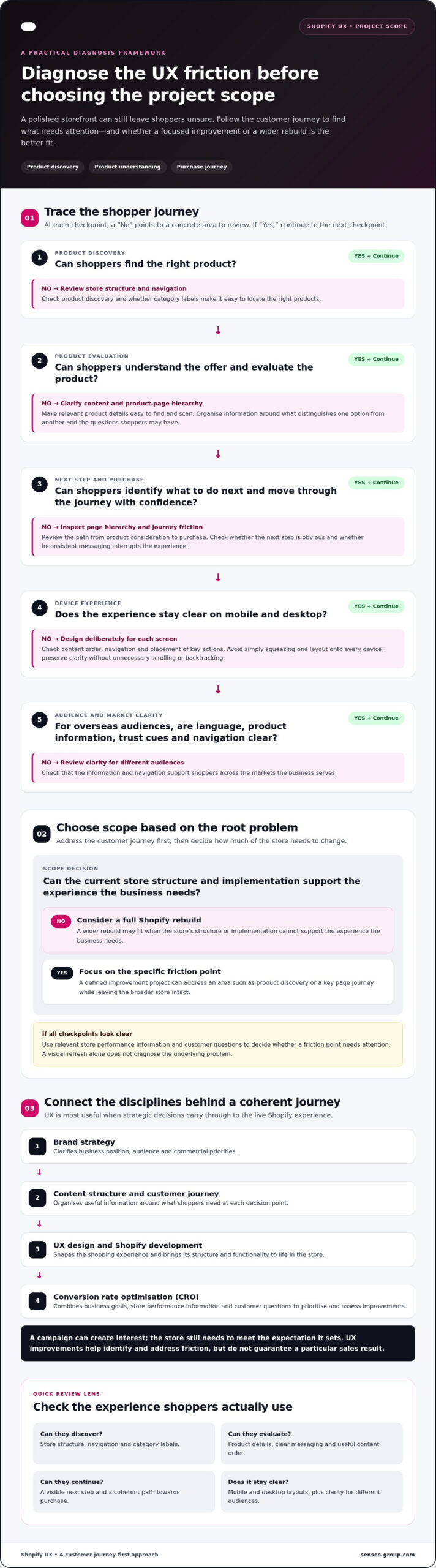
The scope can include store structure, navigation, product discovery, page hierarchy and the path from product consideration to purchase. For example, shoppers may struggle if category labels are unclear, essential product details are difficult to scan, or the next step on a page isn’t obvious. Each issue interrupts a different part of the journey. The right response depends on what customers are trying to do and what the business needs the store to achieve.
Mobile and desktop use also call for deliberate design decisions. On a smaller screen, content order, navigation and the placement of key actions may need to differ from the desktop layout. Rather than squeeze one design onto every device, preserve clarity and usability across the ways customers browse. Check whether visitors can find a product, understand its details and identify the next step without unnecessary scrolling or backtracking.
When an ecommerce business should consider UX support
Consider a focused UX project when customers ask questions the store should answer, have difficulty finding products, or encounter inconsistent messaging as they move between pages. These signals can point to gaps in structure or content, not just a need for a new look. Expansion into overseas markets can add complexity: language, product information, trust cues and navigation need to remain clear for different audiences.
A defined improvement project may address a specific friction point, such as product discovery or a key page journey, while leaving the broader store intact. A full Shopify rebuild is a wider decision, suited to situations where the store’s structure or implementation can’t support the experience the business needs. Diagnose the customer journey first, then choose a scope that addresses the root problem.
What a Strong Shopify UX Engagement Should Connect
A strong engagement links decisions that are often handled in isolation. It begins with the brand’s position, audience and commercial priorities, then translates them into a content structure and customer journey. UX design shapes how shoppers move through that journey; Shopify development makes the chosen experience work in the store. Conversion rate optimisation (CRO) helps determine which friction points deserve attention first and whether changes support the intended goals, without assuming any one design will guarantee a conversion lift.
Connected UX disciplines align brand promise, useful content, store functionality and marketing touchpoints into one coherent shopping journey. That connection matters because a campaign can create interest, but the store still has to meet the expectation it sets.
How brand strategy and content shape the customer journey
Brand positioning clarifies what the business stands for and why a shopper should consider it. Visual identity makes that promise recognisable, while consistent language carries it across the homepage, category pages and product details. For a closer look at how these elements work together in retail, explore this guide to retail brand identity.
Content structure helps customers find the information they need at each decision point. A product page might prioritise the details that distinguish one option from another, followed by supporting information that answers likely questions. The aim isn’t to add more copy indiscriminately. It’s to make relevant information easy to locate and understand. Nielsen Norman Group’s e-commerce user experience guidelines offer a useful reference for evaluating how the store supports shoppers’ tasks.
How Shopify design, CRO, and marketing work together
UX decisions need to translate into a usable Shopify experience. Navigation, page templates and content hierarchy should be reflected in the implementation, so the live store supports the intended journey rather than diluting it. CRO adds a disciplined way to prioritise: combine business goals with relevant store performance information and customer questions, then focus on the friction that matters most.
The journey should also remain consistent before and after a shopper arrives. If an advertisement highlights a particular product benefit, the landing page should make that benefit clear. If an email brings a shopper back to an item, the destination should preserve context and make the next step understandable. For an example of how email can support this journey, see the guide to Klaviyo abandoned cart strategy.
For businesses expanding into overseas markets, this joined-up approach helps keep brand expectations and store content aligned as audiences and campaigns broaden. Explore integrated Shopify UX and ecommerce strategy as a way to connect those decisions across the customer journey.
How to Compare Shopify UX Design Services and Agency Fit
A proposal should explain why each part of the work matters to your business, not simply list deliverables or promise a new look. Strong Shopify UX design services connect customer needs and commercial priorities to a practical scope, whether you’re improving an existing store, planning a rebuild or preparing to serve new markets.
Use these criteria to compare agency approaches:
| Criterion | What to look for |
|---|---|
| Strategic depth | A clear link between business goals, customer needs and the proposed work. |
| UX scope | Attention to navigation, product discovery, content hierarchy and the purchase journey, rather than visual styling alone. |
| Shopify implementation | A practical explanation of how the proposed experience will translate into store structure and functionality. |
| Evidence | Relevant ecommerce examples with project context, contributing services and stated outcomes. |
| Growth alignment | A tailored scope that considers your current store and future plans, including expansion into overseas markets. |
A visual-only redesign may update colours, imagery and page layouts without resolving why shoppers struggle to find products or understand the offer. UX work starts with those customer-journey questions, then connects design and implementation to the business objective. In a proposal, look for a direct rationale linking the problem, recommended work and how progress will be assessed.
What to look for in a Shopify UX proposal
The scope should show how UX design, strategic content structure, CRO and Shopify development fit together. An existing store with one difficult product journey may need targeted improvements, while a rebuild may be appropriate when the underlying structure can’t support the required experience. Market expansion may call for clearer content and navigation for new audiences. The scope should reflect those differences rather than force every business into the same package.
How to assess experience and case-study evidence
Read case studies for context: what was the business challenge, which services were connected, and what outcome was reported? Senses Group’s Monchhichi Jewelry Atelier example describes an integrated ecommerce rebuild combining brand strategy, website, email automation and social strategy, with revenue doubling shortly after launch. That result belongs to the combined system and its particular context, not UX alone, and it doesn’t guarantee the same outcome for another store.
For additional context on platform decisions, see this strategic Shopify guide for SMEs. As you assess your own needs, Baymard Institute’s UX research methods can also help frame how research turns observed friction into actionable priorities. A tailored Shopify UX approach should make that logic visible from the first diagnosis through the proposed deliverables.
How to Prepare for a Shopify UX Project and Measure Progress
A focused Shopify UX project starts before design work begins. Clear priorities help distinguish customer friction from symptoms, set a useful scope and give the team a shared basis for evaluating progress. This preparation is especially valuable for businesses planning to serve new overseas audiences, where changes in content, customer expectations or market focus can affect the shopping journey.
A practical readiness sequence before engaging an agency
Work through these steps to turn a broad concern into a defined project brief:
- Define the challenge. State the commercial issue you want to address, who the intended audience is and what growth plans the store needs to support. For example, clarify whether the priority is helping existing customers find products or making the journey easier to understand for a new audience.
- Document customer friction. Gather recurring customer questions, feedback, support enquiries and examples of where shoppers appear to hesitate or lose their way. Note content gaps and pages that may not answer the questions customers need resolved before buying.
- Bring the existing materials together. Collect store content, brand assets and relevant performance information. This gives the project team a view of what should be retained, what needs clarification and which parts of the current journey merit closer attention.
- Align decision-makers. Agree on the project’s priorities and boundaries, who will make decisions, and how proposed changes will be assessed. Shared expectations reduce the risk of scope drifting towards subjective preferences rather than customer and business needs.
This groundwork helps shape Shopify UX design services around the store’s actual situation, whether the need is a targeted improvement or a wider experience redesign.
How to evaluate outcomes after UX changes
Before work begins, agree on measures that connect directly to the project objectives. If the project aims to improve product discovery, review whether shoppers can move through the relevant navigation and category structure more clearly. If the focus is product-page content, assess whether key information is easier to locate and understand. Store performance information can add context, but measures should reflect the specific changes and how the store is being used.
Project objectives can be measured; commercial outcomes can’t be guaranteed. A UX change may contribute to a broader result, but performance can also be influenced by factors beyond the design work. Review evidence in context, consider customer feedback alongside store data, and use what you learn to guide continued optimisation rather than treating one result as a universal benchmark.
Ready to turn customer friction into a focused Shopify UX project? Explore Shopify UX and ecommerce strategy with Senses Group.
Why Choose Senses Group for Shopify UX Design Services
A stronger Shopify experience is built by connecting decisions, not treating them as separate tasks. Senses Group brings brand strategy, strategic content structure, UX design, conversion rate optimisation (CRO) and Shopify development together, aligning the store with the business it needs to support. This integrated approach shapes the customer journey around your brand foundations, commercial priorities and plans for growth.
An integrated approach to Shopify store experience
Custom-crafted work starts with understanding what the brand needs shoppers to recognise and what customers need to do in the store. Brand identity establishes a consistent expression; content structure makes product information easier to navigate; UX design shapes the path from discovery to purchase; and Shopify development implements that experience. CRO helps prioritise improvements in relation to business objectives, while marketing touchpoints can reinforce the same promise before shoppers arrive.
This connection is especially useful for consumer-facing businesses growing beyond their existing audience. As acquisition activity reaches new shoppers, consistent messaging between campaigns, landing pages and product content can help the experience feel joined up. Priorities differ by business, audience and store. The aim isn’t to apply a fixed template, but to build an experience that reflects the brand and supports its next stage of growth.
The Monchhichi Jewelry Atelier ecommerce rebuild illustrates the value of an integrated system. The work brought together brand strategy, website, email automation and social strategy, and revenue doubled shortly after launch. That result describes the combined ecommerce effort in its particular context. It isn’t evidence that UX alone doubled revenue, nor a promise that another business will achieve the same outcome.
Choose a Shopify UX partner built around growth
When assessing fit, look for strategic alignment between business objectives and customer needs, a connected scope across brand, UX and Shopify implementation, relevant evidence that explains the context behind results, and measurable objectives for the work. These criteria help you distinguish a partner focused on sustainable progress from a redesign built around appearance alone.
For SMEs and startups, the right foundation should serve the current store while leaving room for evolving campaigns, audiences and overseas growth. Senses Group connects brand, ecommerce and marketing decisions to create a tailored growth engine rather than a standardised package. If your next step is improving product discovery, clarifying the purchase journey or preparing the store for expansion, build a tailored Shopify growth engine with Senses Group.
Build a Shopify Experience Ready for What’s Next
Choosing Shopify UX design services is about more than selecting a design direction. The strongest partner connects customer needs with brand strategy, content structure, Shopify development and measurable project objectives. A clear scope helps you focus on the friction that matters now while building an experience that can support growth into new markets.
Senses Group brings brand and ecommerce disciplines together, with experience working with global brands including Sony, Barclays, Panasonic and LVMH. For Monchhichi Jewelry Atelier, an integrated ecommerce rebuild brought together brand strategy, website, email automation and social strategy. Revenue doubled shortly after launch, an outcome of the combined system and its specific context, not a guarantee or a result attributable to UX alone.
If your store needs a clearer customer journey or a stronger foundation for expansion, take the next step with a partner focused on connecting brand, experience and growth. Build a tailored Shopify growth engine with Senses Group. With the right priorities and a considered plan, your Shopify experience can move forward with greater clarity and purpose.
Frequently Asked Questions
What do Shopify UX design services include?
Shopify UX design services improve how customers navigate, understand and use an online store. The scope may cover store structure, navigation, product discovery, page hierarchy and the journey from landing page to checkout. It also connects content and brand presentation with Shopify implementation, so shoppers can find relevant information and understand their next step. Deliverables should reflect the store’s goals, customer needs and specific points of friction.
How do I choose a Shopify UX design agency?
Choose an agency by assessing how clearly it connects business objectives, customer experience and proposed work. Look for relevant ecommerce examples that explain the project context, the services involved and the outcomes reported. A strong proposal should show how UX design relates to content structure, Shopify development and conversion rate optimisation, and why its scope suits your existing store, rebuild plans or expansion goals. Case studies demonstrate experience, not guaranteed results.
Can Shopify UX design services improve conversions?
They can address obstacles that make it harder for shoppers to progress, such as unclear product information, confusing navigation or unnecessary friction in the purchase journey. Better usability can support customer confidence, but conversions are influenced by more than UX alone, including the offer, traffic and marketing context. Agree on project objectives and relevant measures before work starts, then assess store and customer-journey evidence without assuming a specific uplift.
How much do Shopify UX design services cost?
There isn’t one standard cost for Shopify UX work because the investment depends on the project’s scope and requirements. A focused improvement to a specific journey differs from a broader redesign involving content structure, brand alignment and Shopify implementation. The condition of the existing store and the work needed to meet business goals also shape the scope. Define the problem and intended deliverables first so the project can be tailored appropriately.
Is a Shopify UX redesign different from a Shopify website redesign?
Yes. A UX redesign focuses on how shoppers move through the store, find products, understand information and complete key tasks. A website redesign may include those improvements, but it can also involve broader changes to visual identity, page templates, content and technical implementation. The terms can overlap. Start by identifying the root issue: if the main concern is customer friction, define the UX objectives before deciding whether the wider site needs rebuilding.
How long does a Shopify UX design project take?
Project duration depends on the agreed scope, the state of the current store and the work required to design and implement changes. Improving one part of the customer journey is different from coordinating a wider Shopify redesign with content and development work. Clear priorities, timely decisions and access to existing store materials can help keep the project focused. Set milestones around agreed deliverables rather than relying on a generic timeline.
Should Shopify UX design account for overseas customers?
Yes, if your business plans to serve shoppers in overseas markets, design the experience with those audiences in mind. Review whether product information, navigation, brand messaging and trust cues make sense for each intended market, rather than assuming one journey fits everyone. Keep the core brand recognisable while adapting relevant content to customer needs. Planning for these differences early can help maintain a coherent store experience as the business expands.