
Most businesses treat brand building as a creative luxury; however, for the modern Hong Kong entrepreneur, it’s a technical necessity for survival. In a market where customer acquisition costs have surged by 60% to 80% since 2021, the traditional model of buying traffic is fundamentally broken. Successful direct to consumer brand building is not about aesthetic flair. It is the systemic integration of a distinct commercial identity with a high-performing technical infrastructure. If your marketing feels like a series of disjointed experiments that fail to yield a profit, you aren’t lacking creativity; you’re lacking a unified system.
You likely recognize that standing out in a saturated digital landscape requires more than just a functional website. We understand that the pressure to scale while maintaining margins is the primary challenge for SMEs and startups in this region. This article provides a clear roadmap for aligning your brand strategy with Shopify development and Klaviyo automation to drive sustainable growth. We will examine how to move from superficial excitement to a foundation of AI-driven optimization and brand equity. You’ll learn to transform your online presence from a simple store into a high-converting sales funnel that reaches both local and international markets.
Key Takeaways
- Move beyond the outdated middleman-free approach toward an experience-first model that prioritizes long-term customer relationships over one-off transactions.
- Learn why effective direct to consumer brand building treats visual identity as a strategic foundation for authority rather than just a creative exercise.
- Replace generic templates with custom Shopify development and Klaviyo automation to create a high-converting technical infrastructure that scales globally.
- Secure your brand’s future by transitioning from traditional SEO to AI Engine Optimisation, ensuring visibility within the emerging landscape of AI-driven search.
- Adopt an integrated system by aligning strategy, design, and technical execution to eliminate the wasted capital associated with fragmented marketing efforts.
The Evolution of Direct to Consumer Brand Building in 2026
In 2026, the definition of direct to consumer brand building has undergone a fundamental transformation. It is no longer a simple logistics play where businesses bypass retailers to capture a larger share of the margin. Instead, it has become an experience-first discipline. The global DTC market is projected to reach 880.1 billion dollars by 2034, but this growth isn’t distributed evenly. Success now belongs to those who view their brand as a commercial moat rather than a mere label. For Hong Kong SMEs looking to scale into overseas markets, the shift from being a product-led company to a brand-led ecosystem is the only viable path to long-term stability.
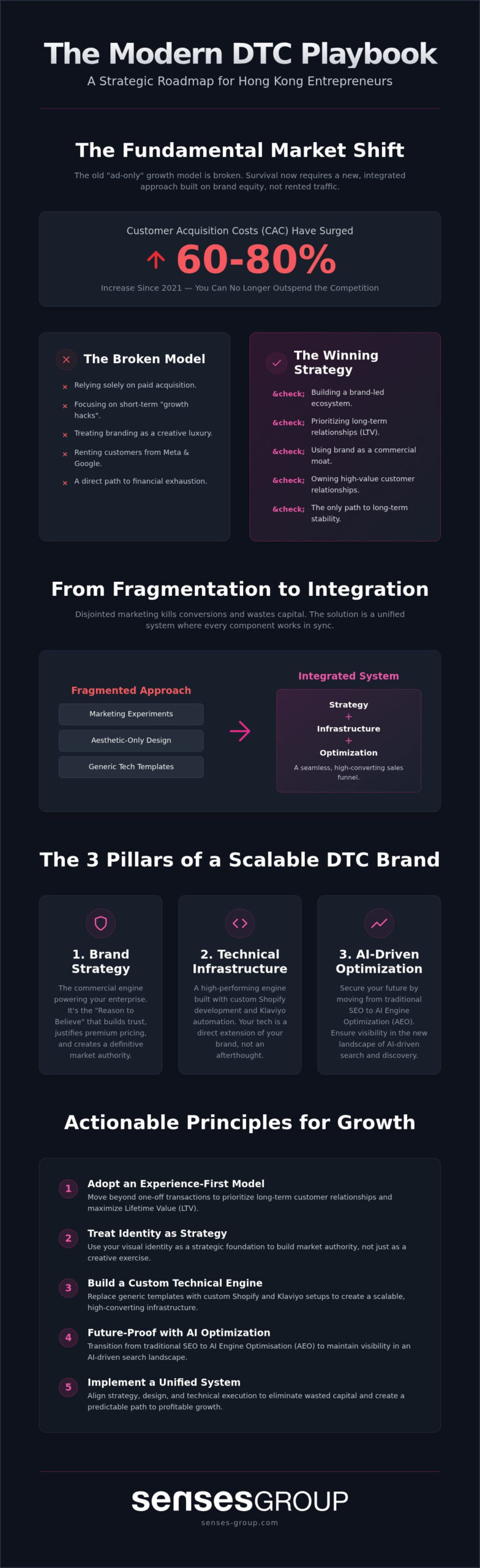
The “ad-only” growth model that dominated the last decade is effectively dead. Relying solely on paid acquisition is now a strategy for financial exhaustion. Since 2021, Customer Acquisition Costs (CAC) have surged by 60% to 80% due to privacy shifts and market saturation. You can’t outspend the competition in a bidding war; you must out-position them. This requires moving beyond the transactional. It requires building a system where your identity acts as a magnet for high-value customers, reducing your reliance on expensive, interrupted attention.
The Death of the Tactical Growth Hack
Short-term tactics produce diminishing returns in a saturated market. The era of the “one-click” hack to double your sales has been replaced by the need for deep strategic alignment. Consumers have become increasingly sophisticated, shifting their loyalty toward brands that offer comprehensive solutions rather than just commodities. This represents a psychological shift in the buyer journey. Brand Equity is the financial value of your reputation that allows you to command higher margins and lower your long-term marketing costs; it’s the primary driver of Lifetime Value (LTV). Without it, you’re merely renting customers from Meta or Google.
The Integrated Sales Funnel Framework
To survive this landscape, you need a unified system. This framework rests on three pillars: Strategy, Infrastructure, and Optimization. Your foundational identity must influence every touchpoint, from the first social impression to the final Klaviyo post-purchase sequence. Your brand and your Shopify store are not separate entities. They are a single, integrated unit. A disjointed approach leads to friction, and friction is the primary killer of conversion. By treating your technical infrastructure as a direct extension of your brand strategy, you create a seamless journey that turns a cold visitor into a loyal advocate. This integration is what separates a struggling startup from a scalable commercial powerhouse.
Constructing the Brand Foundation: Strategy and Identity
Branding is often misunderstood as a decorative layer applied at the end of a project. In reality, it’s the commercial engine that powers your entire enterprise. For Hong Kong SMEs, effective direct to consumer brand building begins with a rigorous strategic audit. It’s about identifying the root of your market advantage and codifying it into a system that resonates globally. The process of direct to consumer brand building is essentially the act of building trust at scale. It transforms your business from a commodity provider into a definitive authority.
A clear brand foundation reduces friction in the sales process by answering the customer’s unspoken questions before they arise. When your identity is grounded in logic rather than just aesthetics, you create a sense of permanence. This stability is vital for businesses looking to recover their footing or scale into new, unfamiliar territories. It ensures that your growth is not a series of lucky breaks, but a predictable outcome of your strategic positioning.
Defining Your Brand Foundation
To scale from a local startup to an international player, you must establish a “Reason to Believe” that transcends price. Your brand foundation is the logical argument for your existence. It defines your core market differentiation and justifies premium pricing power. When your positioning is clear, you stop competing on cost and start competing on value. Aligning these values with the specific needs of a national or global audience requires a deep understanding of local market dynamics. A well-defined brand strategy ensures that your growth is built on a stable foundation rather than fleeting trends.
Visual Identity as a Conversion Tool
Identity design is not just a logo; it’s a psychological trigger that communicates authority before a single word is read. High-quality visual assets act as a shortcut to trust. In a digital market where consumers decide to stay or leave in milliseconds, your visual identity must support a high-converting user experience (UX). Cohesive brand assets that scale across social media and your Shopify store reduce the cognitive load on the customer. This clarity facilitates a smoother transition through the sales funnel, making the path from discovery to checkout feel inevitable. Professional design doesn’t just look better. It converts better.
We view identity through a “not this, but that” lens. It’s not a creative indulgence; it’s a commercial asset. It’s not just a color palette; it’s a strategic tool for expert positioning. When your foundation is solid, every marketing dollar works harder because the recipient isn’t just seeing an advertisement. They’re experiencing a brand that understands their needs and possesses the authority to solve them. For early-stage companies navigating a crowded field, understanding brand positioning for startups in competitive markets like Hong Kong is the critical next step toward building a foundation that commands premium pricing and reduces reliance on paid acquisition.
The Technical Engine: Shopify and Klaviyo Integration
A brand strategy is a conceptual exercise until it meets a technical infrastructure. For Hong Kong SMEs, the execution of direct to consumer brand building relies on a tech stack that converts traffic into first-party data. Shopify has evolved into the definitive engine for this transition. With its latest API version (2026-07) and the sunsetting of Shopify Scripts in favor of Shopify Functions, the platform provides the agility required for international expansion. It is not just a digital storefront; it is a sophisticated system for capturing and leveraging consumer behavior.
Generic templates often act as a bottleneck for growth. They lack the specialized architecture needed to reflect a unique brand identity and often carry bloated code that slows down performance. Custom Shopify development allows you to eliminate specific friction points in the customer journey. This isn’t just about appearance. It’s about engineering a path to purchase that feels frictionless. By building a “Single Source of Truth,” you ensure that every interaction, from a social media click to a repeat purchase, is recorded and utilized for future optimization.
High-Converting Shopify Architecture
Success in modern commerce requires a mobile-first architecture that prioritizes site speed. Search engines and AI shopping tools now penalize slow, unresponsive sites. Your technical infrastructure must support a seamless transition from landing page to checkout. Custom features, such as native AI merchandising introduced in the Shopify Spring ’26 Edition, allow brands to present the right product to the right user at the perfect moment. This level of technical precision reduces the cognitive load on the buyer and directly lowers your cost per acquisition.
Retention Marketing with Klaviyo Automation
Direct to consumer brand building doesn’t end at the first transaction. Klaviyo integration turns your store into a data-gathering machine that fuels long-term loyalty. Klaviyo now manages over 9 billion consumer profiles, providing the scale needed to move beyond traditional newsletters. You can build automated revenue streams that respond to real-time customer behavior. By using first-party data to personalize the post-purchase experience, you maximize Lifetime Value (LTV) and reduce your reliance on expensive paid ads. Automated flows for abandoned carts, win-backs, and post-purchase education ensure that your brand remains top-of-mind without manual intervention. For a deeper understanding of how email automation directly contributes to lowering customer acquisition costs, explore how foundational brand strategy and integrated ecommerce systems serve as the ultimate levers for sustainable profitability.
Integrating these two powerhouses creates a feedback loop. Your Shopify store provides the behavioral data, and Klaviyo uses it to drive the next sale. This ecosystem is the foundation of sustainable profit. It allows you to scale your operations while maintaining a personal connection with your audience, whether they are located in Hong Kong or across the globe.
Sustainable Scale: SEO and AI Engine Optimization
Scaling a brand from Hong Kong’s competitive business hub requires a fundamental shift in how you view digital discovery. Traditional search engine optimization is no longer the sole driver of organic traffic. As we move through 2026, the emergence of agentic commerce and AI-driven shopping experiences has transformed the digital environment. Sustainable direct to consumer brand building now requires a dual-track approach that combines traditional search visibility with AI Engine Optimisation (AEO). You aren’t just competing for a spot on a results page; you’re competing for relevance in a machine-led ecosystem.
This evolution is a strategic necessity. While traditional SEO focuses on ranking for specific keywords, AEO focuses on becoming the definitive, authoritative source for AI models that increasingly make purchasing decisions on behalf of consumers. If your brand isn’t structured to be recognized by these systems, you’re invisible to a significant portion of the modern market. By establishing a clear, entity-based digital footprint, you ensure that your brand remains discoverable as consumer behavior shifts toward automated discovery.
Mastering AI Engine Optimisation
AI Engine Optimisation is the process of structuring your brand’s digital assets so they are easily understood and recommended by AI-driven search tools. This requires a move toward entity-based SEO. Instead of targeting isolated phrases, you must establish your brand as a credible entity with clear relationships between your products, values, and customer solutions. By utilizing Shopify’s Universal Commerce Protocol, you can ensure your data is accessible to the AI shopping experiences that now represent nearly 20% of global e-commerce. You aren’t just ranking for a search; you’re becoming the recommended answer.
Performance Marketing for Premium Brands
Organic visibility provides the foundation, but paid Meta and Google advertising provides the momentum. However, the goal of performance marketing in 2026 has shifted. We don’t prioritize Return on Ad Spend (ROAS) as a vanity metric. We focus on contribution margin and sustainable profit. Your brand strategy acts as the secret weapon here. A strong identity lowers your ad costs because it increases your click-through rates and conversion efficiency. When your ads lead to a high-converting technical infrastructure, every dollar spent on acquisition works harder to build long-term equity.
Success requires a partner who understands the deep mechanics of these interconnected systems. To move beyond disjointed tactics and build a scalable growth engine, you should explore our integrated SEO & AI Engine Optimisation services. This systemic approach ensures that your brand is not just seen, but chosen by both human consumers and the AI systems that guide them.
The Path Forward: Implementing an Integrated System
A disjointed approach to direct to consumer brand building is the most expensive mistake a Hong Kong business can make. It’s not just about the capital lost to inefficient ad spend. It’s about the systemic failure of a fragmented customer experience. When your brand strategy exists in a vacuum, isolated from your Shopify architecture or your Klaviyo automation, you create friction. This friction is a silent killer of conversion. It erodes the trust you’ve worked hard to build and forces you to constantly overspend on acquisition just to maintain your current position.
The 2026 roadmap for sustainable growth requires a unified front. For SMEs in this region looking to scale into overseas markets, the path forward isn’t found in more tactics, but in better integration. You must audit your current model for “systemic gaps” where the brand promise fails to align with the technical delivery. Success isn’t a collection of separate parts. It is a single, interconnected ecosystem where every component reinforces the others. This alignment transforms your digital presence from a simple storefront into a commercial asset that builds equity over time.
Choosing a Strategic Growth Partner
There’s a fundamental difference between a subservient service provider and an authoritative guide. A provider follows instructions; a guide challenges your assumptions to ensure commercial success. Commercial thinking must always precede creative execution. If you don’t understand the deeper mechanics of why your growth has plateaued, a new logo or a faster website won’t solve the root problem. You need a partner who views your business as a whole, identifying the foundational weaknesses that prevent you from scaling profitably on the global stage. This requires a level of disciplined, strategic confidence that goes beyond mere aesthetics.
Your First Steps Toward Integration
Before you commit another dollar to Meta or Google advertising, you must establish a solid brand foundation. This is the logic that justifies your price and builds your moat against rising competition. Once the strategy is clear, you can audit your Shopify store for specific conversion and SEO performance gaps. This methodical progression ensures that your technical infrastructure is ready to handle the traffic your marketing generates. It moves you from a state of reactive recovery to one of proactive, disciplined expansion. To stop managing disjointed vendors and start building a scalable future, partner with Senses Group to build your integrated DTC ecosystem.
Securing Your Commercial Future
Building a brand in Hong Kong’s complex market is no longer about isolated tactics; it is about building a unified system. We have seen how the integration of identity, custom Shopify architecture, and AI Engine Optimisation creates a moat that rising acquisition costs cannot breach. When you move from a product-led approach to a brand-led ecosystem, you transform your business into a scalable asset. Direct to consumer brand building is the process of engineering trust and automating loyalty. It requires a move from fragmented marketing to a single, high-converting sales funnel.
As seasoned strategic partners, we understand that your growth depends on this systemic alignment. As a Shopify Agency Partner and Klaviyo Automation Experts, we provide the technical depth and commercial insight needed for international expansion. Our AI Engine Optimisation Specialists ensure your brand is ready for the next era of digital discovery. Elevate your brand with a strategic DTC sales funnel from Senses Group. Your path to sustainable scale and market recovery begins with a single, integrated decision.
Frequently Asked Questions
What is the most important element of direct to consumer brand building?
The most important element is the systemic alignment between your commercial identity and your technical infrastructure. Success isn’t just about a logo; it’s about a system that converts trust into transactions. For Hong Kong businesses, this means establishing a clear market differentiation that justifies your price on the global stage. Without this strategic foundation, your marketing spend will always be inefficient.
How much does it cost to build a professional DTC brand on Shopify?
Costs vary based on the complexity of your custom requirements and the scale of your operations. While Shopify offers plans ranging from the Basic plan at 39 dollars per month to Shopify Plus starting at 2,300 dollars per month, the true investment lies in the strategy and development. You should prioritize building a custom architecture that solves specific friction points rather than relying on generic templates.
Why is brand strategy important for reducing customer acquisition costs?
A robust brand strategy reduces acquisition costs by increasing your click-through rates and conversion efficiency. When your identity communicates authority, you spend less to convince a prospect to buy. This is critical in a market where CAC has increased by 60% to 80% since 2021. By building equity, you create a moat that allows you to maintain margins despite rising competition in saturated digital channels.
How does AI Engine Optimisation differ from traditional SEO for brands?
AI Engine Optimisation focuses on making your brand the authoritative answer for AI models, while traditional SEO targets keyword rankings on search pages. As AI shopping experiences now represent nearly 20% of global e-commerce, your content must be structured as an entity that machines can recognize. This shift ensures your brand remains discoverable as consumer behavior moves toward automated, agentic commerce recommendations.
Can I build a DTC brand while still selling through retail partners?
Yes, a hybrid model is often a powerful strategy for scaling and recovery. Selling direct to consumer allows you to own your customer data and build long-term loyalty while retail partners provide broader physical reach. The key is ensuring your online positioning complements your retail presence. This integrated approach allows you to use e-commerce as a tool for international expansion without cannibalizing your existing partnerships.
What role does Klaviyo play in an integrated ecommerce sales funnel?
Klaviyo acts as the retention engine that transforms one-time buyers into repeat customers through automated, data-driven communication. It leverages first-party data from your Shopify store to personalize the post-purchase journey. By managing over 9 billion consumer profiles, Klaviyo provides the scale needed to maximize Lifetime Value. It’s not a newsletter tool; it’s a revenue-generating system that responds to real-time behavioral triggers.
How long does it take to see results from a comprehensive brand strategy?
While technical optimizations can yield immediate improvements in conversion rates, a comprehensive brand strategy typically requires three to six months to show full commercial impact. This timeline allows for the accumulation of brand equity and the optimization of automated sales funnels. Sustainable direct to consumer brand building is a long-term investment in stability. It moves your business from reactive growth hacks to a predictable, scalable commercial system.