
A polished logo isn’t a strategy; it’s a liability if it lacks the structural integrity to support international growth. For Hong Kong SMEs, the difference between a stagnant local shop and a global ecommerce powerhouse lies in a rigorous brand foundation and identity. Most businesses treat branding as a creative afterthought, yet it’s actually the commercial operating system that dictates your capacity to scale in 2026.
You’ve likely felt the mounting pressure of soaring customer acquisition costs and the friction of inconsistent messaging across your digital channels. It’s exhausting to compete in a crowded market when your positioning feels indistinguishable from the noise. This article provides a clear roadmap to build a strategic brand foundation that transcends visual aesthetics to drive sustainable growth and global expansion. We’ll explore how to leverage government support like the HK$7 million BUD Fund and AI-integrated workflows to transform your business into a premium entity that commands market authority. By the end, you’ll understand how to align your brand identity with a high-converting sales funnel that reduces friction and secures your commercial future.
Key Takeaways
- Understand why a strategic brand foundation acts as your commercial operating system, providing the structural integrity required to scale beyond the local Hong Kong market.
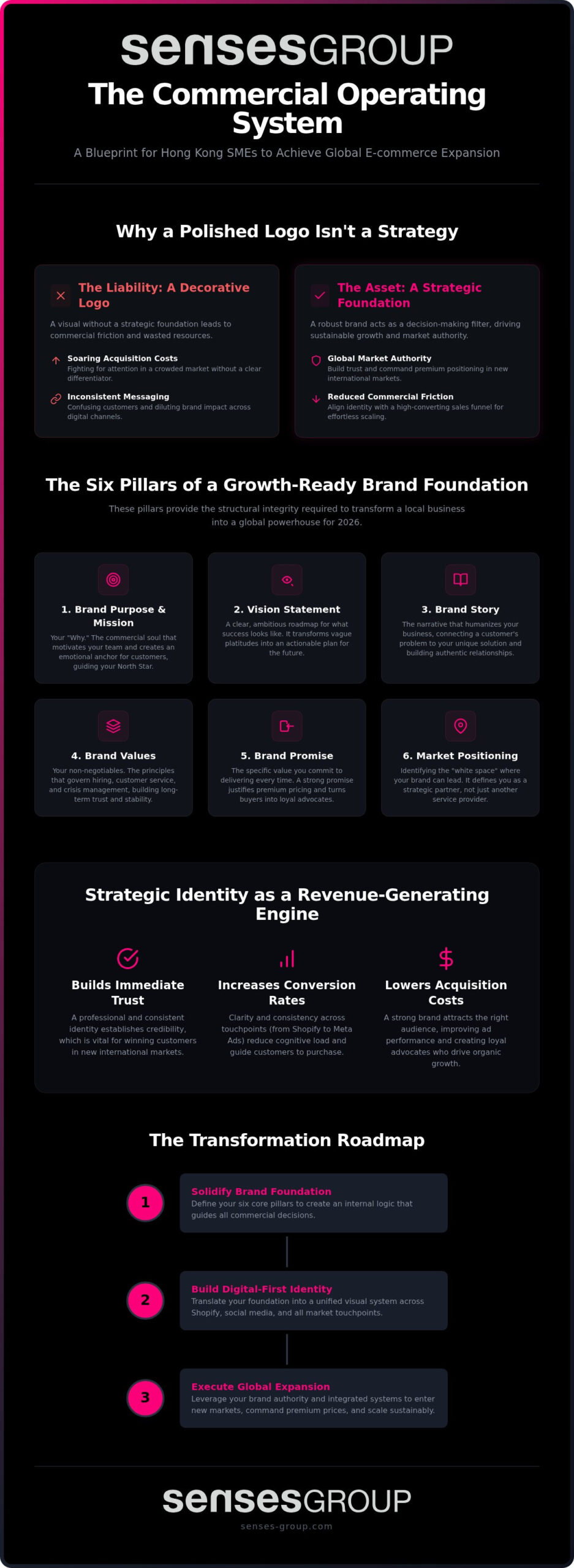
- Identify the six essential pillars of a brand foundation and identity that transform a simple logo into a high-performance business asset for 2026.
- Learn how premium identity design serves as a revenue engine by building immediate trust, increasing Shopify conversion rates, and lowering customer acquisition costs.
- Discover a roadmap for transitioning traditional business models into digital-first entities that leverage international standards to command premium positioning.
- Master the integration of brand strategy with Shopify and AI-driven growth tools to create a unified system that ensures sustainable, global expansion.
Beyond the Visual: Defining Brand Foundation and Identity
A logo without a strategy is merely a decorative element. It doesn’t drive sales, it doesn’t build loyalty, and it won’t help you scale. In the field of Brand management, the distinction between your brand foundation and identity is the difference between a business that survives and one that dominates. The foundation is the internal logic of your company; the identity is how that logic is perceived by the market. Commercial thinking requires us to view branding not as an artistic exercise, but as a decision-making filter. When your foundation is clear, every choice becomes simpler. You know exactly which products to develop, which talent to hire, and which marketing channels will actually deliver a return on investment.
The Anatomy of a Brand Foundation
Success starts with the “Why.” For a Hong Kong SME, this isn’t just about profit. It’s about the commercial soul of the business. Why do you exist in a market this competitive? Your brand purpose provides the answer. It motivates your team and creates an emotional anchor for your customers. Without this clarity, your marketing spend is often wasted on disjointed messages that fail to resonate. A strong foundation ensures that your internal culture aligns with your external reputation.
- Brand Values: These are your non-negotiables. They govern how you hire, how you treat customers, and how you handle crises. They build the trust necessary for long-term stability and international growth.
- The Brand Promise: This is the specific value you commit to delivering every time. A strong promise justifies premium pricing. It transforms a one-time buyer into a loyal advocate by setting clear expectations.
The Role of Visual Identity Systems
Your visual identity is the sensory expression of your strategic bedrock. It is the face of your foundation. When your typography, color palettes, and imagery are unified, you reduce the cognitive load for your buyers. They don’t have to guess who you are. They recognize you instantly across every touchpoint, from your Shopify store to your Meta ads. This consistency is vital for building authority in international markets where you don’t yet have a local reputation to lean on.
Effective brand foundation and identity work focuses on longevity. We don’t chase fleeting design trends that will look dated in eighteen months. Instead, we build assets that grow with your company. This disciplined approach ensures that your brand remains relevant as you transition from local operations to global ecommerce expansion. It is about creating a system that is both impactful and enduring.
The Six Pillars of a Growth-Ready Brand Foundation
Scaling a business requires more than just capital. It requires a brand foundation and identity that can withstand the pressures of global competition. A growth-ready brand isn’t a collection of colors. It’s a solid foundation built on a meaningful mission. This mission serves as your North Star. It guides your team and resonates with an audience that’s increasingly skeptical of superficial marketing. Without these pillars, your scaling efforts will likely result in higher costs and lower loyalty.
Your vision statement shouldn’t be a vague platitude. It’s a clear, ambitious roadmap for what success looks like in 2026. This roadmap is fueled by your brand story. A good story doesn’t just list features. It narrates the journey from a specific problem to your unique solution. This narrative is what builds authentic relationships in a digital-first world. It humanizes the business, turning a faceless entity into a trusted partner. When customers understand your journey, they’re more likely to join you on it.
Establishing Market Positioning
Positioning is about identifying the “white space” in the market where your brand can lead. We use a competitive audit to find where your rivals are weak. The “Not This, But That” framework is vital here. You aren’t just another service provider; you’re a strategic partner. For Hong Kong businesses, this means balancing local expertise with international standards. You must position yourself as a gateway to global trade, not just a regional player. This clarity allows you to command premium pricing even in a crowded international landscape.
Crafting the Brand Voice and Tone
Professional authority is non-negotiable for premium brands. Your voice should project strategic confidence. It shouldn’t be passive. We develop a rhythmic communication style. We mix short, punchy declarations with deep, explanatory sentences. This creates momentum. Consistency is the final piece. Whether it’s a Klaviyo email or a Shopify product description, the tone must be identical. Inconsistent messaging creates friction in the sales funnel. If you’re unsure where your current voice stands, a professional Brand Strategy audit can reveal the gaps in your positioning and help you refine your message for a global audience.
- Brand Purpose: The driving force that connects emotionally with your audience.
- Brand Personality: The human traits that make your business relatable.
- Brand Positioning: Your unique space in the global market.
Strategic Identity as a Revenue-Generating Engine
Identity is not a cost center. It is a revenue engine. While many Hong Kong SMEs view design as a secondary aesthetic concern, commercial thinkers recognize that a premium brand identity design functions as a silent salesperson. It communicates authority and value before a customer reads a single line of copy. This immediate perception is vital for scaling. A robust brand foundation and identity ensures your business isn’t just a name on a registration certificate but a recognizable force in the market. Consider the case of Monchhichi Jewelry Atelier. By doubling down on their strategic identity, they didn’t just update their look; they doubled their revenue. They transformed from a local player into a brand with international appeal.
Brand equity matters. It’s the value of your reputation translated into commercial power. When you invest in a cohesive brand foundation and identity, you’re building an intangible asset that sits on your balance sheet. This equity allows you to command premium pricing and ensures that Branding Creates Loyal Customers who return without the need for constant remarketing spend. It’s about shifting from a transactional model to a relational one.
Branding and the Ecommerce Sales Funnel
Your identity must perform at every stage of the Shopify sales funnel. At the top of the funnel, your visual system must stop the scroll. It needs to capture attention in a saturated social feed. In the middle of the funnel, consistency builds trust. If your Instagram ads don’t match your website’s aesthetic, you create cognitive dissonance that kills sales. At the bottom of the funnel, brand familiarity reduces friction. A customer who recognizes and trusts your brand is far less likely to abandon their cart at checkout. They aren’t just buying a product; they’re buying into the perceived value your identity projects.
Lowering CAC Through Brand Authority
High customer acquisition costs (CAC) are the primary barrier to scaling for most Hong Kong businesses. A strong brand creates an “Organic Pull” effect. It reduces your reliance on increasingly expensive paid ads by driving direct traffic and referrals. When you do run ads, a refined identity improves performance. Meta and Google algorithms reward high engagement, and users engage more with brands that look and feel professional. By aligning your visual execution with your core strategy, you’re effectively lowering customer acquisition costs through strategic alignment. You stop paying for attention and start earning it.
- TOFU: Visual impact that commands immediate attention.
- MOFU: Consistency that builds psychological safety.
- BOFU: Perceived value that justifies the final purchase.
Transforming Traditional Models for Global Ecommerce Expansion
Traditional Hong Kong business models often hit a glass ceiling. Local reputation is a powerful asset, but it’s rarely enough to sustain global growth. Transitioning from a brick-and-mortar mindset to a digital-first strategy requires a fundamental re-evaluation of your brand foundation and identity. It isn’t about digitizing old habits; it’s about building a systemic framework that commands authority in markets where your name isn’t yet known. Digital transformation is the vehicle for this evolution. It ensures your operations are future-proofed against shifting consumer behaviors and international standards.
Local branding often fails to translate because it relies on cultural shorthand that global audiences don’t share. To build a “global-ready” identity, you must strip away the provincial and focus on the universal. This doesn’t mean losing your heritage. It means framing your heritage as a unique commercial advantage. When you move beyond the local, you aren’t just selling a product; you’re selling a standard of excellence that transcends borders. It’s a move from being a regional vendor to becoming a global contender.
The Pivot to Digital Commerce
Before launching a global storefront, you must audit your current brand assets. A logo that looks professional on a business card might fail in a high-converting Shopify environment. You need to adapt your brand story for international audiences without losing your cultural roots. This balance is delicate. It requires translating local values into universal benefits that resonate in London, New York, or Singapore. Partnering with a premium brand design agency is often the critical factor in navigating this transition successfully. Expert guidance ensures your visual and strategic elements are optimized for the speed and scrutiny of the digital marketplace. It’s about moving from a traditional shop to a commercial powerhouse.
Scaling Beyond the Local Market
Global market entry requires more than just shipping logistics. It demands a brand foundation that supports multi-currency and multi-region operations from day one. You shouldn’t be building a separate brand for every country; you should be building one brand that is flexible enough to adapt to local nuances. Ecommerce serves as the primary vehicle for this rapid expansion. It allows you to test markets with minimal overhead before committing to deeper localized strategies. By establishing a robust brand foundation and identity, you create a consistent experience that builds trust regardless of the user’s location. If you’re ready to move beyond regional limits, our Brand Strategy services can help you define a roadmap for sustainable international scaling.
Implementing an Integrated Brand System with Senses Group
Strategy without execution is a hallucination. In the competitive Hong Kong ecosystem, building a brand foundation and identity requires more than just a creative brief; it demands a unified commercial system. Senses Group approaches branding as a strategic partner, not a subservient service provider. We don’t just design logos. We build high-converting sales funnels that integrate brand strategy with Shopify development and AI-driven marketing. Our 18-year track record with global brands like Sony and Barclays ensures that your business is built to international standards from day one.
Moving from a foundational strategy to actual revenue requires a disciplined process. We call this the “Bespoke Sales Atom.” It’s our proprietary framework for transforming your brand’s core purpose into a functional ecommerce engine. This isn’t a one-size-fits-all template. It’s a customized execution plan that aligns your identity with SEO & AI Engine Optimisation and Meta & Google Advertising. By treating every element as a building block in a larger argument, we ensure your brand remains impactful and enduring as you scale.
The Future of Branding: AI and GEO
The digital environment of 2026 is governed by Generative Engine Optimisation (GEO). To remain visible, your brand foundation and identity must be data-rich and distinct. AI search engines don’t just look for keywords; they look for brand authority and semantic clarity. If your identity isn’t “readable” by these next-generation systems, your business will effectively disappear. We leverage AI visual production to create high-quality assets at scale, ensuring your brand story is consistently told across every digital touchpoint. This isn’t about replacing creativity with machines. It’s about using technology to amplify your strategic voice and ensure your brand is the definitive answer to user enquiries.
Building for Longevity and Scale
Longevity is the ultimate proof of a successful brand foundation. Senses Group is committed to turning strategy into sustainable revenue. We’ve seen what works and what doesn’t over nearly two decades of Hong Kong-founded expertise. Our mastering retail brand identity guide serves as the essential starting point for any SME looking to dominate in 2026. It provides the deep insights needed to transition from a traditional model to a global ecommerce powerhouse.
Your transformation begins with a single strategic decision. Don’t let your business be defined by superficial excitement. Choose substance. Choose clarity. Schedule a strategic consultation with Senses Group today to begin building a growth engine that commands premium positioning in the global market. It’s time to build something that lasts.
Securing Your Commercial Future in 2026
Establishing a robust brand foundation and identity is the most effective way to ensure your business survives the transition from a local entity to a global powerhouse. It’s about shifting from a decorative mindset to a strategic one. By defining clear pillars of purpose and positioning, you don’t just look better; you operate with a definitive decision-making filter that lowers customer acquisition costs and builds long-term equity. Scaling requires a systemic approach that integrates high-level strategy with technical execution on platforms like Shopify.
Senses Group brings 18+ years of expertise to your digital transformation. We’ve managed over $4 million in ad spend and successfully doubled revenue for our ecommerce clients by aligning commercial goals with premium identity systems. This process isn’t just about creativity; it’s about building an enduring asset that commands market authority. Stop chasing fleeting trends. Start building a foundation that supports your highest ambitions.
Let’s Build Your Growth Engine – Start Your Brand Transformation with Senses Group. Your journey toward global expansion starts today.
Frequently Asked Questions
What is the difference between brand foundation and brand identity?
The brand foundation is the strategic bedrock consisting of your purpose, vision, and positioning. In contrast, the brand identity is the sensory expression of that strategy, including your logo, typography, and voice. Think of the foundation as the commercial operating system and the identity as the user interface. You cannot have a functional interface without a stable system. Both must work in unison to support long-term business scaling and international market entry.
How long does it take to build a complete brand foundation?
Developing a comprehensive strategic framework usually requires four to eight weeks of focused analysis. This period includes a deep competitive audit, stakeholder interviews, and market positioning exercises. Rushing this process often leads to shallow messaging that fails to resonate with global audiences. A methodical approach ensures that every visual asset created later is grounded in commercial logic rather than fleeting aesthetic trends. It is an investment in permanence and stability.
Can a small startup afford high-level brand identity design?
High-level design is accessible to Hong Kong SMEs through strategic financial planning and government initiatives. The BUD Fund offers cumulative funding of up to HK$7,000,000 to help local enterprises develop brands and promote sales in outside markets. By utilizing these resources, even early-stage startups can establish a premium brand foundation and identity that commands authority. Investing in professional strategy early prevents the costly need for a total rebrand during the scaling phase.
How does a strong brand foundation help with SEO and AI search?
Modern search algorithms and Generative Engine Optimisation (GEO) prioritize entities with high semantic authority. A clear brand foundation provides the consistent, data-rich environment that AI models need to categorize your business accurately. When your messaging is unified across all digital touchpoints, you become more “readable” to next-generation search tools. This clarity increases your chances of being cited as a definitive source, effectively turning your brand strategy into a powerful SEO asset.
Why is branding more important for ecommerce than traditional retail?
Ecommerce lacks the physical cues of traditional retail, such as store ambiance or face-to-face interactions. In a digital-first environment, trust is the only currency that matters. A strategic brand identity compensates for this lack of physical presence by projecting professional authority and reliability through every pixel. It reduces the psychological friction of online shopping, ensuring that customers feel secure enough to complete their purchase on platforms like Shopify without hesitation.
What are the signs that my current brand foundation needs a rebuild?
Several red flags indicate a structural weakness in your branding. If your customer acquisition costs are rising while conversion rates stagnate, your message is likely failing to connect. Other signs include inconsistent visuals across social media and a struggle to explain why you are different from cheaper competitors. If your business feels like a commodity rather than a premium choice, your foundation is no longer supporting your commercial goals.
How does branding impact my Customer Acquisition Cost (CAC)?
A robust brand foundation and identity directly influences your bottom line by creating an “organic pull.” When your brand is recognizable and trusted, your paid advertisements perform better because users are more likely to click on a known entity. This increased engagement lowers your ad spend per conversion. Over time, a reputable brand reduces your reliance on expensive paid channels, shifting your growth towards more cost-effective direct traffic and referrals.
What role does Hong Kong play in global brand positioning?
Hong Kong is a unique gateway that combines local market insight with international standards. Businesses here can leverage the city’s reputation for quality and legal integrity to position themselves as premium global players. Because Hong Kong uses a “first-to-file” trademark system, securing your brand identity early is a critical step in protecting your intellectual property. This strategic positioning allows HK companies to bridge the gap between Mainland China and global Western markets.