
Your rising ad spend isn’t a traffic problem; it’s a structural failure of your brand ecosystem. For many Hong Kong SMEs and startups, the reality of digital trade has become a relentless cycle of feeding the Meta and Google algorithms with diminishing returns. You’ve likely watched your ROAS stagnate while high bounce rates on premium traffic signal a deeper disconnect between your message and your market. The challenge of lowering customer acquisition costs is not solved by simply bidding less or cutting budgets. It requires a fundamental shift from reactive spending to strategic architecture.
We understand the pressure of scaling in a hyper-competitive global hub where every click is a capital investment. This guide explores how foundational brand strategy and integrated ecommerce systems serve as the ultimate levers for reducing CAC and driving sustainable profitability. Instead of viewing marketing as a series of isolated ad sets, we’ll demonstrate how to build a unified system where brand identity and Klaviyo automation work together to increase customer lifetime value. You’ll discover a path toward a brand-led growth model that converts organic and paid channels with greater efficiency, ensuring your business isn’t just surviving the algorithm, but mastering it.
Key Takeaways
- Understand why brand identity is a commercial asset that reduces conversion friction and establishes trust at the first touchpoint.
- Identify the technical “leaks” in your Shopify store that are driving up ad spend and negatively impacting your platform performance scores.
- Learn the strategic framework for lowering customer acquisition costs by shifting from brute-force advertising to high-retention Klaviyo automation.
- Discover how transitioning to AI Engine Optimisation (AEO) provides a competitive edge for Hong Kong SMEs in the evolving digital landscape.
- See how an integrated approach combining brand psychology with ecommerce technology creates a sustainable and scalable growth model.
The Escalation of Acquisition: Understanding the CAC Crisis in 2026
The digital marketplace in Hong Kong has reached a saturation point where traditional growth tactics are failing. Relying on sheer ad spend is no longer a viable strategy for scalability. The cost to buy a click is rising, yet the value of that click often remains stagnant. This imbalance is the core of the modern acquisition crisis. Scaling in 2026 is not a matter of budget size, but a matter of strategic efficiency. If your business model relies on the algorithm to find your customers, you’re building on sand.
Calculating the Real Cost of a Customer
Many founders simplify their math by dividing ad spend by conversions, yet this ignores the systemic reality of commercial growth. To understand the true Customer Acquisition Cost (CAC), you must account for every dollar invested in the transaction. This includes media spend, platform fees, and the technical infrastructure required to host the sale. Ultimately, calculating your true CAC requires a comprehensive view of the total commercial investment, including the necessity of factoring in creative overhead and production costs.
Attribution has become a labyrinth that obscures the truth. With privacy changes and fragmented user journeys, knowing exactly which dollar drove which sale is harder than ever. This complexity often masks the true expense of acquiring a customer, leading to skewed data and poor strategic decisions. For a Hong Kong startup, these hidden costs can be the difference between a profitable quarter and a cash flow emergency. This is not just a marketing metric; it is the heartbeat of your commercial viability.
The Diminishing Returns of Media Buying
Ad platforms have commoditized attention. In the 2026 landscape, bidding higher on Meta or Google is a race to the bottom that favors the platform, not the merchant. This brute force approach is yielding lower returns because consumers are exhausted by generic interruptions. They now require more touchpoints, deeper trust, and a clearer brand promise before they commit their wallet. A consumer might see your ad on Instagram, search for you on an AI engine, and visit your Shopify store twice before finally purchasing. If your brand doesn’t resonate at every step, that acquisition cost balloons.
Algorithm dependency is a liability for any brand looking to scale. There is a specific tipping point where the cost to acquire a single customer exceeds the revenue from that initial purchase. If your business model relies on this first transaction to be profitable without a strategy for lowering customer acquisition costs over time, you aren’t building a brand; you’re just renting traffic. You become a slave to the platform’s price fluctuations, losing control over your own margins.
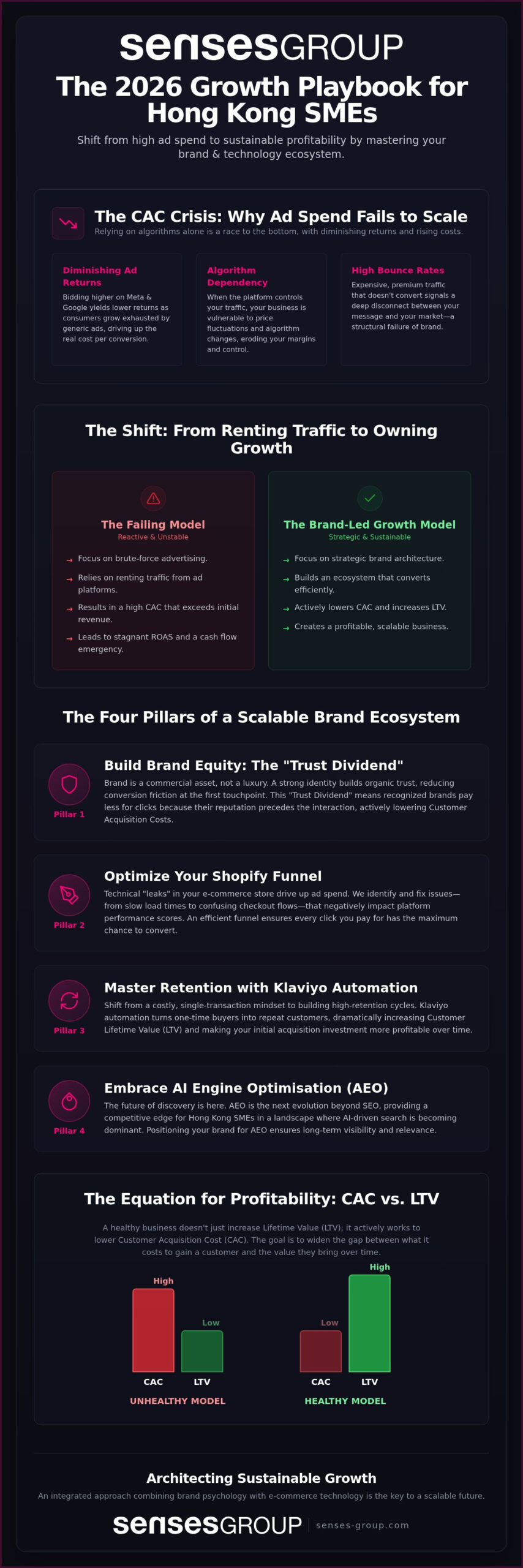
The true measure of business health is the relationship between CAC and Lifetime Value (LTV). A high CAC is sustainable only if the LTV is significantly higher. However, the most successful brands don’t just increase LTV; they actively work on lowering customer acquisition costs by building brand equity that converts more efficiently at the first touchpoint. In Hong Kong’s tight-knit but globalized market, your reputation acts as a force multiplier. A strong brand strategy ensures that every dollar spent on advertising works twice as hard by reducing the friction of the sale. Brands that pursue sustainable ecommerce growth by balancing commercial longevity and ethical impact are increasingly finding that consumer trust becomes a durable competitive advantage that further reduces acquisition friction over time.
Brand Equity as a Financial Lever: How Identity Lowers CAC
Brand strategy is not a luxury expense; it is the commercial foundation of organic trust. In the volatile Hong Kong market, where startups compete for global attention, a weak identity acts as a tax on every ad dollar spent. Conversely, a robust Brand Strategy serves as a financial lever, creating what we call the Trust Dividend. Recognized brands often pay less for the same click because their reputation precedes the interaction, lowering the psychological barrier to entry. When a user recognizes a brand’s authority, the friction of the first touchpoint vanishes, directly contributing to lowering customer acquisition costs.
Strategic positioning does more than attract the right customers; it actively disqualifies the wrong ones. By being clear about who your product is for, you stop wasting budget on high-bounce, low-intent traffic. This focus ensures your media spend is concentrated on users who resonate with your values. This alignment naturally improves conversion rates and efficiency. You aren’t just buying traffic; you’re inviting the right audience into a pre-built ecosystem of trust.
The Psychology of the Click
Visual identity is a silent communicator of professional authority. A polished, cohesive aesthetic reduces the perceived risk of a transaction, which is critical for ecommerce brands scaling from Hong Kong to international markets. It’s not just about aesthetics. It’s about signaling reliability. Consistent messaging further shortens the consideration phase by removing ambiguity. We must distinguish between superficial brand awareness and a strategic brand foundation. Awareness is simply being seen; a foundation is being understood and trusted.
Positioning for Premium Efficiency
True growth comes from moving your business from a commodity to a category of one. When you aren’t compared on price alone, you gain the ability to set higher price points. These increased margins effectively subsidize your CAC, allowing you to outspend competitors while remaining profitable. The goal is not more ads, but more resonance. By focusing on deep alignment with your audience, you achieve a level of efficiency that brute force advertising can never replicate. This brand-led approach is the most effective path for lowering customer acquisition costs in a crowded digital trade environment. It transforms your marketing from a series of expensive interruptions into a steady stream of high-value connections. For founders navigating this challenge, understanding brand positioning for startups in crowded markets like Hong Kong is the critical first step toward building a brand that converts on authority rather than ad spend alone.
The Shopify Funnel: Technical Optimization for Conversion Efficiency
Your store is the final, most critical stage of the acquisition journey. If your brand strategy is the engine and your ads are the fuel, your Ecommerce Shopify Store is the chassis that must hold everything together under pressure. Many Hong Kong businesses focus exclusively on the top of the funnel, yet they ignore the technical leaks that drain their budgets. A poorly optimized store acts as a leaking bucket; no matter how much traffic you pour in, your ROI will continue to evaporate. Technical efficiency is a prerequisite for lowering customer acquisition costs in a market where attention is both expensive and fleeting.
Ad platforms like Meta and Google don’t just look at your bids. They evaluate the destination. High bounce rates and slow load times result in lower quality scores, which in turn drive up your cost-per-click. By optimizing your Shopify store’s technical performance, you aren’t just improving the user experience; you’re actively signaling to the algorithms that your traffic is worth less than your competitors’. This structural alignment ensures that your brand identity isn’t just a visual asset, but a functional one that drives commercial results.
Streamlining the Path to Purchase
Checkout friction is the silent killer of profitability. For Hong Kong startups looking to scale into international markets, a mobile-first architecture is non-negotiable. Every additional field in a form or every unnecessary click is an opportunity for a customer to reconsider. A single second of delay in your site’s load time directly inflates acquisition costs by increasing the probability of bounce before your brand even has a chance to speak. We prioritize Shopify Plus features like Shop Pay and accelerated checkouts to remove these barriers, ensuring the transition from “interested” to “converted” is as seamless as possible.
High-Converting Shopify Architectures
Custom theme development offers a level of precision that off-the-shelf templates cannot match. While templates are accessible, they often carry “code bloat” that slows down performance and restricts your ability to tell a unique brand story at the moment of truth. An architected approach to Shopify development allows you to integrate social proof and brand narratives directly into the product page layout. This data-driven design ensures that the high-intent users you’ve paid to reach are met with a professional, high-trust environment. Use Shopify analytics to identify exactly where users are dropping off. Plugging these leaks is the most direct path toward lowering customer acquisition costs without increasing your marketing budget. By treating your store as a high-performance sales tool rather than a static catalog, you turn every visit into a strategic opportunity for growth.
The 2026 Playbook: AEO, Personalization, and Retention Cycles
The era of siloed marketing is over. For Hong Kong SMEs looking to scale in 2026, success requires a unified commercial engine where every channel feeds into a centralized intelligence system. Traditional media buying is no longer a standalone solution; it is merely one component of a broader architecture. By integrating Meta and Google advertising with sophisticated retention cycles, you create a feedback loop that identifies high-value users and ignores the rest. This systemic approach is the most effective method for lowering customer acquisition costs while simultaneously building a defensible market position.
Data-driven personalization has evolved beyond simple “first name” tags in an email. It now involves using AI to predict customer behavior and optimize ad spend in real-time. Instead of casting a wide net, your systems should identify the psychological triggers that lead to a transaction. When your paid social ads, search presence, and email flows speak the same language, you reduce the cognitive load on the consumer. This alignment accelerates the path to purchase and ensures your brand remains the definitive choice in a crowded global marketplace.
Dominating Search with AI Engine Optimisation
Traditional SEO is undergoing a fundamental shift toward AI Engine Optimisation (AEO). As Large Language Models (LLMs) and AI-driven search results become the primary gatekeepers of information, your content must be optimized for machine understanding, not just keyword density. This isn’t about stuffing phrases into a blog; it’s about authority building. By positioning your brand as the definitive source of truth in your category, you secure zero-cost organic traffic that bypasses the bidding wars of paid search. AEO reduces your long-term reliance on performance marketing, providing a sustainable foundation for organic dominance that protects your margins from rising ad prices.
Retention as the Ultimate CAC Reducer
The cheapest customer to acquire is the one you already own. We utilize Klaviyo Email Automation to turn a one-time transaction into a lifetime relationship. By focusing on the “Second Purchase Rate,” you effectively dilute the initial cost of acquisition over multiple orders. Automated win-back and loyalty sequences ensure that your brand remains top-of-mind without requiring additional ad spend. This retention cycle is the secret to lowering customer acquisition costs over the long term. When your backend systems are architected for repeat business, you can afford to be more aggressive in your initial outreach, knowing that the lifetime value will far outweigh the entry price. If you’re ready to stop renting traffic and start building an asset, it’s time to implement our SEO & AI Engine Optimisation strategies to secure your brand’s future.
Architecting Sustainable Growth with Senses Group
Success in the competitive Hong Kong hub requires more than tactical survival; it demands systemic market leadership. Fragmented marketing efforts, led by a disjointed collection of freelancers, often result in a diluted brand message and wasted capital. When your brand identity doesn’t speak to your ad strategy, your conversion rates suffer. Senses Group provides a definitive alternative by acting as a single, strategic partner that understands the deeper mechanics of business success. We bridge the gap between creative identity and performance metrics, ensuring that every design choice is rooted in commercial logic.
The transition from a struggling startup to a scaling enterprise is rarely achieved through better ads alone. It is achieved through better systems. By viewing your business as an interconnected funnel, we eliminate the inefficiencies that plague traditional marketing models. We don’t just provide services; we build foundations. This strategic alignment ensures that your brand remains impactful and enduring, regardless of how the global market shifts.
The Integrated Solution for National Brands
We believe that a unified strategy is the only way to achieve sustainable growth. By aligning your Brand Strategy with your Ecommerce Shopify Store and Klaviyo Email Automation, we create a seamless ecosystem that prioritizes clarity and substance. Our approach combines brand psychology with advanced ecommerce technology to ensure that your traffic doesn’t just visit, but converts. We use AI to optimize your growth trajectory, making data-driven decisions that reflect both the “logo” and the “ledger”. This holistic oversight is the most reliable lever for lowering customer acquisition costs across all channels. For brands committed to building lasting commercial relevance, exploring the principles of sustainable ecommerce growth that balances commercial longevity and ethical impact reveals how purpose-driven systems can further strengthen every layer of your acquisition and retention strategy.
Next Steps: Securing Your Competitive Advantage
Moving from recovery to expansion requires a disciplined audit of your current funnel. We identify the specific technical and psychological friction points that are inflating your spend. By developing a brand foundation that sustains long-term scaling, we help you transition from renting traffic to owning your audience. It’s time to stop chasing the algorithm and start building an enduring commercial asset. You can Consult with Senses Group to re-engineer your acquisition strategy and secure a clear path toward stability and growth. Your journey toward lowering customer acquisition costs begins with a commitment to systemic integration and strategic excellence.
Mastering the Commercial Ecosystem for Long-Term Growth
The path to commercial stability in Hong Kong’s digital trade hub is not found in more aggressive media buying; it’s found in the architectural integrity of your brand. You’ve seen how brand equity acts as a financial lever to reduce conversion friction and how technical Shopify optimization prevents your budget from leaking away. By shifting your focus toward organic AEO and high-retention Klaviyo flows, you transition from renting traffic to owning a sustainable market position. This systemic approach is the only definitive way of lowering customer acquisition costs while building a business that scales beyond the limitations of any single algorithm.
As a Shopify Plus Partner and Klaviyo Automation Expert, Senses Group understands the deeper mechanics of your success. We don’t just design stores; we architect high-converting funnels that turn your brand into a commercial asset. It’s time to move beyond tactical survival and secure your competitive advantage through an integrated branding and performance agency. Build a high-converting brand funnel with Senses Group and begin your journey toward enduring scalability. Your brand’s potential is a foundation waiting to be built.
Frequently Asked Questions
What is a good target for Customer Acquisition Cost (CAC) in 2026?
A sustainable CAC target depends on your industry’s average order value and your specific gross margins. Generally, a healthy commercial ratio is considered to be 3:1 for Lifetime Value (LTV) relative to CAC. For Hong Kong SMEs, this means your customer’s total value should triple the cost of acquiring them. If your acquisition cost exceeds your initial transaction value without a clear retention strategy, your business model isn’t scalable and requires structural intervention.
How does brand strategy actually impact my Facebook and Google ad costs?
Brand strategy reduces ad costs by improving your relevance and click-through rates. When your messaging is precise and authoritative, ad platforms reward your high engagement with lower costs per click. It’s not just about visuals; it’s about building trust before the click happens. Strong positioning ensures you’re lowering customer acquisition costs by attracting high-intent users who recognize your brand’s specific value proposition immediately, leading to higher conversion rates.
Can Shopify optimization really lower my acquisition costs?
Technical Shopify optimization is a direct lever for conversion efficiency. Every second shaved off your load time and every friction point removed from your checkout reduces the tax you pay on traffic. If your store converts 3% instead of 1%, your acquisition cost effectively drops by two-thirds. High-performance architectures ensure that the expensive traffic you buy doesn’t evaporate due to technical failures or poor mobile UX, making every ad dollar work significantly harder.
What is the difference between SEO and AI Engine Optimisation (AEO)?
SEO focuses on ranking in traditional search engine results pages, while AEO optimizes your content to be the definitive answer for Large Language Models. In 2026, AI engines like Perplexity or Gemini are the new gatekeepers of digital trade. AEO requires structured data and high-authority content that machines can easily parse and recommend. This transition secures organic visibility in an era where traditional blue links are becoming less prominent for complex consumer queries.
How does Klaviyo email automation help with lowering CAC?
Klaviyo automation assists in lowering customer acquisition costs by maximizing the value of every lead you capture. Instead of paying to re-acquire the same customer through expensive retargeting ads, automated flows nurture them toward a second purchase for free. This retention cycle dilutes the initial acquisition expense over a longer customer lifecycle. When your backend systems are automated, your front-end marketing spend becomes significantly more efficient and your margins remain protected.
Should I focus on lowering CAC or increasing LTV first?
You should focus on them simultaneously, as they are two sides of the same commercial coin. However, if your CAC is currently higher than your initial profit margin, stabilizing your acquisition funnel is the priority for immediate cash flow. Increasing LTV through loyalty and retention provides the long-term capital to outspend competitors. A balanced approach ensures you aren’t just surviving today but building a scalable asset that can withstand future market shifts.
How often should I audit my customer acquisition funnel?
You should conduct a comprehensive audit of your funnel at least once per quarter. Digital markets in Hong Kong move rapidly, and algorithm shifts can turn a profitable funnel into a liability overnight. Monthly reviews of your conversion data and ad platform performance scores help you identify emerging leaks early. Consistent auditing ensures your brand strategy remains aligned with consumer behavior and technical standards, protecting your business from unexpected volatility and diminishing returns.
Why is an integrated agency better than a specialized performance agency for CAC?
Integrated agencies provide a unified vision that performance-only agencies lack. A specialized agency might optimize your ads in a vacuum, but they won’t fix the brand disconnect or technical store issues driving up your costs. We bridge the gap between creative identity and performance metrics. Having one partner manage your branding, Shopify store, and digital marketing ensures every element of your ecosystem works toward the same commercial goal with absolute clarity.