
What if the strongest brand strategy agency isn’t the one with the most polished presentation, but the one that helps you make better business decisions? For SMEs and startups, agency descriptions can sound remarkably alike. When branding stops at visual identity, it may do little to connect your position with sales, customer experience or the demands of ecommerce.
That distinction matters when you’re building a Shopify store, strengthening your market position or preparing to reach overseas customers. A useful strategy should clarify who you serve, why they should choose you and how that promise carries through your website and marketing. It should give your team a practical foundation for growth, not just a set of attractive slides.
This guide explains how to assess an agency’s strategic thinking, compare its approach using meaningful questions and evidence, and identify the decisions its work should shape. You’ll also learn what to look for when connecting brand foundations with ecommerce, customer journeys and sustainable expansion across markets.
Key Takeaways
- Judge a brand strategy agency by the business decisions its thinking clarifies, not by the polish of its presentation.
- Look for a clear path from business diagnosis and audience understanding to positioning, differentiation and practical activation.
- Compare strategic ownership, execution connections and coordination needs to decide whether an integrated partner or specialist supplier suits your business.
- Use a focused checklist to align your target customers, brand promise, channels and operational readiness before expanding ecommerce locally or overseas.
- See how connected strategy, identity, Shopify and digital marketing can support growth, including the Monchhichi project, which reported doubled revenue shortly after launch.
What Should a Brand Strategy Agency Actually Help Your Business Decide?
A brand strategy should settle the decisions that shape how your business competes: who you serve, what makes your offer meaningfully different, and how customers should understand its value. That might mean deciding which customer needs to prioritise, what makes your business a stronger choice, and how that position should carry across ecommerce and overseas-facing channels.
These foundations guide customer-facing work. They inform which benefits your website leads with, how products are presented, what advertising promises, and what customers experience after they buy. This is closely connected to brand management, the ongoing work of shaping how people perceive and engage with a brand. Strategy gives that work a clear direction.
Brand strategy versus logo and visual identity
Positioning, audience understanding, brand story and differentiation are strategic foundations. A logo, colour palette, typography and other design elements form the visual identity system that expresses them. Neither replaces the other. Visual consistency matters when it makes a clear, relevant position recognisable, rather than simply making every asset look alike.
Without that foundation, a polished identity can still leave customers unsure why to choose you. A product page may emphasise quality, an advert may focus on price, and an email may tell a different story. The result is activity without a coherent reason to believe.
When does a business need a brand strategy agency?
A business may need strategic work when customers struggle to distinguish it from alternatives, teams describe the offer in conflicting ways, or growth is moving faster than the brand can keep up. Startups can use strategy to establish a credible position before investing in a full identity or customer-facing campaigns. Growing businesses can use it to bring consistency to ecommerce or prepare for entry into overseas markets.
The sequence matters. Advertising amplifies a message, ecommerce turns it into a customer journey, and identity gives it a recognisable expression. If the underlying position is unclear, each activity can reinforce a different impression. A thoughtful brand strategy agency should help resolve the questions behind those choices before execution begins.
A strategy engagement should produce clarity the business can act on, not simply more marketing assets. It should help decision-makers align what they sell, whom they prioritise, why customers should care, and how the brand communicates that value across products and interactions. When those decisions are settled, design and marketing have a stronger foundation to build from.
How to Assess a Brand Strategy Agency’s Thinking and Deliverables
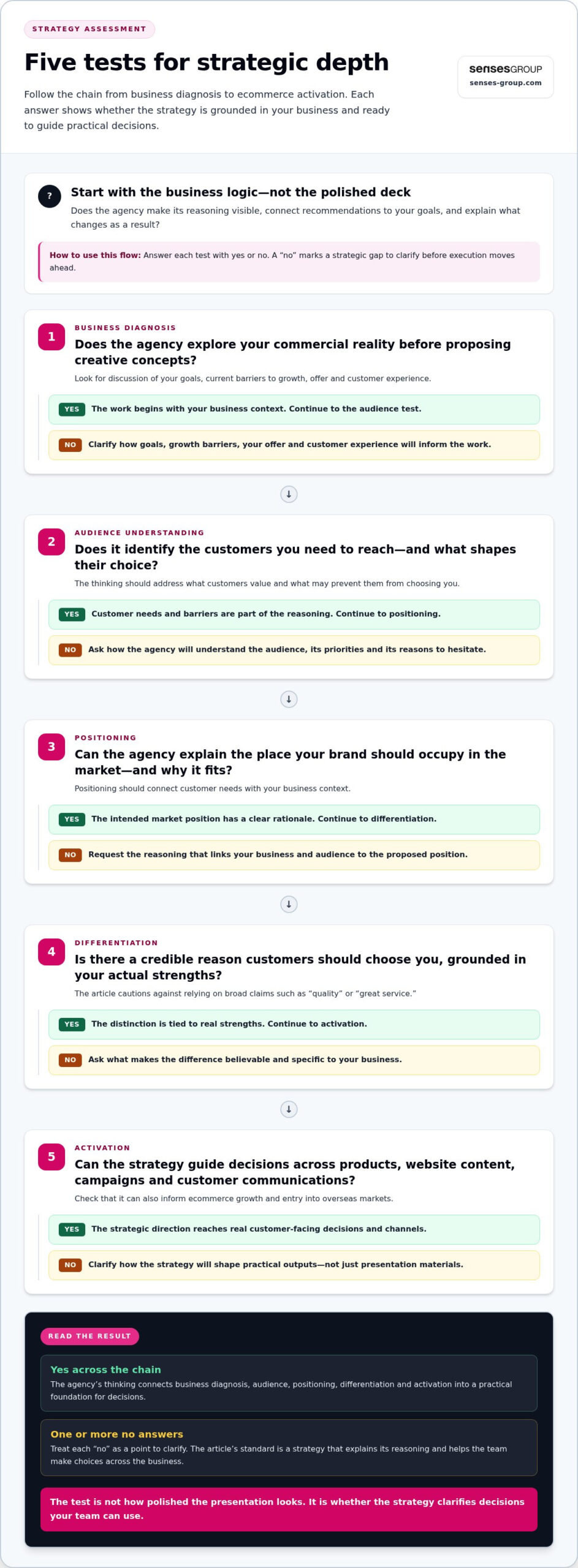
A polished deck can present ideas clearly without proving they fit your business. Assess the reasoning behind the recommendations: does the work move from your commercial reality to decisions your team can use? A capable brand strategy agency should make the logic visible, connect it to your goals and explain what changes as a result.
Use this sequence to examine the work:
- 1. Business diagnosis. Does the agency explore your goals, current barriers to growth, offer and customer experience, rather than jumping straight to creative concepts?
- 2. Audience. Does it identify the customers you need to reach, what they value and what may prevent them from choosing you?
- 3. Positioning. Can it explain the place your brand should occupy in the market and why that position fits your business?
- 4. Differentiation. Does it identify a credible reason customers should choose you, supported by your actual strengths rather than broad claims such as “quality” or “great service”?
- 5. Activation. Can the strategy guide decisions across products, website content, campaigns and customer communications, including as you grow ecommerce or enter overseas markets?
Which questions reveal strategic depth?
Ask how the agency studies customers, competitors, business goals and barriers to growth. Then listen for the connection: how do audience needs lead to a defensible position and a clear brand story? Strong answers explain the reasoning and reflect your business context. If the same category phrases could describe any competitor, the strategy may not be specific enough to guide real choices.
Some strategies also clarify how different offers or sub-brands relate to one another. A considered brand architecture strategy can help a business organise those relationships as its offer develops. Look for recommendations that explain what to group, distinguish or prioritise, and why.
What should the strategy leave the team able to do?
A useful brand strategy deliverable is one that guides a real business decision. Positioning and messaging principles should help your team decide what to lead with on a product page, which customer benefit belongs in a campaign, and how to describe the offer consistently. Brand guidelines then translate the strategic direction into a shared system for expressing it across internal and external touchpoints.
Strategy becomes valuable when it carries through to identity and customer experience. For a practical example of strategy translated into retail expression, explore this guide to retail brand identity. Judge each proposed output by whether it makes a decision clearer or helps your team apply the brand consistently. Relevant reasoning, specific examples and a clear link between insight and action are more useful evidence than generic frameworks or unsupported growth guarantees.
Brand Strategy Agency or Specialist Supplier: Which Approach Fits?
The right model depends on what needs to change. If your business needs a clear brand position and has the team to carry it through, a focused specialist may be the better fit. If growth priorities span identity, ecommerce, acquisition and retention, an integrated partner can connect those decisions under one strategic foundation.
Strategy isn’t a logo presentation when it shapes what happens next. It should influence how your offer is expressed, how customers move through your store and how marketing supports the brand promise. The distinction is whether the work changes downstream decisions, not how many disciplines appear in a pitch.
| Consideration | Focused brand strategy specialist | Integrated agency partner |
|---|---|---|
| Strategic ownership | Concentrates on brand foundations and direction. | Connects brand direction to related execution. |
| Execution connection | Provides a strategy your team or suppliers apply. | Can carry the foundation into identity, ecommerce and digital marketing. |
| Coordination needs | Your team manages handoffs and consistency across suppliers. | More disciplines can work from a shared strategic foundation. |
| Best-fit context | A bounded strategic issue with internal execution capacity. | Growth priorities that span several customer-facing disciplines. |
When is a focused brand strategy specialist the right fit?
A specialist can be a strong choice when the central issue is unresolved positioning, audience focus or differentiation, and your team already has the capability to implement the recommendations. Concentrated expertise can clarify the brand’s direction without widening the project unnecessarily. Plan ownership from the outset: decide who will translate the strategy into identity, website and campaigns, and how consistency will be maintained across channels.
When does an integrated agency approach make sense?
An integrated approach can suit a business preparing to launch or improve ecommerce while also aligning brand identity, customer acquisition, conversion and retention. For example, the brand promise should be reflected in the product page, checkout journey and follow-up communications, not just in an advertising message. Shared strategic ownership can reduce disconnects between what the brand says and what customers experience. For further context, explore this guide to integrated digital marketing solutions.
Neither model is automatically superior. Match the choice to your priorities, internal capacity and the number of decisions that need to work together. If the brief is narrow, a specialist may be enough. If the work must connect multiple disciplines, an integrated brand strategy agency can help keep those efforts aligned around a consistent position.
How Hong Kong SMEs Can Evaluate Brand Strategy for Ecommerce Growth
Ecommerce growth puts your brand promise into every customer interaction, from the first advert to the post-purchase email. Expanding an online store or entering overseas markets calls for more than a new channel. The strategy needs to connect the business’s position with what customers see, understand and experience, while allowing communication to suit different audiences.
What should an SME clarify before an agency engagement?
Prepare a short brief that grounds the work in your business priorities. A brand strategy agency can develop more useful recommendations when it understands what needs to change and where decisions are currently unclear.
- Current challenge: Identify the issue you see, such as weak product interest, unclear messaging or a customer journey that feels disjointed. Then consider the root cause, which may be weak differentiation rather than a need for more promotional content.
- Priority audience: Define the customers you most need to reach, whether you’re strengthening ecommerce or planning to serve customers overseas.
- Growth objective: State what progress should look like for the business, such as making the offer easier to understand or building a more coherent online experience.
- Unclear decisions: Note what your team needs to resolve, from which benefits to emphasise to how the brand should adapt its communication for another market.
A focused brief doesn’t dictate the answer. It gives strategic work a commercial context and helps separate symptoms from the underlying decisions that need attention.
How should strategy guide an ecommerce customer journey?
Trace the brand promise through the full online experience. On a Shopify site, it should inform how customers move through the store, how product information communicates value and whether the purchase experience feels consistent with the brand’s position. Then check acquisition messaging: an advert should set expectations the landing page can fulfil, not promise a different experience.
Retention matters too. Klaviyo email automation can carry the same position into post-purchase communication, helping the brand sound consistent after checkout. Consistency doesn’t mean identical wording everywhere. Keep the underlying promise clear, then adapt the examples, emphasis and language to the expectations of each audience without creating a different brand in each market.
Before scaling, assess operational readiness alongside the customer journey: can the business support the product range, order experience and customer communications it intends to promise? A Shopify growth plan should account for these operational realities as well as the storefront and marketing.
Use this checklist to identify where your strategy and customer experience need alignment. Explore how Senses Group builds growth systems that connect brand foundations with ecommerce and digital marketing.
How Senses Group Connects Brand Strategy to Long-Term Growth
For a growing business, a brand should do more than create recognition. It should guide a connected customer experience, from how people discover the business to what they see in the online store and how the relationship continues after purchase. Senses Group brings brand strategy and identity together with funnel planning, Shopify development and digital marketing, giving each discipline a shared foundation.
From brand foundations to an integrated customer journey
The process begins with the brand’s position and promise. Those foundations can inform identity, site structure and product communication, so customers encounter a coherent story rather than a collection of disconnected messages. From there, acquisition and retention activity can reinforce the same position across channels.
For example, SEO and GEO can support discovery, while Meta and Google advertising can bring relevant audiences to the store. Shopify development shapes the ecommerce experience, and Klaviyo email automation supports communication beyond the initial visit or purchase. The aim is alignment: the promise made in a campaign should be recognisable in the website experience and follow-up messages, whether the business is growing locally or reaching overseas customers.
What the agency’s experience can contribute
Senses Group reports more than 18 years of expertise as of 2026, alongside experience managing Meta and Google advertising spend. That perspective can help connect strategic choices with the practical demands of brand identity, ecommerce and marketing execution.
A documented example is the Monchhichi Jewelry Atelier ecommerce rebuild, which integrated strategy, identity, website and lifecycle marketing. The project reported that revenue doubled shortly after launch. That result belongs to this specific project; it isn’t a forecast or guarantee for other businesses. Outcomes depend on the business, its market and how the strategy is put into practice.
The value of an integrated approach is not simply having several services under one roof. It is having brand foundations inform the decisions each discipline makes, so the customer promise remains clear as the business grows. For SMEs, that connection can create a stronger basis for sustainable ecommerce growth across markets.
Build your growth engine with Senses Group.
Choose a Strategy That Moves Your Business Forward
The right partner does more than present a polished brand. A strong brand strategy agency clarifies who you serve, what sets your business apart and how those decisions should shape ecommerce, marketing and customer experience. Choose a specialist or an integrated partner according to your priorities and the capabilities your team needs to put the strategy into action.
For businesses growing locally or reaching overseas customers, consistency matters. Your message can adapt to different audiences while staying grounded in the same brand promise. Look for thinking that connects the foundation to real business decisions, not claims of guaranteed results.
Senses Group, founded in 2008, reports more than 18 years of expertise as of 2026 and experience managing Meta and Google advertising. In a documented Monchhichi Jewelry Atelier ecommerce project, revenue doubled shortly after launch. That was a specific project outcome, not a promise of what every business will achieve.
Build your growth engine with Senses Group and put a connected brand and ecommerce strategy behind your next stage of growth.
Frequently Asked Questions
What does a brand strategy agency do?
A brand strategy agency clarifies a business’s audience, positioning, differentiation, story and communication principles. These foundations help teams make consistent choices across brand identity, websites, marketing and customer experience. For example, a clear position can guide which benefits a product page emphasises and how an advert describes the offer. Strategy is broader than logo design, though it can provide the direction for a visual identity that expresses the brand.
How do I choose a brand strategy agency?
Start by defining the business challenge and the decisions you need to make. Then assess how the agency investigates customers, market position and commercial goals. Look for reasoning tailored to your business, practical outputs your team can apply, and an approach that fits your internal capabilities. Relevant project examples can show how the agency connects strategy to execution. Focus on the clarity of its thinking, not just the polish of its presentation.
How much does a brand strategy agency cost?
Fees depend on the scope, research required, strategy and identity work involved, and whether implementation is included. There’s no useful universal figure without understanding those factors. Compare proposals by the decisions and deliverables they cover, how your team will use the outputs, and what responsibilities remain in-house. Consider whether the work addresses your business priorities. A large presentation or long list of assets alone doesn’t demonstrate strategic value.
Can a brand strategy agency help an ecommerce business grow?
Yes, it can help an ecommerce business clarify its market position and create a more consistent customer journey. Strategy can guide website structure, product communication, advertising and retention messaging, so each touchpoint supports the same brand promise. For instance, an ad’s message should match what customers find on the landing page. Results depend on the business, its execution and market conditions, so strategy shouldn’t be treated as a guaranteed sales outcome.
What is the difference between a brand strategy agency and a branding agency?
The terms can overlap, so assess the work rather than relying on the agency’s label. Brand strategy focuses on foundations such as audience, positioning, differentiation and messaging. Branding can also refer to the identity and assets that express those foundations. Ask how strategic decisions connect to design, customer experience and business priorities. The key distinction is whether the work only creates brand assets or also clarifies the direction behind them.
How long does brand strategy work take?
Timing varies with project scope, research needs, stakeholder involvement and the decisions to be resolved. A focused strategy assignment differs from work that also includes identity design, ecommerce development and marketing implementation. Ask how the agency structures its process, what input your team needs to provide, and how decisions are reviewed. A timeline should reflect the project’s actual requirements rather than assume one fixed duration works for every engagement.
Does a brand strategy agency help with international expansion?
Yes, it can help a business define a consistent core position and plan how to communicate it to different audiences. For a business preparing to expand overseas through ecommerce, strategy can connect customer understanding and messaging with the online buying experience. The brand’s core promise can remain consistent while examples, language and emphasis adapt to local customer expectations. Market-specific execution should be informed by the business’s own research and operating context.