
What if the best custom Shopify solution for your business is smaller than you think? Custom development should solve a clear growth constraint, not add features that make a store harder to manage. The decision reaches beyond technology: brand, store experience and marketing need to work together, while the store remains adaptable as your business grows.
It’s sensible to question whether custom work is necessary. A more complex build isn’t automatically a better investment. Start with the friction holding your business back, such as a confusing customer journey, product information that is difficult to compare, or marketing activity that isn’t supported by the store.
This guide will help you identify which requirements justify custom Shopify solutions, define a practical scope and assess a partner’s strategic, design, technical and growth capabilities. You’ll also learn how to connect store decisions with branding and marketing, so the experience can support customers today and adapt as your business expands.
Key Takeaways
- Custom work can mean tailored strategy, design, development or integrations, not necessarily a fully bespoke build. Define the business requirement before choosing the level of customisation.
- Connect brand experience, customer journeys and operational workflows to specific business goals, including the needs of current and intended markets.
- Compare themes, apps and custom Shopify solutions against documented requirements, flexibility needs and the effort required to maintain them.
- Use a clear scoping process to prioritise requirements, assess providers and agree how success will be measured before committing to a project.
- See how Senses Group brings brand strategy, Shopify development and marketing together, with the Monchhichi Jewelry Atelier rebuild as a case example, not a promise of the same result.
What custom Shopify solutions solve beyond a standard online store
A store can look polished and still make buying harder than it needs to be. Custom Shopify solutions bring strategy, design, development and integrations together to address a defined business need, rather than simply changing the storefront’s appearance. That need might be confusing product navigation, a content structure that makes comparison difficult, or a marketing workflow that operates separately from the store.
A tailored ecommerce system is a Shopify experience shaped around a specific customer journey and business requirement; cosmetic customisation changes how a store looks without necessarily changing how well it works. Custom doesn’t automatically mean writing every feature from scratch. A theme or existing app may already meet the need. Choose the scope based on the constraint, not the size of the feature list.
E-commerce encompasses different business models and ways of buying and selling online, as outlined in this overview of e-commerce. The practical question is how well the store supports your business model today and whether its content, customer journeys and workflows can adapt as your business grows.
When does a growing business need more than a standard setup?
Look for friction before proposing development. Where do customers hesitate, struggle to find information or abandon a purchase? Where do staff repeat manual steps to keep product content or marketing activity in sync? Separate essential requirements from preferences. A new visual effect may be appealing, but clearer product comparisons or more useful navigation may address a real buying barrier.
Growth can change those requirements. A store may need new product content, a different browsing experience or additional marketing workflows as the business reaches new audiences. Map those needs first, then decide whether configuration, an app or custom development is the appropriate response.
What should a custom Shopify project include?
A well-scoped project connects each stage to the business need: discovery identifies the constraint; brand and UX direction shape the customer experience; development implements agreed requirements; quality checks test key journeys; and post-launch optimisation uses observed performance to guide improvements. Ask how these stages connect, rather than treating design and development as isolated tasks.
For example, a distinctive product range may need a more considered way to browse and compare. A store building repeat purchases may need customer information and email marketing workflows to work together. The technical approach depends on the current Shopify plan, chosen apps, integration capabilities and project requirements, so confirm what is supported before setting the scope. Custom work earns its place when it makes the buying experience clearer or the business easier to operate.
Which custom Shopify capabilities connect the store to business growth?
Store features create value when they support a business goal. A clear brand experience can help customers understand an offer; a more direct journey can reduce friction between discovery and checkout; connected workflows can make follow-up marketing more consistent. Scope custom Shopify solutions around the outcomes the business needs, not a catalogue of possible features.
Start by mapping each goal to a store requirement. If customers struggle to compare products, review product information, navigation and page structure before adding functionality. If the business wants to encourage repeat purchases, identify what customer information and follow-up messages the marketing workflow requires. This keeps customisation useful and prevents complexity from growing without a clear purpose.
How should store design support the customer journey?
Brand positioning, product details, navigation and calls to action need to answer the questions customers bring to each stage of a purchase. A distinctive visual identity builds recognition, while consistent language and clear content help shoppers understand the offer and decide what to do next. Map key paths, such as arriving from an advert, comparing products and completing a purchase, before choosing design or development work. For a broader planning framework, see this strategic Shopify guide for ecommerce businesses.
Plan for expansion at the same time. New audiences may need different product explanations or content organisation. A sound structure should make those differences manageable without fragmenting the brand experience.
Which integrations and growth systems deserve early planning?
List the workflows the store must support, then confirm which tools and connections are required. Email automation may need relevant customer or purchase information; advertising activity may depend on consistent campaign measurement; analytics should help the team assess whether key journeys are working. Klaviyo can support email automation, but the specific setup and data flow must be scoped to the store’s needs.
Consider these requirements during discovery:
- Email: Which customer actions should inform follow-up messages?
- Measurement: What information will help the team assess marketing and store performance?
- Content and discoverability: Can customers and search systems understand the products, categories and brand? Plan SEO and GEO alongside page structure and technical performance, rather than treating them as last-minute additions.
Platform features, app compatibility and third-party integrations depend on current plan and technical requirements, so confirm them before including them in scope. For an example of a specific email workflow, explore this Klaviyo abandoned cart strategy. Businesses aligning brand, Shopify and marketing decisions can also review Senses Group’s ecommerce and branding capabilities.
Custom Shopify development versus templates, apps, and piecemeal fixes
There isn’t one best way to build a Shopify store. A theme, an app or custom development can each be the right choice, depending on the requirement. Identify what customers or staff can’t do effectively today, then choose the simplest approach that addresses it without creating avoidable maintenance.
| Approach | Strengths | Limitations | Suitable use case |
|---|---|---|---|
| Standard theme | Uses existing store layouts and options. | May not support a distinctive journey or specialised requirement. | A new or growing store whose content and buying flow fit available theme capabilities. |
| App-led customisation | Can add focused functionality without building everything from scratch. | Compatibility, app dependencies and ongoing management need consideration. | A specific need, such as an email or store workflow, that an appropriate app can meet. |
| Custom development | Can address requirements that standard configurations can’t reasonably meet. | Needs clear technical scope and a plan for future support and updates. | A persistent business constraint or distinctive customer journey that existing options can’t serve well. |
When is a theme or app-led approach enough?
Use existing capabilities when they support the required customer journey and store operations. A theme may be sufficient if shoppers can find product information, understand the offer and complete a purchase without friction. An app may address a defined workflow. Before adding either, ask what validated problem it solves. If the answer is mainly that the feature looks novel, it may not justify the added complexity.
Separate functional requirements from visual preferences. Brand colours, imagery and layout refinements may be possible within existing theme options; a new customer interaction or connected workflow may require a different solution. Check app compatibility and the ongoing effort required to manage the setup before committing.
When does custom development become the stronger fit?
Custom development is worth assessing when a constraint persists despite reasonable theme settings or app options. That might involve a distinctive product discovery journey, a store workflow that needs to connect with other systems, or an experience designed to support planned expansion. It’s not automatically superior: compare the business value of resolving the constraint with the added technical complexity and support needs.
Document the requirement, the expected benefit and how the solution will be maintained. This gives a provider a clear basis for recommending a theme adjustment, app or custom build. For a closer look at the trade-offs, read this custom Shopify theme development comparison.
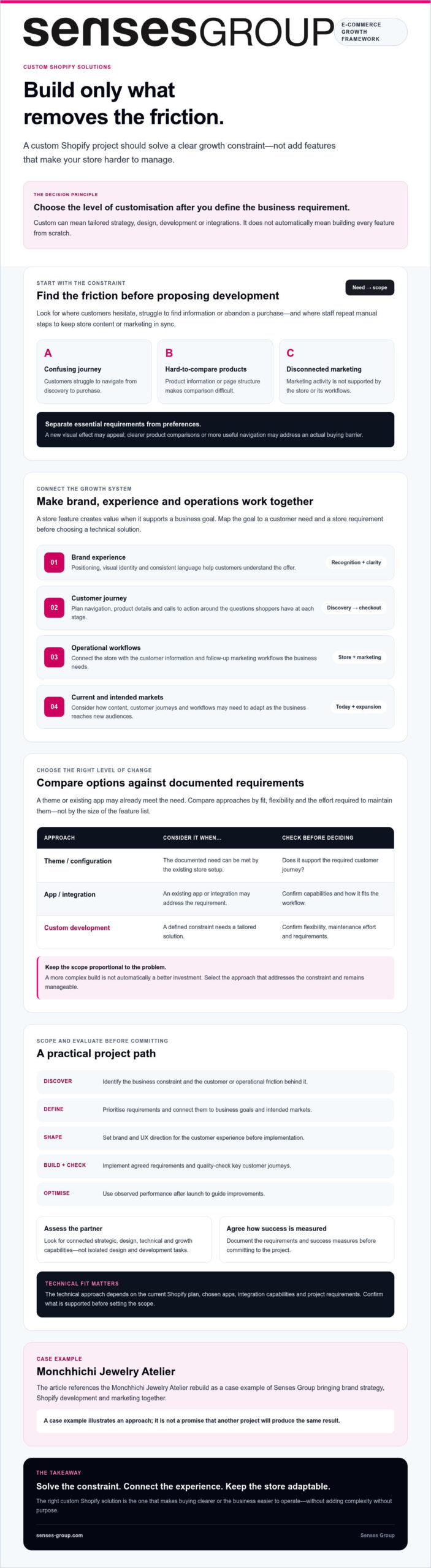
How to scope and evaluate a custom Shopify project before you commit
A strong brief turns a broad ambition, such as “grow online,” into decisions a provider can assess. It should show where the store is falling short now, which customer journeys matter next, and what evidence will indicate progress. Use this process to keep custom Shopify solutions focused on business priorities.
- Define the growth constraint. Identify the specific barrier, such as customers struggling to find product information or a manual workflow slowing marketing activity. Describe what happens today and who it affects.
- Map requirements. Record target customers, important buying journeys, current bottlenecks and business priorities. Consider how the needs of different audiences may vary.
- Prioritise the scope. Separate essential requirements from improvements that can wait. This protects the project from feature creep and makes trade-offs easier to assess.
- Assess providers. Ask how strategy, design, development, integrations, quality checks and post-launch work connect. Request clarity on responsibilities, dependencies and any technical questions that need validation.
- Agree success measures. Define what the project should improve and how you’ll evaluate it. Measures should relate to the original constraint, such as whether a key journey is easier to complete or a required workflow operates as intended.
What should a practical Shopify project brief contain?
Keep the brief useful, not exhaustive. Include who the store serves, what’s not working, which journeys matter, and what the business needs to support in its next growth stage. Mark each requirement as essential or later-phase, then ask providers to flag assumptions, dependencies and features that require technical validation. Review a related Shopify store audit and performance analysis to consider how store evaluation can inform project priorities.
How can you assess a Shopify agency beyond its portfolio?
Look beyond visual polish. Does the provider investigate the business constraint before recommending a build? Can they explain why a proposed feature is needed, who will handle each stage, and how ongoing support or post-launch optimisation is approached? Ask for relevant case evidence and clarify its context, including what changed and what other factors may have influenced the result.
An aligned brief makes provider comparisons more meaningful because every proposal responds to the same business requirements. If you’re preparing a project and want to assess how brand strategy, Shopify development and marketing fit together, explore Senses Group’s Shopify and growth services.
How Senses Group connects custom Shopify solutions to the wider growth system
A Shopify store performs its role best when it reflects a clear brand and supports the wider marketing system. Senses Group brings brand strategy, brand identity design and conversion-focused Shopify development together with Klaviyo email automation, SEO and AI Engine Optimisation, and Meta and Google advertising. The aim is not to add every possible feature. It’s to align the customer experience, store structure and marketing activity with the business’s priorities.
That connection matters for businesses building demand while preparing to serve new audiences. Brand positioning can inform how products are presented; that content structure can guide the customer journey; and the store can provide a foundation for email, search and advertising activity. Each element should serve a defined purpose and be scoped to the business’s requirements.
What does an integrated Shopify engagement connect?
Brand foundations help shape the store’s visual identity, language and user experience, so customers can understand the offer consistently across key pages and marketing touchpoints. Klaviyo can support email automation, while SEO and GEO help shape how content is structured for discovery. Paid advertising can bring targeted audiences to the store, where the experience needs to make the next step clear. Specific integrations and capabilities should be confirmed against current platform and technical requirements.
These disciplines work best as a connected system, not as separate decisions made in isolation. For a broader perspective on bringing marketing activity together as a business scales, read this integrated digital marketing scaling guide.
Senses Group’s Monchhichi Jewelry Atelier ecommerce rebuild was associated with revenue doubling shortly after launch. It’s a documented case example, not a forecast or promise that another business will achieve the same result. Its relevance is in showing why a store rebuild should be considered in the context of the brand and customer experience, rather than as a visual refresh alone.
What should the next step look like for your business?
Bring a clear starting point to the conversation: your business goals, the constraints in your current store, the customer journeys you want to improve and the markets you intend to serve. A useful first discussion should clarify what the business needs and what scope may be appropriate, not assume that a particular feature or full rebuild is the answer.
If you’re ready to explore whether custom Shopify solutions fit your growth priorities, discuss a custom Shopify solution with Senses Group.
Build a Shopify foundation for your next stage of growth
The right custom Shopify solutions start with a documented business constraint, not a longer feature list. Choose a theme, app or custom development based on what your customers and team need; then connect brand experience, store structure and marketing around clear priorities.
Senses Group, founded in 2008, claims more than 18 years of expertise as of 2026. Its Monchhichi Jewelry Atelier ecommerce rebuild was associated with revenue doubling shortly after launch. That result is a case example, not a forecast or guarantee. The agency has also managed more than $4 million in advertising spend, demonstrating experience across the wider growth system.
If you’re assessing a store project, bring your goals, current constraints and intended markets into the conversation. A useful first step is to clarify what your business needs before deciding how much custom work is appropriate.
Discuss a custom Shopify solution built around your growth goals. With a focused brief and the right partner, your store can become a stronger foundation for reaching customers wherever you plan to grow.
Frequently Asked Questions
What are custom Shopify solutions?
Custom Shopify solutions are store experiences tailored to a business’s specific customer journeys, brand and operational requirements. They can combine strategic planning, design, development and selected integrations, but don’t necessarily require fully bespoke code. For example, a business might refine product navigation, shape clearer product information or connect a marketing workflow. The right scope starts with a defined need, then uses the simplest suitable approach to address it.
When should a business choose custom Shopify development instead of a theme?
Choose custom development when a persistent business requirement can’t reasonably be met through a suitable theme or its available settings. This could involve a distinctive customer journey or a workflow that standard configurations don’t support. First document the problem and assess how it affects customers or operations. If the requirement is mainly a visual preference, check whether existing theme options can deliver it before approving a more complex build.
Can a Shopify store be customised without building everything from scratch?
Yes. A store can often be tailored through theme settings, selected apps and focused development, rather than a complete bespoke build. A theme may support the desired visual direction, while an app may address a specific workflow. Before adding an app or custom code, confirm that it fits the store’s requirements and current technical setup. This staged approach helps avoid unnecessary complexity while leaving room to address validated needs.
How do I choose a Shopify development agency for my business?
Assess how an agency understands your business before recommending a solution. Ask how it connects brand strategy, user experience, development, integrations and post-launch work, and clarify who is responsible for each part. Review relevant project evidence and ask what changed and what results were documented. Senses Group combines brand strategy, identity design, Shopify development and marketing services, so consider whether that connected approach matches your priorities.
What should be included in a custom Shopify project brief?
Include your target customers, current store bottlenecks, priority customer journeys and business goals. Note which audiences you currently serve and intend to reach, and describe any differences in the experience you need to support. Separate must-have requirements from later improvements. Ask providers to identify dependencies, app or platform requirements, technical questions that need validation and how success will be assessed after launch.
Can custom Shopify solutions support international ecommerce expansion?
Yes, a carefully scoped store can be planned around both current customers and intended overseas markets. Discovery should identify how customer journeys, product content and marketing needs may differ, then establish which requirements the store must support. Don’t assume every market needs a separate build or that a particular feature is available by default. Confirm relevant Shopify plan capabilities, apps and integrations before including them in the project scope.
How can Shopify connect with Klaviyo and other marketing tools?
Shopify can be part of a wider marketing setup that includes Klaviyo email automation, analytics and advertising tools, but the required data flows and capabilities need to be confirmed for each project. Define the workflow first: for example, which customer actions should inform an email sequence, or what information the team needs to assess campaign performance. Check app compatibility, plan requirements and technical dependencies during discovery rather than assuming every integration is included.