
In 2026, the competitive advantage in digital advertising has shifted from the bidding table to the foundation of your brand identity. If you’re operating a Shopify store in Hong Kong, you’ve likely felt the suffocating pressure of rising CPCs and the difficulty of breaking into international markets. It’s a common struggle. A sophisticated Google ads strategy for brands is no longer about manual keyword tweaks; it’s about building a systemic growth engine. You understand that traditional models are failing to capture global attention in a world dominated by AI. This guide provides the definitive framework to master the transition from local visibility to international dominance using a brand-first approach. We’ll examine how to integrate Google’s latest AI Max features and Omni asset tools to drive higher average order values. You’ll learn to move from fragmented tactics to a unified, AI-enhanced content ecosystem that prioritizes commercial depth over superficial clicks. By the end of this guide, you’ll have a clear roadmap for scaling revenue and securing a permanent foothold in the global marketplace.
Key Takeaways
- Learn how to navigate the 2026 shift from manual keyword management to AI-driven automation using the latest AI Max and Performance Max frameworks.
- Discover why prioritizing brand search volume is the most effective Google ads strategy for brands seeking long-term commercial sustainability and market authority.
- Understand the critical link between brand identity design and performance marketing to ensure your visual assets drive higher conversion rates on Shopify.
- Master the “Bespoke Sales Atom” methodology to construct a high-conversion funnel that aligns perfectly with the modern customer journey.
- Gain actionable insights on leveraging Hong Kong’s unique position as a gateway to scale your e-commerce operations into dominant international markets.
The Evolution of Google Ads Strategy for Brands in 2026
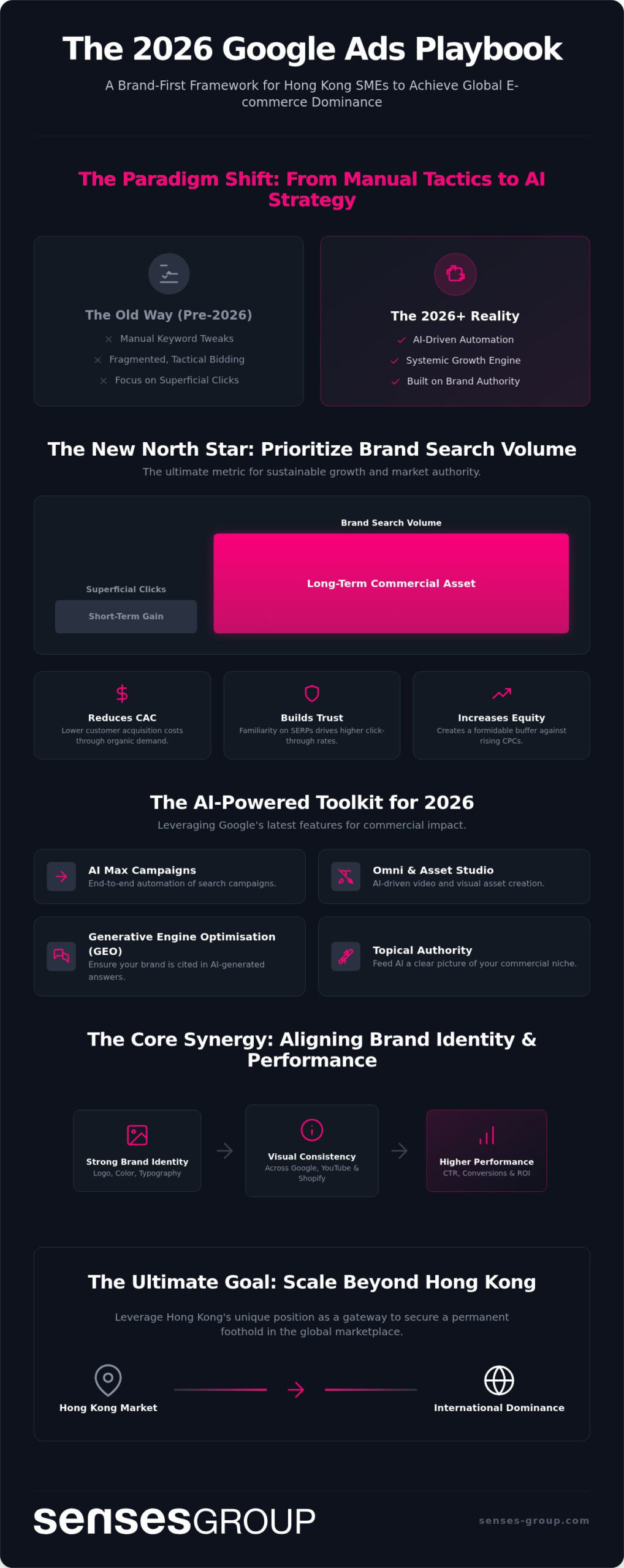
The 2026 digital auction is no longer a battle of manual bids; it is a competition of data quality and systemic brand resonance. We’ve moved beyond the era of granular keyword management. As of September 1, 2026, Google’s automatic upgrade of Search campaigns to AI Max has finalized the shift toward end-to-end automation. For Hong Kong SMEs, a successful Google ads strategy for brands now requires a pivot from technical tinkering to high-level strategic positioning. Success is built on the foundation of brand authority rather than just the mechanics of online advertising. A brand-first ad strategy is the deliberate integration of core identity with consumer intent, ensuring every touchpoint reinforces a unified commercial message.
While many focus on immediate clicks, the ultimate KPI for long-term sustainability is brand search volume. This metric reflects the psychological impact your business has made on the market. It indicates that consumers are seeking you specifically, not just a generic category solution. This organic demand provides a critical buffer against rising CPCs in the competitive Hong Kong market. Complementing this is Generative Engine Optimisation (GEO). By structuring your content for generative models, you ensure your brand remains the primary citation within AI-generated answers. This synergy between paid and organic AI visibility creates a formidable presence that traditional models cannot replicate.
Beyond the Click: The Importance of Brand Equity
Strong brand foundations do more than look professional; they actively reduce customer acquisition costs (CAC). When a user recognizes your brand on the search engine results page (SERP), the psychology of trust overrides the friction of the unknown. This familiarity leads to higher click-through rates and better conversion efficiency on your Shopify store. We don’t view ads as mere transactional triggers but as relationship-building touchpoints. This approach transforms a single purchase into a long-term commercial asset, fostering the stability needed for successful global market entry.
AI and Automation in the 2026 Ad Ecosystem
Automation requires sophisticated fuel, and that fuel is high-quality, structured data. Leveraging LLM-optimized metadata ensures your ad relevance remains high as Google’s AI interprets your brand’s core offerings. With the August 2026 launch of “Omni” and multimodal video creation tools in Asset Studio, the impact of AI visual production on Performance Max assets has become a primary differentiator. A “topical map” approach ensures your digital presence is interconnected, feeding the AI a clear, authoritative picture of your commercial niche. This logic-driven system is what separates a sustainable Google ads strategy for brands from a temporary spike in traffic. It’s about building a foundation that scales as the technology evolves.
Aligning Brand Identity with Performance Marketing
Performance marketing is often reduced to spreadsheets and bidding algorithms. This is a mistake. A truly effective Google ads strategy for brands treats identity as a performance variable. We adopt the “Commercial Thinker” approach. This means understanding that your typography, color palette, and logo aren’t just aesthetic choices; they’re commercial signals that influence trust and ROI. Research into The Marketing Strategy of Google highlights how the platform’s own evolution prioritizes high-quality, relevant user experiences. For a brand, this means ensuring total visual consistency across Google Search, YouTube, and your Shopify store. If the visual promise made in an ad isn’t kept on the landing page, the psychological disconnect results in immediate bounce rates.
In the crowded Hong Kong ecosystem, your brand story is your primary differentiator. It’s the “why” that separates you from a sea of generic competitors. By weaving this narrative into your ad copy and visual assets, you create a sense of depth and permanence. This isn’t about superficial excitement. It’s about seasoned assurance. When you present a unique value proposition (UVP) that resonates with international audiences, you stop competing on price and start competing on value. This shift is essential for any business looking to scale beyond local borders and achieve international dominance.
The Synergy of Design and Data
Professional brand identity design is a direct lever for improving ad click-through rates (CTR). It isn’t enough to be seen; you must be recognized as an authority. We’ve seen the power of this integration firsthand. For instance, we helped Monchhichi Jewelry Atelier double their revenue by moving from a generic e-commerce look to an identity-led experience. By building brand guidelines that empower ad creative rather than restricting it, we enabled their Performance Max campaigns to generate assets that felt premium and cohesive. This alignment ensures the AI has high-quality inputs to work with, which is essential in the 2026 ad ecosystem.
Lowering CAC through Strategic Positioning
Strategic positioning is the secret weapon for Hong Kong startups looking to challenge established giants. In a competitive market, you don’t win by outspending; you win by out-positioning. By crafting a UVP that addresses specific customer pains, you target high-intent segments with surgical precision, effectively lowering your customer acquisition costs (CAC). Transitioning your business model requires a deep dive into mastering retail brand identity to ensure your digital presence is robust enough for global scale. When your brand story is clear, your Google ads strategy for brands stops being a cost and starts being an investment. If you’re ready to refine your market position, our brand strategy services can help you build a foundation for dominance.
How to Construct a High-Conversion Google Ads Funnel
Constructing a high-conversion funnel requires a shift from linear thinking to a systemic approach. At Senses Group, we utilize the “Bespoke Sales Atom” to map every digital touchpoint to a specific stage of the customer journey. This methodology ensures that your Google ads strategy for brands isn’t just a collection of ads but a unified growth engine. The process begins with mapping the Atom to identify where your audience experiences the most friction. We then conduct keyword research that prioritizes high-intent brand and category terms, ensuring you capture traffic that is ready to convert. By August 2026, the general availability of Multimodal Video Creation in Asset Studio has made it essential to create AI-driven visual assets for YouTube and Discovery ads. This data-driven creative is then funneled into a Shopify landing page optimized for conversion. For the traffic that doesn’t convert immediately, we implement Klaviyo email automation flows to nurture leads and recover potential revenue. This interconnected system is how we’ve managed over $4M in ad spend to drive sustainable growth.
Search Strategy: Protecting and Projecting
A robust search strategy must both protect your existing territory and project your brand into new markets. Bidding on your own branded keywords is a non-negotiable tactic to prevent competitors from stealing high-intent traffic at the final stage of the funnel. Simultaneously, we use negative keyword lists to filter out low-value shoppers, preserving your budget for users who match your ideal customer profile. To dominate the search results, you must target high-intent long-tail queries that signal a specific, urgent readiness to purchase rather than just a general interest in the category. Google reports that advertisers using the new AI Max features are seeing an average of 7% more conversions at a similar cost per acquisition, making these automated tools a vital component of your search projection.
The Landing Page: Where Profit is Made
The landing page is the foundation of your entire ad strategy. Even the most sophisticated Google ads strategy for brands will fail if the destination doesn’t convert. A high-converting Shopify store must balance brand story with specific product features to build trust while driving action. This requires a strategic content structure that leads with a bold value proposition followed by logical proof points. For Hong Kong SMEs, this digital transformation is the key to transitioning from a traditional model to a global e-commerce powerhouse. To understand the technical and strategic requirements of this transition, you should consult our 2026 strategic Shopify guide for Hong Kong SMEs. By aligning your landing page with the intent of your ads, you ensure that every dollar of spend is an investment in a scalable revenue machine.
Scaling Beyond Hong Kong: International Market Entry
Hong Kong serves as a unique strategic gateway, but transitioning from local visibility to international dominance requires more than just budget; it requires a systemic recalibration of your brand’s digital presence. When scaling, a successful Google ads strategy for brands must account for the removal of manual language targeting that took effect in September 2026. Google’s AI now relies entirely on the quality of your ad copy and landing page assets to determine linguistic relevance. This makes localization a foundational requirement. It isn’t a matter of simply translating words, but of translating commercial values and cultural expectations. For instance, international shipping and logistics must be addressed directly within your ad copy. Managing these expectations early reduces friction and builds the trust necessary for a high-conversion global funnel.
Global influencer networks play a critical role in this ecosystem by providing the local social proof that paid ads cannot manufacture alone. By integrating these voices into your content strategy, you bridge the gap between a foreign brand and a local household name. This is about building an impactful and enduring presence in new territories, not just capturing temporary traffic.
Testing New Markets with Google Ads
Before committing significant capital, use small-scale “test” campaigns to validate product-market fit in high-growth regions. Identify these opportunities using Google Trends and internal CRM data to ensure you’re entering markets with genuine demand. We advise scaling your budget based on lifetime value (LTV) rather than just initial ROI. This long-term commercial perspective allows you to outlast competitors who are tethered to immediate transaction metrics. It’s a disciplined approach that turns international expansion from a gamble into a structured process.
Integrated Multi-Channel Growth
A dominant global presence isn’t built on a single platform. Combining Google Ads with Meta Ads creates an omni-channel presence that captures intent on search while building desire on social. To understand how to synchronize these efforts, you should explore our Meta Ads management for ecommerce framework. Supporting these paid efforts with 100k follower growth engines provides the organic momentum needed to lower blended acquisition costs. For a comprehensive approach to unifying these channels, our multi-channel marketing strategy for Shopify provides the 2026 framework to transform your fragmented digital presence into a high-performance growth engine. If you’re ready to transform your Hong Kong business into a global brand, our international growth consultancy can help you build the necessary infrastructure for success.
The Senses Group Approach: Integrated Growth Engines
At Senses Group, we don’t view advertising as a series of isolated campaigns. We build revenue-generating machines. A high-performing Google ads strategy for brands must be part of a systemic ecosystem that drives long-term commercial value rather than temporary spikes in traffic. With 18 years of expertise and over $4M in managed ad spend, we’ve refined a process that prioritizes commercial substance over superficial metrics. Our “Marketing Map” system integrates SEO, GEO, and Paid Media into a single, unified framework. This ensures that while your ads capture immediate intent, your organic and AI-generated presence builds the permanence required for international market dominance. We don’t just manage budgets; we engineer growth.
AI visual production is a core component of this engine. It isn’t just about creative efficiency; it’s about commercial impact. By using AI-driven visual production within the “Bespoke Sales Atom” framework, we’ve seen engagement rates and average order values (AOV) triple for our clients. High-quality, on-brand assets provide the data-rich fuel that 2026’s AI Max features require to optimize effectively. This turns every impression into a building block for your brand’s authority, ensuring your digital presence remains sophisticated and persuasive across all Google surfaces.
Custom Solutions vs. Standard Packages
Standardized ad packages are designed for the average, but the Hong Kong market is anything but average. One-size-fits-all strategies fail because they ignore the unique competitive pressures and cultural nuances of the local ecosystem. We function as a strategic partner and an authoritative mentor, not a subservient service provider. We identify the “root” of your growth stagnation rather than just treating the symptoms with more spend. Our commitment is to building businesses that are both impactful and enduring. We value logic and systems over mere creativity, ensuring your strategy is grounded in practical experience and global insight.
Building Your 2026 Growth Engine
Transforming your business from a traditional model to a robust e-commerce presence requires a methodical and deliberate approach. It starts with a comprehensive audit of your current digital foundation to ensure every functional element supports your commercial goals. You can find detailed actionable steps in our integrated digital marketing scaling guide for 2026. Once the foundation is secure, we layer on the “Bespoke Sales Atom” to drive international expansion and local market retention. If you’re ready to stop running ads and start building a revenue machine, let’s build your growth engine today.
Securing Your Global Commercial Foothold
The transition from a local Hong Kong operation to an international powerhouse requires more than just technical execution; it demands a fundamental shift in how you perceive your digital presence. We’ve established that a successful Google ads strategy for brands in 2026 is built on the synergy of brand authority and AI-driven automation. By aligning your visual identity with performance data and constructing a resilient “Bespoke Sales Atom,” you create a system that scales logic rather than just spend. This isn’t about chasing the next algorithm update but about building a permanent foundation for revenue growth.
At Senses Group, we leverage 18 years of strategic branding expertise and have managed over $4 million in ad spend to transform Shopify stores into global leaders. We’ve seen these frameworks double revenue for our clients by treating marketing as a unified growth engine. It’s time to move beyond fragmented tactics and embrace a disciplined, systemic approach to market dominance. Partner with Senses Group to scale your brand with an integrated Google Ads strategy and start building an impactful, enduring commercial legacy today. Your expansion into the global marketplace begins with a single, strategic decision.
Frequently Asked Questions
Is bidding on my own brand name in Google Ads a waste of money?
Bidding on your brand name is a critical defensive and offensive tactic. It prevents competitors from hijacking your traffic and ensures you dominate the search results for users with the highest intent. By securing the top position, you control the narrative and landing page destination. This protection is a fundamental component of a Google ads strategy for brands, ensuring that the brand equity you’ve built isn’t siphoned off by rivals.
How much should a brand spend on Google Ads to see results in 2026?
There is no universal figure, but your budget should be determined by your commercial goals and market competition. We recommend starting with a spend that allows for sufficient data collection to inform Google’s AI Max features. Instead of chasing a specific number, focus on scaling based on lifetime value (LTV) rather than initial ROI. This strategic approach ensures your investment fuels a sustainable growth engine that outlasts competitors restricted by short-term metrics.
What is the difference between Google Ads and Meta Ads for brand scaling?
Google Ads primarily captures existing demand by targeting users who are actively searching for solutions. In contrast, Meta Ads excels at generating new demand by building desire through visual storytelling and interest-based targeting. For successful scaling, these platforms should work in tandem within an omni-channel framework. Google secures the high-intent conversion, while Meta builds the awareness and follower growth engines that feed the search funnel, creating a comprehensive, interconnected sales machine.
How does branding affect my Google Ads Quality Score?
A strong brand identity directly influences your Quality Score by improving click-through rates (CTR) and user engagement on your landing pages. When your ads and Shopify store are visually cohesive, users are more likely to trust the content and remain on the site. This positive behavior signals relevance to Google’s AI. High-quality brand assets ensure that your Google ads strategy for brands results in lower costs per click and better ad placement over time.
Can Google Ads help my Hong Kong business expand to international markets?
Google Ads is a powerful vehicle for transitioning from local visibility to international dominance. By leveraging AI Max and multimodal video creation, Hong Kong businesses can reach global audiences with localized content that resonates across cultures. The platform allows you to test new markets with small-scale campaigns to validate product-market fit. This data-driven entry strategy reduces the risks associated with global expansion, helping you build an impactful and enduring international presence.
What are the most important KPIs for a brand-focused Google Ads campaign?
While clicks are important, a brand-focused campaign prioritizes brand search volume, average order value (AOV), and customer lifetime value (LTV). Brand search volume indicates the psychological impact your marketing has on the market. AOV and LTV reflect the depth and commercial sustainability of your customer relationships. By tracking these metrics, you ensure your Google ads strategy for brands is building a robust revenue engine rather than just generating temporary, low-value transactions.
How long does it take to see a return on investment from Google Ads?
Initial data and conversions can appear within the first few weeks as the AI begins to optimize your campaigns. However, building a systemic, high-performing growth engine typically requires three to six months of consistent data collection and refinement. This period allows the “Bespoke Sales Atom” to fully integrate and for AI-driven visual production to resonate with your audience. We prioritize long-term stability and sustainable profit over frantic, short-term spikes that lack commercial depth.
Why do I need a Shopify expert if I am only running Google Ads?
An ad campaign is only as effective as the landing page it directs traffic to. A Shopify expert ensures your store is optimized for conversion, site speed, and user experience, which are the foundations of ROI. Without a high-performing website, your ad spend is wasted on a leaky funnel. We integrate branding, Shopify development, and Google Ads into a single system to ensure your visitors are successfully transformed into loyal, high-value buyers. To further strengthen your paid media results, pairing your Google Ads efforts with a robust ecommerce social media advertising strategy ensures your brand captures demand across every digital touchpoint where your customers spend their time.