
A brand that looks and sounds different across its storefront, social channels and ads creates friction where customers need clarity. Brand audit services help identify those gaps in customer-facing visuals and messaging, so you can make informed improvements rather than refreshing assets by instinct. Companies can track brand performance every 12 to 18 months or after completing a major strategic initiative.
It’s understandable to focus on immediate sales when you’re scaling an SME or startup in Hong Kong. But if your local identity doesn’t translate clearly to overseas e-commerce customers, or growth has stalled despite ongoing marketing, the issue may sit deeper than a single campaign.
This guide explains why a brand audit matters, when to review your brand, and what a structured assessment examines and collects. You’ll see how visual identity, messaging, customer experience and market position fit together, and how the findings can inform practical next steps.
Key Takeaways
- Review how your visuals and messaging work across the customer touchpoints that matter, from your online store to marketing materials.
- Use an assessment to uncover inconsistencies, clarify your market position and turn findings into practical priorities.
- Consider a review every 12 to 18 months, or after a major strategic initiative, to keep your brand aligned with business changes.
- Set clear objectives before gathering feedback so the assessment connects to real growth challenges in Hong Kong and overseas markets.
- Choose research methods that fit the question, combining customer perspectives, internal insight and competitor analysis where useful.
Creative review and analysis of customer-facing visuals and messaging
A brand audit assesses awareness and perception against defined objectives, often using quantitative audience research. It also examines positioning by comparing what customers associate with a brand with its intended place in the market. The findings show where recognition, messaging, and customer experience align or diverge.
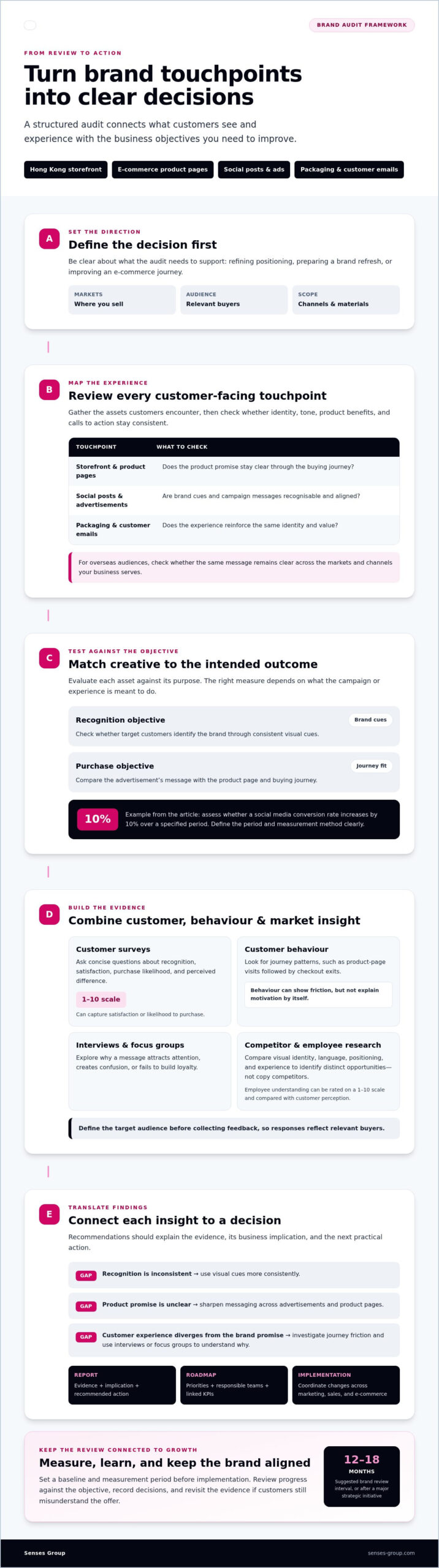
Start with a touchpoint inventory. Gather the Hong Kong storefront, product pages, social posts, paid advertisements, packaging, and customer emails. Review each asset for consistent use of identity, tone, product benefits, and calls to action. For an overseas audience, check whether the same message remains clear across the channels and markets the business serves.
Then assess creative performance against a defined objective. If an ad aims to build recognition, look for consistent brand cues and whether target customers identify them. If it aims to drive purchases, compare the message with the product page and buying journey. An audit can assess whether a social media conversion rate increases by 10% over a specified period, but the period and measurement method need to be clear.
Quantitative surveys add structure to customer feedback. Ask existing and potential customers concise questions about brand recognition, satisfaction, purchase likelihood, and perceived difference. A 1-10 scale can capture satisfaction or likelihood to purchase, while consistent questions make responses easier to compare. Define the target audience first so the results reflect relevant buyers, not just whoever happens to respond.
Customer behaviour adds context. Examine available journey data for patterns such as product-page visits followed by checkout exits, then compare the observed experience with the brand promise. Behaviour can reveal friction, but it does not explain motivation by itself. Interviews or focus groups can help clarify why a message attracts attention, creates confusion, or fails to build loyalty.
Competitive and employee research complete the picture. Compare competitors’ visual identity, brand language, positioning, and customer experience to identify distinct opportunities, not copy their creative. Ask employees how well the brand reflects the company’s vision, using a 1-10 rating if useful. Differences between employee understanding and customer perception can point to messaging that needs greater clarity.
Bring the evidence together by linking each finding to a decision. A recognition gap may call for more consistent visual cues; an unclear product promise may require sharper messaging. This connects creative review to advertising effectiveness and loyalty: customers need to recognise the brand, understand its value, and experience that promise consistently at every touchpoint.
Why do I need a brand audit?
A brand audit can help identify why growth has stalled, why a refresh may be needed, or where customers misunderstand your value. Its findings turn scattered concerns into recommendations tied to business objectives.
In Hong Kong, the price depends on the case and is given after a quote request; scope, research methods, touchpoints, and reporting needs shape the work.
Branding agencies and marketing consultancies conduct brand audits. Look for a team that can connect research and creative findings to clear business objectives, rather than reviewing design in isolation.
Audit Scope and KPIs
Begin by defining the decision the audit needs to support, such as refining positioning, preparing a brand refresh, or improving an e-commerce journey. Agree on the scope with leadership and relevant teams before research begins. Specify which markets, customer groups, channels, and brand materials the assessment will examine, so the findings address the actual challenge.
Choose KPIs that connect to the objective. For a recognition challenge, track awareness among the target audience; for a conversion challenge, assess customer actions along the relevant journey. Set a baseline and measurement period before implementation. This gives the business a consistent way to assess whether changes support the intended outcome, rather than relying on subjective approval of new creative.
Audit Reports and Recommendations
A useful report explains the evidence behind each finding, its business implication, and the recommended action. For example, if product pages describe benefits differently from advertisements, the report can identify the mismatch and propose consistent messaging across both touchpoints. Recommendations should be specific enough to guide decisions and grounded in the audit’s scope and evidence.
Ask whether the report distinguishes urgent inconsistencies from longer-term opportunities. A clear roadmap groups actions by priority, names the teams responsible, and connects each action to a KPI. It should also record decisions and assumptions, so leaders can understand why a recommendation was made and evaluate progress during implementation.
Implementation is where analysis becomes operational. Assign an owner to each approved recommendation, then translate it into deliverables, such as revised messaging, updated brand guidelines, or a prioritised set of digital assets. Coordinate changes across marketing, sales, and e-commerce teams. A new campaign promise, for instance, should appear on the landing page and in customer communications, not just in the advertisement.
Use review points to monitor progress against the baseline. If a change improves message consistency but customers still misunderstand the offer, revisit the supporting evidence and refine the work. Keep a record of decisions, results, and unresolved issues; this creates a practical reference for the next strategic review. To turn audit findings into a brand roadmap, connect each priority to the strategy and customer experience it is meant to strengthen.
How often should a brand be reviewed?
Track brand performance every 12 to 18 months or after a major strategic initiative. For Hong Kong businesses serving local and overseas audiences, review language and visuals in each market, not just the original version.
Audit bilingual materials by comparing meaning, tone, terminology, and visual context across versions. A direct translation can preserve the words while losing the intended message.
Visual Identity and Asset Review
A visual review checks whether brand assets work across the places customers encounter them. Inspect the logo, colour palette, typography, product photography, packaging, and templates used in social posts and e-commerce pages. For example, compare a mobile product page with a campaign graphic and product packaging. Look for inconsistent colours, outdated logos, or imagery that no longer reflects the product range.
Use an asset register to record each item, its channel, owner, and last update. Then assess whether the design remains legible at different sizes and suits the intended audience. A logo that reads clearly on a desktop banner may lose detail as a mobile icon. Record the issue and affected touchpoint before recommending a change.
Timing should reflect business change as well as the calendar. Companies can track brand performance every 12 to 18 months or after completing a major strategic initiative. A new product range, shift in positioning, or overseas e-commerce launch can also prompt a focused visual review, since these changes affect which assets customers see and what those assets need to communicate.
Messaging and Identity Consistency
Compare brand language with visual identity across advertisements, product descriptions, emails, and social channels. If an ad presents a product as premium but its product page relies on generic claims, the mismatch can weaken credibility. Check that the same core promise appears consistently, while allowing channel-specific details to suit each customer interaction.
Hong Kong brands communicating in Chinese and English should check more than translation accuracy. Compare product names, benefit descriptions, tone, and calls to action in each version. Confirm that the intended positioning survives the adaptation, and review how imagery and layout support the message for each audience. For cross-border stores, assess whether market-specific wording remains consistent with the brand’s central promise.
Set a practical review method: select representative assets from each active channel, compare them against current brand guidelines, and log inconsistencies by impact. A product-page headline and paid campaign, for example, can be reviewed side by side. This turns a broad visual review into specific issues teams can resolve and revisit during the next audit.
Consistency matters commercially, but it must serve clarity rather than uniformity for its own sake. According to Lucidpress, brands with consistent messaging and visuals across platforms can see a revenue boost of up to 33%. Treat this as a reported potential, then use your own brand measures to assess whether improvements support recognition, comprehension, and customer response.
Brand audit consultation and assessment process
A focused assessment starts with business goals, then examines how the brand performs against them. The scope should reflect the decision ahead, such as addressing stalled growth or preparing for expansion.
Compare agencies and consultants by relevant experience, research methodology, reporting, client support, and value relative to cost. Look for a process that connects evidence to business objectives, rather than offering visual opinions alone.
An audit’s duration depends on its scope, research methods, stakeholder access, and the number of markets or touchpoints reviewed. A focused review of existing materials involves different work from an assessment that includes customer surveys and interviews.
Brand Strengths and Weaknesses
Begin the consultation by clarifying the business challenge and the decisions the assessment must inform. Gather existing brand materials, customer feedback, and relevant performance information, then align leadership and cross-functional stakeholders on objectives. This keeps the review anchored to business priorities, such as improving customer understanding or supporting a move into overseas e-commerce.
Assess strengths and weaknesses using evidence, not internal preference. A strong product reputation may be a strength, while inconsistent explanations of its value across sales and marketing materials may be a weakness. Record each finding with its evidence and likely business impact. This distinction helps teams preserve valuable brand assets while addressing the root of a problem.
Brand Audit Assessment Areas
A brand audit examines the brand’s message, image, and market position to assess strengths and weaknesses. It can review customer-facing materials, the experience across active touchpoints, and how competitors communicate and present themselves. Define which areas matter to the objective, so a review of e-commerce positioning doesn’t become an unfocused inventory of every asset.
For a Hong Kong business entering another market, include the customer journey and materials used for that audience. Compare the intended brand promise with the information customers encounter on product pages, campaigns, and other selected channels. The assessment can also gather internal and external perspectives, helping reveal differences between what the business intends to express and what people understand.
Audit Timing and Limitations
Set the schedule after defining the scope and research plan. Reviewing existing materials and arranging stakeholder input require different steps from collecting survey responses or conducting interviews. Access to relevant information, the number of touchpoints, and alignment among decision-makers also shape the work. Agree on milestones for research, analysis, and findings before the assessment begins.
Brand audits have limits. A small set of interviews with highly qualified participants can indicate brand position and perception, but it cannot provide quantitative brand-awareness metrics. Surveys can measure awareness when objectives and the target audience are defined. Findings also reflect the materials and feedback examined, so an audit should describe its scope and distinguish direct evidence from interpretation.
Finally, treat recommendations as decisions to implement and measure, not automatic fixes. A finding about unclear positioning may point to a strategy issue, while inconsistent creative may call for clearer identity guidance. Connect each proposed action to the evidence and business objective. This discipline makes the assessment useful to leadership and gives teams a reasoned basis for prioritising change.
Brand audit data collection methods
Prepare materials that show how the brand is presented and experienced. A useful starting set includes current brand guidelines, customer-facing assets, channel performance data, customer feedback, and information about business objectives.
Organise the evidence around the audit scope. For an e-commerce business, gather representative product pages, campaign materials, email examples, and customer journey data. Include Hong Kong and overseas versions where both markets are part of the assessment. This gives reviewers a basis for comparing intended messaging with the experience customers actually encounter.
- Brand guidelines, logos, and approved visual assets
- Website, product page, advertising, and email examples
- Available customer feedback and survey results
- Business objectives, target audiences, and relevant performance measures
Surveys can gather comparable views from existing and potential customers. Keep questions concise, define response options clearly, and avoid combining several ideas in a single question. Ask about recognition, associations, and purchase considerations. A well-framed question might ask which qualities respondents connect with the brand, rather than suggesting answers through loaded wording.
Interviews and focus groups add context to survey findings. They can reveal why customers interpret a product promise in a particular way or where an online buying journey creates uncertainty. Employee interviews can show whether teams understand the brand’s intended positioning and apply it consistently in customer interactions.
Competitor research adds a market perspective. Compare selected competitors’ visual identity, language, product presentation, and customer experience. Record the examples and comparison criteria used, so conclusions reflect observed differences rather than assumptions. This helps explain where the brand stands in its competitive landscape and how its reputation is shaped by customer-facing evidence.
Refresh the asset and evidence list before analysis. Confirm that each item is current, identify its channel and market, and remove duplicated or superseded files. For example, label an old campaign as archived rather than treating it as active messaging. Check that survey responses, interview notes, and performance records relate to the agreed scope.
For AI readiness, review whether the brand’s core facts are clear and consistent across its website and product information. Check that names, descriptions, and business details agree across relevant pages. Structured, consistent information makes the brand easier to interpret across digital experiences. The audit should note gaps and prioritise corrections without treating automated tools as a substitute for customer research.
Finally, connect each data source to the question it answers. Customer feedback explains perception, channel records show interaction, and competitor review provides context. Turn audit evidence into a practical brand plan by linking findings to decisions, owners, and measures for follow-up.
Senses Group: Brand Strategy
Senses Group helps businesses turn brand findings into a clearer strategic direction. If an audit reveals that customer perceptions, messaging, and business ambitions have drifted apart, Brand Strategy can define the position and priorities that guide future decisions.
When the challenge is inconsistent visuals, Brand Identity Design can translate that direction into a cohesive identity across customer touchpoints. For businesses scaling through e-commerce, an Ecommerce Shopify Store and Klaviyo Email Automation can carry the brand experience into the online store and customer communications.
The right next step depends on what the assessment uncovered. Start with the most consequential gap, then connect strategy, identity, and customer experience around it. Contact Senses Group to discuss how your audit findings can shape your next brand decisions.
Put your audit findings to work
The value of an audit lies in the decisions it enables. Use the findings to choose a clear next move, whether that means sharpening your positioning, aligning customer-facing identity, or improving how your e-commerce experience expresses the brand. For Hong Kong businesses preparing to reach overseas customers, the next step should connect the brand promise with the experience each market receives.
Choosing brand audit services is only the beginning. The lasting work is translating evidence into a practical direction, then carrying that direction consistently through strategy, identity, and the digital storefront. Senses Group offers Brand Strategy, Brand Identity Design, and Ecommerce Shopify Store development, helping businesses turn brand priorities into customer-facing decisions.
If your findings point to a need for a clearer strategic foundation or a more coherent online brand experience, contact Senses Group about your brand audit. Take the next step with purpose, and build a brand that can move forward with clarity.
Frequently Asked Questions
What does a brand audit service include?
Professional brand audit services typically combine a review of customer-facing materials, research, and business context. They may examine whether packaging, order confirmations, product pages, and sales messages express the same promise. Research can test whether buyers recognise the business and understand its difference. For an online retailer, this can reveal a gap between a product description and what customers expect after purchase.
What are the benefits of a brand audit for a business?
A brand audit helps leaders decide which brand issues deserve attention first. For example, a business adding a new product line can use findings to spot conflicting descriptions before those messages spread across its store and campaigns. A business entering overseas markets can identify where local assumptions may not translate. This makes brand decisions more deliberate, helps teams coordinate their work, and directs resources toward issues connected to business priorities.
What are the steps in a professional brand audit?
A professional audit follows a defined sequence: agree on the business decision, set the scope, gather relevant evidence, analyse patterns, and present recommendations. Before research begins, identify who will approve the objectives and provide access to materials. During analysis, separate observed evidence from interpretation. At the end, translate priorities into assigned actions and measures, so teams can put the findings into practice rather than leaving them in a report.
What deliverables should a brand audit report include?
A useful report includes the agreed scope, evidence reviewed, key findings, and implications for business decisions. It should distinguish strengths from issues, explain how conclusions were reached, and state where evidence has limitations. Recommendations are most actionable when each includes a priority, a responsible team, and a way to assess progress. For an e-commerce business, an asset inventory or touchpoint map can help teams locate exactly where changes are needed.