
A brand repositioning deck earns board approval through strategic clarity, not slide volume. An executive board presentation for brand repositioning should connect market perception to company strategy, then show how the proposed change will be implemented. Examples range from a two-slide brand reposition framework to a 68-slide repositioning presentation, while another template structures the work as a seven-stage process.
It’s understandable to look for a presentation you can copy. Examples can provide a useful structure, but the strongest board case is built around your business: what customers perceive today, where that perception diverges from your ambitions, and what must change to close the gap. For Hong Kong SMEs and startups expanding through e-commerce, that argument should also make clear how the position will hold across local and overseas markets.
This article explains what board presentation examples can teach you, how to shape a repositioning strategy around market evidence and commercial direction, and how to present the implementation and financial case. The goal is a decision-ready narrative, not a borrowed deck that leaves directors guessing what they’re being asked to approve.
Key Takeaways
- Use presentation examples as a framework, then shape the narrative around the decision your board needs to make.
- Ground your positioning in how customers perceive the brand and where that perception differs from your intended market role.
- Connect the repositioning to company priorities and show how it can support growth across Hong Kong and overseas e-commerce markets.
- Make implementation tangible by linking the strategic direction to the changes customers will see across brand touchpoints.
- Strengthen the business case by presenting actual results alongside plans or budgets, with clear variance for important figures.
Are there board presentation examples I can copy?
Yes, use a brand repositioning template as a starting structure, not a finished argument. Examples include a two-slide brand reposition framework, a five-slide PowerPoint, and a 68-slide repositioning presentation. Their different lengths show why the board’s decision matters more than matching a template’s slide count.
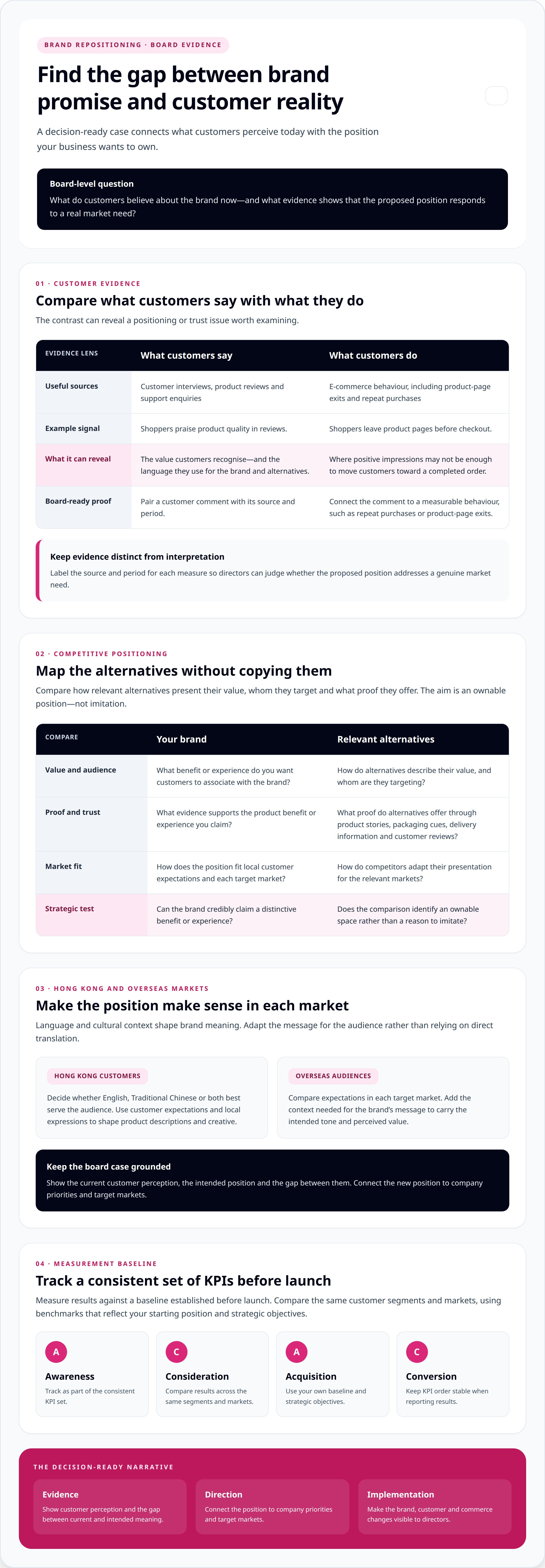
Measure repositioning success against a baseline established before launch. Track a consistent set of KPIs, such as awareness, consideration, customer acquisition, and conversion, then compare results across the same customer segments and markets. Benchmarks should reflect your starting position and strategic objectives, not another company’s performance.
A practical template should make the decision visible early. Put the executive summary after the agenda, then state the approval requested, the reason for repositioning, and the expected business implications. A seven-stage brand repositioning process can organize the supporting case, from current position through implementation. Connect each stage to a board decision.
Available examples vary widely. A framework presentation may contain two slides, while named template descriptions range from 38 slides for a competitive advantage presentation to 60 slides for a product repositioning presentation. Other examples include 40 slides for an implementation plan and 45 slides for growth strategies. Treat these as reference formats, not prescribed lengths.
Executive board PowerPoint templates can also help standardize how directors review information. Choose a consistent structure across meetings. Keep KPI order stable, use full-sentence slide titles, label periods and units, and define unfamiliar metrics. A 16:9 widescreen layout can suit presentation screens, while pre-read materials need enough context to stand alone. Keep pre-read and meeting versions aligned in figures, chart styles, and colours.
- For market evidence: show the current customer perception, the intended position, and the gap between them.
- For strategy: connect the new position to company priorities and target markets.
- For implementation: identify the brand, customer, and commerce changes directors are being asked to approve.
Template costs depend on the format, licensing terms, and level of adaptation required. Weigh these alongside editing time and the work needed to make the deck specific to your business. A short deck may still require substantial rewriting; an editable template can save formatting effort but cannot supply your market evidence.
For a Hong Kong SME expanding through e-commerce, use examples to clarify the narrative, then tailor the evidence to local customers and overseas audiences. The strongest board presentation turns a reusable format into a decision-ready case, with a clear request, consistent measures, and a credible implementation path.
The Proven Repositioning Strategy for Market Excellence, Repositioning Services Adapting Market Perception, and Repositioning Your Brand for Success presentation templates each contain 42 slides.
Market perception and competitive positioning
Repositioning starts with the gap between intended meaning and customer reality. A Hong Kong retailer may describe its skincare as premium, while shoppers see it as an unfamiliar online brand. The board needs evidence for that gap, not internal assumptions. Show what customers currently associate with the brand, what they value, and what holds them back.
Support the case with customer interviews, product reviews, support enquiries, and e-commerce behaviour. Compare what people say with what they do. For example, shoppers may praise product quality in reviews but leave product pages before checkout. That contrast points to a positioning or trust issue worth examining.
Present research in slides that distinguish evidence from interpretation. Quote a customer comment, then connect it to a measurable behaviour, such as repeat purchases or product-page exits. Label the source and period for each measure. This gives directors a clear basis for judging whether the proposed position responds to a genuine market need.
Competitive positioning requires more than comparing logos or slogans. Map how alternatives present their value, whom they target, and what proof they offer. For a Hong Kong food brand expanding overseas, compare product stories, packaging cues, delivery information, and customer reviews across relevant markets. The aim is to identify an ownable position, not imitate a competitor.
- Customer language: Identify phrases customers use for the brand and its alternatives.
- Purchase friction: Find where product-page visits fail to become completed orders.
- Distinctive value: Specify the product benefit or experience competitors cannot credibly claim.
- Market fit: Compare local customer expectations with those in each target market.
For Hong Kong businesses, language and cultural context shape brand meaning. Decide whether English, Traditional Chinese, or both best serve each audience, then adapt product descriptions and creative accordingly. Avoid direct translation when local expressions change the tone or perceived value. A message that works for Hong Kong customers may need different context overseas.
Regulatory considerations also matter when repositioning changes product claims, promotions, or customer data use. Map the rules that apply to the sector and target market before approving new wording. For example, a wellness brand should distinguish substantiated product information from broad promises. This keeps the positioning commercially persuasive and grounded in responsible communication.
Use the evidence to define a clear positioning choice: the audience, the need, the differentiating value, and the proof. Then show how that choice changes customer-facing touchpoints, such as the Shopify storefront, product descriptions, and campaign messages. A focused brand positioning strategy can connect these decisions before the board reviews execution.
Close the section by setting out the trade-offs. Explain which customers the new position prioritises, which messages it replaces, and how success will be monitored. For example, track customer feedback alongside conversion patterns in each target market. This lets directors assess whether repositioning is changing perception and supporting the intended commercial direction.
Presentation alignment with company strategy
A repositioning earns board support when it advances a strategic priority. Connect the proposed market position to a business objective, such as entering overseas e-commerce or improving repeat purchases. Show how the brand choice supports that objective, rather than treating new visuals as the strategy.
Compare options against the same criteria. For example, a Hong Kong skincare startup might weigh a premium position against an accessible, everyday position. Assess each option’s fit with the target audience, product value, channel economics, and ability to scale across markets. This gives directors a disciplined basis for choosing.
Strategic fit means the position reinforces what the company can deliver. A business promising expert guidance needs product information, customer service, and content that make that promise credible. A low-price position, by contrast, must fit the company’s margins and selling model. Show where each option aligns and where it creates tension.
Use a simple comparison table in the board deck. Give each positioning option its own column, then assess it against:
- Growth priority: Does it support the company’s next market or sales channel?
- Customer value: Does it answer a real audience need?
- Distinctiveness: Can customers tell it apart from alternatives?
- Delivery requirements: Can the business fulfil the promise consistently?
- Trade-offs: Which customers, products, or messages become less central?
For an overseas expansion, make the market choice explicit. A Hong Kong brand entering an English-speaking market may need a clearer product story, while another market may respond to different proof points. Keep the core promise coherent, but show where language, imagery, and channel execution must adapt. Distinguish strategic consistency from identical execution.
A three-stage brand repositioning framework can organize the logic: establish the current position, define the intended position, and connect it to implementation. In the presentation, link each stage to a strategic decision. For example, show why the current perception limits growth, what customer value the new position claims, and which commercial priorities it supports.
Make the recommendation direct. State the preferred option, explain why it fits company priorities, and identify the cost of choosing another route without inventing financial projections. A premium direction may require stronger product proof; an accessible direction may demand clearer price communication. These are strategic consequences, not design preferences.
Close with the decisions directors need to make. Specify whether they are approving the position, the intended audience, or the next implementation phase. Tie each request to an owner and a business priority. This keeps the discussion focused on strategic fit, rather than drifting into preferences about individual colours or layouts.
Brand repositioning strategy
Strong repositioning connects customer value to business direction. The board case should show the commercial logic, execution choices, and measures behind that shift.
Business Case and Financial Projections
Build the business case around the costs and commercial effects of the proposed change. For each important financial measure, show actual results, plan or budget, and variance. Then explain which assumptions link repositioning to projected revenue, acquisition, or retention. Separate established performance from forecast outcomes so directors can assess the basis for approval.
Use a clear ROI method: compare expected financial benefit with the investment required, using consistent assumptions and periods. Show how different scenarios affect the decision, such as a slower customer response or higher implementation effort. A Hong Kong ecommerce business might model new product-page messaging, creative updates, and campaign changes separately. This reveals what drives the projection, rather than presenting one unsupported return figure.
Successful Strategy Examples and Outcomes
A useful strategy example links a specific repositioning choice to observable customer and commercial outcomes. For instance, a Hong Kong snack brand entering overseas ecommerce might shift from “local gift” to “everyday premium snack.” The strategy would then align product descriptions, packaging language, and storefront imagery with that promise. Success measures could include customer understanding, product-page conversion, and repeat orders in the target market.
Another example is a startup moving from broad affordability to specialist expertise. It would focus its message on a defined customer need, support claims with product knowledge, and make the buying journey reflect that expertise. In the board presentation, distinguish intended outcomes from proven results. Set a baseline, identify the measures, and explain how customer response will inform future decisions.
Repositioning Risks and Mitigation
Key risks include confusing existing customers, weakening a distinctive position, and promising more than operations can deliver. A sudden change in tone may also disrupt recognition across ads, product pages, and email. Mitigate these risks by mapping affected touchpoints, testing the central message with relevant customers, and aligning launch stages with business readiness.
Answer the board’s risk question by naming each exposure and its control. For example, if a new premium position raises expectations, connect every claim to product evidence and customer experience. If overseas messaging differs from local communication, define what remains consistent and what adapts by market. Assign an owner to each key action, then review customer feedback and commercial indicators after implementation.
The strategic takeaway is simple: repositioning is a system, not a slogan. In the board deck, connect the chosen position to financial assumptions, customer-facing changes, and a review process. This gives directors a basis for approving the direction while keeping execution accountable.
How to build a business case for brand repositioning with ROI and financial projections?
A board case links repositioning investment to commercial outcomes. It should show the baseline, assumptions, expected effects, and decision required. For a Hong Kong ecommerce business, separate local results from overseas projections. This helps directors see which conclusions rely on current performance and which depend on future market response.
Start with the financial baseline. Select relevant measures, such as sales, customer acquisition, repeat purchases, and average order value. Present actual results beside the plan or budget, then show the variance for each important figure. Keep periods, units, and definitions consistent. A clear comparison lets directors judge whether the case addresses a genuine performance gap.
Next, map the repositioning investment to specific work. For example, a business entering a new market may need updated brand assets, product-page content, and campaign creative. Separate these activities from ongoing operating costs. Explain which budget supports each activity and how it relates to the proposed position. Avoid combining unlike costs into one unexplained figure.
Build projections from explicit drivers, not a top-line growth promise. A Shopify retailer might model how clearer product messaging could affect conversion, then connect projected orders to revenue and margin. Show the source of each assumption, its effect on the forecast, and what changes if customer response is slower. Distinguish observed evidence from estimates throughout the deck.
Assess return by comparing expected financial benefits with the full investment required. Include implementation costs and the resources needed to maintain the new position. Then show how benefits may arise, such as improved customer retention or stronger conversion. Don’t imply that brand change alone causes every projected result. Identify other factors, including product, price, and media activity.
- Baseline: Present actual performance, plan or budget, and variance.
- Assumptions: Explain each forecast driver and its evidence.
- Scenarios: Show how different customer responses affect the case.
- Review: Set measures for tracking outcomes after implementation.
A practical board presentation also makes uncertainty clear. Use a central forecast and show the assumptions that could alter it. For overseas e-commerce, keep projections for each target market distinct. Different customer expectations, acquisition channels, and fulfilment conditions can affect performance. Directors can then see where the opportunity lies and which market deserves priority.
End with a decision request. State the investment to approve, the work it enables, and the measures that will guide review. A well-structured brand strategy for commercial growth can connect positioning choices with the financial logic behind them.
Senses Group
Senses Group helps Hong Kong SMEs turn a repositioning decision into a coherent brand and e-commerce experience. Its Brand Strategy and Brand Identity Design connect the chosen market position to a clear identity. When that direction needs to carry through online sales, an Ecommerce Shopify Store and Klaviyo Email Automation can support consistent customer experiences across the storefront and email journey.
Turn to Senses Group when the board has set a strategic direction, but the customer-facing brand and digital experience need to align with it. The work can connect positioning, identity, and e-commerce touchpoints to support growth across local and overseas markets.
To discuss how Senses Group can support your repositioning, contact the team.
Turn board direction into lasting market change
The decision is a starting point, not the finish line. An executive board presentation for brand repositioning should lead into coordinated action, with clear ownership for translating the approved direction into the customer experience. For a Hong Kong business expanding through e-commerce, that means making sure the intended position is recognisable across local and overseas customer journeys.
Keep the next phase connected. Brand Strategy can define the direction, Brand Identity Design can express it consistently, and an Ecommerce Shopify Store can carry that experience into the buying journey. The right sequence depends on what the board approves and where the current customer experience falls short.
When you’re ready to shape that next step, contact Senses Group to discuss how your repositioning can move from board decision to a coherent brand and ecommerce experience. A clear strategic choice gives your business a stronger foundation for growth.
Frequently Asked Questions
How much does it cost to have a board deck designed?
The cost depends on the deck’s scope and is provided after a quote request. Factors include how much content needs shaping, whether charts or diagrams require custom design, and how complex the presentation structure is. A deck built from organised material differs from one requiring extensive synthesis. Define the decision, audience, source materials, and required format so the work can be scoped clearly.
What should a board meeting presentation include?
A board meeting presentation should help directors prepare, discuss, and record decisions. Include the agenda, prior action updates, key operating developments, financial information, material risks, and decisions requiring approval. Name the owner for each proposed action and clarify dependencies that could affect delivery. For example, a new market launch may depend on product readiness, inventory planning, and channel preparation, not marketing activity alone.
What should an executive board presentation for brand repositioning include?
An executive board presentation for brand repositioning should clarify what approval enables after the meeting. Include the proposed decision, implementation ownership, dependencies across teams, and criteria for reviewing progress. For example, if product descriptions and campaign messages change together, assign responsibility for keeping them aligned. Explain how the business will handle customer questions during the transition, so directors can assess readiness beyond the launch visuals.
How to define new brand positioning, target audience, value proposition, and differentiation?
Define positioning by connecting a priority audience with a need your business can meet distinctively. Specify who the offer is for, the problem it addresses, the benefit customers receive, and the evidence supporting that benefit. Then compare the statement with customer language and competitor claims. For example, a Hong Kong homeware seller might focus on compact living needs, if its product range and customer feedback support that promise.