
A rebrand is easier to approve when it solves a business problem, not just a visual one. Knowing how to convince executive stakeholders to rebrand starts with connecting the change to where the company is going, what has shifted in its market, and how its current brand may be holding back growth.
It’s reasonable for leaders to ask how long a rebrand will take and what it will cost. Both depend on the work involved: a focused refresh is different from changing positioning, messaging and identity across an ecommerce business, especially when the brand needs to work in Hong Kong and overseas markets. Clear scope, timely decisions and a realistic view of the assets affected help make those commitments more credible.
This article explains how to build a business case around strategy and market change, define who shapes and approves decisions, and gather input without diluting direction. It also covers how to plan milestones and costs around the actual work, so executives can assess a rebrand as a strategic investment rather than a design preference.
Key Takeaways
- Connect the rebrand to the company’s direction, customer needs and market shifts, rather than presenting it as a visual update alone.
- Clarify whether the business needs a brand refresh or a deeper change to its positioning, story and identity.
- Set decision owners, approval points and milestones early to reduce delays and prevent late-stage changes from expanding the work.
- Use stakeholder surveys and focus groups to surface perceptions and test assumptions, while keeping strategic direction with the leadership team.
- Build a stronger executive case by linking the need for change to business goals, rollout requirements and the assets the rebrand will affect.
1. Aligning the rebrand with long-term business strategy
Start with the business direction, not a mood board. Senior leaders should help shape the company’s ambition for the next 3-5 years, then define why its current brand may not support that direction. Set specific goals before visual changes begin. For a Hong Kong ecommerce business, those goals might include presenting a clearer offer locally or making the brand easier to understand in overseas markets.
A rebrand has a stronger strategic case when it responds to a real shift. A merger, a new strategy or a growing mismatch between the brand and the business can create a clear reason to change. For example, a retailer expanding its ecommerce business into overseas markets may need to reconsider how its positioning speaks to new audiences. Connect that market change to the company’s purpose and goals.
To address concerns about risk and disruption, connect the proposed change to specific business scenarios, rollout needs and delivery capabilities. The European Commission notes that a business plan can include scenario analyses that define critical risks and essential events for success. This gives executives a grounded way to consider what could affect the rebrand, rather than debating visual preferences in isolation.
Bring board members, staff and relevant business partners into the process early, drawing on each group’s practical knowledge. Product leaders can assess whether the brand promise fits current capabilities and future plans; HR leaders can connect values with culture, hiring and employee experience. These perspectives help executives test the strategic direction against how the company actually operates.
Employees need a clear account of why the change is happening, how it may affect them and what role they can play. A branding professional helps leadership shape that explanation and bring teams into the process before launch. For example, a team serving both local and overseas customers can identify where current messaging causes confusion. That input can reveal where new brand language needs to create continuity, not just change.
Consensus does not require every stakeholder to prefer every detail. A positioning workshop can help senior leaders and key contributors agree on the brand’s essence, promise, archetype and personality. Starting with these strategic foundations also reduces disputes driven by personal attachment to a logo or colour. Once the direction is clear, executives can assess identity decisions against shared values and the company’s longer-term ambition.
2. Connecting rebranding to business and market changes
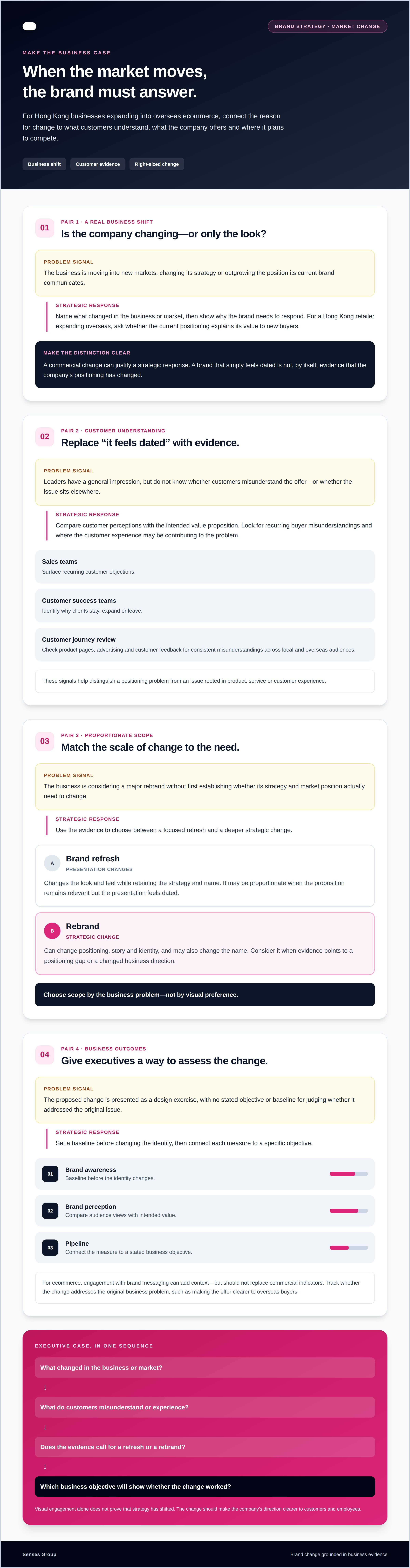
A rebrand earns executive attention when it answers a commercial change. A repositioning changes what the company stands for and where it competes. If a Hong Kong business is moving from local retail towards overseas ecommerce, its existing identity may no longer explain its value to new buyers. The case should show what changed in the business or market, and why the brand must respond.
Executives need evidence, not a general claim that the brand feels dated. Compare customer perceptions with the company’s intended value proposition, then examine where buyers misunderstand the offer. Sales teams can surface recurring objections; customer success teams can identify why clients stay, expand or leave. These signals help distinguish a positioning problem from an issue rooted in product, service or customer experience.
To justify the decision, establish a baseline for brand awareness, perception and pipeline before changing the identity. Connect each measure to a stated objective, such as improving recognition among a target audience or making the offer clearer to overseas buyers. For an ecommerce business, engagement with brand messaging can add context, but it should not replace commercial indicators. Measures should show whether the change addresses the original business problem.
Market shifts can make an established brand less relevant without making its history worthless. IBM changed how it was perceived as enterprise customers shifted from buying hardware to buying services. Apple rebranded in the late 1990s after coming close to bankruptcy. These examples show why leaders should assess how customer expectations and the company’s offer have changed, rather than treating visual identity as the root cause.
For a Hong Kong consumer brand expanding across borders, test whether its current story communicates the same value across local and overseas customer journeys. Review product pages, advertising and customer feedback for consistent misunderstandings. A clear gap between the company’s intended position and audience perception supports strategic change. If the proposition remains relevant and only the presentation feels dated, a brand refresh may be the more proportionate exercise.
The distinction matters. A refresh changes the look and feel while retaining the strategy and name. A rebrand can change positioning, story and identity, and may also change the name. Executives can use that distinction to match the scope to the business need. Strong visual engagement alone does not prove the strategy has shifted; the change should make the company’s direction clearer to customers and employees.
When evidence points to a positioning gap, a structured brand positioning approach can connect market signals to a coherent identity. That gives leaders a basis for discussing the scale of change, the audience it must serve and the commercial outcomes to track.
3. Defining approvals, responsibilities and milestones
A rebrand can stall when leadership treats approval as one final meeting. Set decision rights before work begins: name who shapes the direction, who recommends options and who gives final approval. Executives should help shape the rebrand, not simply endorse finished creative work. That gives the organization a clear route for resolving challenges before they disrupt launch planning.
Assign owners to decisions, not just broad workstreams. A hypothetical B2B website rebrand schedule closes positioning by the end of week 2, messaging by the end of week 3, and site structure by the end of week 4. These milestones show how one decision informs the next. Keep decision ownership to a maximum of 3 people where practical, so feedback has clear accountability.
Cross-functional input still matters. A rebrand committee can bring together marketing, design and community-relations expertise, while executive sponsors connect decisions to company priorities. Jack Henry’s rebranding program had three executive sponsors representing Human Resources, operations, and sales and marketing. For an ecommerce business, similar sponsorship can connect internal culture, customer experience and the practical demands of a local and overseas launch.
Build the approval path around the work’s dependencies. Positioning should guide messaging; approved messaging should guide visual identity and customer-facing materials. Involve legal teams early to review naming, claims and language, particularly where a business operates across global markets. Early review can surface trademark risks and reduce avoidable rework. It is a risk-control step, not a substitute for strategic approval.
A working rebrand plan should record approval steps and timing, assigned responsibilities, milestones and checkpoints, resources and costs, plus internal and external communications. For example, specify who signs off on the brand platform, who coordinates website updates and who informs employees before customers see the new identity. Set realistic deadlines for partners, then communicate changes transparently as the transformation progresses.
Timing depends on scope, decision speed and how many customer-facing assets need updating. A corporate rebranding initiative may take months or years. Jack Henry’s process took four months from its workshops to the next pitch meeting, but that is not a universal project schedule. Use checkpoints to surface delays early, record decisions and keep executives informed without reopening settled choices at every review.
Before launch, confirm that each milestone has an owner, an approver and a completion condition. A single progress view can track decisions, key performance indicators and asset status. This gives leadership a practical way to see what is ready, what remains blocked and where the launch plan needs attention.
Gathering stakeholder input through surveys and focus groups with a branding professional
Useful research turns opinions into evidence for a strategic decision. A branding professional designs surveys and focus groups to uncover how employees, customers and business partners understand the current brand. For a Hong Kong ecommerce business planning overseas growth, the research can explore whether local and international audiences understand the same promise. The goal is not to collect approval for a preferred design. It is to identify what the brand communicates, where it creates confusion and which assumptions need testing.
Start by mapping the groups affected by the change. Internal participants may include sales, customer service, product and marketing teams; external participants may include customers and business partners. Each group sees different parts of the customer journey. Sales teams can identify buyer objections, while customer service can explain recurring questions about products or delivery. A branding professional uses those perspectives to develop research questions that connect everyday experience to positioning.
A stakeholder survey can assess perceptions of the organization, its value proposition, competitive traction and concerns about change. Keep questions focused: ask what people believe the business offers, what distinguishes it and where its communications fall short. For customers, research can reveal which promises feel credible. Share the findings in a discussion before proposing brand strategy, so participants can examine evidence together rather than defend personal preferences.
Focus groups add depth to survey responses. A facilitator can explore why a message resonates, what feels unclear, and how different audiences interpret the same concept. For example, a Hong Kong retailer might ask local and overseas customers to discuss product-page language separately. Comparing those responses can reveal whether a positioning statement travels across markets or needs greater clarity. The professional records recurring themes, not isolated preferences.
In one project described by the rebranding author, 15 people initially gave feedback. That example shows why teams should define who participates and how feedback will be used. It does not mean every participant becomes a decision-maker. A branding professional synthesizes patterns, tests assumptions and presents implications to leadership, keeping accountability for the direction clear.
Customer input should validate ideas, not turn customers into brand designers. Participants can assess whether a proposed promise feels believable or whether communications match their experience. They should not be asked to choose logos or develop the visual identity. This boundary protects the strategic work while giving the business meaningful evidence about audience expectations.
Finally, close the loop. Share findings, explain which themes informed the positioning and identify concerns requiring a response. Clear communication helps stakeholders see how their input moved the work forward, even when every suggestion cannot be adopted. That collaboration builds informed support and gives leadership a stronger basis for the next decision.
How a branding professional builds a business case for rebranding to executive stakeholders
A business case starts with a precise diagnosis, not a preferred logo. A branding professional links the current brand gap to a commercial challenge, such as unclear positioning or inconsistent customer communications. The case then defines why change matters, which outcomes it should support, and what evidence will show progress. For a Hong Kong ecommerce business, that might mean explaining how its brand supports expansion into overseas markets.
Scope drives the investment required. Map the work across strategy, identity and every customer-facing asset, from product pages to packaging and advertising. Businesses may have thousands of physical and digital branded assets, so an asset inventory helps reveal rollout requirements early. Account for these assets from the outset, rather than treating launch as a logo replacement alone.
Executives also need a clear view of decision risk. A plan can compare the cost and disruption of acting now with the consequences of retaining a brand that no longer fits. If leaders reopen decisions after design, a rebrand plan can run at twice to three times the baseline. That possibility makes clear approval stages a financial control, not simply a project-management preference.
Past launches show why customer response deserves attention. Tropicana’s sales fell 20% over the month following its rebrand launch, and the company reintroduced its old packaging less than two months after launch. This example supports a practical case for testing whether a proposed identity communicates clearly before rollout. It also shows why continuity, customer recognition and execution belong in executive discussions.
A credible proposal connects the new brand promise to what the business can deliver. For an ecommerce company, consider whether product information, customer service and the buying experience support the intended position. The case should also outline rollout priorities, from essential digital touchpoints to later asset updates. This helps leadership weigh the transformation against operational capacity without reducing the decision to design preference.
Jack Henry illustrates the internal work behind executive approval. The author spent a year convincing its Corporate Leadership Team that the company needed a rebranding strategy. Its Marketing Leadership Team then spent eight weeks developing a new brand platform before presenting it to the Corporate Executive Team. The sequence shows how evidence, internal alignment and a developed strategic platform can build a more substantial decision case.
For an executive-ready case grounded in business strategy, develop a rebrand business case with professional support. Frame the decision around the business need, scope, rollout demands and measures of impact, so leadership can assess the transformation with clarity.
Senses Group
Senses Group helps Hong Kong SMEs and startups connect rebranding decisions to business direction, customer expectations and ecommerce growth. When executive support depends on a clearer strategic foundation, its Brand Strategy and Brand Identity Design can align positioning with the identity customers encounter. For businesses expanding locally and overseas, an Ecommerce Shopify Store and Klaviyo Email Automation can carry that brand experience into online sales and customer communications.
The right next step is a focused discussion about your business goals, the markets you serve and the changes your brand needs to support. Contact Senses Group to discuss your rebrand.
Give the next growth stage a clear brand foundation
A rebrand should create direction for the business, not simply replace familiar visuals. For leaders considering how to convince executive stakeholders to rebrand, the strongest case connects the decision to the company’s next stage and shows how customers should experience that change. The goal is a brand that makes the business easier to understand and trust across its markets.
Knowing how to convince executive stakeholders to rebrand also means treating the brand as part of the customer journey, not as a separate design exercise. Senses Group brings Brand Strategy and Brand Identity Design together with Ecommerce Shopify Store development, connecting strategic direction with the online experience. A focused conversation about your goals can clarify what your brand needs to support next.
Discuss your rebrand with Senses Group and take the next step with clarity and purpose.
Frequently Asked Questions
How long does a rebrand take, and what does it cost?
A rebrand can take months or years, depending on its scope, decision pace and rollout demands. Project pricing depends on scope and is provided after a quote request; key cost drivers include research, strategy, identity development, the number of assets and implementation across channels. A company updating its positioning and ecommerce experience needs a different plan from one changing only selected brand materials. Clear approvals help control timing and rework.
Is rebranding just a new logo?
No. A logo is one visible expression of a brand, while a rebrand can also reshape how the business presents its value, story and customer experience. For example, an online retailer may need consistent product descriptions, tone and visual cues across its storefront, email and advertising. A logo change without those supporting decisions can leave customers seeing a new symbol but receiving the same unclear message.
Rebrand, refresh or repositioning: which do you need?
Choose based on the business problem. A refresh can suit a company whose strategy still fits but whose presentation needs greater consistency. Repositioning is relevant when the company needs to change what it stands for or where it competes. A broader rebrand may be appropriate when that strategic shift also requires a new story and identity. For an ecommerce brand entering another market, assess whether customers understand the offer before deciding the scope.
How does a branding professional estimate the cost and ROI of a rebrand?
A branding professional scopes the work first, then connects investment to measurable business objectives. Cost drivers include research, strategy, design, asset updates and rollout complexity. To assess potential return, establish relevant commercial measures before launch, such as qualified enquiries, ecommerce conversion or repeat purchasing. Compare performance after implementation with the chosen baseline, while considering other changes that may influence results. This creates a more useful assessment than treating visual preference as ROI.
How does a branding professional present a rebranding proposal to senior executives?
A strong proposal makes the decision clear: state the business problem, explain the recommended scope, show the evidence and identify the decision executives must make. To show how to convince executive stakeholders to rebrand, link the recommendation to growth priorities and present trade-offs in plain commercial terms. For example, executives can compare a focused identity update with a broader strategic change, including each option’s implications for customers and operations.
What are the steps and timeline for an executive-approved rebrand?
An executive-approved rebrand typically moves from discovery to strategic direction, identity development, implementation and launch. The timeline depends on project scope, asset volume, review cycles and how quickly decision-makers resolve open questions. For example, an ecommerce business may need to coordinate its storefront, product content and customer communications around one launch plan. Assign owners to each stage and allow time for reviews before public rollout.