
A brand strategy workshop should produce decisions, not just a room full of ideas. Plan brand strategy workshops around the outcomes your business needs: a clearer view of audience needs, a distinct brand voice, a defensible position and ground rules that help the team work openly. Then turn those decisions into practical direction for your Hong Kong business and its next markets.
A productive workshop depends on more than the right activities. It needs the right people, a clear purpose, and a process that turns different perspectives into decisions the business can use. Without that structure, teams can leave with plenty of notes but little agreement about what the brand should stand for.
This guide explains how to decide when to hold a workshop, set useful objectives, prepare participants, and guide discussion from audience insight to positioning and voice. You’ll also learn how to set ground rules and capture decisions so they can inform your ecommerce experience and wider growth plans.
Key Takeaways
- Set workshop goals around the audience decisions your business needs, not a list of activities.
- Use brand personality and voice exercises to turn abstract values into language your team can apply consistently.
- Map the competitive landscape before writing a positioning statement, so your distinction is grounded in customer relevance.
- Establish a safe, non-judgmental space and capture ideas before the team selects its strongest direction.
- Choose the timing based on a real business need, such as preparing for growth or entering a new market.
Audience goals, problems, and desires
- Start by naming the business decision this workshop must support. For a Hong Kong ecommerce startup, that might mean deciding whether its current offer can serve overseas buyers. Separate the business goal from the workshop output: the goal may be stronger market relevance, while the output is an agreed audience priority. This distinction keeps discussion focused on decisions rather than a collection of unrelated ideas.
- Build an audience picture from real customer needs, not internal assumptions. Ask participants to describe what customers are trying to achieve, what frustrates them, and what makes them hesitate. For example, a local skincare brand might explore whether shoppers need clearer product guidance or stronger reasons to trust its online store. Record evidence and assumptions separately, then identify which audience problem matters most to the business.
- Use Simon Sinek’s Golden Circle to develop a shared purpose. Define why the brand exists, how it creates value, and what it offers. Then connect that purpose to a vision the team can work toward. A practical template can ask where the brand should be in 5, 10, and 15 years. Keep the answers commercially grounded: describe the customer impact and the role the business intends to play.
- Translate the purpose into business goals and measures of success. Connect the audience need to the intended outcome, such as improving product understanding before expanding an ecommerce range. Assess the strategy over short-, medium-, and longer-term horizons. Near-term measures should show whether the team is applying the strategy; longer-term reviews should assess whether it continues to support relevance and growth.
- Prioritise awareness goals before choosing messages or channels. Decide whether the audience needs to recognise the brand, understand its difference, or trust its value. Rank these needs by how much they influence the business goal. An unfamiliar overseas audience, for instance, may first need a clear explanation of the offer, while an established audience may need stronger reasons to choose it again.
- Choose a format that gives each decision enough room. A focused live workshop can last 90 minutes to 3 hours. For deeper work, plan three sessions for the brand’s core, positioning, and persona, with each session lasting approximately 2 hours. Keep exercises focused on useful outputs, and record decisions and next steps so the team can act on them.
Use the template’s Simon Sinek Golden Circle exercise to bring the brand’s why, how, and what into the same conversation. Ask participants to explain how each part relates to the audience problem already prioritised. If the answers point in different directions, note the gap rather than resolving it through guesswork. This helps the team check whether its stated purpose connects with the value it intends to offer.
Close by turning the discussion into a usable audience brief. Capture the priority audience, the problem the business intends to address, and the desired change in customers’ understanding or behaviour. Mark which points are supported by evidence and which remain assumptions to test. Keep open questions visible, assign an owner to each next step, and use the brief to guide decisions about positioning and communication.
Brand personality, voice and tagline exercises
Turn audience insight into a recognisable character, a consistent voice, and messages your team can use. A focused process helps Hong Kong businesses stay coherent across local retail touchpoints and overseas ecommerce channels.
-
Explore Brand Personality and Archetypes
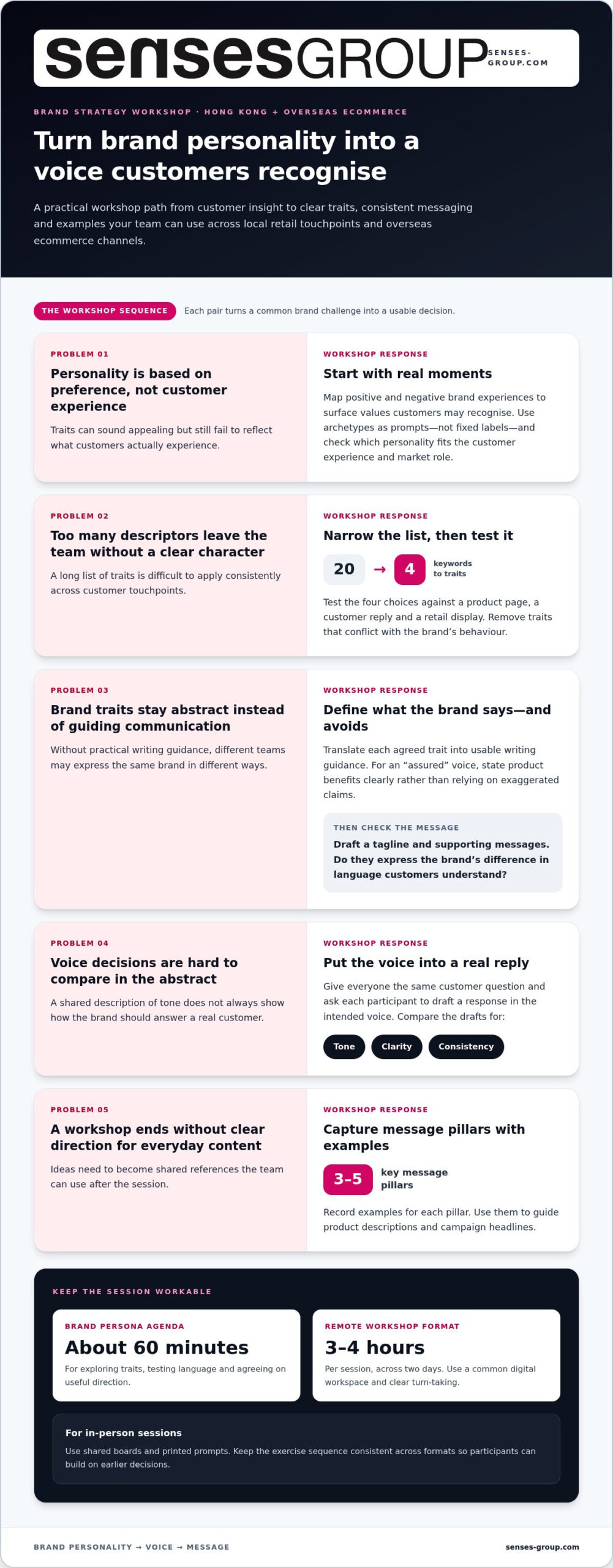
Ask participants to map positive and negative experiences associated with the brand. Use those moments to surface values customers may recognise, rather than choosing traits just because they sound appealing. Then explore archetypes as prompts, not fixed labels. For example, a skincare business might compare a guide-like personality with a challenger-like one, checking which better reflects its customer experience and market role.
-
Define Brand Personality
Have each participant select words that describe how the brand should feel to its target audience. Narrow the group’s choices from 20 keywords to four, then test each against real situations, such as a product page, a customer reply, or a retail display. Remove traits that conflict with the brand’s behaviour. A personality is useful only when teams can apply it consistently.
-
Develop Voice and Messaging
Translate the agreed traits into practical writing guidance. For each trait, describe what the brand says and what it avoids. If “assured” is a defining quality, the voice might state product benefits clearly rather than rely on exaggerated claims. Draft a tagline and supporting messages, then check whether they express the brand’s difference in language customers understand.
- Use a comparison exercise to make voice decisions concrete. Give the team one customer question, then ask everyone to draft a response in the intended voice. Compare the drafts for tone, clarity, and consistency. The agenda allocates about 60 minutes to the Brand Persona section, enough time to explore traits, test language, and agree on useful direction.
- Plan facilitation around how participants will contribute. In-person sessions can use shared boards and printed prompts, while remote sessions need a common digital workspace and clear turn-taking. A remote workshop can be divided into sessions lasting 3-4 hours each over two days. Keep the same exercise sequence in both formats so each participant can build on earlier decisions.
- Close by recording three to five key message pillars and examples for each. These pillars can guide product descriptions, campaign headlines, and customer communications across markets. If the agreed personality also needs a visual expression, connect the written direction to brand identity design so language and visual choices reinforce the same position.
Competitive landscape and positioning
Use market analysis to turn competitor observations into a clear customer-facing choice. A competitive landscape map and positioning statement connect your brand’s strengths to audience priorities.
-
Assess the Competitive Landscape
Map the alternatives your target customers consider, including direct competitors and other ways to solve the same problem. Compare their audiences, offers, price cues, claims, and customer experiences using public-facing examples such as product pages. Look for patterns, but don’t treat a competitor’s visual style as proof of its strategy. The goal is to identify customer needs that current choices meet well or leave unresolved.
-
Define Brand Positioning
Write a positioning statement that names the audience, the need, the category, and the reason to choose your brand. For example, a Hong Kong food business might serve time-poor households seeking distinctive local flavours through convenient online ordering. Check that the statement describes a real customer benefit, not simply the founder’s ambition. Keep the wording direct enough to guide product, content, and channel decisions.
-
Identify Differentiation
Test each proposed point of difference against the competitive map. Ask whether customers value it, whether your business can deliver it consistently, and whether another brand already makes the same claim. A meaningful distinction may come from how the offer is curated, explained, or experienced, rather than a broad claim such as “premium quality.” Choose evidence customers can recognise in the product and buying journey.
-
Set Market Positioning
Decide how the brand should be understood in Hong Kong first, then assess what changes for overseas audiences. Language, category expectations, and shopping habits can affect how customers interpret the same offer. Keep the core promise consistent while adapting examples and supporting information to each market. Record which elements remain fixed and which can change, so expansion doesn’t weaken recognition.
- Turn the positioning into an action test. Ask the group to review a product page, campaign headline, and customer response against the statement. If the materials could belong to any competitor on the map, the claimed difference needs stronger proof. If each example expresses the same customer value, the positioning is becoming useful. Assign someone to capture the final wording and rationale.
- Close the exercise by recording the team’s decisions and the questions that still need evidence. Use the competitive map to explain why the brand occupies its intended space, then share the positioning statement with the people responsible for marketing and ecommerce. This creates a working reference for future decisions, rather than an output that stays in the room.
Facilitator and participant ground rules
Strong facilitation gives everyone room to contribute while keeping decisions tied to business needs. Set expectations before the first discovery exercise, and make the facilitator responsible for structure and fair participation.
- Choose a facilitator who can guide discussion, manage disagreement, and turn ideas into clear decisions. They should stay neutral when founders or department leads have competing views. A strong facilitator asks precise follow-up questions, notices who hasn’t spoken, and keeps the group focused on the agreed outcome rather than personal preferences.
- Prepare participants with a concise briefing on the workshop purpose, expected decisions, and relevant customer context. A discovery survey should take no more than 30 minutes to complete. Ask about customer questions, recurring feedback, and points of confusion, so the group arrives with useful observations rather than relying only on memory.
- Agree on ground rules before creative work begins. Create a safe space where people can share ideas without judgment or vetoes. Ask participants to listen fully, question assumptions respectfully, and distinguish an early suggestion from a final decision. For example, capture a challenging idea first, then assess its relevance against customer needs.
- Assign someone to capture every idea in a shared template. Recording suggestions without immediate evaluation protects quieter contributions and prevents senior voices from dominating the discussion. Review and select the strongest ideas later, using agreed criteria such as audience relevance, business fit, and practical use across ecommerce or retail communications.
- Facilitate in a clear sequence: silent reflection, round-robin sharing, group discussion, then decision capture. Silent writing gives each participant time to form a view before conversation begins. A round-robin ensures everyone speaks, while the final record captures the decision, its rationale, and any follow-up action.
- Build breaks and transitions into the format. A short workshop break can last 5-10 minutes, giving participants time to reset before a new topic. For remote groups, explain how to use the shared board and invite responses through the agreed channel. Clear transitions help prevent digital tools from interrupting the discussion.
- Watch for common pitfalls: letting the most senior person decide too early, debating wording before agreeing on strategy, or treating every idea as equally actionable. Pause when discussion becomes circular and restate the decision needed. For a Hong Kong audience, examine local consumer insights and whether bilingual brand communication carries the same meaning across languages.
When to run a brand strategy workshop
Run a workshop when the business faces a decision that needs shared strategic direction, not simply because the calendar allows it. The right moment is when unresolved questions affect customers, growth, or how the brand appears across channels.
- Schedule one when your business model or offer is changing. A Hong Kong retailer adding ecommerce, for example, may need to clarify whether its online experience serves the same audience as its physical shop. Bring stakeholders together before new campaigns or store updates lock in assumptions. The workshop should resolve a defined business question, not replace routine planning.
- Use a workshop before entering a new market. Overseas expansion can expose gaps in how customers understand your offer, its value, and its difference. Bring together the people responsible for product, marketing, and customer experience to decide what stays consistent and what needs local adaptation. A clear positioning statement gives teams a shared reference before channel execution begins.
- Act when customer feedback points to a deeper brand problem. If shoppers repeatedly ask what makes a product different, the issue may be unclear messaging rather than campaign reach. Review customer questions, product-page language, and sales conversations before the session. This evidence helps participants distinguish a communication issue from a wider strategic decision.
- Bring stakeholders together when separate teams are making conflicting brand choices. For example, an ecommerce team may emphasise convenience while retail staff describe craftsmanship as the main reason to buy. Use the session to identify the customer value connecting both views. A workshop is timely when disagreement affects decisions across touchpoints, not just wording in one campaign.
- Choose the format according to the decision’s complexity and participants’ ability to contribute. A focused discussion may need one working session, while interconnected questions about audience, positioning, and brand behaviour benefit from staged thinking. For remote work, divide the agenda into two sessions held over two days. Avoid compressing major decisions into a single exhausting meeting.
- Don’t schedule a strategy workshop to solve an execution problem alone. If the audience, offer, and positioning are already agreed, a campaign review may be the more direct step. Hold the workshop when the underlying direction is uncertain, several decisions depend on it, and key stakeholders can bring relevant customer evidence.
- Set a clear trigger and a practical follow-through before booking the session. Define the decision required, the people who must shape it, and how the result will guide future work. If your business needs strategic direction before a major growth or market-entry move, explore brand strategy support to build a stronger foundation for the next stage.
Senses Group: Brand Strategy
Senses Group helps turn workshop decisions into a connected brand direction and customer experience. For Hong Kong SMEs and startups, Brand Strategy can clarify how to reach local audiences and prepare for overseas ecommerce growth. Brand Identity Design translates that direction into a consistent visual expression, while an Ecommerce Shopify Store and Klaviyo Email Automation can support the journey from first visit to ongoing customer communication.
Turn to Senses Group when your team has identified its audience and positioning but needs to carry those decisions into practical brand and ecommerce work. A clear foundation helps align what customers see with what your business stands for.
Visit senses-group.com to discuss how these next steps could fit your business.
Put Your Brand Direction Into Practice
A strategy becomes valuable when it shapes the choices your business makes next. Use its direction to guide new products, customer communications, and market opportunities, rather than treating it as a document to revisit only during a rebrand. Consistent decisions create a clearer customer experience at every point of contact.
For Hong Kong SMEs preparing to grow through ecommerce, the challenge is balancing a recognisable brand core with relevant execution in each market. Keep the central promise stable, then assess local customer language, product context, and buying journeys before adapting campaigns. This turns strategic thinking into a practical discipline, not a one-time exercise.
Use brand strategy workshops to establish shared direction, then keep decisions accountable by assigning ownership and applying them to real customer-facing work. Your brand can evolve without losing its foundation when each adjustment has a clear reason.
If you’re ready to put that direction into practice, contact Senses Group to plan your workshop. Take the next step with clarity and build toward growth with purpose.
Frequently Asked Questions
What is a brand strategy workshop and what does it cover?
A brand strategy workshop brings key people together to make decisions about a brand’s direction. Brand strategy workshops can examine audience priorities, purpose, market position, personality, and how those choices shape communication. For example, a business entering a new category can assess whether its existing brand promise fits the new offer or needs refinement before launch.
What are the typical steps and deliverables of a brand strategy workshop?
A typical process reviews business context, identifies customer needs, evaluates strategic options, and records decisions. Deliverables may include an audience profile, positioning statement, message principles, and a decision log that captures rationale and ownership. For an ecommerce team, a useful follow-through is a brief showing how the agreed direction should inform product descriptions, campaign language, and customer support responses.
Who should attend a brand strategy workshop and how long does it take?
Include the decision-maker and people with direct knowledge of customers, products, and brand communication. Depending on the scope, a live workshop can take 90 minutes to 3 hours. A growing business might invite its founder, ecommerce lead, and customer-facing team member, ensuring both strategic authority and practical customer insight inform the discussion.
How do in-person, online, and hybrid brand strategy workshops compare?
In-person workshops support direct conversation and hands-on activities; online formats make it easier for distributed teams to contribute through shared documents. Hybrid brand strategy workshops need a clear process for remote input, such as a facilitator monitoring chat and inviting online participants into each discussion. Choose the format that lets every essential contributor participate and ensures decisions are captured in one shared record.
How much do brand strategy workshops cost in Hong Kong?
Pricing for brand strategy workshops in Hong Kong typically varies based on the scope, preparation required, and agency expertise. Fees can range widely for customized facilitation, stakeholder interviews, and comprehensive post-workshop documentation. At Senses Group, pricing is tailored to each organization’s specific needs, ensuring you receive a clear, value-driven investment outline before any strategy sessions begin.