
A brand refresh should strengthen recognition, not erase it. A thoughtful brand refresh strategy evolves the identity and messaging people already know, while a rebrand can reshape the business’s name, positioning and wider identity. The right choice depends on whether your current brand needs clearer expression or a more fundamental change.
For Hong Kong SMEs and startups, that distinction matters when a business is growing beyond its original audience, entering overseas markets or building an ecommerce presence that needs to work across channels. A new look alone won’t solve unclear positioning or inconsistent customer experiences. The work starts with understanding what customers value, what no longer reflects the business, and what the next stage of growth demands.
This article explains what a brand refresh involves, when it may be appropriate and how to audit existing assets, clarify messaging and coordinate a rollout. You’ll learn how to preserve valuable recognition while aligning the brand more closely with your direction, from your website and social channels to customer communications.
Key Takeaways
- Choose between a refresh and a rebrand by identifying whether the business needs clearer expression or a fundamental change in direction.
- Audit customer perceptions, messaging and visual assets before deciding what to update, so valuable recognition is retained.
- Look for signs of a mismatch between the brand and the business’s current audience, offer or growth plans.
- Shape positioning and messaging around what makes the business distinct, then apply them consistently across customer touchpoints.
- Plan the rollout as coordinated workstreams, with clear ownership, internal communication and a practical sequence for updating assets.
1. What is a brand refresh?
A brand refresh updates how a business expresses its existing identity without discarding the meaning customers already recognize. It may refine a logo, colour palette, typography, imagery, messaging or tone of voice. The core promise and values remain familiar, while the brand’s expression becomes more relevant to its audience. A successful refresh makes the business clearer, not unrecognizable.
A rebrand reaches deeper. It can reshape a company’s name, mission, visual identity and market positioning. Ask whether the problem is presentation or direction: a dated website and inconsistent typography may call for a refresh, while a changed business model or new market position may require broader decisions. A brand refresh strategy should start with that distinction, not a request for a new logo.
Both approaches can involve visual and verbal elements, but their scope differs. A refresh preserves recognition and strengthens selected assets; a rebrand may replace the foundations customers associate with the business. Instagram’s 2016 logo change modernized its camera icon while keeping the app and mission. Mastercard simplified its logo in 2016, retaining its overlapping red and yellow circles. These examples show how change can preserve useful memory.
A full rebrand may be appropriate when the current name or positioning no longer reflects the company’s purpose, or when the business has changed substantially. A startup that has moved beyond its original product category may need to define a new audience and proposition. If customers cannot understand what the company now offers, polishing the existing identity may leave the central problem untouched. A rebrand can also create confusion and dilute brand equity, so the decision should follow a clear assessment of strengths and weaknesses.
Time is another distinction. A brand refresh typically takes 2-3 months, while a full rebrand often takes 6 months or more because it involves deeper strategic work. These timelines help frame the scale of the decision, but the actual work depends on how many business, messaging and identity elements must change. Define the intended outcome before setting the rollout plan.
Measure a refresh by comparing brand recall, customer sentiment, website engagement and relevant business outcomes, such as enquiries or repeat purchases, before and after launch. The United Nations notes that social media analytics tools can track campaign performance, helping teams monitor audience response across social channels.
For Hong Kong businesses, adapt the refresh for bilingual audiences by reviewing English and Traditional Chinese messaging together, not translating one version as an afterthought. Test whether the same promise, tone and visual cues remain clear across both languages, local customer touchpoints and overseas ecommerce pages.
In practice, keep a decision record: identify what must stay recognizable, what needs updating and what evidence supports a deeper change. That discipline helps SMEs connect identity decisions to business direction, rather than treating a refresh as a cosmetic exercise.
2. Auditing brand assets and retaining recognition
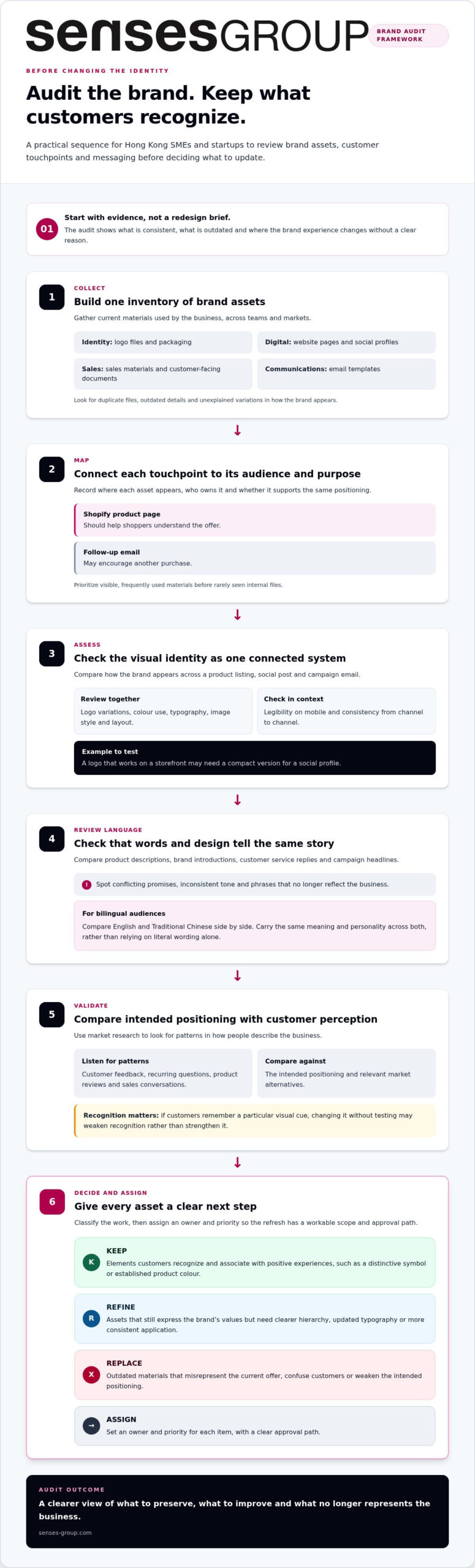
Start the audit with evidence, not a redesign brief. Gather current logo files, packaging, website pages, social profiles, sales materials, email templates and customer-facing documents. Include assets used across teams and markets. This inventory reveals duplicates, outdated details and places where the brand identity changes without a clear reason.
Next, map each touchpoint to its audience and purpose. A Shopify product page must help shoppers understand the offer, while a follow-up email may encourage another purchase. Record who owns each asset, where it appears and whether it supports the same positioning. This communications audit helps scope the project: teams can prioritize visible, frequently used materials before rarely seen internal files.
Assess the visual identity as a connected system. Compare logo variations, colour use, typography, image style and layout across a product listing, social post and campaign email. Note which elements remain legible on mobile screens and which become inconsistent between channels. A logo that works on a storefront may need a compact version for a social profile.
Review language alongside design. Compare product descriptions, brand introductions, customer service replies and campaign headlines. Look for conflicting promises, inconsistent tone or phrases that no longer reflect the business. For Hong Kong SMEs serving bilingual audiences, compare English and Traditional Chinese content side by side. The meaning and personality should carry across, not merely the literal wording.
- Keep: elements customers recognize and associate with positive experiences, such as a distinctive symbol or established product colour.
- Refine: assets that still express the brand’s values but need clearer hierarchy, updated typography or more consistent application.
- Replace: outdated materials that misrepresent the current offer, confuse customers or weaken the intended positioning.
- Assign: an owner and priority to every item, so the refresh has a workable scope and clear approval path.
Then add market research to the audit. Review customer feedback, recurring questions, product reviews and sales conversations for patterns in how people describe the business. Compare those perceptions with the intended positioning and relevant market alternatives. If customers remember a particular visual cue, changing it without testing may weaken recognition rather than strengthen the identity.
Test proposed changes with representative customers before rollout. Show a current asset beside its revised version, then ask what feels familiar, what feels clearer and what seems disconnected. Record the responses and use them to refine the guidelines. A focused brand identity review can help turn audit findings into a practical scope for evolving marketing assets.
3. Signs a brand refresh may be appropriate
A refresh becomes relevant when the external brand no longer reflects the business customers encounter. For example, a Hong Kong retailer may expand from a local shop into overseas ecommerce, yet its website still presents the original product range and audience. The gap between the current offer and its public expression can make it harder to communicate what the company now does.
Look for patterns in customer behaviour, not just one disappointing campaign. Changes in website traffic, social engagement, repeat purchases or brand sentiment may signal that the brand no longer captures attention or loyalty. Compare indicators over time, then connect them to customer feedback, product updates and marketing activity. A single weak result doesn’t establish that the identity needs redesign.
Business change provides another practical trigger. Entering a new market, launching a product line or responding to changing consumer behaviour can alter audience expectations. If the brand’s positioning, tone or visual system still speaks to an earlier stage, a focused update may improve consistency across product pages, advertisements and customer communications.
Market movement can help frame the decision, but it shouldn’t set an automatic schedule. Bynder is cited as reporting that 74% of S&P 100 companies rebrand within seven years. That figure concerns large public companies, not a timetable for Hong Kong SMEs. A small business should assess its own positioning, customer recognition and growth plans rather than redesign simply because a certain period has passed.
To decide whether a refresh is justified, compare the business’s current direction with how customers perceive it. Identify the gap, assess whether the core positioning still fits and determine whether targeted updates can close it. If the name, mission or market position no longer reflects the business, the issue may require deeper strategic work than a visual update.
- Audience mismatch: Your messaging still addresses the customers you served before a product or market expansion.
- Channel inconsistency: Your website, social content and sales materials communicate different promises or appear disconnected.
- Reduced distinction: Competitors’ positioning has shifted, and your brand no longer makes its value clear.
- Internal friction: Staff describe the business differently, making customer experience inconsistent across touchpoints.
The schedule depends on the scope of the update, approval process and launch dependencies. For example, a retailer coordinating a new product range with a website campaign should align the rollout with product photography, page updates and campaign approvals. Plan around those dependencies so customers see a coherent change rather than incomplete assets appearing at different times.
For Hong Kong businesses, assess the refresh against customer response in the intended markets and the channels those customers use. The best timing is when evidence points to a meaningful mismatch and the team can align its message, assets and customer experience around a clear direction.
4. Brand positioning and messaging
Positioning determines what customers should understand, remember and choose. Before changing visual assets, write one sentence describing who the business serves, what it provides and why that matters. For a Hong Kong skincare startup, “simple routines for humid-city living” is more specific than “quality skincare.” The first creates a clear foundation for product pages, campaigns and customer conversations.
Build the message from evidence and business direction. Use this sequence:
- Define the audience: describe the customer’s needs, context and purchase priorities, not only age or location.
- State the value: connect the offer to a customer outcome, such as making product selection easier.
- Identify the distinction: explain what the business does differently from competitors, using a real product or service feature.
- Set the proof: support the claim with an example customers can see, such as clear ingredient information or a reliable product comparison.
This sequence prevents a refresh from replacing useful clarity with polished but generic language. If a business claims to be “premium,” specify what customers experience: considered materials, specialist advice or a carefully edited product range. Avoid claims that could describe any competitor. A distinctive message gives customers a reason to choose, not just another adjective to remember.
Visual choices should reinforce the position. A value-led homeware brand might use warm product photography, readable typography and restrained colour, while a technical equipment retailer may need precise diagrams and a structured layout. Review each asset against the same positioning statement. If a logo, image style or headline suggests a different promise, the system is working against itself.
Translate positioning into a usable voice. Define how the brand sounds in a product description, an abandoned-cart email and a customer service reply. A direct, knowledgeable voice, for example, can explain a product benefit without exaggerated claims. Record preferred words, phrases to avoid, sentence style and channel-specific examples. This gives writers and staff a practical standard instead of a vague instruction to “sound friendly.”
For ecommerce, shape messaging around the customer’s decision sequence. A product listing can establish the category and key benefit; the product page can explain details and address likely objections; checkout can reinforce delivery and support information. This hierarchy gives each asset a distinct job, helping customers move from discovery to purchase without forcing every message to carry the entire brand story.
Test new messaging and visuals with customers before updating every channel. Compare headline options on a landing page or show revised packaging beside the existing design. Ask which version communicates the offer, feels credible and stands apart. Use responses to refine the guidelines, then apply approved assets consistently across ecommerce pages, advertisements and email. That alignment makes the refreshed brand easier to recognize and choose.
5. Managing brand refresh workstreams
A refresh succeeds through coordinated delivery, not a collection of disconnected design tasks. Define the objective, decision-makers, workstreams, dependencies and launch measures before production begins. For a Hong Kong retailer updating its ecommerce identity, work may span positioning, visual design, Shopify pages, email templates, advertising and staff communications. One shared plan keeps those changes aligned and makes ownership visible.
The key steps are to set the outcome, assign owners, approve the identity system, update priority assets, communicate the change and measure adoption. Build them into a project plan with clear approval points. Each owner should know what they deliver, who reviews it and which other workstream depends on it.
- Set governance: appoint one project lead and a decision-maker who can resolve conflicts. Include marketing, sales, product development, customer service and leadership representatives.
- Define workstreams: group tasks into strategy, design, digital channels, customer communications and internal rollout. Record deliverables, owners, dependencies and approval status in one shared tracker.
- Approve the system: finalize the logo, palette, typography, image direction and messaging before teams adapt individual assets. Document usage rules and examples in brand guidelines.
- Sequence the launch: prioritize high-visibility digital assets, such as the homepage and social profiles, before physical materials needing production lead time.
- Measure and refine: track asset completion, staff adoption and audience response after launch. Use findings to correct gaps and retire outdated materials.
Internal communication is a workstream, not a final announcement. Explain why the business is changing, what is changing and how the refreshed brand supports its direction. Customer service teams should understand the new promise before updating replies; sales staff need language that matches the website. This alignment reduces mixed messages at launch.
Choose a phased rollout when substantial visual or messaging changes affect many channels. For example, publish the updated Shopify storefront and social profiles together, then replace printed retail materials as existing stock is used. Keep a legacy-asset register with each item’s owner, replacement date and channel. This prevents old logos or claims from resurfacing in campaigns.
Before launch, check the live customer journey. Test key pages on mobile and desktop, place a test order and confirm that confirmation emails reflect the updated identity. Check that campaign links reach the intended pages and product information remains accurate. Assign an owner to resolve issues, then schedule a post-launch review to capture anything missed during testing.
If your team needs a clearer operating plan for the refresh, build a coordinated brand refresh plan around strategy, identity and rollout priorities.
Senses Group: Brand Strategy
Senses Group helps Hong Kong SMEs turn brand refresh decisions into a coherent commercial system. Its Brand Strategy can clarify positioning and priorities; Brand Identity Design translates that direction into visual assets and guidelines. For businesses bringing the refreshed identity into ecommerce, an Ecommerce Shopify Store and Klaviyo Email Automation can connect the customer experience across storefront and email.
Consider this next step when your team has identified a gap between the brand’s current expression and its growth plans, but needs to align strategy, identity and digital touchpoints. A joined-up approach helps keep the refreshed brand consistent as the business serves local customers and expands overseas.
Contact Senses Group to discuss your brand refresh.
Make the next move with purpose
A refresh becomes valuable when it changes how the business is understood and experienced, not simply how it looks. Before approving another asset, connect each decision to a business priority: make the offer easier to understand, strengthen recognition across markets or create a more coherent customer journey. This gives your team a practical standard for deciding what to build next and what to leave untouched.
For Hong Kong SMEs expanding through ecommerce, the next step is to turn the brand’s direction into a system that can travel across channels and markets. A well-formed brand refresh strategy gives teams that shared foundation, while customer response and business priorities guide future refinements.
When you’re ready to develop the next stage of your brand, contact Senses Group to discuss your brand. A clear direction can help your business move forward with greater confidence and consistency.
Frequently Asked Questions
What is a brand refresh?
A brand refresh is a deliberate update to how a business presents itself while keeping its central promise recognizable. For example, a food retailer might improve product photography and simplify packaging labels without changing its name or customer proposition. The purpose is to make the brand more relevant and easier to understand. It should address a business need, such as clearer product navigation, rather than follow a passing design trend.
What is a rebrand?
A rebrand changes the foundations of how a business is understood, which may include its name, purpose, positioning or identity. A company shifting from selling one product category to serving a different audience may need more than updated graphics. It must define what the business stands for now and communicate that change clearly. The scope depends on how much of the original customer promise and market role has changed.
What are common pitfalls to be aware of during brand updates?
Common pitfalls include changing assets without a clear objective, overlooking customer recognition and updating only the most visible channel. For instance, a new social profile paired with outdated product pages can make an online store feel fragmented. Word-for-word translation can also weaken meaning across English and Traditional Chinese. Set a business reason for each change and review the full customer journey before launch.
What is a brand refresh strategy, and how does it differ from a rebrand?
A brand refresh strategy sets out why the business is updating its expression, what should remain familiar and how changes will reach customers. A rebrand revisits deeper foundations, such as the company’s name or market position. For example, a retailer entering a new category might retain a recognizable logo but refine its messaging. If its original purpose no longer fits, broader repositioning may be necessary.
How do you audit a brand before planning a refresh?
Begin by collecting real customer-facing examples, such as a product page, welcome email, social post and customer service reply. Review them together to find conflicting claims, unclear product details or visual inconsistencies. Then compare your findings with customer questions, reviews and sales feedback. A practical audit records the issue, its business impact and the asset that needs attention, helping the team distinguish essential changes from personal design preferences.
What should a brand refresh include: logo, messaging, identity, or customer experience?
Include the elements that address the identified problem, not every brand component by default. If shoppers recognize the logo but misunderstand product benefits, prioritize messaging and product-page structure. If the offer is clear but the storefront, emails and social content feel unrelated, address the identity system and its application. Every interaction, from discovering a product to receiving support, reinforces what the brand promises.
What are the risks and common mistakes in a brand refresh?
A refresh can weaken recognition if distinctive assets disappear without a compelling reason, or create confusion if teams launch inconsistent versions. It may also have limited effect when the underlying positioning is unclear. Reduce risk by defining what success looks like, checking proposed changes with customers and assigning one owner to approve final assets. After launch, review audience response and correct any points where the intended message is not coming through.