
What if the reason your email campaigns aren’t building repeat business is that each one starts from scratch? For Hong Kong SMEs, effective Klaviyo email automation depends on more than sending the next promotion. It connects Shopify activity, customer insight, and brand strategy into a journey that stays relevant after a customer browses, buys, or goes quiet.
It’s understandable to feel unsure where to begin. There are multiple flows to consider, and messaging that works for local customers may not suit overseas audiences. The answer isn’t to automate everything at once. It’s to prioritise based on customer behaviour and business goals, then make sure each email reflects a consistent experience across your store and inbox.
This guide explains how to build a practical system for growth: how Shopify and Klaviyo work together, which flows to prioritise, and how to adapt segmentation and messaging as you reach new markets. You’ll also learn what to look for in an agency partner, so automation supports a coherent customer journey rather than operating as a standalone tool.
Key Takeaways
- Build flows around customer signals, message purpose, relevant content, and a clear next action.
- Prioritise automation according to your store’s customer journey and the data you can use, rather than trying to launch every possible flow.
- Assess an agency’s strategic discovery, Shopify integration, flow planning, copy, design, and reporting before choosing a partner for Klaviyo email automation Hong Kong.
- Use a practical roadmap to diagnose business needs, select priority flows, implement them, and review how they support local and overseas growth.
- See how Welcome, Behavior-Based, and Monthly Promotion flows can connect Klaviyo with brand strategy and the Shopify experience.
Why Klaviyo Email Automation Matters for Hong Kong Ecommerce Growth
One-off campaigns can announce an offer, but they don’t create a consistent customer journey. Klaviyo email automation Hong Kong merchants can use is behaviour- and customer-data-led communication: messages are organised around what a customer does or the information they have shared, rather than sent only because a campaign is scheduled.
“An automated flow is a connected series of messages triggered by a customer signal; a promotional campaign is a one-off message sent to an audience at a chosen time.” That distinction matters. An email address alone doesn’t tell a business what to say next. A customer’s signup, browsing activity, or purchase can provide context for a more relevant message. This is the practical role of Marketing automation: using customer information and defined processes to make communication more responsive.
What does Klaviyo email automation do for an ecommerce business?
When Klaviyo is connected to a Shopify store, customer actions and available profile data can inform email journeys. For example, a shopper signs up through the store and receives a welcome message that introduces the brand and explains what to expect. If they later browse or purchase, that new signal can guide subsequent communication, provided the relevant data and flow are set up.
The goal isn’t to send more. It’s to make each message timely and useful, so the next step reflects the customer’s relationship with the store. An email that repeats a generic promotion regardless of someone’s actions can feel disconnected. A carefully planned flow supports communication without replacing a compelling offer, a distinctive brand, or a store experience that makes it easy to buy.
Why Hong Kong SMEs should connect email and ecommerce strategy
For a lean team, repeatable communication creates structure without requiring every customer interaction to be planned from scratch. The value grows when email reflects the same positioning, product information, and buying experience customers encounter in Shopify. If the store promise and email message conflict, automation simply repeats the inconsistency.
Overseas growth calls for the same discipline. Avoid assuming that every market or customer group responds to the same message. Use actual customer data, such as purchase history, preferences, or engagement where available, to determine whether segments need different content. Build on observed behaviour rather than stereotypes, and review whether the store experience supports the expectations set by each message.
Email works best as part of a connected ecommerce system, not as a separate retention tool. For a broader view of how store foundations support growth, see the 2026 Strategic Shopify Guide for Hong Kong SMEs. The principle is straightforward: align the customer journey, then automate the communication that helps move it forward.
How Klaviyo Flows Turn Customer Signals into Useful Ecommerce Journeys
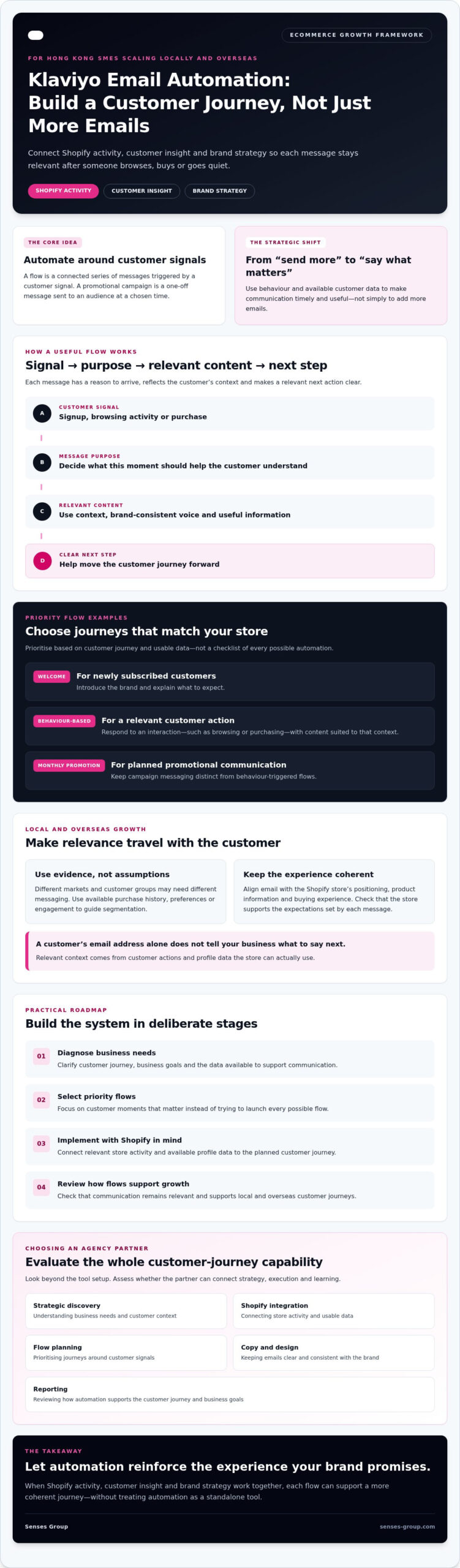
A useful flow has a clear chain: a customer signal prompts a message with a specific purpose, the content reflects that context, and the message guides the customer toward a relevant next action. Useful automation connects a customer signal to a relevant message, then makes the next step clear. That’s more deliberate than setting emails to send on a calendar and hoping they fit each recipient.
This is how Klaviyo email automation Hong Kong businesses can use should be planned: around the Shopify customer journey and the data the store can actually use. Automation can automate repetitive marketing work, but efficiency alone isn’t the objective. The message still needs a reason to arrive, a brand-consistent voice, and a useful next step.
Which Klaviyo flows should a Shopify business consider first?
Start with the moments that matter in your customer journey. A Welcome flow speaks to newly subscribed customers, introduces the brand, and sets expectations. A Behavior-Based flow responds to a relevant action, such as browsing or purchasing, with content suited to that interaction. Select these journeys based on your store’s priorities and available customer data, not a checklist of every possible automation.
Monthly Promotion flows serve a different purpose. They support planned promotional communication, while behaviour-based journeys respond to customer signals. One doesn’t replace the other. A calendar-led promotion can reach an audience at a planned time, but it shouldn’t be treated as a substitute for communication shaped by what a customer has done.
How customer data and brand voice shape each message
Before building segments, ask what you know and what decision that information can support. Does purchase history indicate a useful follow-up? Does engagement suggest which content a customer may find relevant? Where reliable market information exists, does it justify adapting the message for a particular audience? If the data isn’t available or meaningful, don’t force a segment. Keep the communication focused and review the information your Shopify journey can provide.
Every flow should sound and feel like the same brand customers encounter in the store. Align the language, visual identity, and offer with the brand’s positioning; otherwise, even a well-timed email can create a disjointed experience. For a closer look at one specific customer signal, explore this Klaviyo abandoned cart strategy.
For SMEs shaping a connected Shopify and email journey, Senses Group’s Klaviyo email automation and brand strategy can be considered as part of a wider ecommerce approach.
Klaviyo Automation for Hong Kong SMEs: What to Evaluate Before Choosing an Agency
Installing Klaviyo is not the same as building a retention strategy. The platform can support communication, but it can’t decide which customer journeys matter, what each message should say, or how success fits your business goals. For Klaviyo email automation Hong Kong SMEs, agency selection should be based on strategic thinking and clear delivery responsibilities, not platform setup alone.
What should an agency clarify before building Klaviyo flows?
Before recommending flows, an agency should understand your brand positioning, products, customer groups, and existing Shopify journey. It should also explain how it will review the data and consent records available to the project, and identify any technical assumptions that need checking before implementation. Ask who owns each decision: strategy, copy, design, implementation, approval, and changes after launch.
For local and overseas audiences, include the markets you want to serve in the brief, but don’t assume language, preferences, or buying behaviour. Ask how the agency will use actual customer information to determine whether separate segments or messages are justified.
| Area | What to evaluate |
|---|---|
| Strategic discovery | How will the team understand your brand, offer, audiences, and existing customer journey? |
| Shopify integration | What store data and existing systems will be reviewed, and what assumptions require verification? |
| Flow planning | Does each proposed flow have a clear customer signal, purpose, and intended next action? |
| Copy and design | Will the messages reflect your positioning and provide a consistent experience with the store? |
| Reporting | Which measures will be reviewed against your own baseline and business goals, and how often? |
How to assess an automation plan beyond platform setup
A sound proposal explains why each flow belongs in the plan, which customer action it responds to, and what the message is meant to help the customer do. It should also set out scope, responsibilities, assumptions, and a review cadence, so your team knows what happens after implementation and how decisions will be made.
Ask how reporting will distinguish activity from business progress. The agency should establish a relevant starting point with you, then review results against your goals rather than relying on unsupported promises or generic benchmarks. Email also sits within a broader acquisition mix; for context on how channels can play different roles, read Why Email Marketing Works Better Than Meta Ads. The right partner makes the system understandable, measurable, and aligned with the customer experience you intend to build.
A Practical Klaviyo Automation Roadmap for Local and Overseas Growth
A strong automation programme is built in sequence, not switched on all at once. For Klaviyo email automation Hong Kong businesses can use to support growth, the starting point is the customer journey and the team’s real capacity. Add complexity only when the available evidence and business priorities justify it.
How to prioritise flows without overcomplicating the setup
- Diagnose the business. Clarify the goal, such as improving the experience after signup or encouraging a relevant next purchase. Note constraints that shape the plan, including available customer data, team capacity, and the store’s current setup.
- Map the customer journey. Trace the path from first interaction through purchase and subsequent engagement. Identify moments when timely, useful communication could help, and where an email would add little value.
- Choose initial flows. Prioritise journeys that match customer behaviour, business goals, and data you can reliably use. A smaller, well-founded set is more manageable than launching every possible flow without a clear purpose.
- Implement and test. Confirm that each message reflects the intended signal, audience, brand voice, and next action. Test the experience from the customer’s perspective before relying on the automation.
- Review and expand. Record assumptions and define what evidence would support adding or adapting a flow. Use what you learn to refine the journey rather than expanding on instinct alone.
For overseas growth, treat each market as a question to investigate, not a set of assumptions. Review verified market information alongside actual customer and Shopify store data. Consider whether differences in customer behaviour, available information, or the store experience justify adapting a journey. If the evidence isn’t there yet, document what you need to learn before creating separate messaging.
How to review and improve automated email journeys
Set a business-specific starting point before judging performance. Review relevant engagement and commerce measures against that baseline and the goals you agreed on. Then check whether the audience is appropriate, exclusions prevent irrelevant or overlapping communication, and each message still makes sense in the customer journey. More messages aren’t automatically better. Relevance comes first.
Email should also work alongside the rest of the marketing system, with consistent positioning and a coherent customer experience across channels. For a broader view of that coordination, explore the Integrated Digital Marketing: Scaling Guide for 2026.
If you’re ready to shape a roadmap around your Shopify journey, customer data, and growth priorities, discuss a tailored Klaviyo automation approach with Senses Group.
How Senses Group Connects Klaviyo Automation with Brand and Shopify Growth
Klaviyo works best when its messages carry the same promise as the brand and the Shopify store. Senses Group is a Hong Kong-based branding and ecommerce agency offering Klaviyo Email Automation alongside Brand Strategy, Brand Identity Design, and Shopify ecommerce development. The objective is a connected customer experience, not automation operating in isolation.
What Senses Group brings to a Klaviyo engagement
Founded in 2008, Senses Group states it has more than 18 years of expertise as of 2026. Its documented Klaviyo work includes Welcome, Behavior-Based, and Monthly Promotion flows. These flow categories provide a foundation for planning communication around a business’s customer journey, brand proposition, and Shopify context. The specific scope should reflect the business’s objectives and available information, rather than assume every store needs the same setup.
A custom-crafted approach means shaping the work around the brief: how the brand is positioned, what the store experience communicates, which customer journeys matter, and what the team needs to support. It doesn’t mean adding complexity for its own sake. The value is in making decisions about strategy, messaging, design, and implementation in relation to the business, with responsibilities and scope clearly understood.
Senses Group reports that Monchhichi Jewelry Atelier’s revenue doubled shortly after a complete ecommerce system launch. This is evidence of an integrated ecommerce outcome, not a result that should be attributed to Klaviyo alone. The distinction matters: growth can involve the wider system, including the store experience and brand, alongside customer communication.
What to prepare before discussing Klaviyo automation
A focused first conversation starts with context, not a request to install every possible flow. Bring the information that helps clarify the commercial problem and the customer journey:
- Your current business objectives and the customer experience you want to improve.
- Your Shopify store context, including questions about where customers engage or lose momentum.
- Existing email activity and any flows already in place.
- Your local and overseas growth priorities, along with what you know and still need to learn about those audiences.
This gives both sides a clearer basis for discussing what should be prioritised, what information needs review, and how Klaviyo email automation Hong Kong can fit into a broader brand and ecommerce plan. You don’t need a finished automation strategy before starting; clear questions and business context are a practical foundation.
Discuss a Klaviyo growth plan with Senses Group, and bring your business goals, Shopify context, and market plans to the conversation.
Build a Customer Journey That Can Grow With You
Lasting email growth doesn’t come from switching on every possible flow. It comes from understanding where communication can improve the customer journey, choosing priorities your team can support, and reviewing whether each message remains relevant as the business evolves. That clarity gives local and overseas growth a stronger foundation.
For SMEs considering Klaviyo email automation Hong Kong, the key is to connect customer insight with a consistent brand and Shopify experience. Senses Group’s documented Klaviyo work includes Welcome, Behavior-Based, and Monthly Promotion flows. Founded in 2008, the agency states it has more than 18 years of expertise as of 2026, with capabilities spanning branding, Shopify development, and digital marketing. Together, these disciplines can inform a more coherent ecommerce journey, rather than treating email as a standalone tool.
Bring your business goals, existing email activity, Shopify context, and market plans into the conversation. Discuss a Klaviyo growth plan with Senses Group and identify a practical starting point for your next stage of growth. A clearer system can help your business build with purpose, one relevant customer interaction at a time.
Frequently Asked Questions
Is Klaviyo a good fit for a Hong Kong Shopify business?
Klaviyo can be a good fit if its capabilities match your store’s goals, customer data, email needs, and team capacity. For a business exploring Klaviyo email automation Hong Kong, the platform may help organise relevant customer journeys when they’re grounded in a clear strategy. It isn’t essential for every store. Before committing, assess your current systems, requirements, and integration details, and confirm the proposed setup suits your business.
Can Klaviyo automate emails for customers in overseas markets?
Yes, businesses can plan different email journeys for overseas audiences when they have relevant customer and market data to guide those decisions. Avoid assuming that customers in every market share the same preferences or buying behaviour. Review what your store and customer information actually show, along with your store configuration and operational requirements. Any market-specific legal or technical requirements should be checked with a qualified expert using current information.
What Klaviyo flows should an ecommerce business set up first?
Start with the customer journey and business priorities, then decide which flows support them. Welcome flows can introduce the brand to new subscribers; Behavior-Based flows can respond to relevant customer actions; promotional communication can support planned offers. The right order depends on your customer experience, available data, and team capacity. Define each flow’s purpose and intended action, then review results against your own starting point rather than assuming one flow performs best for every store.
How does Klaviyo work with Shopify?
At a high level, Shopify provides an ecommerce context, while Klaviyo can use relevant store and customer information to support email journeys. The exact data fields, integration setup, and available features can change, so verify them before implementation rather than assuming every detail is included or configured automatically. Review your store setup, privacy practices, and technical requirements with a qualified implementation partner to confirm the connection supports your intended customer experience.
How much revenue should a business expect from Klaviyo automation?
There’s no universal revenue figure or guaranteed return from Klaviyo automation. Outcomes depend on factors such as your offer, audience, existing customer relationships, implementation, and measurement method. Establish a baseline before launch, define relevant business goals, and review performance over a period suited to your sales cycle and data. That process helps you understand the role automation plays without treating revenue changes as proof that email alone caused the result.
What happens if my business has limited customer data?
Limited customer data doesn’t prevent you from planning a focused starting point, but it does limit how confidently you can personalise or segment. Review what information your business already collects and identify responsible ways to improve customer understanding. Begin with a simple journey that fits your offer and capacity. Before sending, check your consent records, platform configuration, and data practices. Automation can structure communication, but it can’t compensate for an unclear brand or offer.
Should a Hong Kong SME hire a Klaviyo agency or build flows in-house?
Choose based on your internal expertise, available time, strategic needs, implementation complexity, and capacity to own ongoing updates. An in-house team may be suitable when it has the skills and time to plan, build, and review flows. An agency may help connect automation with brand and ecommerce strategy. Neither option is right for every business. Clarify the scope, responsibilities, and ongoing ownership before deciding which approach fits your team.