
What if the answer to rising acquisition costs isn’t more advertising, but making every customer relationship work harder? The right email automation ecommerce agency doesn’t simply schedule campaigns. It translates your brand into relevant customer journeys, using the data in your Shopify store to build stronger relationships and repeat revenue.
For Hong Kong SMEs and startups expanding locally or overseas, fragmented marketing can weaken even a strong offer. Emails may feel disconnected from your brand, while valuable customer information sits unused. You’re right to expect more than a technical setup: automation should support your positioning, improve the customer experience and contribute to sustainable growth.
This guide explains how to choose an agency that can connect brand strategy, Shopify and Klaviyo into a cohesive revenue engine. You’ll learn what to assess in its strategic approach, how to make better use of customer data, and how well-designed lifecycle journeys can support higher average order value and more repeat purchases. The goal isn’t to set up a few flows and walk away. It’s to build a system that runs consistently and can be refined as your business grows.
Key Takeaways
- Assess whether an agency connects email journeys to your brand strategy, rather than treating automation as a technical setup alone.
- Learn how welcome, abandoned checkout and post-purchase flows can support a more considered customer lifecycle.
- Use Shopify and Klaviyo data more purposefully by reviewing what information is available and how it can inform relevant email experiences.
- Compare potential partners by their strategic process, including brand auditing, marketing mapping and preparation of historical data.
- Choose an email automation ecommerce agency with integrated branding and ecommerce expertise to build a system designed for long-term growth.
The Strategic Shift: Why Email Automation is the Core of Ecommerce Profitability
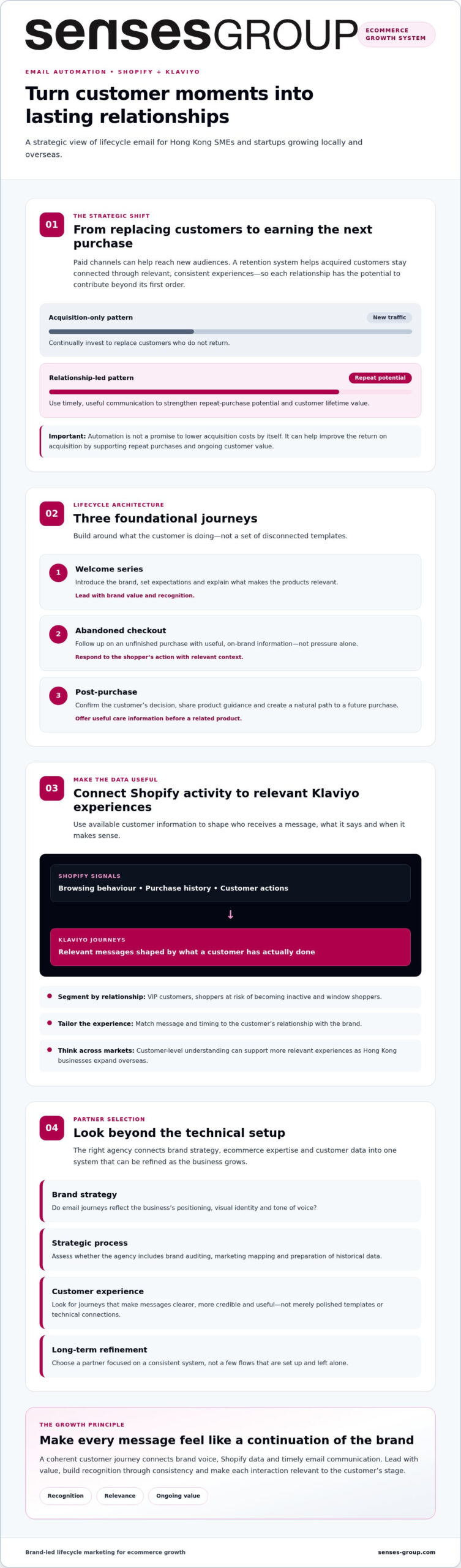
A first purchase is a starting point, not a growth strategy. For Hong Kong ecommerce businesses competing locally and overseas, relying on new customers alone can leave revenue exposed to rising acquisition costs and fluctuating ad performance. Sustainable growth depends on earning the next purchase, then the one after that, through a consistent experience customers have reason to trust.
Email automation is a strategic extension of brand identity, translating what your business stands for into timely, relevant communication across the customer lifecycle. It’s more than a schedule of promotions: it connects customer actions and Shopify data with a coherent brand voice. For a broader grounding in email marketing strategies, consider how email works alongside other channels, then build automation around the specific role it should play in your customer journey.
Combating Rising CAC with Retention Systems
Meta and Google advertising can help a business reach new audiences, but depending on paid traffic alone means continually investing to replace customers who don’t return. A retention system gives each acquired customer a reason to stay connected. In Klaviyo, an opted-in subscriber who browses a product or begins checkout can receive a relevant follow-up, while a previous customer can hear about complementary products or useful care information. These journeys can recover opportunities that a single visit might otherwise leave behind.
The economics are cumulative: when more customers return and spend over time, each acquisition can contribute value beyond its first order, reducing dependence on continually finding new buyers. This isn’t a promise that automation will lower CAC by itself. It’s a strategic way to strengthen the return on acquisition by improving repeat purchase potential and customer lifetime value. The shift is from transactional, one-order thinking to a relational model built on recognition, relevance and ongoing value.
The Psychology of Automated Trust
Trust is built through repeated, consistent experiences. When an email reflects the same positioning, visual identity and tone as a Shopify store, customers can recognise the brand and understand what to expect. A polished design won’t guarantee higher open or click-through rates, but it can make messages clearer, more credible and easier to act on. Inconsistent visuals or a voice that changes from one campaign to the next can weaken that recognition.
Lead with value before asking for another sale. A welcome sequence can explain what makes the brand distinct; a post-purchase message can offer product guidance before presenting a related item. Each interaction should feel like a considered continuation of the relationship, not an automated demand for attention. The right email automation ecommerce agency treats those details as part of brand strategy, not decoration added after the technical setup.
The Architecture of a High-Converting Email Automation Ecosystem
Effective automation is built around the customer journey, not a collection of disconnected templates. Three foundational flows help an ecommerce brand respond at key moments:
- Welcome series: Introduce the brand, set expectations and help new subscribers understand what makes its products relevant.
- Abandoned checkout: Remind shoppers about an unfinished purchase with useful, on-brand information rather than relying on pressure alone.
- Post-purchase: Confirm the customer’s decision, share relevant product guidance and create a natural path to a future purchase.
Connecting Shopify with Klaviyo gives these journeys useful context, such as purchase history and browsing behaviour, so messages can reflect what a customer has actually done. For Hong Kong businesses expanding overseas, this customer-level understanding can support more relevant experiences across markets. It also helps ensure each email has a role within a wider global ecommerce growth strategy.
Behavior-Based Lifecycle Marketing
Generic blasts treat every subscriber alike. Behavior-based lifecycle marketing responds to meaningful signals instead: a first visit, a completed order or a period without engagement. Segment audiences by their relationship with the brand, such as VIP customers, shoppers at risk of becoming inactive and window shoppers. Then tailor the message and timing to fit each group.
A monthly promotion can still have a place, provided it supports the brand rather than training customers to wait for discounts. Make the offer purposeful, vary the content with product education or brand news, and consider whether each segment needs the same message. A strategic email automation ecommerce agency should also connect campaign themes to a topical map: a structured view of the subjects your brand can credibly cover across SEO content and email. This creates continuity between what customers discover through search and what they receive after subscribing.
The Role of AI in 2026 Automation
AI can help turn customer and product signals into timely communication. For example, a restock reminder may be triggered when a relevant item becomes available, while recommendations can draw on a customer’s previous purchases or browsing interests. These applications depend on reliable data and should be reviewed for brand fit. AI-generated visuals can also help develop campaign creative, but human direction remains important: imagery should feel consistent with the brand’s identity, not interchangeable with every other store.
There is a broader connection between discovery and retention. SEO and generative engine optimization (GEO) can help qualified audiences find useful brand content; a topical map gives that content structure, while email can continue the conversation with subscribers who choose to hear from you. In this way, AI supports the top of the funnel and lifecycle marketing builds on that interest after discovery.
Senses Group reports a track record of doubling revenue for clients, including Monchhichi Jewelry Atelier. That outcome is best understood in the context of integrated branding and marketing, rather than attributed to a single automated flow. Businesses assessing a connected approach can explore integrated ecommerce marketing as one possible starting point.
Selecting the Right Partner: What to Look for in an Agency
An agency can connect Klaviyo to Shopify, configure flows and produce campaign reports. That’s technical delivery. The more consequential question is whether it can explain how each activity supports your brand and business objectives. For a Hong Kong SME expanding into new markets, the partner should understand how customer expectations, brand positioning and channel performance work together, not treat email as an isolated task.
Look for cross-platform understanding across Shopify, Klaviyo, Meta and Google. These platforms play different roles, but the customer should experience one coherent brand, from the first ad interaction to a post-purchase email. Forbes offers practical context on ecommerce email marketing and its potential high return on investment. The point isn’t to assume a particular outcome; it’s to evaluate whether an agency can connect strategy, execution and measurement.
Technical Expertise vs. Strategic Vision
Klaviyo proficiency matters. Strategic judgment matters more. A capable partner can explain why a specific message should reach a particular audience at a particular point in the journey, and how its purpose relates to customer value, not just clicks. Ask how it will assess performance alongside commercial measures such as repeat purchasing and average order value. A high click-through rate means little if the campaign doesn’t contribute to healthy business growth.
For a useful comparison of channel roles, see this discussion of email marketing versus Meta Ads. The strongest decision isn’t “email or advertising,” but how each channel supports the wider customer journey.
The Proven Track Record
Experience gives an agency context for making better decisions, but years in business alone aren’t proof of fit. Senses Group brings over 18 years of branding and digital marketing expertise, with more than $4 million in ad spend managed. When assessing any partner’s record, ask what its role was, which business objectives it supported and how results were evaluated. Spend managed can indicate exposure to scale, but it doesn’t guarantee your outcome.
Look for Z-to-A thinking: building the foundations before accelerating traffic. That means clarifying positioning, customer journeys and the ecommerce experience before scaling activity across platforms. If an agency says it has built brands from the ground up, ask for evidence of its role and the commercial context. Choose a strategic partner, not simply a technical setup shop. An email automation ecommerce agency should be able to connect brand decisions, platform execution and business performance into one considered plan.
From Setup to Scale: Implementing Your Data-Driven Strategy
Automation performs best when it’s built in sequence. Starting with a clear brand and data foundation helps Hong Kong ecommerce businesses avoid scaling disconnected messages into local or overseas markets.
- Phase 1: Audit and map. Review brand positioning, customer journeys, existing marketing activity and available Shopify data. Turn those findings into a marketing map that defines audiences, messages and the role of each channel.
- Phase 2: Integrate and clean. Connect Shopify with Klaviyo, check how customer and purchase data is recorded, and review the email list before using it for campaigns. A larger list isn’t automatically a more valuable one; relevant, engaged contacts give you a stronger starting point.
- Phase 3: Launch core flows. Establish the “Essential 4” around welcome, abandoned checkout, post-purchase and browse-abandonment journeys. Confirm each flow has a clear trigger, audience and brand-consistent message before activating it.
- Phase 4: Optimize. Test one meaningful variable at a time, such as a subject line, message angle or call to action. Use the results and available AI-driven insights to guide refinements, not replace strategic judgment.
The First 90 Days: Building the Foundation
Treat the first 90 days as a planning and implementation horizon, not a promise of a particular result. Use a Bespoke Sales Atom to connect the customer journey across channels, so advertising, ecommerce and email reinforce the same brand promise. List cleanup belongs early in this process: identify inactive or unsuitable contacts and establish sensible segments before increasing send volume. For a closer look at one core journey, explore this Klaviyo abandoned cart strategy.
Advanced Optimization Tactics
Once the foundations are in place, invite customers to share preferences directly through quizzes or surveys. This zero-party data can help refine segments and automation logic, provided the questions are useful and the answers inform relevant communication. Test brand storytelling against concise direct-response copy to learn which approach best serves a specific audience and objective.
For international growth, review each market’s language, customer expectations, product context and campaign timing rather than assuming one message fits all. An experienced email automation ecommerce agency can help connect these decisions to a longer-term strategy. To plan an integrated approach across your brand, Shopify store and Klaviyo automation, explore Senses Group’s ecommerce growth approach.
The Senses Group Advantage: Integrating Brand and Automation
Email works best when it carries the same strategic intent as every other customer touchpoint. Senses Group brings over 18 years of branding and digital marketing expertise to ecommerce, using brand strategy to shape not only how an email looks, but what it says, when it arrives and how it supports the customer relationship. That foundation matters for Hong Kong businesses serving both local and overseas customers, where a consistent brand experience must hold across channels and markets.
The Follower Growth Engine is designed to connect audience growth with the next step in the customer journey: inviting suitable followers to become email subscribers, then nurturing that relationship with relevant brand communication. The value isn’t simply a larger list. It’s a clearer path from discovery to a permission-based relationship that the brand can develop over time.
A Unified Sales Funnel Approach
We don’t just send emails. We build connected systems that bring brand strategy, Shopify ecommerce, Klaviyo automation and paid advertising into a coherent sales funnel. Meta and Google can help introduce the brand and attract potential customers; email can continue the conversation with subscribers and customers. Together, these channels can support stronger order value and repeat purchasing, but no channel combination can guarantee a particular increase, including a tripling of average order value.
Custom Shopify development and Klaviyo automation should work as parts of one customer experience. Store structure and brand identity establish the foundation; customer data helps make email communication more relevant. The result is not a set of isolated tactics, but a system built to learn and improve as the business grows. For practical considerations on building that ecommerce foundation, read the 2026 strategic Shopify guide.
AI-Enhanced Commercial Growth
AI can support the way a brand is discovered and how it communicates. Generative engine optimization (GEO) helps businesses consider how useful, clearly structured content can be surfaced in AI-assisted search experiences. AI tools can also inform creative development, while strategic oversight keeps visuals and messaging aligned with the brand rather than letting automation dictate its identity.
This is the Z-to-A commitment: establish the right foundations, connect the channels and build for longevity, not just a short-term campaign. Senses Group’s integrated offering includes brand strategy, Shopify development, Klaviyo email automation, SEO and AI engine optimisation, and Meta and Google advertising. If your business is ready to connect those elements into a considered growth plan, let’s build your growth engine.
Build a More Connected Engine for Growth
Choosing an email automation ecommerce agency is a strategic decision, not just a technical one. The strongest partner connects brand identity with Shopify data and lifecycle communication, so each customer touchpoint feels consistent and purposeful. It also builds in stages, establishing a clear foundation before refining journeys and expanding across markets.
For Hong Kong SMEs and startups, that joined-up approach can help turn customer relationships into a more durable growth asset. Senses Group brings over 18 years of branding and digital marketing expertise and has managed more than $4 million in ad spend. The business also reports doubling revenue for clients, including Monchhichi Jewelry Atelier. These credentials speak to experience, but your strategy should still be shaped around your own audience, offer and commercial goals.
When brand, ecommerce and automation work together, growth becomes more than a series of campaigns. It becomes a system you can learn from and strengthen over time. Turn your visitors into buyers with Senses Group’s integrated automation solutions.
Your next stage of growth starts with a stronger connection between what your brand promises and what customers experience. Build that foundation with clarity, then give it room to scale.
Frequently Asked Questions
How much revenue should email automation generate for my ecommerce store?
There’s no universal revenue target because results depend on your products, customer base, email list, margins and existing marketing. Set a baseline first: track email-attributed revenue alongside repeat purchase rate, average order value and unsubscribe activity. Then assess whether automated flows are contributing incremental value, not simply claiming sales that might have happened anyway. A useful target should reflect your store’s economics and be reviewed as customer behavior changes.
Can an email automation agency help with my Shopify store design too?
Yes, some agencies combine email automation with Shopify store development, while others focus only on campaigns and flows. Confirm the scope before choosing a partner. Senses Group offers both an Ecommerce Shopify Store and Klaviyo Email Automation, alongside brand strategy and identity design. This integrated capability can help align the store experience with email, but clarify which design and development work is included in the proposed project.
Is Klaviyo the best platform for high-growth ecommerce brands in 2026?
Klaviyo can be a strong fit for ecommerce brands that want to connect customer and purchase data with automated email journeys, but no platform is best for every business. Consider your store platform, data needs, team capacity, budget and plans for growth. Senses Group provides Klaviyo Email Automation and is an official Klaviyo and Shopify expert. Compare platform capabilities with your actual requirements before committing.
What is the difference between email marketing and email automation?
Email marketing includes the broader practice of communicating with customers and subscribers through email. A campaign might be sent to an audience at a planned time, while automation sends a message in response to a defined trigger or customer behavior. For example, a welcome message can follow a subscription, and a post-purchase email can follow an order. Both approaches can work together within a consistent brand strategy.
How long does it take to see results from a professional email automation setup?
There’s no reliable fixed timeline for results. Timing depends on the quality of your data, list engagement, store traffic, purchase cycle, flow design and how quickly you can learn from performance. Establish a baseline before launch, then review deliverability, conversions, revenue contribution and customer response over time. A sound setup prioritizes accurate integration and relevant communication rather than promising a specific result by a set date.
Do I need a large email list before hiring an agency?
No, a large list isn’t a prerequisite. A smaller, relevant audience can provide a useful foundation for testing welcome and post-purchase journeys, while your store continues to attract subscribers. Focus first on collecting appropriate customer data and understanding who has chosen to hear from your brand. An agency can help assess your current list, identify useful segments and build automation that can develop as your audience grows.
How does email automation help in lowering my customer acquisition costs?
Email automation doesn’t directly control the cost of acquiring a customer, and it can’t guarantee lower CAC. It can support stronger customer retention by nurturing subscribers, encouraging repeat purchases and helping customers discover relevant products after their first interaction. This may improve the value generated from existing acquisition activity. Track acquisition cost alongside repeat purchase behavior and customer lifetime value to understand whether the overall economics are improving.
What role does AI play in modern ecommerce email automation?
AI can help marketers interpret customer signals, refine audience segments, generate content ideas and support personalized product recommendations. Its usefulness depends on accurate data and clear brand direction. Review AI-assisted messages and visuals to ensure they’re appropriate, accurate and consistent with your identity. AI should strengthen human-led strategy, not replace it. For an email automation ecommerce agency, the priority is applying these tools to relevant customer journeys and measurable business goals.