
More campaigns don’t automatically create better customer relationships. For Hong Kong ecommerce teams expanding locally and overseas, Klaviyo campaign management works best when email, SMS and mobile push are coordinated around customer behaviour, not sent as disconnected promotions.
It’s easy to see why teams use campaigns to launch products, support seasonal activity, and bring customers back. The harder task is making each message relevant, timely, and consistent across channels, while learning which activity contributes to performance.
This guide explains how campaign management can coordinate personalised email, SMS, and push notifications; build real-time segments from browsing and purchase behaviour; and schedule sends for subscribers’ local time zones. It also covers how AI can support campaign creation and how performance insights can guide the next improvements. The goal is not simply to send more messages, but to build a clearer system for customer communication as your ecommerce business grows.
Key Takeaways
- Coordinate email, SMS and mobile push around each campaign goal so customers receive consistent messages across channels.
- Use AI to support content creation, then shape each message around the audience and the action you want recipients to take.
- Build segments from customer behaviour, purchase history, location and engagement to make campaign messages more relevant.
- Schedule sends around subscriber time zones to better align campaign timing with customers across Hong Kong and overseas markets.
- Use campaign analytics to assess revenue and engagement, then apply those insights to the next round of optimisation.
Personalised email, SMS, and mobile push campaigns
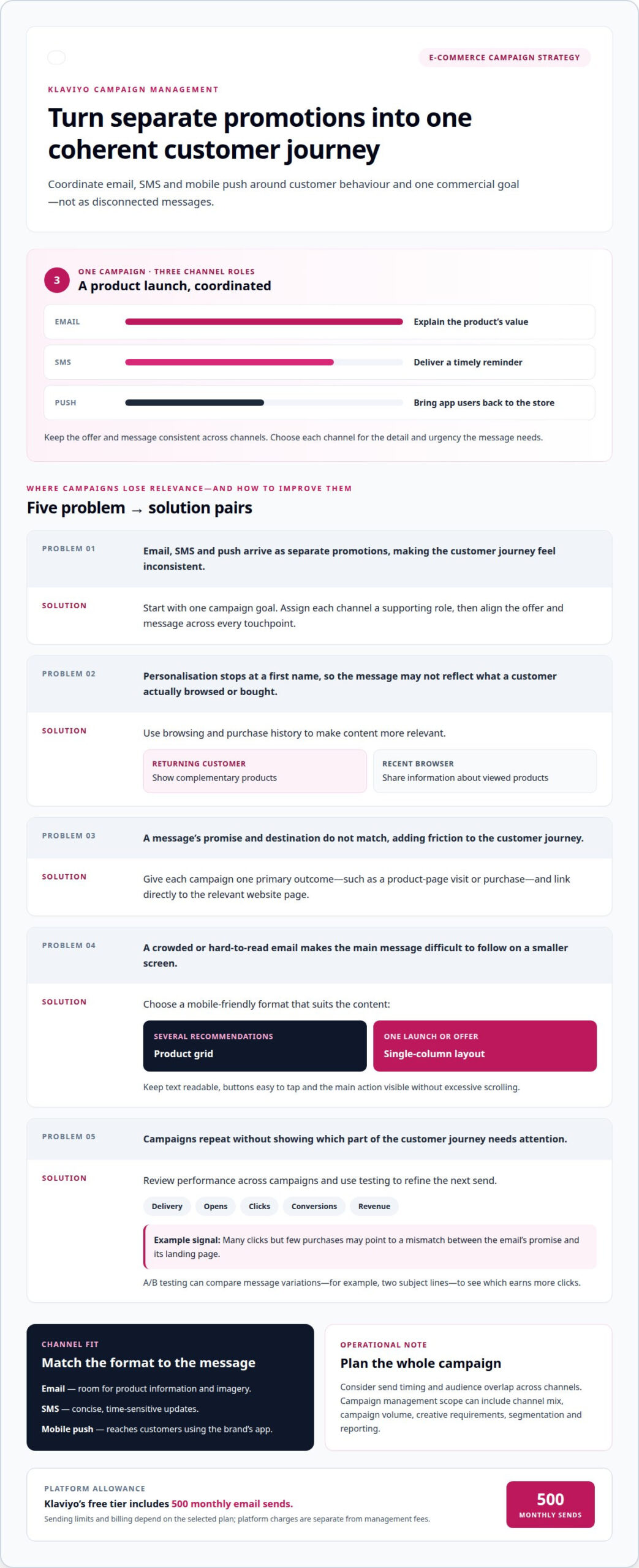
Strong campaigns coordinate email, SMS, and mobile push around one commercial goal. For a Hong Kong retailer launching a new product, email can explain its value, SMS can deliver a timely reminder, and push can bring app users back to the store. Klaviyo supports all three channels, while consistent offers and messaging keep the customer journey coherent.
Personalisation should reflect a customer’s relationship with the brand, not just add a first name. Klaviyo can use browsing and purchase history to recommend relevant products in email content. A returning customer might see complementary items, while a recent browser receives information about products they viewed. Clear campaign goals, such as driving a product-page visit or purchase, help determine the message and call to action.
Mobile-first email design matters for campaigns read on smaller screens. A professional selects a format to suit the message: a product grid works for several recommendations, while a single-column layout keeps one launch or offer in focus. Responsive emails use readable text, easy-to-tap buttons, and a visible main action without excessive scrolling. A direct route from email to the relevant website page also reduces friction.
Choose channels according to the message’s urgency and detail. Email allows space for product information and imagery; SMS suits concise, time-sensitive updates; mobile push can reach customers who use the brand’s app. A professional plans send timing and audience overlap, then uses Klaviyo’s A/B testing to compare email, text, or push variations. Testing two subject lines, for example, can show which earns more clicks.
Monitor email deliverability alongside creative performance. The campaign manager reviews delivery indicators, opens, clicks, conversions, and revenue to identify weak points. Many clicks but few purchases may signal a mismatch between the email’s promise and its landing page. Reviewing these results across campaigns helps teams refine their content and sending approach.
When choosing a provider for Klaviyo or Mailchimp campaigns, assess how they connect platform setup, audience strategy, responsive design, and performance reporting. Ask how they will align campaign goals with your ecommerce priorities and plans for overseas markets.
Klaviyo’s free tier includes 500 monthly email sends. Limits and billing depend on the account’s selected plan; review the plan’s included sending allowance and charges before setting campaign volume.
Professional email and SMS campaign-management fees depend on the scope, including channel mix, campaign volume, creative requirements, segmentation, and reporting. Pricing is determined for the specific project after a quote request. Platform charges are separate from management fees.
AI-assisted campaign creation and personalisation
AI can speed up campaign production, but commercial judgement should set the direction. Klaviyo can help create audience segments, draft subject lines and text messages, and shape email content. A professional starts with the campaign goal, such as promoting a product or encouraging repeat orders, then uses AI to develop relevant creative options. This keeps messages anchored to business priorities rather than novelty.
An ecommerce brand expanding overseas may need to frame the same product differently for different markets. A campaign manager can use AI-generated drafts as a starting point, then refine wording, product details, and tone for each audience. A launch email might highlight product benefits, while a follow-up text focuses on one clear next step. AI assists with creation, but the final message must fit the brand.
Dynamic personalisation makes emails more relevant by adapting content for each recipient. Klaviyo supports details such as first names and product recommendations based on previous purchases. A professional can use these elements while keeping the core offer and visual identity consistent. For example, a repeat customer could see complementary products, while a new subscriber receives a clear introduction to the brand.
Personalised content needs a clear action. Each campaign should guide readers towards one primary outcome, such as viewing a product, completing a purchase, or signing up. The call to action should match the email’s promise: a product-focused message might use a “View the collection” button, while a replenishment reminder can link directly to the relevant item. A mismatch between message and destination weakens the customer journey.
AI can also generate alternative subject lines and message approaches for testing. A campaign manager might compare a benefit-led subject with a product-led one, then use engagement and conversion results to guide future content. The strongest version is not necessarily the most inventive; it is the one that supports the campaign objective and feels familiar to the customer.
Quality control remains essential before scheduling. The professional reviews AI-generated copy for accuracy, brand voice, product relevance, and a working call to action. They also check that dynamic content makes sense when inserted and that each email has a useful fallback for recipients without a relevant recommendation. These checks protect the customer experience in both personalised and standard versions.
For stronger results, treat AI as one part of a structured email personalisation strategy. Clear objectives, suitable customer data, distinctive brand language, and measured testing turn faster content production into a repeatable campaign process.
Real-time behavioural and purchase-based segmentation
Klaviyo segmentation uses real-time behaviour and purchase history to tailor campaign messages. It can group audiences by location, engagement, abandoned carts, or repeat purchases, and exclude selected groups from a send.
Behavioural and Purchase-Based Audiences
Behavioural segmentation responds to what a customer does, while purchase-based groups reflect what they have bought. For example, a Hong Kong retailer can distinguish recent product viewers from repeat buyers, then shape each campaign around that relationship. A professional considers the campaign objective, the freshness of each behaviour, and whether the purchase makes the message more useful.
Real-time signals help keep segments relevant as customer activity changes. A shopper who abandons a cart may qualify for a follow-up, while a completed purchase changes the context. A campaign manager maps these actions to a clear message and destination instead of treating every profile as a sales opportunity. For overseas audiences, location can also guide campaign relevance and market-specific product choices.
Predictive analysis adds a forward-looking layer to audience planning. Klaviyo analytics provide customer lifetime value information, which can help a professional identify groups that may need distinct retention messages. For example, repeat customers may receive content that recognises their ongoing relationship, while less-engaged subscribers may need a more direct reintroduction. These signals inform campaign priorities, but should not replace commercial judgement or customer context.
Professional segment selection and campaign exclusions in Klaviyo
Start by defining the campaign’s purpose, then identify the behaviour or purchase pattern most relevant to it. A new-product announcement might target engaged subscribers, while a replenishment message could focus on previous buyers. The professional also reviews who to exclude, such as customers who have already purchased the promoted item, to avoid irrelevant messages.
Exclusions matter when campaigns overlap. Before scheduling, a campaign manager can exclude a selected list or segment, such as people already receiving a related message. They consider recent engagement, purchase timing, and offer relevance, then align the audience with the email content. Subject lines can reflect the segment’s relationship with the product instead of making one broad claim to everyone.
Effective segmentation is not simply a matter of creating more groups. A professional checks whether each segment has a distinct message, useful customer signal, and measurable purpose. They then compare results across audiences, including clicks and conversions, and use those patterns to refine later campaigns. This gives Hong Kong ecommerce teams a clearer basis for serving local customers and adapting communication for overseas markets.
Klaviyo can segment email audiences by customer behaviour, including abandoned carts and repeat purchases. Campaigns can also tailor messages using purchase history, location, and engagement level.
Send-time scheduling and subscriber time zones
Klaviyo lets campaign senders schedule sends to the minute and adjust delivery to subscribers’ local time zones. For Hong Kong businesses, campaign planning should account for Hong Kong recipients and overseas subscribers separately. SMS is a supported campaign channel, while destination availability and billing currency should be considered in account and market setup.
Scheduling is a coordination decision, not simply a choice of convenient hour. A promotion sent at local lunchtime may reach overseas subscribers in the evening, so one fixed send can create uneven timing. Klaviyo’s local-time scheduling helps align delivery with each subscriber’s time zone. A professional maps campaign timing to audience location and the message’s purpose.
For a product launch, the campaign manager can schedule the announcement for local morning hours, then plan a follow-up for subscribers who have not engaged. A seasonal offer may need separate timing for local and overseas segments, particularly when the promotion ends at different times in each market. Klaviyo allows sends to be scheduled to the minute, giving the team control over campaign sequencing and launch coordination.
Subscriber engagement scoring can help determine who receives a campaign and how often. A professional reviews signals such as recent opens, clicks, purchases, and inactivity, then groups subscribers by meaningful engagement patterns. Recently active customers, for example, may receive a launch announcement, while inactive subscribers may be held back from repeated promotional sends. A score is useful when it informs a defined campaign decision, not as a standalone objective.
Consent and privacy need deliberate handling across markets. Klaviyo campaign management includes automatic consent checks, segment refreshes, and smart sending to help prevent over-messaging. For audiences covered by GDPR, campaign workflows should account for consent records, the stated communication purpose, and unsubscribe handling. A professional considers recipient locations and the data used for targeting, then aligns campaign operations with applicable privacy requirements.
Hong Kong businesses should also distinguish platform billing from campaign-management fees. The account’s billing currency and SMS destination settings affect operational planning, so teams should review these before forecasting spend. Avoid assuming a displayed currency or SMS capability applies uniformly across every recipient market. A professional builds the campaign plan around the account configuration and the countries the business intends to reach.
Before scheduling, the campaign manager reviews the audience, time-zone settings, consent status, and overlapping sends. Klaviyo’s smart sending can help limit excessive messages, while exclusions prevent selected segments from receiving a particular campaign. These controls matter during busy ecommerce periods, when product launches, automated messages, and promotions might otherwise compete for subscribers’ attention.
AI-driven campaign insights and optimisation
AI-informed optimisation starts with evidence, not automated guesswork. Klaviyo analytics track campaign revenue alongside opens, click-throughs, and conversions. A campaign manager considers these measures together, then identifies where customer response changes. High opens but few clicks, for example, may point to a mismatch between the subject line and the email content.
Revenue provides a commercial lens, but it needs context. Strong sales may reflect a timely promotion, an engaged audience, or a relevant product offer. The professional compares results with the campaign’s objective and audience rather than treating one successful send as a universal template. This turns reporting into a decision-making system.
Customer lifetime value adds a longer-term perspective. Klaviyo analytics provide information about this value, helping campaign teams consider whether a message supports repeat engagement as well as immediate revenue. A campaign that encourages a first purchase and one that rewards returning customers serve different purposes, so assess their performance against those distinct aims.
Testing creates a disciplined route from insight to improvement. A campaign manager can compare two email versions by changing one element, such as the subject line or content. They then review clicks, conversions, and revenue to determine which version better serves the objective. Changing one variable at a time makes the result easier to interpret and apply to future campaigns.
Use effective campaign content as a starting point for other relevant segments. Klaviyo reporting can reveal which messages attracted engagement or revenue; a professional can adapt a successful idea for a different audience. The adaptation matters: a product story that resonates with new customers may need a different emphasis for repeat buyers, even if the central offer is similar.
Attribution also depends on consistent measurement. Enabling tracking parameters in a Klaviyo campaign automatically appends UTM parameters according to the account’s default UTM tracking settings. This helps connect email activity with website traffic reporting. The campaign manager reviews this setup alongside platform metrics so comparisons use a consistent measurement approach across sends.
AI can support this optimisation cycle by helping teams develop campaign variations and organise next-step hypotheses. It should not replace commercial judgement: the professional interprets performance, checks the audience context, and decides what to test next. For a Hong Kong ecommerce business entering overseas markets, comparisons by audience and campaign objective can show where messaging needs to adapt.
Build a more measurable growth system with campaign performance optimisation aligned to your ecommerce goals.
A professional remains responsible for deciding whether a suggested variation fits the audience, offer, and campaign objective. The top 10% of industry-leading email campaigns drive 9x more RPR than average brands. That gap is a reason to study standout performance carefully, while checking whether the conditions behind it apply to the next send rather than copying its tactics without context.
Email campaigns should use responsive designs optimised for mobile devices. A mobile-friendly layout helps keep the message and its call to action usable across screens, supporting a consistent experience for recipients. Reviewing design choices alongside campaign results gives teams practical areas to test and refine.
Senses Group: Klaviyo Email Automation
Senses Group provides Klaviyo Email Automation for ecommerce teams that need a more coordinated approach to campaigns, audience segments, scheduling, and performance analysis. It is a natural next step when campaign activity is growing but strategy, customer experience, and measurement are not working as one system.
For Hong Kong businesses scaling locally or overseas, effective email automation should connect customer data with a consistent brand experience. Senses Group can align campaign planning with Brand Strategy and Brand Identity Design, or connect it with an Ecommerce Shopify Store. This helps build a clearer foundation for customer communication as the business expands.
If your team is ready to strengthen its email campaigns, contact Senses Group to discuss your Klaviyo Email Automation needs.
Build the next stage of your customer journey
As your ecommerce business grows, campaign communication should grow with a clear commercial direction. The next step is to connect customer messaging with the experience your brand creates across its store and wider marketing. That foundation helps keep campaigns coherent as you serve Hong Kong customers and enter overseas markets.
Well-planned Klaviyo campaign management can support your business when it reflects your brand strategy, customer experience, and priorities. Senses Group brings together Klaviyo Email Automation, Brand Strategy, Brand Identity Design, and Ecommerce Shopify Store development, giving your team a connected foundation for building and improving its ecommerce presence.
Whether you are refining an existing campaign programme or preparing to expand, start by defining the customer experience you want each message to support. A clear brief focuses the next decisions, from campaign priorities to the role of your ecommerce store.
Discuss your campaign goals with Senses Group and take a considered next step towards stronger customer communication.
Frequently Asked Questions
How can a professional A/B test Klaviyo campaigns and measure results?
A professional tests one meaningful difference at a time, then judges the result against the campaign’s goal. For a Hong Kong store promoting a new range, they might compare two subject lines while keeping the offer and audience consistent. They can then assess opens, clicks, conversions, and campaign revenue together. Recording the winning version and the audience it reached helps inform future tests without assuming the same result applies to every segment.
What campaign analytics and key performance metrics does Klaviyo provide?
Klaviyo reports email campaign open rates, click-through rates, conversion rates, and revenue generated. It also provides customer lifetime value information. A professional connects these figures to the campaign objective: a product-awareness send, for example, should be assessed for engagement and visits, while a sales campaign needs conversion and revenue context. Reviewing metrics together helps distinguish an attention problem from an issue in the purchase journey, such as a landing page that does not match the email.
What deliverability, consent, and compliance risks should Klaviyo users consider?
Key risks include sending to disengaged or incorrectly selected recipients, unclear consent records, and messages that do not match the audience’s expectations. A professional reviews list quality, campaign targeting, and unsubscribe handling, then considers privacy obligations for each market reached. For businesses serving customers in Hong Kong and overseas, recipient location matters; GDPR considerations apply to relevant audiences. Monitor delivery and engagement patterns so repeated problems can inform changes to list management and campaign practices.