
If your brand is indistinguishable from the competition, you aren’t running a business; you’re simply managing a race to the bottom on price. You likely see the daily evidence of this in your dashboard through climbing Meta and Google ad costs that eat away at your margins. It’s a common struggle for Hong Kong SMEs trying to reach international audiences; the harder you push, the more the market feels saturated. You know that simply having a product isn’t enough anymore. You need a systemic brand differentiation strategy to break the cycle of high acquisition costs and low loyalty.
We’ve spent nearly two decades helping brands move past superficial aesthetics to build genuine commercial engines. This article provides the strategic framework you need to transform your brand into a high-converting asset that commands premium pricing. You’ll learn how to communicate unique value to global audiences and implement a model that scales profitably. We’re moving beyond mere creativity to focus on the logical steps that lower your CAC and elevate your average order value. It’s time to stop chasing the algorithm and start building a foundation that lasts.
Key Takeaways
- Move beyond visual aesthetics to understand brand differentiation as the commercial foundation of your business rather than just a logo.
- Master the three pillars of Story, Positioning, and Value to create a comprehensive brand differentiation strategy that resonates with international markets.
- Identify the critical difference between short-term tactical gimmicks and long-term strategic assets that build permanent market authority.
- Discover how to integrate your brand identity with high-converting Shopify stores and AI-driven SEO to build a self-sustaining growth engine.
- Learn the roadmap for scaling your revenue by transitioning from a commodity seller to a globally recognized strategic leader.
Beyond the Logo: What is a Brand Differentiation Strategy?
A common misconception among business owners is that branding begins and ends with a visual identity. While a logo serves as a recognizable marker, it’s merely the surface-level signal of a much deeper strategic choice. A true brand differentiation strategy acts as your “Marketing Map,” serving as the strategic commercial foundation of your entire operation. It isn’t an artistic endeavor; it’s the logical blueprint that dictates how your business functions, speaks, and competes in a global marketplace.
Think of your business as a “Growth Engine.” In this system, differentiation is the fuel that determines the efficiency of your sales and marketing efforts. Without a clear distinction, your engine stalls because it lacks the necessary pressure to move consumers through a funnel. Brand differentiation is the unique value intersection where customer needs meet your non-replicable strengths.
The Psychology of Choice in a Crowded Market
Modern consumers face constant decision paralysis. Effective brand differentiation solves this by providing a mental shortcut that reduces cognitive load. For Hong Kong entrepreneurs expanding into overseas markets, this requires moving from explaining “what we sell” to articulating “why it matters.” This clarity directly lowers customer acquisition costs (CAC). When your positioning is sharp, you stop bidding against the entire market and start speaking to a specific, high-intent audience.
Commercial Impact: From Commodity to Category Leader
Generic brands are trapped in a perpetual cycle of price wars and discount events. When your product is perceived as a commodity, price becomes the only lever you can pull to drive sales. Conversely, a strong brand identity for retailers creates price inelasticity. It gives customers a reason to choose your specific solution even when cheaper alternatives exist. By building a robust brand differentiation strategy, you move away from the race to the bottom and toward a sustainable, scalable business model that generates profit through authority rather than just volume.
The Architecture of Distinction: Defining Your Brand Foundation
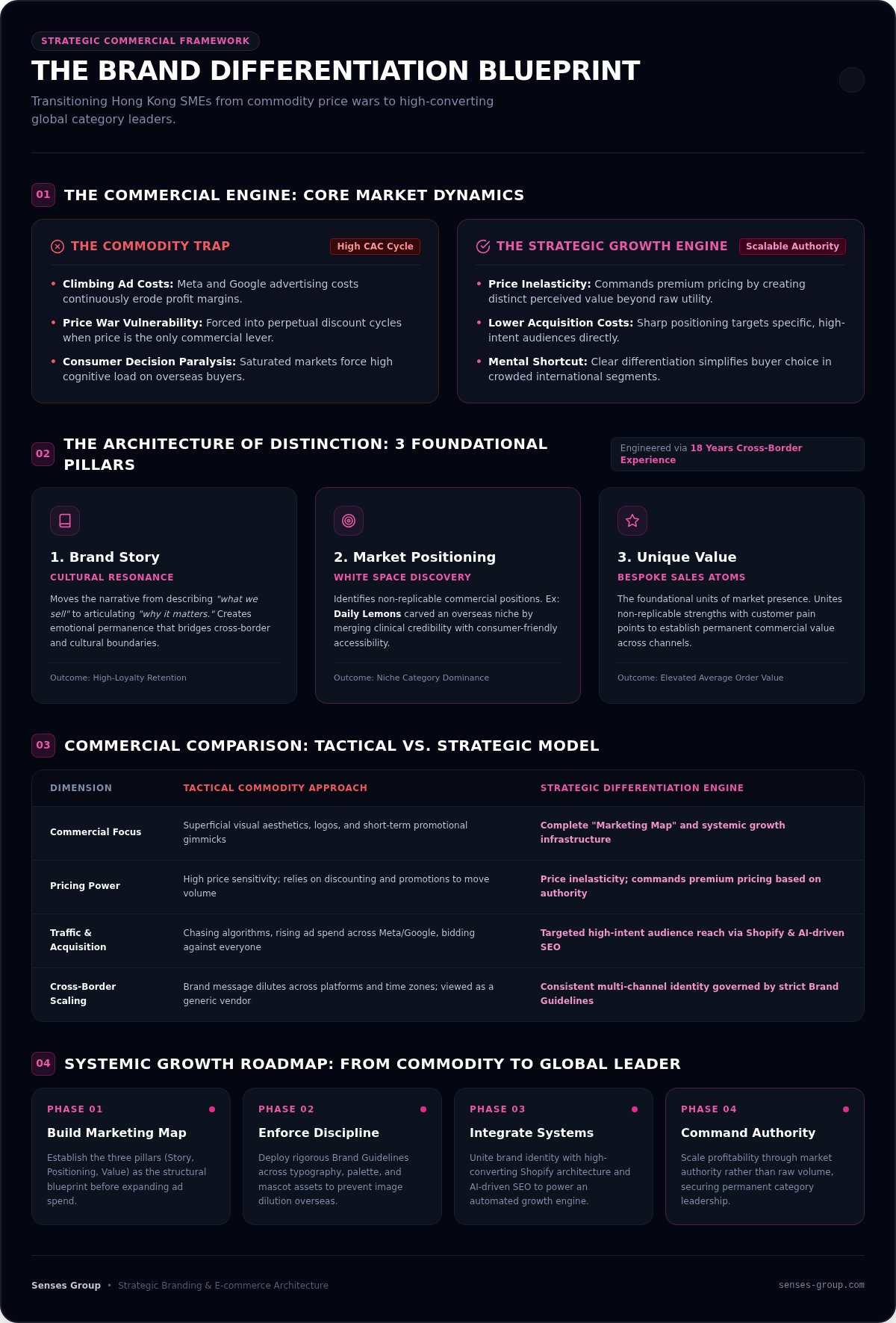
Constructing a brand is an exercise in structural integrity, not decoration. A high-level brand differentiation strategy rests on three non-negotiable pillars: Story, Positioning, and Value. These elements form your “Marketing Map,” a comprehensive blueprint that ensures every digital activity serves a specific commercial purpose. At Senses Group, we draw on 18 years of cross-border experience to refine these pillars into “Bespoke Sales Atoms,” the foundational units of a business’s market presence that remain stable even as you scale into new territories.
Without rigorous Brand Guidelines, global image clarity dissolves. For a Hong Kong SME, maintaining a consistent persona across different time zones and platforms is the difference between being a trusted partner and a forgettable vendor. Guidelines provide the discipline required to ensure your brand’s voice and visual signals remain potent, regardless of the channel.
Positioning for Global and Local Markets
Successful scaling requires identifying “white space” within saturated international ecommerce sectors. It’s about adapting your presentation to meet the expectations of diverse stakeholders while remaining authentic to your core strengths. Consider the case of Daily Lemons; they successfully carved out a niche by blending clinical credibility with consumer-friendly accessibility. This proved that precise positioning is the most effective way to bypass market noise and speak directly to the needs of a global audience. When you clarify your position, you stop competing with everyone and start leading your own category.
Visual Identity as a Strategic Asset
Visual identity is a commercial tool, not just an aesthetic choice. Typography, color palettes, and mascot designs are high-functioning assets that drive recognition and trust. In a multi-channel environment, a cohesive visual system is essential for scaling without diluting your message. When your brand story resonates across cultural boundaries, it creates a sense of permanence that outlasts temporary market trends. If you’re ready to solidify your market position, exploring a professional brand differentiation strategy is the first step toward building a systemic growth engine that converts interest into long-term loyalty.
Tactical vs. Strategic Differentiation: A Framework for Growth
True market leadership is built on a fundamental distinction: it’s not about being slightly faster or cheaper, but about being fundamentally different. Short-term tactics like aggressive discounting or promising fast shipping are easily replicated by any competitor with a similar budget. These are tactical maneuvers, not a brand differentiation strategy. Strategic differentiation, by contrast, is a systemic asset that competitors cannot simply buy or copy. It’s the difference between a temporary sales spike and a permanent market moat.
Many businesses fall into the trap of “feature creep,” believing that adding more specifications will win the day. This often results in a cluttered value proposition that confuses the consumer. A focused brand foundation does the opposite; it strips away the noise to highlight a singular, non-replicable strength. Implementing an integrated digital marketing solution ensures this focus is maintained across every touchpoint, protecting your competitive advantage from being diluted by generic industry trends. A successful brand differentiation strategy requires moving past surface-level features to define why your business exists in the first place.
The Pitfalls of “Me-Too” Marketing
Copying a competitor’s ad style or website layout is a recipe for diminishing returns. In an age where AI can generate generic content in seconds, the cost of a “me-too” digital presence is invisibility. When you look like everyone else, you’re forced to pay more for the same attention. Differentiation acts as your business’s moat, creating a psychological barrier that prevents customers from viewing your product as a replaceable commodity. It’s about owning a specific mental space in the consumer’s mind that no one else can occupy.
Building the Senses “Sales Atom” Framework
Moving from fragmented marketing efforts to a unified growth engine requires a shift in perspective. We don’t view branding as a separate entity from performance; we see them as two halves of a single “Sales Atom.” This framework integrates your core brand story with high-performance Shopify development, ensuring that your commercial foundation is as technically sound as it is strategically sharp. Building a multimillion-dollar brand from the ground up, as we have done for clients since 2018, requires more than just creative flair. It demands 18+ years of disciplined corporate branding experience to ensure every element of your growth engine is synchronized for global scale.
Engineering the Growth Engine: Shopify and AI Integration
Your brand differentiation strategy remains a theoretical concept until it’s embedded into a functional digital infrastructure. A high converting Shopify store isn’t just a digital storefront; it’s the functional home for your brand where abstract positioning becomes a tangible user experience. This is where your “Growth Engine” comes to life. By utilizing AI visual production, we ensure your brand imagery remains consistent and high-end across every product page, using a modern visual narrative that reflects your unique identity. For a Hong Kong SME, this technical execution is what turns a local product into a global commercial asset.
Integrating your brand’s core difference into a digital sales funnel requires a methodical, step-by-step approach:
- Identify the Strategic Anchor: Define the non-replicable strength that sets your business apart from local and overseas competitors.
- Optimise for Discovery: Use AI-driven search strategies to ensure your brand appears where high-intent shoppers are looking.
- Design for Conversion: Build a Shopify environment that reinforces your unique value at every touchpoint, from the homepage to the checkout.
- Automate Retention: Implement lifecycle marketing to turn one-time buyers into long-term advocates.
Generative Engine Optimisation (GEO): The New Frontier
The way consumers discover brands is fundamentally shifting as AI Large Language Models (LLMs) like ChatGPT and Gemini act as digital curators. These systems categorize and recommend brands based on their perceived authority and distinctiveness. If your brand lacks a clear brand differentiation strategy, it becomes invisible to these new search engines. We focus on AI search engine optimisation by building comprehensive topical maps and LLM-optimised metadata. This ensures that when an AI engine searches for a leader in your category, your brand is the definitive answer.
Ecommerce Retention and Lifecycle Marketing
Conversion is only the first step in a sustainable commercial model. We use Klaviyo-based flows to reinforce your brand differentiation long after the initial purchase. Automated email marketing isn’t just about sending coupons; it’s about continuing the brand story and increasing customer lifetime value (LTV). By maintaining a consistent voice post-purchase, you transform one-time buyers into loyal brand advocates. If you’re ready to engineer a system that scales, we can help you build a high-performance ecommerce growth engine that integrates strategy with technology.
Scaling with Authority: The Path to a Sustainable Business
Scaling a business from a local operation to a $10M+ global entity requires more than just increased ad spend. It demands a robust brand differentiation strategy that can withstand the pressures of international market saturation. Without this foundation, your growth is fragile; you’re simply scaling inefficiency. We’ve seen that businesses prioritizing their “Marketing Map” early on are the ones that transition from being a simple vendor to becoming a strategic leader in their category.
Our core focus at Senses Group is turning websites into revenue-generating machines. We don’t just build Shopify stores; we engineer commercial growth engines. If you’re a business owner looking to audit your current strategy, start by examining your value proposition. If a competitor can replicate your main hook in a single afternoon, you don’t have a strategy; you have a temporary feature. True differentiation is systemic and non-replicable.
From Startup to Multimillion-Dollar Brand
The journey to a multimillion-dollar brand involves specific milestones, ranging from initial product-market fit to managing the complexity of international advertising and affiliate networks. You’ll need to move beyond basic Meta ads and embrace a data-driven approach that validates your differentiation at every stage. Since 2018, we’ve built a multimillion-dollar home brand from zero. This proves that a disciplined brand differentiation strategy, combined with high-performance execution, is the only way to scale sustainably. It’s about moving from a “service provider” mindset to a “strategic partnership” where every dollar spent on marketing builds long-term equity.
Why an Integrated Agency Partnership is the Final Piece
Fragmented marketing is a silent killer of commercial growth. When your branding, Shopify development, and AI-driven marketing are handled by separate entities, your message dilutes and your technical systems clash. An integrated partnership puts everything under one roof. This ensures that your strategic vision is perfectly reflected in your functional store. We leverage our 18+ years of expertise to guide clients, applying the same seasoned assurance that has managed over $4 million in ad spend. We’ve seen what works and what doesn’t. If you’re ready to stop managing a commodity and start leading a category, let’s build your growth engine.
Building Your Sustainable Commercial Future
Transitioning from a generic commodity to a category leader requires a disciplined brand differentiation strategy that aligns your unique value with technical excellence. You’ve learned that a “Growth Engine” isn’t built on isolated tactics; it’s the result of integrating your core story with a high-converting Shopify store and AI-driven optimization. By focusing on your foundational positioning, you move beyond the race to the bottom on price and start building a moat that protects your margins in both local and international markets.
Scaling a business is a complex journey that demands a seasoned strategic partner. With 18+ years of expertise and a proven track record of doubling ecommerce revenue, we understand the mechanics of sustainable growth. Having managed over $4 million in ad spend, we possess the data-driven insights needed to turn your digital presence into a high-functioning commercial asset. It’s time to stop reacting to market noise and start engineering a system that lasts. Let’s Build Your Growth Engine – Partner with Senses Group today and secure your brand’s position as a global leader.
Frequently Asked Questions
What is the difference between a USP and a brand differentiation strategy?
A USP is a tactical feature, while a brand differentiation strategy is a systemic commercial foundation. USPs like “free shipping” are easily copied by any competitor with a budget. A strategy integrates your story, positioning, and value into a non-replicable asset. It’s the difference between a temporary sales hook and a permanent market moat. We build “Bespoke Sales Atoms” to ensure your entire business model remains distinct.
How long does it take to see ROI from a new brand strategy?
Immediate improvements in engagement often appear within weeks, but a full commercial ROI typically stabilizes between three to six months. This period allows for the implementation of the “Marketing Map” and the optimization of digital sales funnels. We’ve seen revenue double for jewelry clients shortly after launching a coordinated system. A long-term strategy builds compounding equity that lowers acquisition costs over years, not just days.
Can a small business really compete with global giants through differentiation?
Small businesses compete by being more specialized and agile than generic global giants. Differentiation allows SMEs to own a “white space” that massive corporations are too broad to occupy effectively. By building a high-level brand foundation, you stop fighting for the general market and start leading a specific category. This focus creates a level of trust and authority that large-scale competitors often lack due to their impersonal nature.
How does brand differentiation lower my Facebook and Google ad costs?
Differentiation lowers Meta and Google ad costs by increasing your click-through and conversion rates. When your brand differentiation strategy is sharp, your ads resonate more deeply with high-intent audiences, which improves your relevance scores. This efficiency reduces the cost per acquisition (CAC) because you aren’t wasting budget on generic traffic. A distinct identity ensures your creative assets stand out, driving better performance from every dollar spent.
Why is Shopify the preferred platform for a differentiated brand?
Shopify is the preferred platform because it provides the technical flexibility to build a bespoke functional home for your brand. It allows for seamless integration with advanced tools like Klaviyo and AI-driven engines while maintaining a high-performance environment. A custom-crafted Shopify store ensures your strategic positioning is reflected in the user experience. This technical reliability is essential for scaling a unique identity across international markets without compromise.
What is Generative Engine Optimisation (GEO) and why does my brand need it?
Generative Engine Optimisation (GEO) is the process of making your brand visible to AI search engines like ChatGPT and Gemini. These LLMs categorize businesses based on authority and distinctiveness rather than just keywords. Your brand needs GEO to capture high-intent traffic from users who rely on AI for recommendations. Without it, you risk becoming invisible as traditional search evolves into a generative ecosystem where only highly differentiated brands are cited.
How do I know if my current brand is “too generic” for the international market?
Your brand is likely too generic if you’re forced to compete primarily on price or if your messaging mirrors your competitors. If international audiences can’t distinguish your value proposition from a local alternative in their own country, your market position is weak. We look for a lack of clinical credibility or emotional resonance as key indicators. A generic presence leads to high bounce rates and low loyalty in global ecommerce environments.