
Ad spend is only one part of growing an online store through paid advertising. Effective PPC management for ecommerce also requires a clear campaign strategy, careful budget oversight, performance analysis and testing to reach the right buyers.
It’s reasonable to expect advertising to bring more people to your products, but clicks alone don’t show whether campaigns are supporting sustainable growth. For Hong Kong SMEs and startups, the key is understanding how management fees and ad spend relate, and how targeting should change when selling locally or entering overseas markets.
This guide explains what ecommerce PPC management involves, what a professional handles during targeting and setup, and which factors shape the working relationship and costs. You’ll also learn what to expect from campaign testing and reporting, and how to assess whether an approach fits your store’s products, margins and growth plans.
Key Takeaways
- Understand how Google Shopping, Performance Max and Search campaigns serve different roles in an online store’s paid advertising strategy.
- See how audience signals and competitor analysis can help focus campaigns on relevant buyers in Hong Kong and overseas markets.
- Learn what to weigh when choosing a PPC specialist, agency or optimization tool, based on the support your business needs.
- Discover why accurate product feeds and conversion tracking are foundational to campaign decisions and performance measurement.
- Separate agency management fees from advertising spend, and identify the factors that shape each part of your budget.
ECommerce PPC Management: What Is It?
PPC management for ecommerce is the ongoing work of directing paid campaigns, budgets, targeting and performance analysis. For a Hong Kong store, it connects product visibility with measurable commercial goals, whether sales come from local searches or overseas customers.
Shopping, Performance Max, and Search Campaigns
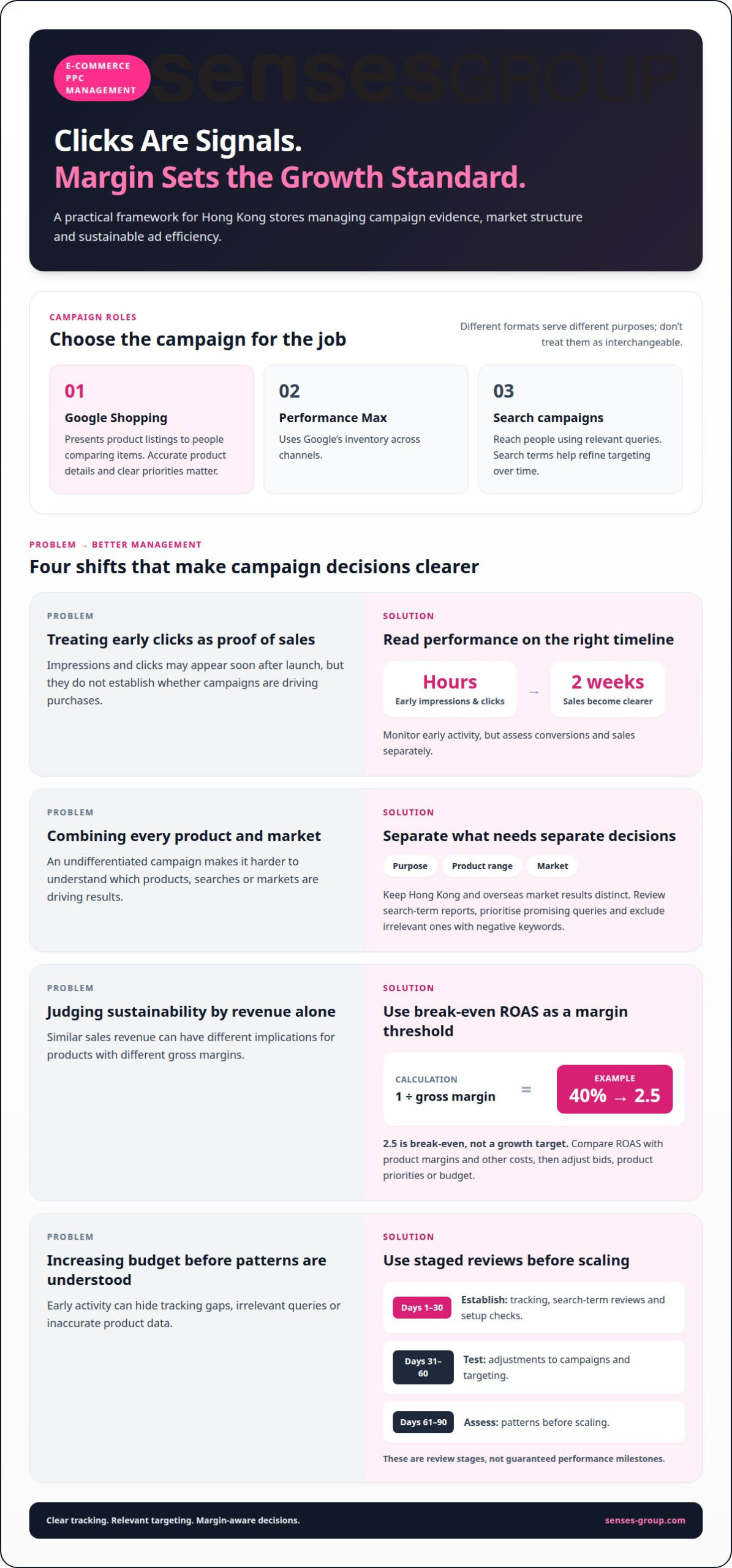
Google Shopping presents product listings to people comparing items, so management starts with accurate product details and clear campaign priorities. Performance Max uses Google’s inventory across channels, while Search campaigns reach people using relevant queries. Each campaign type serves a different purpose. Treating them as interchangeable can make it harder to see which products, searches or placements drive results.
Management includes setting campaign objectives, allocating budget, reviewing search and sales data, and testing adjustments. Early impressions and clicks can appear within a few hours of launch, while conversions and sales typically become clearer within 2 weeks. That difference matters: early activity informs monitoring, but it isn’t the same as established sales performance.
Campaign Structure and Keyword Targeting
A clear structure separates campaigns by purpose, product range, market or other meaningful business distinctions. For example, a store expanding from Hong Kong into another market can keep its market-level results distinct. This makes budget allocation and performance analysis more useful than placing every product and audience into one undifferentiated campaign.
For Google Search, keyword targeting connects ads with relevant queries, while search term reports show what people actually typed. Negative keywords exclude irrelevant searches, helping prevent spend on mismatched intent. Regular reviews should identify promising queries to prioritise and unsuitable terms to exclude, rather than relying indefinitely on the initial keyword list.
Margin-Based Management and Break-Even ROAS
Revenue alone doesn’t tell a store whether paid advertising is sustainable. A campaign’s return on ad spend, or ROAS, needs to be assessed against product gross margin and the other costs affecting profitability. The break-even calculation is 1 divided by gross margin: for a store with a 40% gross margin, break-even ROAS is 2.5.
That figure is a threshold, not a growth target. Sound PPC management for ecommerce compares campaign results with the store’s margins, then adjusts bids, product priorities or budget accordingly. A lower-margin product may need a different efficiency standard from a higher-margin item, even when both generate similar sales revenue.
Campaign Timelines, Platforms, and Policy Considerations
Use the first 30 days to establish tracking, inspect search terms and identify setup issues; use days 31-60 to test adjustments; and use days 61-90 to assess patterns before scaling. These are review stages, not guaranteed performance milestones. Google Ads suits search intent and product listings; Meta advertising can support audience-based discovery. The best platform depends on product, buying behaviour and market goals.
Google Ads campaigns must follow Google’s advertising policies, including requirements affecting ads and landing pages. In Hong Kong, advertising also needs to meet applicable local rules and present product claims accurately. Common risks include poor tracking, irrelevant queries, inaccurate product data and budget increases before performance is understood. Review these risks with each campaign assessment.
Audience targeting and competitor analysis
Effective targeting starts with the buyer, not a broad demographic label. A Hong Kong store selling skincare, for example, may distinguish people searching for a particular product benefit from those browsing general beauty trends. A PPC specialist connects those intentions to suitable keywords, audiences and landing pages, then uses campaign metrics to assess which combinations attract relevant traffic.
Researching Keywords and Competitors
A specialist reviews search term data to understand shoppers’ language, grouping queries by intent and product relevance. Someone searching for a specific product has different intent from someone exploring a broad category. That distinction helps shape keyword choices, ad messaging and the page visitors reach.
Competitor analysis can reveal businesses bidding on the same queries, as well as valuable searches they overlook. When a retailer expands overseas, the specialist assesses each target market separately because competitors, search language and product positioning can differ. The goal isn’t to copy another advertiser, but to identify where the store has a credible reason to win attention.
Targeting and Measurement
On paid social platforms, targeting can use demographic characteristics and preferences. A high-end fashion retailer might focus on users in the top 10% of earnings, an example of how a defined audience can shape campaign targeting. The right approach depends on the product, customer and market, not a segment label alone.
Specialists connect audience choices to meaningful outcomes through performance tracking and analytics. They review impressions, clicks, conversions and cost per acquisition together, rather than treating traffic alone as success. Google Ads reports campaign and query performance; Google Analytics adds context about how visitors behave after arriving. Consistent tracking helps show whether a promising click leads to a purchase.
Reporting, Testing, and Tools
Useful reports explain what changed, what the metrics indicate and what action follows. A specialist might compare a product-focused audience with a broader interest group, then assess which generated stronger purchase activity. A/B testing can compare ad text or creative while keeping the audience and objective clear. Changing several variables at once makes results harder to interpret.
Google Ads, Google Analytics and an ecommerce platform’s analytics each provide different evidence. Their value depends on consistent campaign tagging, reliable conversion tracking and reporting that reflects the store’s sales goals. For a Shopify store, connecting campaign activity with store outcomes makes analysis more commercially relevant. A successful campaign isn’t simply one that reaches more people. It attracts suitable buyers and supports informed decisions about where to allocate budget next.
PPC Manager, Agency or Tool?
A PPC specialist improves ecommerce conversion by aligning the target audience, ad promise and landing page, then testing changes against purchase data. The strongest approach considers the whole journey, not just campaign settings.
Choosing a Specialist, Agency, or Tool
A specialist offers direct campaign expertise and can suit a store with a defined advertising scope. An agency may bring broader team capacity across platforms, campaign analysis and landing-page recommendations. An optimization tool can automate selected tasks, but it can’t replace commercial judgement about product margins, customer intent or market priorities.
Assess the proposed working method. A capable professional should explain how campaign objectives connect to store outcomes, which metrics guide decisions and how findings are reported. If a campaign attracts clicks but few purchases, for example, the analysis should consider the ad, audience, product page and checkout experience, rather than simply increasing the budget.
Landing-page and conversion-rate optimization are part of that assessment. A specialist can compare the promise in a Google ad with the product page’s headline, imagery, price presentation and buying information. If the ad promotes a specific product, sending shoppers to a broad category page can add friction. The page should make the next step to purchase clear.
Tools can support reporting and routine optimization, but they rely on accurate tracking and useful campaign inputs. An agency or specialist should interpret metrics in context, identify what to test and explain why. Choose support that matches your internal capacity and the complexity of your target audience.
Retargeting and A/B Testing
Retargeting can reach people who visited an ecommerce site or viewed a particular product. A campaign might remind visitors about a relevant product after they leave without purchasing. The message should reflect their browsing context, and the landing page should return them to the product or category they considered.
A PPC specialist uses A/B testing to compare ad text, graphics or landing-page elements. For instance, a test might compare a product-benefit headline with a feature-led headline. Keeping the change focused helps clarify which version performs better against the chosen conversion metric. Testing several elements together makes results harder to interpret.
Conversion optimization means looking beyond clicks. A specialist checks whether revised messaging attracts relevant traffic and whether visitors proceed toward purchase. If clicks rise but conversions don’t, the page experience or offer may not match the audience’s intent. If purchases improve, the specialist can assess whether the change should be used more widely.
For stores targeting Hong Kong and overseas buyers, retargeting and landing-page decisions should reflect each market’s product messaging and shopper expectations. The specialist’s role is to connect audience signals, creative testing and conversion tracking, then use the evidence to prioritize the next campaign adjustment.
Product feed, Merchant Center and conversion tracking setup
Shopping campaigns rely on accurate product information, while Google Ads decisions depend on reliable conversion data. A professional setup connects the product feed, campaign structure, tracking and landing pages so performance can be assessed against sales.
Product Feed and Merchant Center Setup
In Google Merchant Center, a product feed supplies details such as titles, descriptions, prices, availability and images. A specialist checks that these match the corresponding Shopify product pages. If the feed lists an item as available but its landing page shows it as sold out, shoppers see conflicting information and campaign delivery may be affected.
Product titles should identify the item clearly and use language shoppers recognise. For example, a Hong Kong store selling skincare can distinguish a cleanser from a moisturiser in the feed, rather than relying on an internal product name. Clear descriptions and suitable images help Google Shopping present relevant products to shoppers comparing options.
Feed reviews also check for missing fields, inconsistent product details and Merchant Center diagnostics that flag item-level issues. For a store selling overseas, currency, availability and product information should align with the target market and landing page. These checks help prevent feed errors from undermining campaign performance.
Account Structure and Conversion Tracking
A well-organised Google Ads account separates campaigns to support useful decisions. A manager might group campaigns by product category or market, keeping performance for local shoppers distinct from overseas activity. This makes it easier to identify where budget is generating relevant visits and sales.
Conversion tracking records actions that matter to the store. A purchase is a core ecommerce conversion; add-to-cart activity can provide extra context about where shoppers leave the journey. The specialist checks that conversion events work correctly and purchase values are passed consistently, so reports reflect store activity rather than unverified clicks.
Google Ads performance reviews connect three metrics: click-through rate (CTR), conversion rate and cost per acquisition (CPA). CTR shows how often impressions lead to clicks; conversion rate shows how often visits lead to the defined action; CPA compares advertising cost with those conversions. A rising CTR alongside weak purchases can indicate a mismatch between the ad and landing page.
Landing pages should deliver on the ad’s promise. If a Google Shopping listing features a specific product, the click should lead to that product page, with clear details and a visible route to purchase. For an overseas campaign, the page should also match the target market and product information, rather than sending visitors to a generic storefront.
During ongoing reviews, a PPC manager compares campaign metrics with actual store outcomes and investigates tracking gaps before changing budgets. A comprehensive setup connects Merchant Center data, Google Ads reporting and ecommerce conversion events. This helps distinguish low-quality traffic from a page or checkout issue and prioritise the next improvement.
Agency management fees and advertising spend
For a Hong Kong ecommerce business, agency fees and advertising spend are separate budget decisions. The fee pays for agreed management work; ad spend funds campaigns on platforms such as Google Ads or Meta. A clear proposal distinguishes both, explains what work is included, and shows how spend is monitored across each market.
There’s no single fee structure for every PPC agency. Agreements may use a fixed management fee, a percentage of ad spend or project-based pricing for defined setup work. Each approach allocates costs differently, so assess the scope alongside the model. A percentage-based fee, for example, can rise as advertising grows, while a fixed fee depends on the management tasks it covers.
Pricing depends on the project and is provided after a quote request. Factors include campaign scope, platform mix, markets, account complexity and reporting requirements.
Before work begins, the proposal should state which campaigns the agency manages, how often performance is reviewed and what reports include. It should also distinguish setup from ongoing optimization. A new store launching Google Shopping, Search and Meta campaigns may need different initial work from an established account that needs restructuring and regular testing.
Advertising spend is the amount allocated to paid placements, not the agency’s fee. The right budget depends on products, margins, target markets, campaign objectives and the evidence available to guide decisions. For a brand entering overseas markets, separate campaign budgets can make local and international performance easier to compare. One pooled budget may obscure which market is using spend effectively.
Increase ad spend in response to evidence, not pressure to scale. A PPC agency can review campaign results, search demand, conversion data and product inventory before recommending changes. If a campaign attracts irrelevant traffic, a larger budget amplifies the problem. The management plan should explain what signals prompt a spend adjustment and how changes are communicated.
Ask how the agency handles billing, account access and budget approvals. The agreement should make clear whether platform charges go directly to the business or are handled another way, who can approve changes, and how any unspent budget is treated. These details matter for Hong Kong SMEs managing cash flow alongside product, fulfilment and market expansion costs.
Compare proposals by deliverables, not by fee alone. Check whether campaign setup, search-term reviews, creative testing, reporting and strategic recommendations are included. A low headline fee may cover a narrower scope; a higher fee is useful only if its added work supports the business’s goals. To align paid campaigns with your growth plan, discuss Meta and Google advertising.
Senses Group: Ecommerce Shopify Store
Senses Group helps Hong Kong businesses build an ecommerce foundation through Shopify store development, Brand Strategy and Brand Identity Design. These capabilities support paid campaign performance by connecting product presentation, brand positioning and the shopping experience. When ads attract visitors but the store doesn’t communicate a clear reason to buy, strengthening that foundation can be a practical next step.
A Shopify store brings product information and purchase journeys together in a structured ecommerce experience. Brand Strategy clarifies market position and the customer promise, while Brand Identity Design gives that promise consistent visual expression across the store. Klaviyo Email Automation can support follow-up communications throughout the buying journey.
If your store needs a stronger ecommerce foundation for local or overseas growth, contact Senses Group to discuss your business needs.
Build the Next Stage of Ecommerce Growth
The next step is to treat paid advertising as part of your wider growth system, not as an isolated traffic source. For a Hong Kong business preparing to expand, that means aligning campaign priorities with the market position you want to build and the customer experience your store can deliver.
Strong PPC management for ecommerce supports growth when campaign decisions connect commercial goals with a coherent brand and shopping journey. The aim isn’t simply to pursue more clicks, but to reinforce why the right customer should choose your store. As your business evolves, keep that strategic link clear across advertising and ecommerce.
Senses Group can help bring that thinking together through Meta and Google advertising, alongside the brand and ecommerce foundations that shape how customers experience your business. Contact Senses Group about PPC to discuss the next stage of growth for your online store.
Frequently Asked Questions
How can an ecommerce PPC agency help elevate your sales?
An ecommerce PPC agency can connect advertising activity with the products and customers most likely to support store growth. For example, it can coordinate campaign priorities with product launches, stock availability and seasonal promotions, so ads reflect what the business can sell. It can also identify where shoppers leave the purchase journey and recommend focused changes. Sales remain influenced by factors beyond advertising, including product fit and customer experience.
How much does PPC cost?
PPC cost has two distinct parts: the advertising spend paid to platforms and the management fee for professional work. There is no single amount that suits every Hong Kong store; spend depends on campaign scope, products, target markets and business objectives. Senses Group’s Google Ads management pricing is provided after a quote request. A proposal should distinguish the agency fee from the platform budget and explain what each covers.
When should you not hire a PPC agency yet?
Consider addressing operational issues before bringing in an agency if the store can’t fulfil orders reliably, product pages lack essential buying information, or the business has no clear advertising objective. Paid traffic can expose these weaknesses without resolving them. First establish which products are ready to promote, how orders will be handled and which business outcome matters. Once those fundamentals are in place, assess professional campaign management against a defined need.
How can a PPC agency improve ROAS while scaling spend?
An agency can help protect ROAS during growth by assessing where additional spend may produce useful sales, rather than raising budgets across every campaign. It can separate results by product, market and campaign objective, then direct more investment towards areas with stronger commercial evidence. The team should also monitor changes in conversion quality and acquisition cost. Scaling means making informed adjustments, not simply increasing the budget.
What are the key benefits of hiring an ecommerce PPC agency?
An ecommerce PPC agency gives a business specialist capacity to manage campaign decisions while its founders focus on product, operations and expansion. It can bring a structured approach to measurement, testing and budget review, especially when campaigns cover several platforms or markets. The practical benefit is clearer decision-making: owners can see which activity supports business goals and where further investment needs stronger evidence.
What does a PPC agency or specialist typically do?
A PPC specialist turns business priorities into an advertising plan, manages campaign settings and reviews performance against agreed outcomes. The work also includes communicating proposed changes, maintaining clear account access and explaining how platform spend is used. Before promoting a new product range, for example, the specialist can align campaign timing with launch readiness and the store’s available product information.
What happens in the first 30, 60 and 90 days?
The first 30 days typically establish account access, objectives, tracking quality and an initial performance baseline. By 60 days, the specialist can use early evidence to refine campaign priorities and test focused changes. At 90 days, the review should connect results with business decisions, such as continuing, revising or expanding market activity. These are planning checkpoints, not guaranteed dates for a particular sales outcome.
What does ecommerce PPC management include?
Ecommerce PPC management involves ongoing decisions that keep paid campaigns connected to store priorities. The scope can include campaign planning, audience and keyword direction, budget oversight, performance reviews and recommendations for next steps. It should also account for business changes, such as a new product launch or a move towards overseas sales. Agreeing on reporting responsibilities and decision-making authority helps keep the work aligned with the store.