
The most popular platform isn’t automatically the right one for your brand. A strong social media strategy for brands starts by choosing channels around the people you need to reach and the business outcomes you need to support, rather than trying to appear everywhere.
For Hong Kong SMEs and startups, that choice matters when you’re building a local customer base, growing an ecommerce business, or reaching buyers in overseas markets. Social media can strengthen a brand community, but only when the platform, content and conversations work together. Posting regularly without that foundation can create activity without building trust or commercial momentum.
This guide explains how to choose platforms based on your audience and goals, develop content suited to each channel, and set measurable objectives linked to business priorities. You’ll also learn how engagement and audience sentiment can help you assess community health and refine your approach. The result is a practical framework for building a recognisable brand presence that supports growth, not just a busier content calendar.
Key Takeaways
- Choose platforms by where your priority customers participate and what your business needs to achieve, rather than trying to maintain a presence everywhere.
- Build recurring content themes that reflect your brand and adapt each post to the channel and audience it serves.
- Read engagement and audience sentiment together to spot what strengthens community trust and where conversations need attention.
- Set focused, measurable social goals that connect activity to business priorities, from awareness to ecommerce growth.
- Use branding to create a consistent, recognisable presence, and marketing to move that presence towards specific commercial outcomes.
Which Social Media Platform Should You Use?
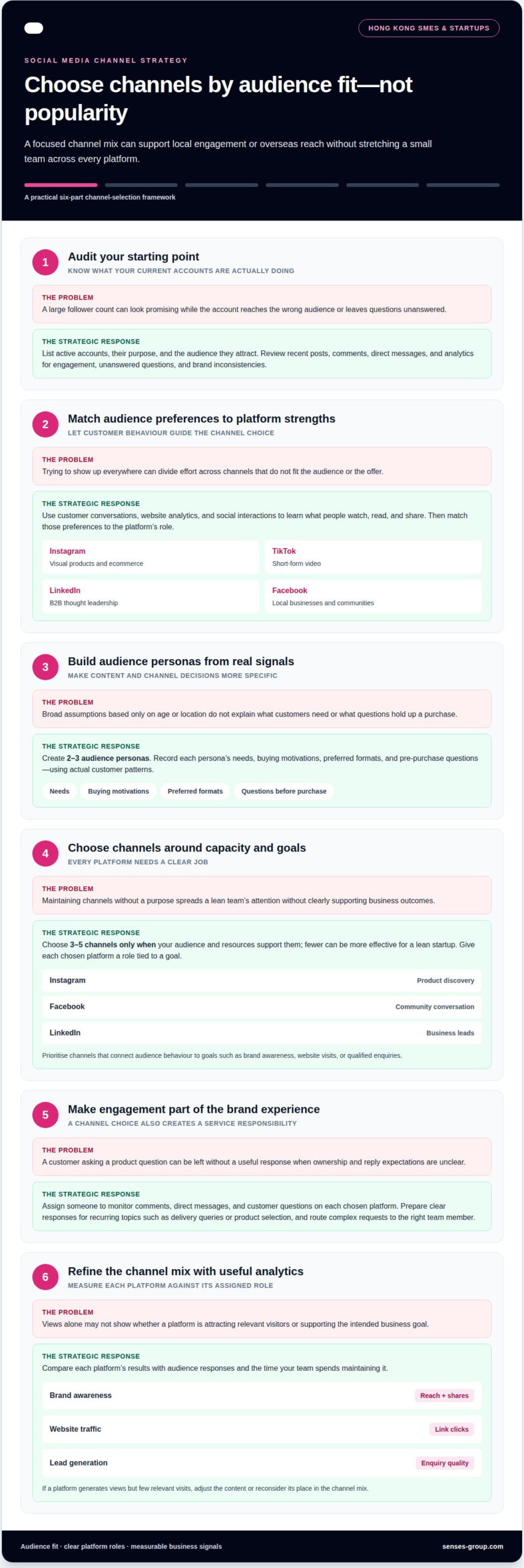
Identify your target audience by reviewing customer and channel data, then choose platforms that match their preferences and your business goals. For Hong Kong SMEs, the right choice supports local engagement or overseas reach without stretching a small team across every channel.
-
Audit Brand Presence and Define Target Audiences
List every active social account, its purpose, and the audience it currently attracts. Review recent posts, comments, direct messages, and analytics for engagement, unanswered questions, and inconsistencies in how the brand appears. Then define the customers you want to reach, such as shoppers discovering a product or overseas buyers comparing ecommerce brands. Don’t treat follower count as proof that an account reaches the right audience.
-
Identify Audience Preferences and Platform Fit
Use customer conversations, website analytics, and social interactions to learn what your audience watches, reads, and shares. Match those preferences to channel strengths: Instagram suits visual products and ecommerce, TikTok supports short-form video, LinkedIn serves B2B thought leadership, and Facebook can help local businesses and communities. A Hong Kong retailer promoting product styling may prioritise Instagram over a channel built around professional discussion.
-
Build Audience Personas from Useful Signals
Create 2-3 audience personas to give your team a clear reference for content and channel choices. Record each persona’s needs, buying motivations, preferred formats, and the questions they ask before purchasing. For example, a local gift shopper may respond to product demonstrations, while an overseas retailer may need clear product details. Use actual customer patterns, not assumptions based only on age or location.
-
Select Platforms Around Capacity and Goals
Choose 3-5 channels only when your audience and resources support them; fewer can be more effective for a lean startup. Set a role for each platform, such as Instagram for product discovery, Facebook for community conversation, or LinkedIn for business leads. Prioritise the channels that connect audience behaviour to goals such as brand awareness, website visits, or qualified enquiries. Don’t spread social media marketing across platforms without a clear purpose.
-
Plan for Engagement and Customer Service
Assign someone to monitor comments, direct messages, and customer questions on each chosen platform. Prepare clear responses to recurring topics, such as delivery queries or product selection, and route complex requests to the right team member. A customer asking about an item on Instagram needs a useful answer there, not a generic post. Consistent replies make engagement part of the brand experience.
-
Use Analytics to Refine the Channel Mix
Measure each platform against its role. Review reach and shares for brand awareness, link clicks for website traffic, and enquiry quality for lead generation. Compare these signals with audience responses and the time your team spends maintaining each account. If TikTok generates views but few relevant visits, adjust the content or reconsider its place in your channel mix.
Developing content pillars and adapting content by platform
Build a repeatable content system around audience needs, brand principles, and each platform’s format. For a Hong Kong ecommerce business, the same product story can serve local discovery and overseas customer education differently.
-
Develop Brand Guidelines and Content Pillars
Define brand guidelines before planning individual posts. Set practical rules for tone, vocabulary, visual style, and product descriptions, so every channel feels recognisably connected. Then choose 3 to 5 recurring content themes that reflect audience interests and business goals. A skincare brand, for example, might cover product routines, ingredient education, customer stories, and seasonal use. Avoid themes that have no clear link to customer needs.
-
Adapt Content and Maintain Brand Voice
Translate each theme into the format that fits its platform, while keeping the same brand character. A product demonstration might become a short TikTok video, a detailed Instagram carousel, or a LinkedIn post about the business’s design process. Adjust the opening, pacing, and call to action for each channel; don’t simply duplicate one caption everywhere. For audiences across Hong Kong and overseas markets, keep core claims consistent and explain unfamiliar context clearly.
-
Create a Content Calendar and Posting Schedule
Record each planned post’s date and time, format, caption, and required images or video in one content calendar. Assign an owner and approval point so product details and brand voice stay aligned before publication. Set a realistic schedule around your team’s production capacity, then review the calendar monthly against performance and upcoming business priorities. Let quality and relevance guide frequency, not pressure to fill every day.
-
Repurpose Content Across Platforms
Start with a useful source asset, such as a product guide, customer question, or demonstration, then adapt it for each platform. Turn one guide into a short video, a carousel of practical tips, and a concise email or social caption. Change the format and emphasis, not the underlying message. Check each version for platform fit, accurate product information, readable text, and a clear next step for customers.
- Use customer-created material only with clear permission. Before publishing user-generated photos or videos, UC Santa Barbara recommends obtaining the owner’s permission and providing proper attribution. Keep the approval and agreed credit details with the asset so the team can use it consistently and respectfully across channels. Customer stories can add real-world context, but should never be edited to imply an experience the customer did not share.
Sentiment analysis, engagement, and community health
Community health is about more than reactions: examine what people say, how they respond, and whether engagement supports business goals. Social media risks include unanswered complaints, misleading posts, and escalating conversations. Clear ownership of responses and regular monitoring help manage them.
-
Conduct Competitive Analysis and Social Listening
Review 3-5 relevant brands to understand their content, audience responses, and distinctive positioning. Compare how they handle customer questions, recurring concerns, and product feedback, then look for needs they leave unaddressed. Social listening adds context from conversations about your brand and category. Review competitor strategies every quarter, but use observations to sharpen your own value, not imitate another brand’s voice.
-
Track Analytics and Measure Performance
Choose metrics that match each social media goal. For brand awareness, track reach, impressions, video views, and shares; for website traffic, measure link clicks, click-through rate, and website sessions. Lead generation calls for leads, form submissions, and cost per lead, while sales require revenue, conversions, and conversion rate. Compare results over the same reporting period and against each channel’s purpose, rather than judging every post by likes.
-
Identify and Manage Social Media Risks
Set a response process for negative feedback, inaccurate claims, and sensitive customer information. Assign a trained owner to review comments and direct messages, and define when an issue needs escalation. For example, an unanswered delivery complaint on Facebook can become a visible thread. Respond calmly, acknowledge the concern, and move private details to an appropriate private channel. Avoid arguing publicly or deleting criticism without a clear reason.
- Read sentiment alongside engagement metrics to understand community quality. A post may attract many comments but also confusion or frustration, so classify feedback as positive, neutral, or negative and note recurring themes. Compare those themes with your social media content and calendar. If customers repeatedly ask how to use a product, create a clear demonstration and monitor whether related questions decline.
- Turn findings into measured improvements. Record the issue, audience response, content involved, and follow-up action in a shared review log. If positive comments increase around practical tutorials, test more instructional content; if a campaign draws clicks but poor-quality leads, revisit its message and landing page. Reassess competitor positioning and community feedback every quarter, then adjust content, service responses, or channel priorities.
Setting SMART goals aligned with business objectives
A social media strategy for brands should connect audience activity to clear business outcomes. Define priority audiences, platform roles, content direction, measurable goals, and a reporting method. Set KPIs that show whether each goal is progressing.
-
Set Clear and Measurable Goals
Choose 1-3 core goals that reflect your current business priorities. A Hong Kong startup entering overseas ecommerce might prioritise brand awareness in a new market, while an established retailer may focus on qualified enquiries. Define the outcome, audience, and channels involved. Avoid treating follower growth as the goal when the real need is product discovery, stronger consideration, or sales.
-
Make Social Media Goals SMART
Develop each objective so it is specific, measurable, attainable, relevant, and time-bound. For example, a brand could aim to increase Instagram followers by 20% over the next six months to support a brand awareness campaign. The target gives the team a clear measure and deadline. Check that the objective fits content capacity and supports a business priority, rather than setting an ambitious figure without a practical route.
-
Set Long-Term Goals and KPIs
Connect immediate social activity to a longer-term outcome, such as growing recognition before expanding an ecommerce store overseas. Select KPIs that show progress at each stage. Track reach, impressions, video views, and shares for awareness; use link clicks and website sessions for traffic; measure leads and conversions when pursuing sales. LinkedIn engagement may matter for B2B visibility, while product-page visits may matter more for ecommerce.
- Separate activity measures from business results. Posting volume and follower counts describe what happened on a channel, but don’t prove commercial impact. Pair them with relevant outcomes, such as form submissions after a lead-generation campaign or conversion rate after product-focused content. This distinction helps a small team set goals that inform decisions, rather than report numbers without context.
- Set a baseline before judging progress. Record current platform results and the business outcome each goal supports, then compare later performance with that starting point. For a social media strategy for brands entering a new market, review awareness signals alongside qualified visits from that audience. Use what you learn to refine the objective, campaign message, or channel investment.
An example target is to grow a business’s Instagram audience by 50 new followers per week. Treat this as a working objective, not a standalone sign of success: connect audience growth to the intended business outcome, and decide what evidence would show that the growth is useful. The team can then review the target alongside relevant audience responses and adjust its approach if the activity does not support the priority.
A social media content strategy should state the desired outcomes, how to achieve them, and how results will be measured. Make these elements explicit before publishing: map each content approach to an outcome, choose a measure that indicates progress, and set a regular review point. This keeps content choices and reporting tied to objectives and gives the team a basis for refining its approach as results accumulate.
Social media branding versus social media marketing
Branding shapes what people recognise and believe; marketing uses that foundation to prompt action. Treat them as connected disciplines, not competing priorities. A campaign may generate clicks, but a coherent brand gives customers a reason to remember and trust the business.
- Define the role of each. Social media branding establishes your digital presence through consistent identity, tone, and values. Social media marketing uses content and paid campaigns to build awareness, encourage engagement, or generate sales. A Hong Kong ecommerce business might use branding to communicate its distinctive product story, then promote a relevant offer to shoppers.
- Connect brand meaning to customer action. Ensure each campaign reflects the qualities your business wants customers to associate with it. If a brand promises thoughtful design, product imagery, captions, and replies should support that impression. This consistency matters across Hong Kong and overseas channels, where customers may encounter separate posts before they visit your store.
- Make values visible through conduct. Translate values into observable choices, such as explaining how a product solves a customer problem or responding constructively to feedback. Avoid statements that sound distinctive but have no evidence in your service, product, or customer experience.
- Measure brand signals and marketing outcomes separately. Shares, comments, and audience language can show whether people are engaging with your message. Link clicks, enquiries, and conversions show whether marketing activity prompts action. Read these signals together: a campaign can earn shares without generating sales, while a steady, recognisable presence can help future campaigns make sense.
- Apply transparent practices to promotions. For Hong Kong campaigns, make paid partnerships apparent and keep product claims accurate and supportable. Give influencers clear product information and agreed messaging, while allowing their own voice to remain credible. Treat platform requirements and the product category as campaign considerations, rather than assuming one creative approach suits every market or offer.
- Plan cost around campaign scope. Social media marketing in Hong Kong has no single price. For managed work, the fee depends on the case and is given after a quote request; relevant factors include channel selection, creative production, campaign management, audience targeting, and paid media spend. Separate service fees from advertising budget when planning resources.
- Bring brand and performance together. Review whether the campaign looks and sounds like the business, then assess whether it advances a defined commercial outcome. If paid activity produces attention but weak engagement, refine the message before increasing spend. To align brand foundations with campaign execution, develop a connected brand and advertising strategy.
Senses Group: Brand Strategy
Senses Group helps Hong Kong SMEs build a clear brand foundation for social activity and ecommerce growth. Turn to its Brand Strategy when your content lacks a consistent position, or when expanding into new markets calls for a sharper story and audience focus.
Brand Identity Design translates that position into a recognisable visual system. For businesses selling online, an Ecommerce Shopify Store and Klaviyo Email Automation can connect the customer experience beyond social platforms, from product discovery to ongoing communication.
These foundations help your team create more coherent social content without treating every post as a standalone campaign. If you’re ready to align your brand direction with your ecommerce growth plans, contact Senses Group.
Build the Next Stage of Your Brand
Community health is a strategic asset when it strengthens trust, sharpens your market position, and supports growth beyond Hong Kong. Keep your social media strategy for brands connected to the customer experience after someone leaves a platform. Each interaction can inform how your business communicates, presents its products, and builds relationships across local and overseas markets.
When your brand direction feels unclear or your online presence lacks consistency, Senses Group can establish a stronger foundation through Brand Strategy and Brand Identity Design. For ecommerce businesses, an Ecommerce Shopify Store can carry that brand experience into the shopping journey. Together, these capabilities help make digital growth more coherent, from discovery through purchase.
The right next step is to align your brand foundations with the markets and customers you want to reach. Contact Senses Group to discuss how to shape that direction. A healthier brand community begins with clear choices, consistent action, and a business prepared to grow.
Frequently Asked Questions
How to create a social media content calendar for a brand?
Start with business priorities, then map each planned post to a customer need and channel. Add fields for campaign objective, target audience, format, publishing date, owner, approval status, and destination link. For example, a product launch calendar can track teaser content, launch-day details, and follow-up answers to common questions. Leave room for timely posts so scheduled content doesn’t prevent your brand from responding naturally to current conversations.
How often should brands post on each social media platform?
Set a sustainable cadence based on your team’s capacity and audience response. A practical starting point is Instagram three to five times per week, LinkedIn two to three, Facebook three to five, and TikTok two to four, depending on available capacity. Treat these as starting points, not quotas. If producing posts at that pace weakens quality or delays customer replies, reduce frequency and focus on useful, consistent content.
How to measure social media ROI and report results?
Connect each campaign to a business outcome, then report attributable results alongside campaign costs. For a Shopify promotion, compare tracked social referrals, resulting orders, and revenue with advertising and production costs. Explain which links or posts contributed, and note any attribution limits. Separate revenue outcomes from supporting signals such as engagement or reach, so decision-makers can see both direct returns and the audience response behind them.
What are the best social media platforms for brands in Hong Kong?
The best platform depends on your audience, offer, and business model. Facebook can support local business communities and broader audiences; Instagram suits visual products and ecommerce; TikTok fits short-form video and consumer brands; LinkedIn is relevant for B2B and professional services. A Hong Kong retailer selling design-led products might prioritise Instagram, while a firm selling to overseas businesses may favour LinkedIn. Choose channels your team can serve consistently.