
More ad spend won’t fix a campaign without a clear commercial purpose. Digital advertising campaigns are online promotions built to reach specific audiences and move them towards an action, such as visiting a product page or making a purchase. For Hong Kong SMEs selling locally and overseas, the strategic task is to connect the right format, audience, budget and destination.
It’s understandable to focus first on the platform or the amount to spend. But sustainable growth depends on what the campaign needs to achieve, how performance will be measured and whether the customer journey is ready to convert interest into sales. Most advertising platforms need a learning period of 4-6 weeks to optimise, so early results should be read in context rather than treated as a final verdict.
This guide explains how digital marketing campaigns work, with examples across paid search, social, display and video. You’ll also learn how to set a practical budget, choose meaningful performance measures and improve campaigns using the results, whether you’re strengthening your Hong Kong market position or reaching e-commerce customers overseas.
Key Takeaways
- Choose an advertising format based on the audience and action you want to drive, not platform popularity alone.
- Build your budget around the conversion goal and the value of each sale, then give the campaign room to learn.
- Match each campaign to clear measures, from attention and engagement through to site visits, sign-ups or revenue.
- Use performance data to refine bids, creative and audience targeting rather than making changes without a clear reason.
- For Hong Kong e-commerce growth, connect advertising with a strong brand, a focused Shopify store and a customer journey that can support local and overseas sales.
What is a digital marketing campaign?
A digital advertising campaign is a coordinated online promotion designed to reach a defined audience and prompt an action. That action might be a product-page visit, app download, booking, email signup, or sale. The campaign connects its message, creative, channels, and measurement to one commercial objective. Effective digital advertising campaigns work as a joined-up plan, not a collection of disconnected posts or ads.
Hong Kong rules: Keep advertising claims accurate, make offer terms clear, and handle audience data responsibly. Platform policies also apply, and relevant requirements depend on the product, promotion, and data involved.
Common risks: A vague objective can generate attention without useful business outcomes. Other avoidable mistakes include mismatched landing pages, unclear offer terms, and judging a campaign by views alone.
UNIQLO, outdoor and video: UNIQLO’s Uncover campaign used digital billboards and video to promote its message. The campaign generated 1.3 million video views. For a Hong Kong retailer, the practical lesson is to connect an outdoor impression to a digital destination, then measure what viewers do next.
Dove, social storytelling: The #Faceof10 campaign addressed conversations about children and beauty standards. Dove used social content and videos to carry its message. The campaign received over 1.5 million organic views and achieved 99% positive sentiment across online conversations. Its example shows how a specific audience concern can shape creative and engagement.
Heineken, product and social conversation: The Boring Phone campaign responded to phone use during social occasions. Heineken built a campaign around a deliberately limited phone concept and extended it through digital channels. It generated 9.5 billion impressions. Reach measures visibility, but it doesn’t by itself show sales or customer acquisition.
Fiji Airways, illustrative travel campaign: Imagine Fiji Airways promoting a seasonal route to Hong Kong travellers. It could combine short destination videos with search ads for relevant travel intent. The result to measure would be qualified itinerary visits and completed bookings, not video views alone.
Lululemon, illustrative retail campaign: A store could introduce a new product through Instagram videos showing real-life use. Retargeting could then reach viewers who visited product pages. Assess whether product interest progresses to checkout, alongside engagement.
Google Photos, illustrative app campaign: A campaign could show how Google Photos helps people rediscover meaningful images. Short videos could direct viewers to an app page, where downloads become the next measurable action. This structure links story, channel, and outcome without assuming a particular result.
Across these examples, start with the audience and desired action. Select channels that can reach that audience, create a message suited to each format, and measure the next step in the customer journey. An app campaign needs different success measures from an e-commerce sale or travel booking.
Campaign learning periods and conversion budgets
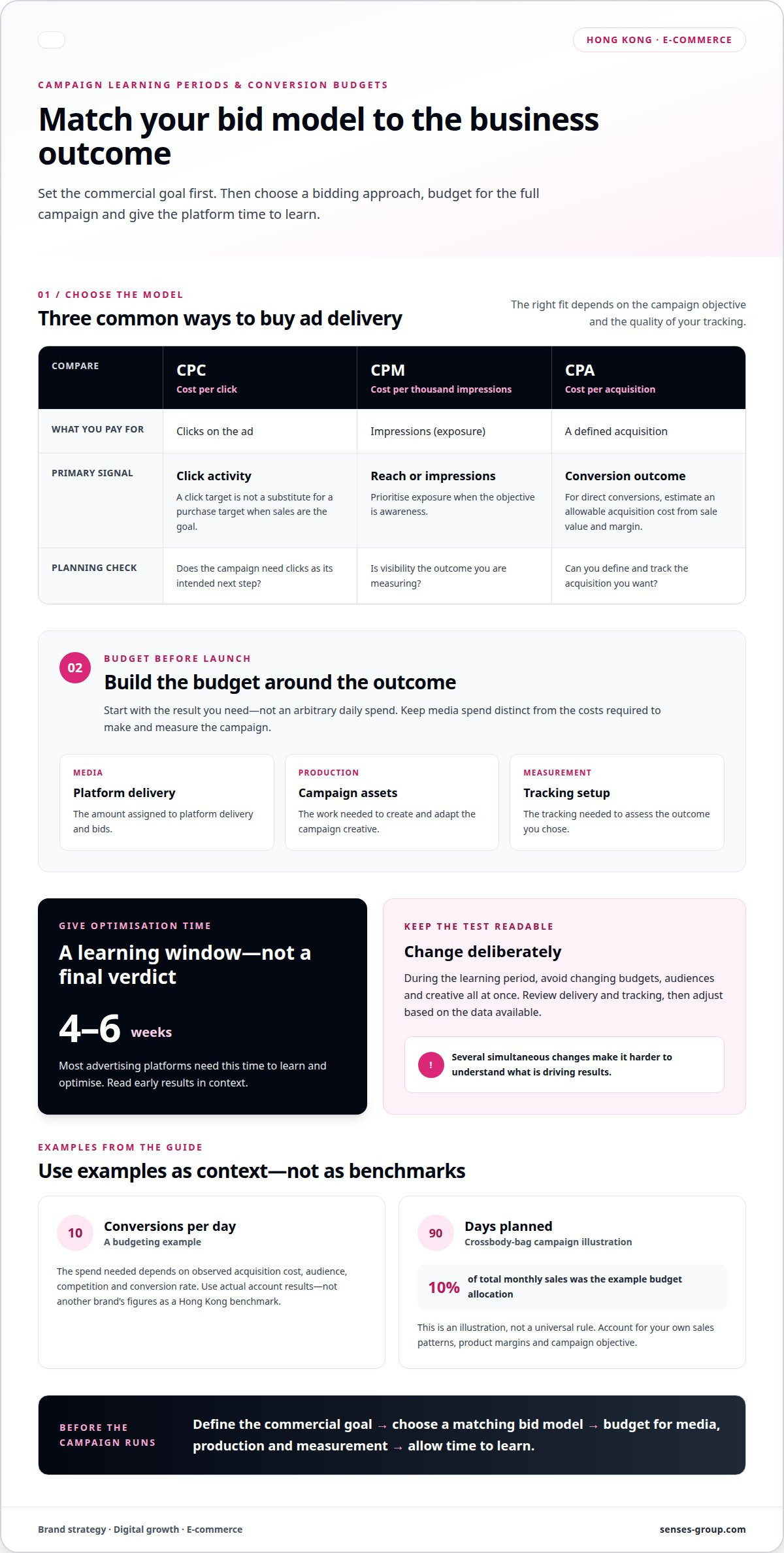
Budgeting starts with the outcome, not an arbitrary daily spend. For a Hong Kong e-commerce brand, distinguish media spend from production costs. Media spend buys delivery through platforms; production costs cover the creative assets needed to run ads. Plan for both, so a campaign does not exhaust its budget before its message is ready.
Set the target before choosing a bidding strategy. For direct conversions, estimate the allowable cost per acquisition based on the value and margin of each sale. For awareness, prioritise reach or impressions instead. A target grounded in business value helps keep bids aligned with what the company can sustain.
Platforms may offer cost-per-click (CPC), cost-per-thousand impressions (CPM), or cost-per-acquisition (CPA) bidding. CPC charges for clicks, CPM focuses on exposure, and CPA optimises towards a defined acquisition. Choose based on the campaign objective and tracking quality. A click target cannot replace a purchase target when sales are the real goal.
Allow most advertising platforms 4-6 weeks to learn and optimise. During that learning period, avoid changing budgets, audiences, and creative all at once. Each major change can make it harder to understand what is driving results. Review delivery and tracking, then make deliberate adjustments based on the data available.
Conversion volume matters because platforms need signals to identify likely customers. A budgeting example uses a target of 10 conversions per day. In practice, the spend required depends on the campaign’s observed acquisition cost, audience, competition, and conversion rate. Use actual account results to set a viable budget, rather than treating another brand’s figures as a Hong Kong benchmark.
Duration should reflect the buying cycle and the question being tested. For example, a crossbody-bag campaign was planned for 90 days, with a budget set at 10% of total monthly sales. That is an illustration, not a universal allocation rule. A Hong Kong retailer should account for its own sales patterns, product margins, and campaign objective.
Separate campaign costs into clear categories before launch:
- Media: the amount assigned to platform delivery and bids.
- Production: the work needed to create and adapt campaign assets.
- Measurement: the tracking setup needed to connect activity with conversions.
For brands expanding overseas, test one market and audience before distributing spend broadly. Compare conversion quality, not just click volume, and preserve enough budget for learning. A considered campaign planning approach can connect budget decisions with the brand’s wider commercial priorities.
Paid social, display, video, and native advertising
Channel choice should follow audience behaviour and campaign purpose. Google Search reaches people expressing intent through queries; Meta social placements can introduce products while people browse. Display ads use visual placements across websites, while native ads match the surrounding format. Paid social is one channel within digital marketing, not a complete campaign strategy.
For Hong Kong SMEs, a practical platform shortlist includes Google for search and display, and Meta for social placements. These platforms serve different roles, so compare them by the audience reached, the action measured, and the cost model. No single platform is automatically the most effective. Track how each source contributes to product-page visits, enquiries, or sales.
Cost and effectiveness depend on the bidding model, audience, creative, and intended outcome. CPC bidding charges for clicks, CPM for impressions, and CPA for acquisitions. Search can capture existing demand, while social or display can build awareness among people who haven’t started searching. Compare cost per qualified action, not just impression volume.
Social media marketing can include unpaid posts, community interaction, and paid placements. Paid social adds audience targeting and campaign controls; organic social depends on content reaching followers and being shared. For example, a retailer can use Instagram videos to introduce a product, then direct interested viewers to a relevant product page. Measure engagement and onward visits together.
Flo Health, social storytelling: The situation was to explain pregnancy experiences through familiar social formats. Flo Health created more than 330 Instagram-style pregnancy stories. The campaign led to an 80% increase in trials. The example shows how a brand can adapt a platform’s native language to its audience and connect engaging content with a defined action.
Google, video: The “Loretta” Super Bowl campaign used an emotional story to demonstrate Google Assistant. The video gained 62 million views. For an SME, the lesson is to make the product’s role clear within the story, then connect viewing to a next step. Views alone don’t establish whether a video generated enquiries or sales.
Native and display formats suit different moments. Native ads resemble the surrounding content, while display ads use distinct visual placements. Digital platforms may determine placement based on bid amount, ad relevance, and ad quality. Strong creative matters, as does relevance between the message and landing page.
Use optimization to improve the fit between channel and audience. Set frequency caps to limit repeated exposure, or use dayparting to schedule delivery during selected periods. A campaign seeking user-generated content might set a clear goal, such as collecting contributions from 50 customers by a specified date. Review reach, engagement, and resulting site visits together, then adjust the format or audience based on performance.
Google and Meta are the main platforms highlighted for Hong Kong SMEs: Google for search and display advertising, and Meta for social placements.
Performance measurement and optimization
Measurement starts with a defined goal and a matching key performance indicator. For an e-commerce campaign, the goal might be completed purchases; for awareness, it might be reach or engagement. Track the action closest to the business objective, then use supporting metrics to explain the result. A high view count cannot replace sales data when revenue is the goal.
Use three stages to read a social campaign: reach, engagement, and outcomes. Reach shows how many people encountered the message. Engagement records responses such as interactions, while outcomes include site visits, signups, or revenue. This sequence helps Hong Kong brands distinguish attention from intent, then intent from commercial impact.
Three calculations clarify performance. Click-through rate equals ad clicks divided by ad impressions. Conversion rate is the percentage of users who complete a desired action after clicking. Return on ad spend equals campaign revenue divided by total ad spend. Read the measures together: a strong click-through rate with weak conversions can indicate a mismatch between the ad and landing page.
Review delivery data within 24 hours to catch tracking problems or a clear mismatch, but don’t treat early movement as the final verdict. Campaign success should be measured continuously against its defined indicators. Compare performance over a consistent period, then change one variable at a time. That makes the effect of a new audience, message, or format easier to interpret.
Optimisation can involve adjusting bids, replacing creative, or refining audience targeting based on performance data. If an ad earns clicks but few product-page actions, check whether its promise matches the landing-page content. If engagement is strong but conversions remain weak, review the offer and checkout journey before increasing spend. Each change should address a specific point of friction.
Timing and repetition also shape results. Dayparting schedules delivery for selected times, while frequency capping limits how often people see an ad. These controls can support engagement and viewing completion goals. A Hong Kong retailer could compare scheduled delivery periods and audience responses, then keep the settings that better support its defined campaign objective.
Creative performance takes more than finding a winning headline. Test whether the format, message, and emotional appeal fit the audience and desired action. A personalised product ad may prompt a different response from a broad brand video. Keep each test focused: change the image or message, not both at once, so the results are easier to interpret.
Campaign measurement should connect exposure with outcomes. Reach, viewing, and audience response provide different measures of performance. For a business seeking online sales, add purchase tracking to determine whether attention also contributes to revenue.
Use a simple review sequence: confirm tracking, compare results with the goal, identify the weakest customer-journey step, then make a targeted adjustment. This turns performance data into decisions, not just reporting. For Hong Kong SMEs entering overseas markets, assess each audience and market separately rather than assuming one format or message will perform identically everywhere.
Digital marketing campaign planning
A strong plan links a commercial goal to one audience, message, channel, and measure. For a Hong Kong e-commerce business expanding overseas, that means defining the market and customer action before choosing platforms. The campaign should support a business priority, not simply keep social accounts active.
Start with a measurable target. In a crossbody-bag example, the campaign aimed for the bags to represent 20% of monthly sales within three months of launch. That target gives the team a commercial direction. It can then build a campaign around sales rather than treating impressions or engagement as the final outcome.
Next, define the audience and the problem the product solves. A campaign for local shoppers may emphasise convenience and product use; an overseas audience may need clearer context about the brand and delivery experience. Keep the promise consistent, but adapt the creative to the market. A hook should reflect genuine audience interest, not a slogan disconnected from the offer.
Choose platforms based on customer demographics and the role each channel plays. Search advertising can capture active demand, while social content can introduce a product and build familiarity. Connect ads to a relevant product page. If an ad promotes one bag, sending visitors to a broad homepage adds friction between interest and purchase.
Map the campaign’s content and activity before launch. The crossbody-bag example included seven to ten PPC ads over its 90-day period, five social media posts per week, email marketing once per week, and one blog post per month. These elements create multiple touchpoints. Each should reinforce the same product story while serving its channel’s purpose.
Use storytelling to make the product meaningful, then give each asset a clear job. A short video might show how the bag fits into a customer’s day; a search ad can answer a direct product query. For a Hong Kong brand targeting overseas customers, localised language and imagery should make the offer understandable without changing its core identity.
Before launch, connect every activity to a measurement plan. Assign a primary outcome, such as purchases, and supporting indicators, such as product-page visits or email signups. Confirm that links lead to the intended destination and tracking records the action. This makes later optimisation evidence-driven, rather than guided by whichever channel looks busiest.
Finally, set review points and decision rules. Decide what evidence would lead to refreshing creative, adjusting audience targeting, or shifting platform emphasis. Keep a record of changes so the team can interpret results. Build a digital campaign plan that connects your audience, channels, creative, and commercial target.
Senses Group: Meta & Google Advertising
Senses Group helps Hong Kong SMEs plan and run Meta & Google Advertising around clear commercial goals. This is a natural next step when you know the audience and outcome you want, but need a campaign structure that connects targeting, creative, and measurement.
For businesses expanding through e-commerce, advertising works best when the brand promise and shopping experience support the same message. Brand Strategy and Brand Identity Design can establish that foundation, while an Ecommerce Shopify Store gives campaigns a focused destination for product discovery and purchase.
If your current ads attract attention but aren’t moving customers towards action, or you’re preparing to enter new markets, contact Senses Group to discuss an integrated campaign strategy.
Build the next campaign around a stronger foundation
Growth comes from more than increasing media activity. For Hong Kong businesses reaching local and overseas e-commerce customers, the next step is to make every campaign reinforce the same brand promise, from the first impression to the shopping experience. That alignment gives your digital advertising campaigns a clearer role in building lasting customer relationships, not simply attracting short-term attention.
Senses Group connects this work through Brand Strategy, Brand Identity Design, an Ecommerce Shopify Store, and digital marketing. These foundations help ensure your positioning, creative direction, and online destination work together as your business enters new markets.
Bring your growth priorities and campaign challenges into a focused conversation. Contact Senses Group to discuss your campaigns and identify the right next step for your business. With a clear direction and a coherent customer experience, you can move forward with greater purpose.
Frequently Asked Questions
What is a digital advertising campaign?
A digital advertising campaign is a coordinated set of paid online messages designed to reach an audience and prompt a business-relevant action. For example, a Hong Kong skincare retailer might use search ads for product queries and social ads to introduce a new range. Effective digital advertising campaigns connect the audience, offer, creative, destination, and tracking, so the business can assess whether activity supports its goal.
What are the main types of digital advertising campaigns?
The main types include paid search, paid social, display, video, and native advertising. Search ads can reach people actively looking for a product, while social ads can introduce it to selected audiences. Display and video formats build visibility through visual placements, and native ads match surrounding content. An online shop can combine formats when each serves a distinct role in the customer journey.
How much do digital advertising campaigns cost in Hong Kong?
There is no single fixed cost for running ads in Hong Kong. Media spend depends on the platform, bidding model, audience, competition, campaign objective, and duration. Creative production and campaign management may be separate from the advertising budget. Set a spending limit based on business goals and conversion value, then use results to guide future budget decisions rather than relying on another company’s spending.
How do I plan and launch a digital advertising campaign?
Start by choosing one business outcome, such as product sales or qualified enquiries. Define the audience, offer, destination page, and measures before selecting platforms. Prepare creative suited to each placement, and confirm that links and conversion tracking work before launch. For an overseas product campaign, direct each audience to a relevant product page with clear information for that market.
How do I set goals and measure digital advertising campaign performance?
Choose a primary result that reflects the business objective, then select supporting measures. For an online store, purchases and revenue show commercial outcomes, while product-page visits help explain customer interest. Compare results with the campaign’s own target and review the customer journey when performance falls short. Click volume alone doesn’t show whether people completed the intended action.
How should I target audiences for digital ads in Hong Kong?
Build audience groups around relevant customer needs, product interest, and buying intent. A Hong Kong retailer might distinguish people searching for a specific product from people who have engaged with its social content. Keep the message and destination relevant to each group, and use language suited to the intended audience. For overseas expansion, assess each market independently instead of assuming local targeting will transfer unchanged.