
More clicks won’t fix a campaign that reaches the wrong people or leads to a weak landing page. Effective Google Ads management services connect keyword research, competitor analysis, campaign structure, ad testing, bidding and budget decisions, conversion tracking, and ongoing optimization. That way, performance is measured by meaningful business outcomes, not traffic alone.
For Hong Kong SMEs and startups, that distinction matters when balancing local demand with the cost and complexity of reaching overseas customers through ecommerce. It’s reasonable to expect campaigns to show what is working; the challenge is linking search terms, ads, landing pages, and conversions closely enough to make informed decisions rather than adjusting spend by instinct.
This article explains what management includes and how keyword selection, competitor insight, conversion measurement, and testing work together. You’ll also learn how campaign structure and landing-page alignment affect results, what to assess in an agency’s experience and case studies, and how to interpret those examples in the context of your own goals and growth plans across Hong Kong and international markets.
Key Takeaways
- Align campaign structure, bids, budgets, and audience settings with the products, locations, and growth priorities that matter to your business.
- Use keyword research and competitor analysis to focus ads on relevant search intent and reduce wasted traffic.
- Connect conversion tracking with landing-page testing to understand which campaigns contribute to meaningful business outcomes.
- Use GA4 and enhanced conversions to build a clearer picture of customer actions across the buying journey.
- Assess agency case studies by looking beyond headline results to the strategy, measurement, and business context behind them.
What do your Google Ads management services include?
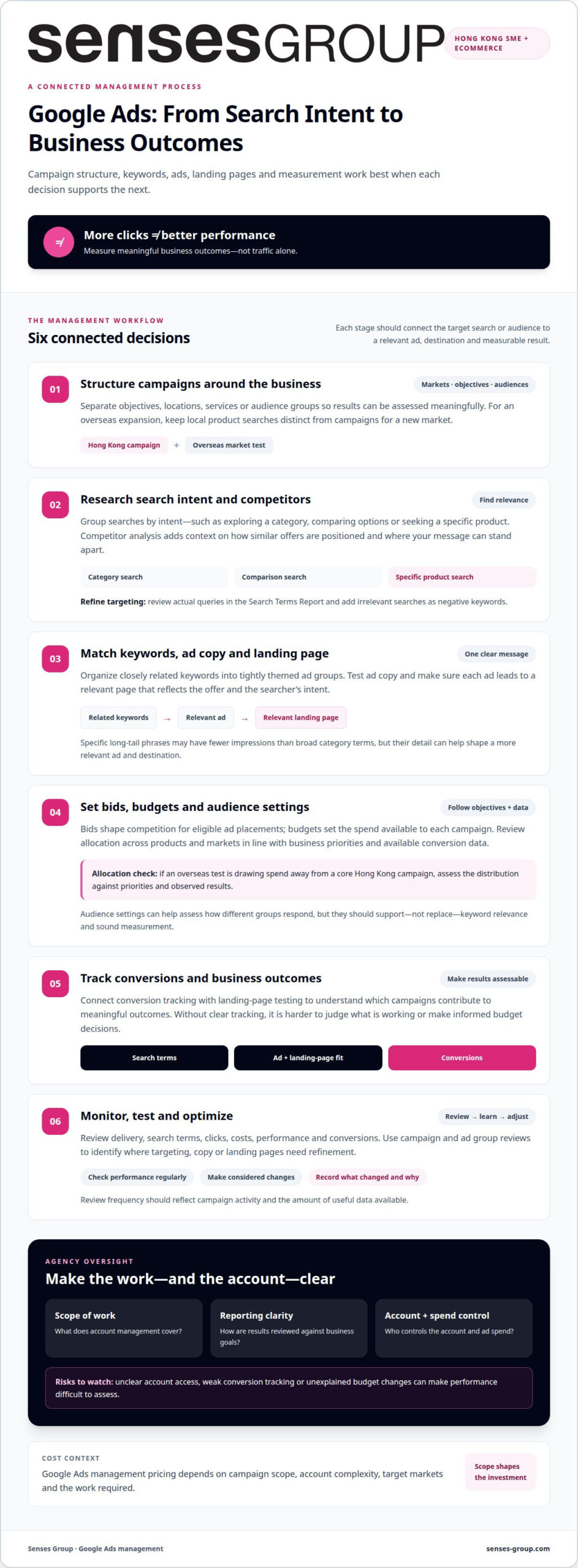
Google Ads management brings campaign structure, bidding, budget decisions, audience settings, and performance reviews into one coordinated process. Each decision should connect the search or audience being targeted with a relevant ad, destination, and measurable business outcome.
In Hong Kong, agencies can be compared by the scope of account management, the clarity of reporting, and how they connect campaign activity to business goals. Ask what the work covers, how results are reviewed, and who controls the account and ad spend.
Campaign and Ad Group Setup
Campaign structure separates objectives, locations, services, or audience groups so results can be assessed meaningfully. For example, a retailer expanding overseas may separate local product searches from campaigns for a new market, rather than combining different search intentions in one campaign.
Within each campaign, ad groups organize closely related keywords and ads. Management includes reviewing that relationship, testing ad copy, and checking that each ad leads to a relevant landing page. A clear structure makes it easier to identify which product, location, or message needs adjustment.
Bidding and Budget Management
Bidding determines how the account competes for eligible ad placements, while budgets set how much ad spend each campaign can use. Managers choose settings in line with campaign objectives and available conversion data, then assess whether spending is concentrated on the intended products, services, or markets.
Budget management also means reviewing distribution across campaigns. If an overseas test is drawing spend away from a core Hong Kong campaign, the allocation may need adjustment based on business priorities and observed results. The goal is deliberate investment, not simply spending 100% of an assigned budget.
How much do Google Ads management services cost in Hong Kong? The price depends on campaign scope, account complexity, target markets, and the work required, and is provided after a quote request.
Audience Optimization
Audience optimization helps distinguish broad reach from groups more relevant to a campaign’s objective. Managers review available audience settings and performance signals, then adjust targeting or observation choices to understand how different groups respond to the same offer.
For an ecommerce business, this could mean assessing how product-focused campaigns perform among different audience groups, while keeping search intent and landing-page relevance central. Audience settings should support the campaign’s target, not replace keyword relevance or sound measurement.
Monitoring and Optimization Schedule
Monitoring covers ad delivery, search terms, clicks, costs, performance, and conversions. The Search Terms Report can reveal irrelevant queries to exclude, while campaign and ad group reviews show where targeting, copy, or landing pages need refinement.
Review frequency should reflect campaign activity and the amount of useful data available. Managers can check performance regularly, make considered changes, and record what changed and why. What risks should businesses consider when hiring a management service? Unclear account access, weak conversion tracking, or unexplained budget changes can make performance difficult to assess.
Google Ads policies apply to campaigns serving Hong Kong, and requirements depend on the advertised content, product, and destination page. Advertisers need to follow applicable Google policies and ensure ads and landing pages accurately represent the offer; sector-specific local requirements may also apply.
Keyword research and competitor analysis
Keyword research connects what people search for with the products, services, and markets a business wants to grow. Competitor analysis adds context by showing how other advertisers position similar offers and where an ad can communicate a clearer distinction.
Keyword Research and Targeting
Research starts by grouping search terms according to intent, such as exploring a category, comparing options, or looking for a specific product. A Hong Kong retailer selling skincare, for example, would separate general skincare searches from queries about a particular product type. That distinction helps match the target keyword, ad message, and destination page.
Managers can compare findings from multiple keyword research tools, then review actual search terms once campaigns begin. The Search Terms Report helps identify queries that are irrelevant to the offer. Adding those queries as negative keywords can filter out unsuitable traffic and keep targeting focused.
Long-Tail Keywords and Ad Groups
Long-tail keywords are more specific phrases that can reveal a clearer need, such as a shopper searching for a particular product category and use. They may generate fewer impressions than broad category terms, but their detail can help shape a more relevant ad and landing page. Choose keywords to suit the offer, not simply because a phrase is long.
Related phrases belong in tightly themed ad groups, where the ad can address their shared intent directly. For an ecommerce store, searches for different product categories should not be forced into one message. Separate themes make it easier to see which keywords deliver relevant visits and which need revised copy or exclusions.
Keyword-Based Audience Targeting
Keywords and audiences provide different signals. A keyword reflects what someone is searching for; audience settings help assess groups of people relevant to a campaign. Managers can use both to refine targeting, while keeping the search query and advertised offer closely aligned.
For example, a campaign aimed at Hong Kong shoppers should use location-specific messaging and a relevant destination, while an overseas campaign needs keywords and copy suited to that market. Audience settings should sharpen this intent, not broaden a campaign until its message loses focus.
Competitor analysis examines the language, offers, and landing-page themes visible in search results for priority queries. The aim isn’t to copy another brand. It’s to identify familiar claims, spot unanswered questions, and clarify why the advertised product deserves consideration. In a crowded category, a specific benefit can make ad copy more distinctive than a generic discount message.
Keyword research also guides copywriting. Managers can mirror a searcher’s intent in the headline, explain the offer in the description, and direct the click to a matching page. A Hong Kong brand preparing to enter another market can use this process to adapt terminology and positioning. Clear product positioning supports that work, alongside a distinctive brand message.
Conversion tracking and conversion rate optimization
Conversion tracking connects a Google Ads campaign with meaningful actions, such as a completed purchase or submitted enquiry. Conversion rate optimization uses those signals to improve the journey from ad click to action.
Conversion Tracking Setup
Start by defining the outcome each campaign should generate. For a Hong Kong ecommerce store, a completed order may be the primary conversion, while an enquiry form may matter more to a service business. Google Ads conversion tracking can use Google Tag Manager, call tracking, and form conversion events to record these actions.
Next, check that each event fires at the right point. A form conversion should register after submission, not simply when someone opens the form. For an online shop, distinguish purchase events from earlier actions such as viewing a product or adding it to a cart. This helps prevent the platform from treating interest as revenue.
Review conversion data alongside clicks, cost per lead, and landing-page performance. If a campaign gets traffic but few recorded actions, trace the path from the ad through the destination page and event setup. A broken form or duplicated event can distort the signal used for optimization.
Landing-page optimization turns that diagnosis into practical changes. Match the page headline to the ad promise, make the next step easy to find, and remove distractions that interrupt the buying journey. For a product campaign, lead with the advertised item and a clear route to purchase. For an enquiry campaign, align the form and service details with the search intent.
Assess the page on mobile as well as desktop, since customers may arrive on different devices. Check that the main action is visible, the page loads correctly, and product or service information supports the promise made in the ad. These checks help distinguish a weak offer from a technical obstacle.
A/B Testing
A/B testing compares a controlled change with the existing experience. Test one meaningful element at a time, such as a headline, call-to-action wording, or page layout. Google Ads experiments can test campaign changes, while landing-page tests compare page versions. A test period, such as two weeks, can provide an initial basis for assessment.
Record the change, audience, and conversion event before testing begins. Then assess completed purchases or qualified enquiries, not clicks alone. Google Ads experiments can be run at no charge, while advertisers pay when people click through to their website. Avoid changing several elements at once, or the results won’t show which change influenced performance.
Bid and budget optimization should follow reliable conversion signals. Managers can adjust campaign budgets and bidding choices based on which activity produces valuable actions, rather than rewarding traffic volume alone. An 8% conversion rate is an example target across campaigns, not a universal standard; product, price, audience, and page experience all affect what is attainable. Campaigns typically begin to show their best ROI after 30 to 90 days of optimization and A/B testing, giving the team time to measure results and refine decisions.
Conversion tracking with GA4 and enhanced conversions
Google Analytics 4 (GA4) and Google Ads can help connect campaign activity with customer actions. Accurate event definitions, attribution settings, and consistent reporting make those records more useful for Hong Kong businesses assessing local and overseas markets.
Conversion and Lead Tracking
Begin by defining which actions count as conversions in each platform. For an online shop, a completed purchase differs from a product view; for a service business, a submitted enquiry differs from a phone-number click. Recording these actions separately helps distinguish revenue signals from early interest.
GA4 is a free tool for tracking website traffic. Configure relevant events, then connect the reporting with Google Ads so campaign performance can be assessed alongside on-site behaviour. Enhanced conversions can supplement measurement by matching customer-provided information from conversion events with Google data in a privacy-conscious manner. They can help improve conversion measurement when standard signals are incomplete.
For lead generation, tracking should follow an enquiry from submission to qualified lead when the business has that information. A form submission shows contact intent, not necessarily a sales outcome. Separating those stages gives a clearer basis for evaluating which campaigns generate useful enquiries.
Attribution for Conversions
Attribution describes how credit for a conversion is assigned across interactions. A shopper might click a search ad, return later through another channel, and then purchase. Google Ads and GA4 may report different totals when their attribution settings, reporting scopes, or conversion definitions differ.
Review the selected model and conversion event before comparing channels. For example, assess whether a report counts the purchase itself or includes an earlier action. Consistent definitions help teams avoid mistaking a reporting difference for a sudden change in sales performance.
Conversion Reporting
A monthly report should connect campaign metrics with business outcomes. Include impressions, clicks, click-through rate, cost per click, cost per lead, keyword and ad performance, landing-page performance, and an ROI summary where the data supports it. For an ecommerce campaign, relate recorded purchases to the products and markets promoted.
Use the monthly review to identify patterns and decisions, not just display totals. Compare results with the previous reporting period, note changes to tracking or campaigns, and explain their likely effect. If a Hong Kong campaign shows more clicks but fewer purchases, investigate the product pages, checkout journey, and conversion event before reallocating budget.
Clear reporting also records what the figures cannot explain. GA4 can show where users move through a site, while Google Ads reports campaign interactions; neither replaces business context such as lead quality or order value. Reviewing both platforms together gives SME owners a stronger basis for decisions about campaign direction and market expansion.
Google Ads agency experience and case studies
Case studies show how an agency turns advertising decisions into measurable outcomes. Read beyond headline growth: examine the business context, campaign objective, conversion definition, and changes that connect clicks with sales or qualified leads.
What are typical Google Ads agency fees and pricing models in Hong Kong? Fees depend on campaign scope, account complexity, target markets, and the reporting or optimization work involved; pricing is provided after a quote request.
To choose an agency in Hong Kong, assess how its process fits your sales model, product, and target markets. A retailer expanding from Hong Kong into overseas ecommerce needs a different campaign approach from a local service business seeking enquiries. Look for a clear account strategy, defined conversion measures, and reporting that links campaign activity to business outcomes.
Case studies are useful when they explain the starting point and the intervention, not just the final percentage. Soundproof Cow’s case study reported a 41% year-over-year increase in paid search ecommerce conversion rate. That figure gains meaning when read alongside the campaign context and measurement period; it isn’t a forecast for another business.
Likewise, Hertz’s featured work reported a 105% increase in online conversions and a 15x return on investment in three months. These results illustrate why the evidence behind a claim matters: conversion definitions, spend, market, and campaign changes shape what a result actually represents.
How can you verify an agency’s certifications, experience, and reporting? Google says Premier Partners are among the top 3% of Google-approved agencies globally. For experience, assess relevant case studies and ask how campaigns were measured; for reporting, look for consistent definitions of clicks, conversions, costs, and return.
Strong reporting makes decisions visible. A monthly review should explain which campaigns generated measurable conversions, how search intent matched the offer, and what the agency changed in response. For example, rising clicks without more completed purchases calls for investigating the product journey, not celebrating traffic alone.
Experience also shows in how an agency interprets evidence. A case study about app downloads, such as PensionBee’s reported increase of over 400% in six months, measures a different outcome from ecommerce revenue or qualified leads. Compare like with like, and prioritize examples closest to your own objective and customer journey.
Use case studies to assess the quality of thinking, not to assume identical results. If your campaigns need a strategy that connects advertising activity with your brand and growth priorities, discuss your Google Ads campaign goals.
Senses Group: Meta & Google Advertising
Senses Group helps Hong Kong SMEs and startups connect Meta and Google advertising with clear brand positioning and ecommerce goals. Turn to this work when campaigns need to support local growth, reach overseas customers, or bring more qualified traffic to a Shopify store.
Advertising works best when the brand promise, campaign message, and shopping experience reinforce one another. Brand Strategy and Brand Identity Design establish a coherent foundation, while an Ecommerce Shopify Store gives customers a focused place to explore and buy products. Together, these elements connect the path from first impression to conversion.
Planning a campaign or refining an existing one? Contact Senses Group to discuss your goals.
Build the next stage of campaign growth
For a Hong Kong SME, the next step is to make advertising serve a clear commercial direction, whether that means strengthening local demand or entering overseas ecommerce markets. Google Ads management services are most useful when campaign decisions align with the brand promise and the experience customers encounter after clicking.
Senses Group connects paid advertising with Brand Strategy, Brand Identity Design, and an Ecommerce Shopify Store. This creates a stronger foundation for consistent positioning, a coherent customer journey, and campaigns shaped around your business priorities. The right starting point depends on where your growth path needs greater clarity, from market positioning to the online store experience.
Discuss how your advertising can support your next stage of growth. Contact Senses Group about Google Ads, and take a considered step toward building a more connected route from audience attention to ecommerce growth.
Frequently Asked Questions
Can you really get qualified leads with Google Ads?
Yes, Google Ads can attract qualified leads when targeting reflects genuine buying intent and the landing page offers a relevant next step. For example, an accounting firm seeking business clients can focus on searches related to its specific services rather than broad finance terms. Lead quality also depends on how enquiries are assessed after submission, so connect campaign results with sales follow-up and the criteria your team uses to identify suitable prospects.
Why Use A Google Ads Agency?
An agency brings campaign planning, platform expertise, and ongoing analysis into one managed process. That can be valuable for an SME without dedicated in-house advertising capacity, particularly when testing new markets or balancing ecommerce with lead generation. Google Ads management services should connect the campaign objective with the business’s wider positioning, rather than treating clicks as the end goal. Clear reporting also helps owners understand the reasons for adjustments.
Are there any long-term contracts required for Google Ads management?
Google Ads doesn’t set an agency contract term; the engagement terms are agreed between the business and its agency. Scope may depend on whether the work covers a campaign launch, ongoing optimization, or multiple markets. Before an engagement begins, establish what work is included, how responsibilities are divided, and how either party can end or change the arrangement. These details clarify expectations without assuming every business needs the same commitment.
Can you show me case studies or performance data from businesses similar to mine?
Relevant case studies should explain the business context, goal, measurement period, and work behind the reported outcome. Senses Group’s Monchhichi Jewelry Atelier project reported doubled revenue shortly after an ecommerce rebuild. That result describes a broader ecommerce system, not an outcome attributed solely to Google Ads. For a useful comparison, consider whether the example shares your business model and conversion goal, then distinguish paid advertising results from other contributing work.
Do you manage both eCommerce and lead generation campaigns?
Yes, campaign planning can support both ecommerce sales and lead generation. An online retailer may focus on completed purchases, while a service business may prioritize relevant enquiries. Campaign structure and measurement should reflect that difference. Senses Group offers Meta & Google Advertising alongside an Ecommerce Shopify Store and Lead Generation, supporting growth plans focused on product sales, customer acquisition, or both.
How do Google Ads help you to reach potential customers?
Google Ads can put a business in front of people searching for products, services, or solutions. A retailer can target relevant searches from local shoppers, while a business entering overseas markets can build campaigns around language and offers suited to those customers. The opportunity depends on matching search intent, location settings, ad message, and destination to the audience the business wants to reach.
How do I know if Google Ads are working or not?
Judge performance against the business outcome the campaign was designed to produce. An ecommerce company should reconcile tracked purchases with order data, while a lead-generation team should review whether enquiries progress into qualified opportunities. If clicks rise but sales quality falls, traffic alone isn’t evidence of success. Compare consistent reporting periods and account for changes in offers, seasonality, or sales follow-up before deciding what to adjust.
How do I start advertising with Google Ads?
Start by defining the offer, target market, and outcome the campaign should support. Then prepare a destination page that explains the offer, set up conversion measurement, and organize campaigns around distinct products, services, or locations. For a Hong Kong ecommerce business testing an overseas market, specify which products and customers the campaign should serve before launch. Senses Group’s Meta & Google Advertising can support the campaign planning and management process.