
Brand equity compounds when a company’s promise and customer experience reinforce each other. The strongest brand equity building strategies go beyond visibility and a polished identity. They shape what customers expect, experience, and remember at every interaction.
For Hong Kong SMEs and startups, that consistency can be difficult to maintain as marketing, ecommerce, and customer service evolve on separate tracks. Awareness may rise without creating preference or trust, while limited resources make it harder to decide what to strengthen first. The answer isn’t simply to do more. Focus on the touchpoints that make your brand promise real, both in the local market and as you expand through ecommerce into overseas markets.
This article sets out a practical framework for understanding how customer perceptions become a business asset. It explains how to prioritise strategies across brand, online store, and retention, and how to track signals that show whether trust and preference are growing. Use those insights to make consistent improvements, so each customer experience contributes to a more distinctive brand.
Key Takeaways
- Separate brand identity and awareness from customer preference and equity to see what your brand is actually building.
- Trace how customers move from encountering your promise to interpreting, remembering, and responding to the experience.
- Prioritise brand equity building strategies according to the customer barrier you need to address, then track observable signals of progress.
- Measure awareness, customer meaning, preference, experience, and repeat behaviour without treating sales results as proof of brand equity on their own.
- Connect brand strategy, Shopify ecommerce, marketing, and retention around one consistent promise, then use customer learning to improve it.
What Brand Equity Means, and Why Recognition Alone Is Not Enough
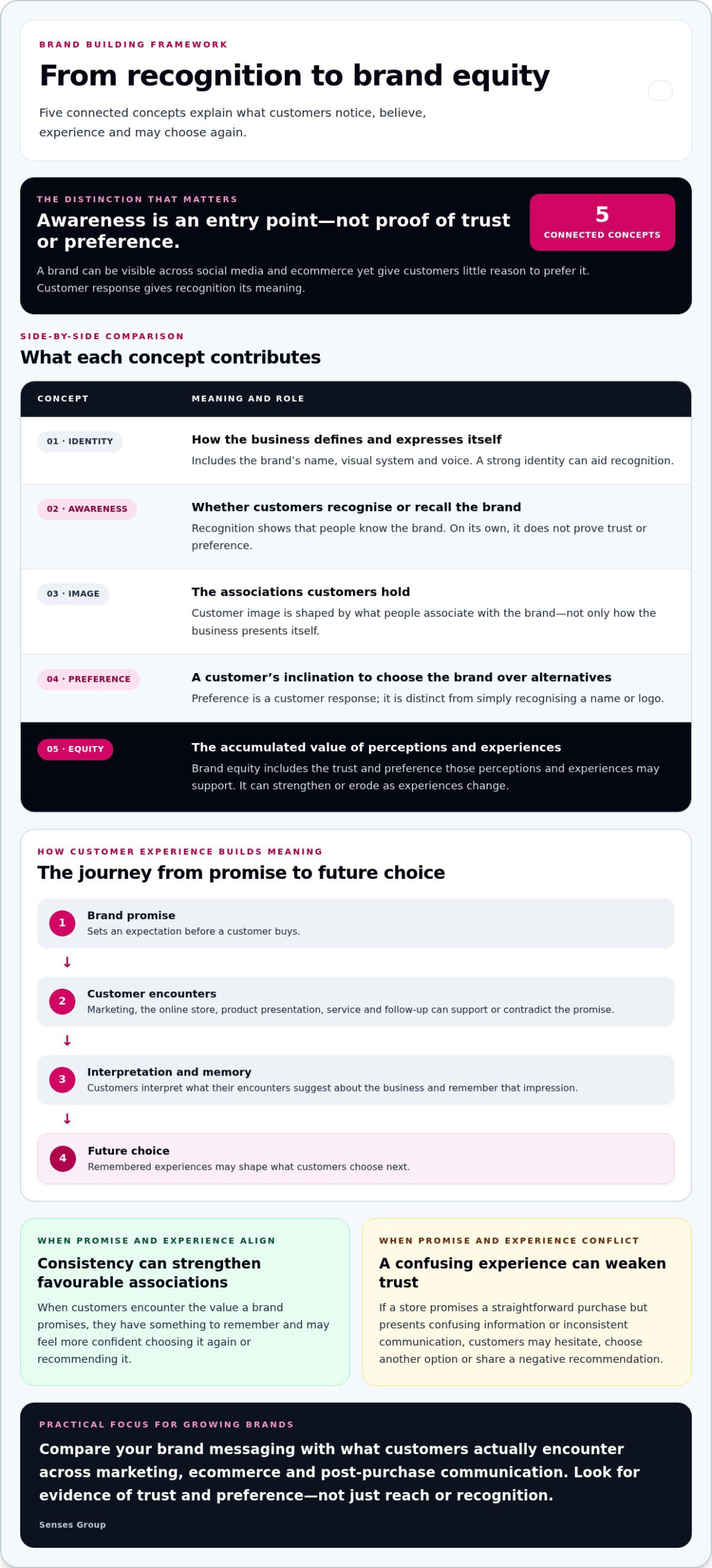
Brand equity is the value created by the perceptions and experiences customers associate with a brand. It develops over time: what people expect, what they encounter, and what they remember all shape whether they trust the business and choose it again. For Hong Kong SMEs and startups, that distinction matters when deciding where to invest in growth. A brand can be visible across social media and ecommerce yet give customers little reason to prefer it.
Several related concepts play different roles. Brand identity is how a business defines and expresses itself, including its name, visual system, and voice. Brand awareness is whether customers recognise or recall it. Brand image is the set of associations they hold. Preference describes a customer’s inclination to choose it over alternatives. Equity is the accumulated value of those perceptions and experiences, including the trust and preference they may support. These concepts are connected, but they aren’t interchangeable. A strong identity can aid recognition; customer response gives that recognition meaning.
How Brand Equity Differs From Brand Awareness
Brand awareness is whether people recognise or recall a brand. Brand equity is the accumulated value of what they believe, feel, and experience in relation to it. Recognition is an entry point, not proof of trust or preference. As discussed in Brand Equity on Wikipedia, brand equity encompasses more than awareness alone.
Consider a Hong Kong consumer who recognises a reusable bottle’s logo from social posts and then visits the brand’s online store. If the product information, imagery, checkout, and follow-up communication are clear and consistent, those encounters can give the logo meaning beyond its design. If the customer recognises the logo but has no reason to trust or choose the brand, awareness hasn’t yet become preference.
Positive and Negative Brand Equity in Practice
Consistent delivery can strengthen favourable associations. When a brand makes a clear promise and the customer experience reflects it, customers have something to remember and may feel more confident choosing the business again or recommending it. That confidence can help the brand stay in consideration when competitors, channels, or market conditions change. It doesn’t guarantee a sale, but it gives the business a meaningful foundation.
The reverse is also true. If an online store promises a straightforward purchase but presents confusing information or inconsistent communication, the gap can weaken trust. Customers may hesitate, choose another option, or share a negative recommendation. Equity isn’t a permanent asset secured by a logo or campaign. It is an accumulated perception that can strengthen or erode as experiences change.
To put brand equity building strategies into practice, compare the promise in your brand messaging with what customers actually encounter across marketing, ecommerce, and post-purchase communication. Look for evidence of trust and preference, not just reach or recognition. That distinction helps a growing business prioritise improvements that make its brand more credible at every stage, including when reaching customers in overseas markets.
How Brand Equity Builds Across the Customer Experience
A brand promise creates an expectation. Customer encounters then either support or contradict it. Over time, customers interpret those encounters, remember what they suggest about the business, and may use that memory to decide what to choose next. This sequence turns brand strategy into something customers can judge through experience, rather than a statement the business makes about itself.
Consistent experiences turn a brand promise into evidence customers remember and use to shape their future choices. Harvard Business School’s discussion of brand value also highlights how consumers and brand-building activity contribute to value. For a growing ecommerce business, the practical implication is clear: the promise, storefront, product presentation, service, and follow-up should work together rather than operate as separate marketing tasks.
From Brand Promise to Consistent Delivery
A promise sets expectations before a customer buys. It might centre on considered design, ease of choosing, or a particular style of service. Brand identity and messaging make that promise recognisable, but the customer experience determines whether people believe it. Compare the promise used in advertising with the information, tone, and support customers encounter afterwards. Retail brand identity principles can help businesses align how they present themselves with what shoppers experience.
Imagine a Hong Kong retailer whose messaging promises a straightforward way to choose a gift. Product pages should make options easy to understand, the purchase process should maintain that clarity, and service communication should reflect the same promise. Touchpoints need not look identical, but they should express the same underlying value. As the business reaches customers overseas, review whether its language, product information, and customer communications set expectations the experience can meet.
Where Ecommerce Shapes Customer Memory
The online journey contains several moments that can reinforce or weaken an impression:
- Discovery: Search results, advertising, and social content establish what the business offers and who it serves.
- Storefront: Navigation, product descriptions, and imagery help customers assess the offer and decide whether it feels credible.
- Purchase communication: Clear, consistent messages after an order carry the brand experience through a moment when customers need useful information.
- Post-purchase contact: Relevant follow-up can sustain the relationship and make the customer feel recognised, not simply retargeted.
Disconnection creates friction. A polished campaign may attract attention, but vague product content or follow-up that conflicts with the original tone can leave a different impression. The strategic Shopify guide for growing businesses is relevant because the storefront is not merely a transaction tool. It is one of the places where the promise becomes tangible.
Review the journey as a customer would: move from an ad or search result to a product page, checkout, purchase communication, and follow-up. Note where the meaning shifts, where expectations become unclear, and which touchpoints reinforce the same promise. This is a practical starting point for brand equity building strategies. Connecting brand strategy, ecommerce, and retention can turn that review into a coherent growth system. See integrated brand and ecommerce strategy for one way to frame that work.
Which Brand Equity Strategies Should You Prioritise First?
There’s no universal order for brand investment. The right priority depends on the customer barrier limiting progress: people may not know the brand, may not see how it differs, may doubt its claims, or may not have a reason to return. For Hong Kong SMEs and startups with limited resources, diagnosing that constraint first helps avoid spreading effort across channels without addressing the underlying problem.
Start with customer evidence rather than a preferred tactic. Review customer questions, feedback, search behaviour, ecommerce analytics, and repeat-purchase patterns. These signals won’t explain everything on their own, but together they can point to where a clearer message, stronger proof, improved experience, or better retention activity is most relevant.
Match the Strategy to the Customer Barrier
Use the symptom as a starting point, then choose an action that addresses its likely cause. The signals below can help you assess whether the action is changing customer response, not just increasing activity. Treat them as diagnostic clues, not guaranteed outcomes or a fixed sequence.
| Customer barrier | Suitable action | Observable signals |
|---|---|---|
| Low recognition | Repeat a clear brand message across relevant content, search, social, and advertising. Use customer education to explain the offer in language people understand. | Branded search activity, direct visits, and customer ability to recall the brand or describe what it offers. |
| Weak preference | Sharpen differentiation. State who the offer serves, what makes it relevant, and why a customer should consider it instead of a familiar alternative. | Customer feedback that reflects the intended distinction, and stronger engagement with content explaining the brand’s value. |
| Fragile trust | Compare claims with the actual offer and customer experience. Clarify product information and close avoidable gaps between what promotion suggests and what the business delivers. | Fewer recurring questions about the same expectations, alongside customer feedback that indicates greater confidence. |
| Experience friction | Identify points where customers struggle to understand the offer, use the store, or complete a purchase, then improve the specific source of friction. | Customer questions, support themes, and store behaviour around the affected pages or steps. |
| Low retention | Make follow-up useful and relevant, and give existing customers a clear reason to stay engaged beyond the first transaction. | Repeat-purchase patterns, email engagement, and customer responses to retention communications. |
Connect Brand Building to the Growth System
Once the barrier is clear, make each channel reinforce the same brand meaning. Content can explain the value, search can help customers discover it when seeking relevant answers, social can express its point of view, and paid media can extend the message to a defined audience. An integrated digital marketing growth framework connects these activities rather than treating each as a separate campaign.
Acquisition is only part of the work. A coherent promise must continue through the ecommerce experience and into retention, where helpful communication and a dependable customer experience can support lasting preference. For an SME expanding from Hong Kong into overseas markets, check that the message remains clear and relevant to each audience without losing the brand’s core distinction. Strong brand equity building strategies focus resources where customer evidence points, then monitor whether the barrier is easing before broadening the effort.
How to Measure Brand Equity and Turn Findings Into Action
Brand equity can’t be read from one dashboard number. Awareness, customer associations, perceived difference, experience feedback, and repeat behaviour each capture a different part of how people relate to a brand. Revenue and conversion are commercial outcomes influenced by factors such as pricing, product availability, promotions, and market conditions. No single metric fully represents brand equity because recognition, meaning, preference, experience, and repeat behaviour reveal different parts of the customer’s relationship with a brand.
For a Hong Kong SME, the aim isn’t to build a complex measurement programme. Establish a useful baseline, observe signals consistently, and connect what changes to decisions the business can influence.
Choose Signals That Reflect Customer Perception
Group measures to see where customer understanding or confidence may be shifting. Choose signals that suit your business and track them consistently, rather than relying on universal benchmarks.
- Awareness: Track branded search activity, direct visits, and customer recall. Unaided recall, where people name brands without being shown a list, can show which names come to mind naturally.
- Customer meaning: Review feedback and ask what customers associate with your brand. Check whether their descriptions match the qualities your business intends to communicate.
- Preference: Ask what influenced a customer’s choice and what alternatives they considered. Differentiation is clearer when customers can explain why your offer stood out, rather than simply saying they liked it.
- Experience: Examine recurring comments, questions, and reviews for points of confidence or confusion. Group comments by theme so individual anecdotes don’t dictate the whole strategy.
- Repeat behaviour: Observe repeat purchases and retention patterns alongside feedback about why customers return or don’t. These are useful signals, but they don’t reveal motivation without context.
Perception measures help explain what customers think; commercial measures show what they do. Neither should substitute for the other. Compare brand-related signals over time and record changes in customer language, not just totals. If customers increasingly describe an offer in the terms the business aims to own, that may indicate clearer meaning, even before commercial outcomes change.
Build a Practical Review and Learning Cycle
Choose a review cadence your team can sustain, then keep the questions focused. For example: “Do new customers understand what makes this offer different?” or “What makes returning customers choose us again?” Record the baseline, the evidence reviewed, and any marketing or customer-experience changes made. This gives you a reference point for interpreting later movement.
Next, connect a change in perception to a relevant decision without claiming direct causation too quickly. If customers don’t recognise the brand’s intended distinction, refine the message and test it in relevant content or campaigns. If feedback points to unclear product information, improve that information before increasing promotion. Observe whether customer descriptions, questions, or responses shift, and note other factors that may also have influenced the result.
Keep the cycle disciplined: measure, interpret, make one focused adjustment, then review the same signals. This makes brand equity building strategies more practical for resource-constrained businesses and helps teams learn before investing more broadly. To connect brand measurement with a growth plan, develop an integrated brand and marketing strategy.
Build Brand Equity Through an Integrated Growth System
Brand equity becomes more durable when the business operates as a connected system, not a collection of independent marketing tasks. Brand Strategy defines the promise and the position the business wants to hold. Brand identity makes that position recognisable. Ecommerce, marketing, and retention carry it into the decisions and experiences customers encounter. For Hong Kong SMEs and startups, this alignment creates a practical foundation for growth at home and through overseas ecommerce.
Align Brand Strategy With Ecommerce and Marketing
Start by translating the brand’s positioning into decisions teams can apply. If the point of difference is expert guidance, for example, the Shopify store should make product choices easy to understand, while campaign content explains that guidance in a consistent voice. Search and social content can reinforce the same meaning from different angles. The aim isn’t to repeat identical copy everywhere; it’s to make the reason to choose the brand clear wherever a customer encounters it.
This connection also makes investment more deliberate. A campaign can attract the right audience, but the store must substantiate the message. Retention communication should extend the relationship in a way that reflects the brand’s character. If those elements are planned separately, customers may encounter different versions of the business. If they are aligned, each interaction can strengthen a recognisable distinction without relying on a single advertisement or visual cue.
At Senses Group, brand strategy, identity, Shopify ecommerce, digital marketing, SEO and AI Engine Optimisation, and Klaviyo Email Automation are considered within an integrated growth system. This approach treats the brand foundation and the channels that express it as connected parts of the same commercial direction, rather than a disconnected service list. The work can be shaped around the customer promise the business needs to communicate and support.
A practical alignment check is to ask each team to complete the same sentence: “Customers choose us because…” Compare the answers, then examine whether the store structure, content, campaigns, and retention activity make that reason visible. If each channel suggests a different answer, clarify the strategic direction before adding more activity.
Turn the Framework Into a Strategic Conversation
There is no standard package of brand equity building strategies that suits every business. The right starting point depends on the current constraint: unclear positioning, inconsistent messaging, a store that doesn’t express the offer, or limited connection with existing customers. The business’s growth stage matters too. An early-stage venture may need to establish a clear market position, while a business expanding overseas may need to express its core value consistently for new audiences.
Bring evidence into the discussion: customer feedback, the messages that attract attention, friction in the online store, and patterns in customer retention. Together, these can help define what needs attention first and how to observe progress. A strategic growth partner can connect brand, ecommerce, marketing, and retention decisions to the same commercial objective, while tailoring recommendations to the business rather than imposing a universal sequence.
To explore how a connected system could support your next stage of growth, start a conversation about your brand and ecommerce strategy.
Make Your Next Brand Decision Count
Start by identifying where customer confidence or preference is hardest to earn, then align your business around improving that point. Strong brand equity building strategies grow from deliberate choices: a clearer promise, a more coherent experience, or a more relevant reason for customers to return. The goal isn’t to add activity for its own sake. It’s to build a growth system that makes your value easier to recognise and trust, in Hong Kong and in the overseas markets you’re targeting.
Senses Group brings that strategic perspective to brand and ecommerce growth. Founded in 2008, the agency has built and scaled its own ecommerce brand into a multi-million-dollar business sold in more than 20 countries, and has worked with clients including Sony, Barclays, Panasonic, and the LVMH group. That experience informs a partnership focused on connecting brand direction with how a business reaches and retains customers.
Bring your current challenge and growth priorities to a focused discussion about what to strengthen first. Book a Strategy Call to take a confident step toward building a brand customers choose and remember.
Frequently Asked Questions
What is the difference between brand equity and brand value?
Brand equity describes the strength of customer perceptions and relationships; brand value is usually a financial estimate of what the brand may be worth to a business. The two are related, but they aren’t interchangeable. Positive customer associations may contribute to commercial value, while a financial valuation also depends on the method and assumptions used. For a founder, customer research can reveal equity signals, while valuation requires a separate financial assessment.
Can a small business build brand equity without a large advertising budget?
Yes. A small business can build equity by making its offer clear and delivering reliably, without relying on large-scale paid promotion. Focus limited resources on one audience and a useful message, then reinforce it through owned channels such as your website, search content, and customer email. These brand equity building strategies depend on relevance and consistency, not spend alone. Encourage satisfied customers to share specific feedback that helps others understand the value you provide.
How long does it take to build brand equity?
There’s no fixed timeframe: progress depends on how often customers encounter the brand, how frequently they buy, and whether their experiences support the same expectations. A business with infrequent purchases may need longer to observe repeat behaviour than one with regular transactions. Set realistic review points around your sales cycle and watch for early signs, such as clearer customer descriptions or more confident enquiries. Treat equity as ongoing work, not a campaign with a guaranteed finish date.
How can a business measure brand equity without relying on sales alone?
Ask customers what they remember, what they associate with the brand, and why they considered it. A short post-purchase question can capture the reason for choosing you; a separate prompt for lost enquiries can reveal why someone chose another option. Review answers by theme and compare them over time. This adds context sales figures can’t provide, helping distinguish stronger customer meaning from changes caused by promotions, seasonality, or product availability.
What should a business do if customers recognise its brand but do not prefer it?
Find out what customers choose instead and why before changing the campaign or lowering prices. Speak with recent buyers and people who considered the offer but selected another option. Look for a gap between the benefit you emphasise and the factor customers use to decide, such as suitability, clarity, or confidence in the offer. Then refine the reason to choose your brand and support it with relevant evidence, rather than simply increasing visibility.
Does brand equity matter for ecommerce businesses?
Yes. In ecommerce, customers often make decisions without speaking to a salesperson, so the brand’s offer and credibility must come through in its digital presence. A clear, distinctive brand can help shoppers understand why an online store deserves consideration among alternatives. For businesses selling across markets, preserve the core positioning while adapting language and examples to audience expectations. This makes the brand easier to recognise without assuming every market responds to identical messaging.