
What if the next product launch made your brand harder to understand, not easier to grow? For e-commerce businesses, new products and overseas markets can quickly multiply names, identities and marketing demands. Customers may struggle to see how a product relates to the parent brand, while your team spreads attention across names that compete for recognition. Brand architecture consulting helps address the root issue: how each brand, product and sub-brand fits into a clear growth system.
Expansion calls for more than a new name or visual identity. The relationships behind those choices need to make sense to customers and support the business as it scales. In this article, you’ll learn how to clarify brand roles, compare architecture models and choose a structure that can grow without fragmenting recognition. We’ll also explore how to carry those decisions into consistent customer experiences across your brand identity, e-commerce store and marketing, whether you’re strengthening your presence at home or reaching customers overseas.
Key Takeaways
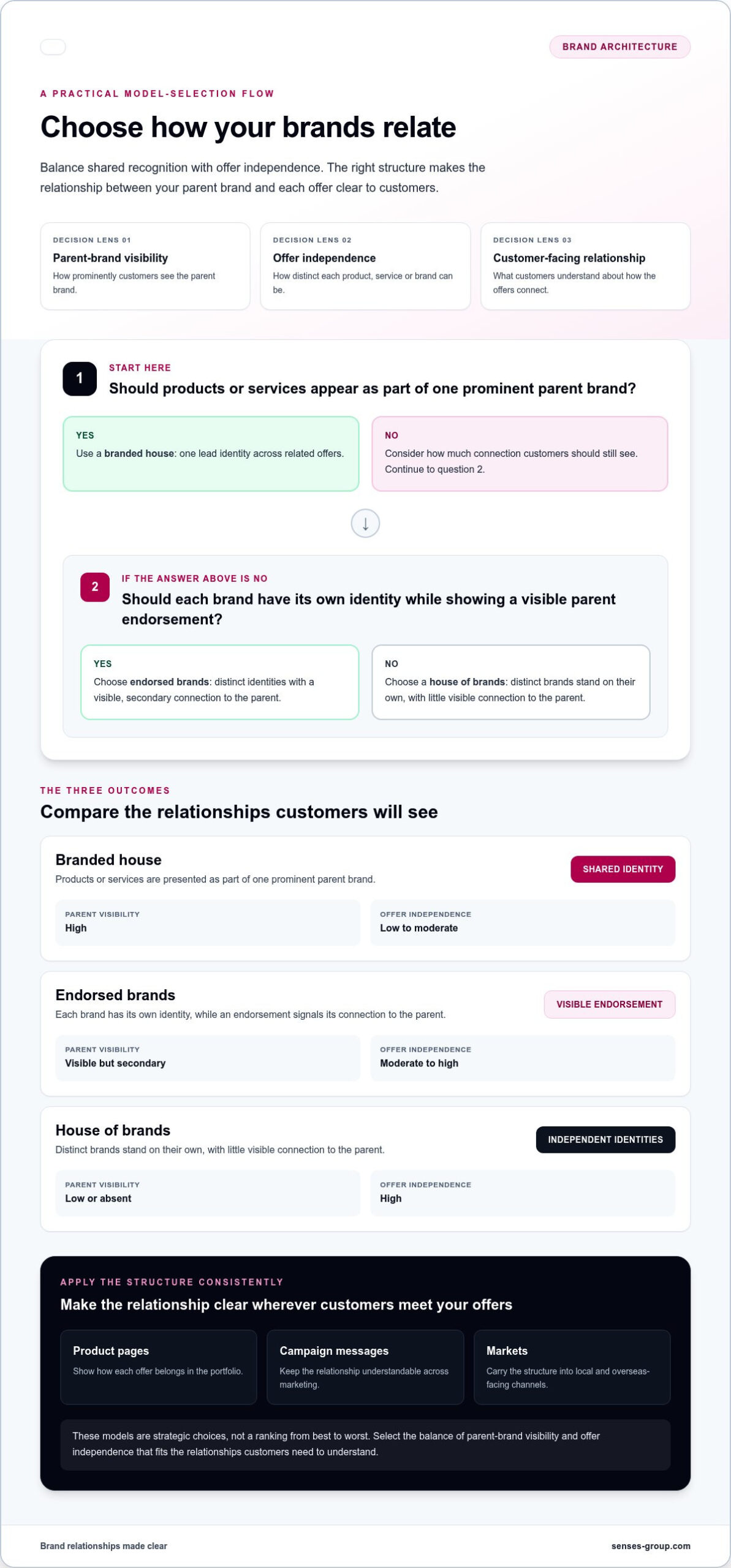
- Compare branded house, house of brands and endorsed-brand models by parent-brand visibility, offer independence and the relationship customers will see.
- Choose a structure based on audience overlap, differences between your offers and the role you want the parent brand to play, not simply the number of launches.
- Use brand architecture consulting to clarify portfolio roles and turn naming and identity decisions into a structure your team can apply consistently.
- Map the portfolio, audiences and brand relationships before rollout, then document naming principles to guide future launches.
- Connect architecture decisions to brand identity, e-commerce and marketing so customers encounter a coherent experience across channels and markets.
Brand architecture consulting: what it solves as a business grows
As a business adds products, services or sales channels, customers and staff need a clear answer to a basic question: how do these offers relate? If product names, storefront categories and marketing messages suggest different relationships, customers may struggle to understand what belongs together. Teams can also waste time explaining the portfolio differently across an e-commerce store, email campaigns and advertising.
Brand architecture is the system that defines how a parent brand, sub-brands, products and services relate, and what role each plays. It is not a logo exercise or a naming session. It sets the strategic relationships first, then guides how those relationships are expressed through names, messaging and visual identity. A useful overview of brand architecture also outlines the different ways these relationships can be structured.
Portfolio structure and visual identity inform each other, but they solve different problems. Architecture clarifies what sits under the parent brand and how distinct each offer should feel. Identity translates that decision into customer-facing cues such as design, tone and naming conventions. A visual refresh can make a portfolio look more consistent, but it can’t resolve uncertainty about which offer serves which audience or how a new product fits.
Consider a hypothetical e-commerce business that begins with one range of home products, then adds a separate offer for family use and prepares to sell overseas. If each launch gets a new name and look without a shared rationale, customers may not see the connection, and the team may be unsure which brand should lead in each market. The challenge is not necessarily the number of offers. It is the absence of agreed roles and relationships.
When does a growing business need brand architecture?
Look for recurring confusion, not just a design that feels dated. Signals include overlapping offers with unclear differences, naming that changes from one channel to another, and staff who describe the same relationship in different ways. A launch or overseas expansion often exposes these issues because it forces the business to decide what carries forward, what needs to stand apart and how the parent brand should appear. If the issue is one campaign or an outdated visual system, a focused marketing or identity project may be enough. If the same questions affect several offers, the underlying portfolio structure needs attention.
What does brand architecture consulting clarify?
Brand architecture consulting helps assign a clear role to each portfolio element: what the parent brand represents, which offers should share its recognition, and where a product or sub-brand needs a distinct position. Those decisions give customers a more coherent path through the portfolio and give internal teams a shared basis for naming, design and coordinated marketing. They can also guide how the business presents its offers across e-commerce and overseas-facing channels, rather than prompting a fresh decision at every launch.
Architecture is a strategic framework, not a promise of sales or market success. Its value is in making choices more coherent: define the relationships, communicate them consistently, and give future growth a structure to build on.
The main brand architecture models and the roles they create
Architecture models are strategic choices, not a ranking from best to worst. Each sets a different balance between shared recognition and independent expression. Brand architecture determines how visibly brands endorse one another, and how clearly customers can see the relationship between them. For a business selling online, that relationship needs to make sense across product pages, campaign messages and markets, not just on a company chart.
| Model | Parent-brand visibility | Offer independence | Customer-facing relationship |
|---|---|---|---|
| Branded house | High | Low to moderate | Products or services are presented as part of one prominent parent brand. |
| House of brands | Low or absent | High | Distinct brands stand on their own, with little visible connection to the parent. |
| Endorsed brands | Visible but secondary | Moderate to high | Each brand has its own identity, while an endorsement signals its connection to the parent. |
Branded house: when a shared parent identity supports the portfolio
A branded house uses one lead identity across related products or services, often with descriptive names to distinguish individual offers. For example, a hypothetical online retailer might use its company name across several related product categories, helping customers carry recognition from one category to another. This can concentrate brand-building effort and make the portfolio easier to navigate. The trade-off is shared reputational exposure: an issue associated with one offer may affect how customers view the broader brand.
This model works best when the parent brand has a meaningful promise that can credibly extend across its offers. On an e-commerce site, consistent naming and visual cues can help shoppers recognise that different product pages belong to the same business. But consistency should clarify the range, not make genuinely different propositions seem interchangeable.
House of brands and endorsed brands: when distinct identities matter
A house of brands gives each offer its own identity and customer relationship. That separation can be useful when audiences, positioning or experiences differ enough that a shared identity would create confusion. The parent company may remain in the background, while each brand communicates directly with its intended audience. The cost of that independence is strategic complexity: each identity needs a clear purpose and coordinated attention.
An endorsed structure sits between the two. A distinct brand leads, while the parent name or identity appears as an endorsement, making the relationship visible without taking over the offer. This can help an e-commerce business preserve a specialised proposition while drawing on parent-brand recognition. The endorsement must be clear in context, including naming and storefront presentation, so customers understand whether they’re seeing a standalone brand, a sub-brand or a product line.
Model selection should follow the role each offer needs to play, not a preference for more names or more logos. Brand strategy and identity support can connect those choices to the way a portfolio is presented across e-commerce and marketing.
How to choose an architecture model for your growth stage
Growth doesn’t automatically require a new brand. A separate identity can help an offer stand apart, but it also creates more naming, design and marketing decisions to manage. The stronger choice is the simplest structure that makes each offer clear today and leaves room for credible expansion, rather than building a complex portfolio around possibilities that may never happen.
Compare each offer against three questions: who it serves, what makes its proposition distinct, and whether the parent brand should lead or simply provide reassurance. The answers reveal whether an offer belongs under a shared identity, needs an endorsed relationship, or has a strong reason to stand independently. Choose separation for a meaningful strategic difference, not just because an offer is new.
Which portfolio questions should guide the decision?
Start with customer needs, not internal product categories. If two offers serve similar audiences and meet related needs, a shared parent identity may help customers understand the connection. If they address different audiences or make distinct promises, a more independent identity may create useful clarity. Then ask whether each offer strengthens what the parent brand already stands for or needs a separate market position.
Consider reputation in both directions. Bringing offers closer can extend the parent brand’s recognition, but it also links their customer perceptions. Keeping them distinct can protect different positions, yet makes the relationship less obvious and adds coordination demands. A practical review should weigh:
- Audience overlap: Do the same customers consider both offers, or do their needs differ?
- Proposition difference: Can one clear parent promise credibly cover both?
- Parent-brand role: Should it lead the experience, endorse the offer, or remain behind the scenes?
- Reputational connection: Would customers benefit from associating the offers, and is that association appropriate?
These questions help prevent a common overcorrection: creating a separate brand to solve a naming or campaign issue that could be addressed within the existing structure. Brand architecture consulting can help turn these considerations into a deliberate choice, rather than a series of disconnected launch decisions.
How should expansion plans affect brand relationships?
Future plans matter when they are specific enough to shape customer understanding. If an e-commerce business is preparing to enter an overseas market, it should test whether current names explain the offer clearly to new audiences and whether the parent brand should provide visible context. Don’t create a new identity solely for a hypothetical market. Set principles now, then adjust when the audience, proposition or route to market genuinely calls for a different relationship.
Your storefront can expose friction early. If customers need extra explanation to understand which products belong together, or navigation makes related offers look unrelated, the issue may be structural rather than cosmetic. Review product-page naming, category labels and parent-brand cues as one connected experience. Planning strategic Shopify growth for SMEs can also help align storefront decisions with the portfolio structure.
The right model balances recognition and efficiency against distinct positioning and added complexity. Choose a structure that fits the evidence in front of you, then document the reasoning so future launches can follow the same logic.
A practical brand architecture roadmap: from portfolio audit to rollout
A useful architecture only works if people can apply it. That means turning portfolio decisions into clear naming, navigation and communication rules that hold across the online store and marketing channels. Use this roadmap to move from an honest picture of the current portfolio to a structure your team can use for future launches.
Turn the portfolio audit into clear brand roles
Begin with what customers see, not just an internal organisation chart. Record each parent brand, sub-brand, product and service, its current customer-facing name, intended audience and the channels where it appears. Note where names overlap, relationships are hard to explain, or the same offer is described differently across the store and campaigns. Assign roles before changing logos or other visual assets.
- Inventory the portfolio. List all brands, offers and services, along with their current names and customer-facing locations. Output: a portfolio inventory that reveals duplication and gaps.
- Identify audiences and needs. Record who each offer serves and what need or purchase decision it addresses. Output: an audience map showing where offers share customers and where they differ.
- Assign distinct roles. Define what the parent brand stands for and the specific function of each portfolio element. Output: a portfolio map with a clear role for every offer.
- Test the relationships. Review whether proposed names and parent-brand cues make sense from the customer’s point of view. Check key journeys, including moving from a category page to a product page. Output: a set of tested relationship and naming decisions.
- Document and roll out the rules. Translate the chosen structure into naming principles, endorsement guidance and practical ownership rules. Output: a short architecture guide teams can use for updates and launches.
Translate the architecture into customer and team experiences
Apply the decisions consistently across website navigation, product names, identity and campaign language. A product title should signal whether an offer belongs to the parent brand or has a distinct identity. Category labels should group related offers in a way customers can understand. Visual elements should reinforce those relationships rather than introduce a competing hierarchy. Consistent retail brand identity design helps carry the same logic across customer touchpoints.
Keep governance practical. Name who owns the architecture guide, who approves naming or endorsement exceptions, and what questions a proposed launch must answer. For example: does this offer serve a distinct audience, strengthen an existing promise, or need a separate position? A small set of rules protects coherence without slowing every decision. For connected channel execution, integrated digital marketing solutions can help keep customer-facing communication aligned.
Brand architecture consulting can connect these strategic decisions to identity, e-commerce and marketing implementation. A clear structure gives teams a practical reference for translating portfolio strategy into customer experiences.
Brand architecture consulting with Senses Group: connect strategy to growth
For a growing business, a portfolio decision is only useful when it shapes what customers actually experience. Senses Group connects brand strategy with identity, e-commerce and marketing, so the relationships between your offers can guide how they are named, presented and promoted. The aim is not to add complexity. It is to build a coherent foundation that can support launches and expansion across markets.
Founded in 2008, Senses Group brings more than 18 years of expertise as of 2026. Its experience includes building and scaling a multimillion-dollar home-family product brand from zero since 2018. That experience informs a practical understanding of growth, but it should not be mistaken for proof that architecture alone delivers commercial results. Strategy gives decisions a clear rationale; execution and market response matter too.
Connect architecture with identity and ecommerce
Architecture defines the role and relationship of each portfolio element. Identity expresses those decisions through visual systems, naming and communication. E-commerce then puts them into practice through navigation, category structure, product pages and customer journeys. Each discipline has a distinct purpose, but they work best when they follow the same strategic logic.
For a Shopify store, that logic can help customers understand which offers belong together, where one proposition differs and what the parent brand represents. A considered structure can guide a conversion-focused experience, but it cannot guarantee performance. The store still needs relevant content, clear product information and ongoing marketing aligned with customer needs.
Make the next step a strategic conversation
Brand architecture consulting should respond to the business, not force it into a standard package. Senses Group develops custom-crafted solutions aligned with your objectives, whether the challenge is overlapping offers, planned launches or a portfolio preparing to reach new markets. The starting point is a clear view of what customers need to understand and what your team needs to manage as the business grows.
Before discussing a portfolio challenge, note which offers feel difficult to distinguish, where customers need extra explanation, and what expansion priorities are shaping your decisions. These practical details help focus the conversation on the relationships that need clarity and the customer experience those decisions should support.
If your portfolio is becoming harder to explain or organise, build a clearer growth engine with Senses Group. Bring your portfolio complexity, upcoming launches or expansion priorities into a strategic conversation about clarity, customer understanding and sustainable growth.
Give your next stage of growth a clearer foundation
As your business evolves, brand decisions become part of everyday operations, from briefing a designer to planning a campaign or updating your store. Treat your architecture as a working business tool, not a document that sits untouched. Assign ownership, revisit assumptions when customer feedback changes, and make each team’s decisions easier to align.
Thoughtful brand architecture consulting can help turn that discipline into a practical direction for sustainable growth, with a structure that supports your ambitions without creating unnecessary complexity.
Bring your portfolio challenge, planned launches or expansion priorities into a strategic conversation with Senses Group. Build a clearer growth engine with Senses Group, and take the next step with greater clarity and confidence.
Frequently Asked Questions
Is brand architecture only useful for large companies?
No. A small business can use it to make decisions more consistently, even if it has one main brand and only a few offers. A simple diagram showing how the parent brand relates to each offer can be enough to align a founder, designer and marketing team. The value comes from having a shared reference point, not from having a large portfolio or a complex organisational structure.
Can a business change its brand architecture without changing every name?
Yes. Keep names that already work, and improve the context around them. For example, a business might add a short descriptor to an existing offer, clarify its parent-brand endorsement in campaign materials, or standardise how the name appears in customer communications. Make changes selectively: update the places where the relationship is unclear, then check that staff use the revised naming consistently.
How often should a business review its brand architecture?
Review it when evidence suggests the current setup no longer reflects how the business operates or how customers understand its offers. Useful signals include recurring questions about what a name means, teams inventing different labels for the same offer, or a discontinued product leaving confusing references behind. A review can also follow a change in ownership or a shift in the business’s core proposition.
What is the difference between brand architecture and brand strategy?
Brand strategy sets the business’s overall direction; architecture addresses how its brands and offers are organised in relation to one another. In practice, strategy helps leaders assess whether an offer supports the company’s intended position, while architecture records the chosen relationship so teams can apply it. Keeping the two connected helps prevent naming decisions from drifting away from the business’s broader priorities.
Can brand architecture help an ecommerce business expand overseas?
Yes, especially when a business needs to preserve a clear offer structure while adapting communication for customers in another market. Before launch, review how names are pronounced and understood, whether product descriptions communicate the intended distinction, and whether localised materials retain the correct relationship between offers. Testing these details with people familiar with the target market can surface misunderstandings before they become embedded in store content.
What should a brand architecture framework include?
Alongside the chosen structure, make the framework useful as a working reference by recording the reasoning behind key decisions, examples of correct and incorrect applications, and any open questions that still need resolution. Include a version date so teams know which guidance is current. If customer feedback or business priorities change, these notes help leaders revisit specific decisions without reopening the entire portfolio discussion.
Does brand architecture affect a Shopify store?
Yes. The structure can influence how Shopify collections are grouped, which labels appear in filters, and how related offers are presented together. For example, if a product line has a distinct identity but belongs to a parent brand, the store can make both facts clear without treating the line as an unrelated seller. Review these elements during store updates so the shopping experience reflects the intended portfolio relationships.