
What if the agency publishing the most content is doing the least to move your business forward? Choosing a social media marketing agency Hong Kong businesses can rely on means looking beyond post volume to the system behind the work: how content, paid activity and ecommerce connect to your commercial goals.
Social media should do more than build followers. For SMEs and startups, it can strengthen brand positioning, earn attention from the right customers and create a clearer path from discovery to purchase. When content, advertising and your online store operate separately, activity can rise without showing what is driving sales or supporting overseas growth.
This article gives you a practical framework for assessing an agency’s capabilities and strategic fit. You’ll learn how to evaluate content strategy, execution and measurement, and how social media can work alongside Shopify, email automation and paid advertising. The aim is a joined-up plan tied to defined business goals, not a calendar full of disconnected posts.
Key Takeaways
- Assess a social media marketing agency Hong Kong SMEs can work with by strategic fit, execution, measurement and ecommerce integration, not post volume alone.
- Look for a clear path from content pillars and creation to consistent publishing, with social activity aligned to your brand and Shopify store.
- Review case studies in context: understand the scope of work, business situation and which activities contributed to the reported results.
- Define business goals, priority audiences and current challenges before writing your agency brief, separating local objectives from overseas expansion plans.
- Consider how content, user-generated content and scheduling can connect with paid advertising and email automation as part of a wider growth system.
Why Hong Kong SMEs Need a Social Media Agency Built Around Growth
For a small or growing business, social media can become a cycle of planning posts, chasing trends and trying to stay visible. The problem isn’t necessarily a lack of activity. It’s activity without a clear connection to brand positioning, customer needs or sales priorities. A capable social media marketing agency Hong Kong businesses work with brings strategic direction and practical execution together, so each task has a clear purpose.
A social media growth partner turns business goals into a coherent plan for what to say, where to say it and how to learn from the response. A content-only supplier may deliver posts; a strategic partner connects audience understanding, channel choices and consistent brand expression to the wider customer journey. Social media is one part of digital marketing, not a substitute for a strong brand or a functioning ecommerce experience.
What should a social media marketing agency do?
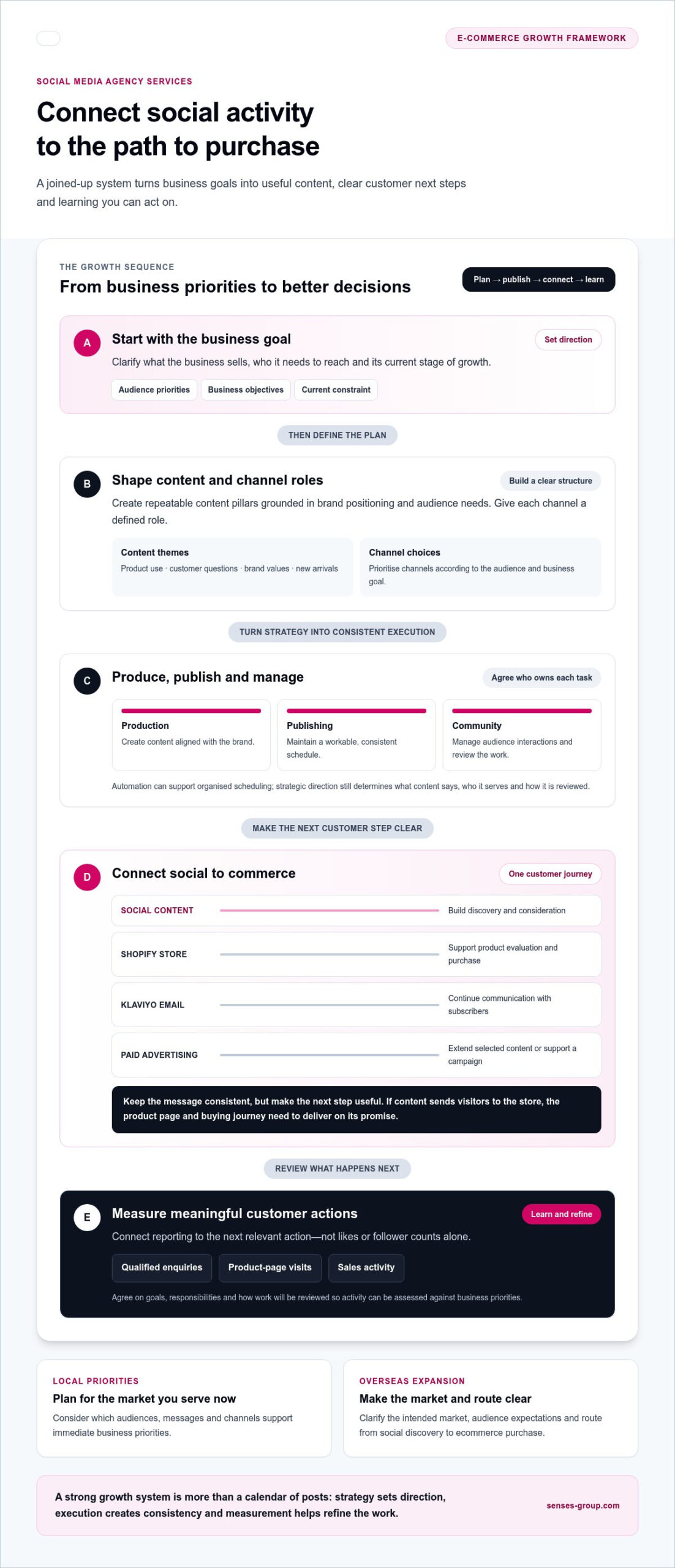
The agency’s scope should start with your business: what it sells, who it needs to reach and its current stage of growth. From there, the agency can shape content pillars, prioritise channels and define the role each channel plays. Planning, production, publishing and community activity are distinct responsibilities, so agree on who owns each one and how work will be reviewed.
- Planning: Set audience priorities, content themes and business objectives.
- Production and publishing: Create brand-aligned content and maintain a workable schedule.
- Community and review: Manage audience interactions and assess performance against agreed goals.
A business building awareness may need a different balance of content and channel support from an ecommerce brand preparing to reach overseas buyers. Choose a scope that addresses your current constraint without creating disconnected activity.
Why social activity needs a commercial purpose
Recognition and engagement can contribute to a customer journey, but neither proves that social activity is generating commercial value. A post may prompt someone to explore a product, visit a Shopify store or return later through another channel. To understand its contribution, connect reporting to the next relevant action, such as qualified enquiries, product-page visits or sales activity, rather than treating likes and follower counts as the final measure.
Local acquisition and overseas expansion also call for different planning questions. For local customers, consider which audiences, messages and channels support your immediate priorities. For overseas growth, clarify the intended market, audience expectations and route from social discovery to ecommerce purchase. Don’t assume one content plan will serve both equally well.
Before appointing an agency, identify the business outcome that matters now and the customer action that would indicate progress. This gives the partnership a foundation: strategy sets direction, execution creates consistency and measurement helps refine the work as the business grows.
What Social Media Agency Services Should Include for Ecommerce Growth
For ecommerce, social media needs to do more than keep a brand visible. It should help the right people understand what the business offers, give them a reason to explore further and connect their interest to a useful next step. A social media marketing agency Hong Kong SMEs work with should connect strategy and content execution to the store and wider marketing system, rather than treating each post as a standalone deliverable.
From content pillars to consistent publishing
Content pillars create repeatable themes grounded in brand positioning and audience needs. An ecommerce business might develop themes around product use, customer questions, brand values and new arrivals. These themes give content a recognisable structure while leaving room to adapt formats and messages for each platform. Without that foundation, a publishing schedule can become a stream of unrelated ideas.
Creation and scheduling turn strategy into consistent execution; they don’t replace it. Senses Group’s social media capabilities include content pillar strategy, content creation and AI-driven posting and scheduling automation. Automation can support an organised publishing process, while strategic direction determines what the content says, who it serves and how performance is reviewed.
Connecting social media with the rest of the growth funnel
A social post can introduce a product or answer an audience question. From there, the customer journey may continue to a Shopify product page, an email sign-up or a paid campaign. Each channel should have a defined role: social can build discovery and consideration, the store can support product evaluation and purchase, and Klaviyo email automation can continue communication with subscribers. Repeating identical messages everywhere isn’t integration. The aim is to make the next step clear and consistent.
That next step matters. If a campaign drives visitors to a store, the product page and buying journey need to deliver on the promise made in the content. Businesses refining this part of the journey can use this Shopify growth guide to consider how store experience fits into ecommerce growth.
Paid advertising can extend selected social content or support a campaign with a defined audience and objective. SEO and GEO can strengthen how people discover and understand the brand through search and AI-generated answers. These disciplines complement social media; they aren’t interchangeable channels. For a wider view of how channel roles can work together, explore integrated digital marketing solutions.
For businesses preparing to sell overseas, the same system needs to account for differences in audience, message and purchase journey. Decide which market a piece of content serves and what action it should support before adding platforms or increasing output. Senses Group’s social media and ecommerce approach brings content planning and execution into the broader growth picture.
How to Compare Social Media Marketing Agencies in Hong Kong
Agency proposals can look similar when each promises strategy, content and reporting. Compare the thinking behind those deliverables instead. A useful evaluation shows whether an agency understands your commercial priorities, can execute consistently and can explain how its work supports your business and, where relevant, overseas growth.
Evidence of business fit is more useful than an impressive metric without the context that explains how it was achieved. Follower growth and engagement can indicate audience response, but alone they don’t show whether the audience matches your customers, whether people took a meaningful next step or what the agency contributed.
Evaluate strategic fit, not just service breadth
Ask each social media marketing agency Hong Kong candidate to connect its proposed approach to your brand positioning, priority audiences and current business objectives. Can it explain why particular content pillars and channels suit your offer, and what role each channel plays? For an SME, a focused plan that answers those questions may be more valuable than a long service list.
Use the same criteria for every proposal. Record specific evidence, not just a general impression.
Strategy: Does the proposal start with your positioning, audience and commercial priorities?
Content execution: Are content themes, production responsibilities and publishing expectations clear and aligned with the brand?
Measurement: Does reporting distinguish activity, audience response and business outcomes?
Integration: Does the agency explain how social connects with your ecommerce store, paid activity or other relevant channels?
Market understanding: Does the plan account for local customer needs and, if applicable, differences in overseas audiences and buying journeys?
Look for a coherent rationale, not a preset platform mix. The agency should explain why its channel choices and content approach fit your current stage, and how those choices could evolve as your priorities change.
Judge evidence and reporting with context
Case studies are useful when they show the conditions behind the result. Review the client’s business context, the work included, the time period and the measures used. Separate the agency’s contribution from other factors, such as changes to the offer, store experience or wider campaign activity. Don’t attribute a reported sales result to social media alone unless the evidence supports that connection.
- Inputs: What work was delivered, such as content, publishing or campaign management?
- Audience response: What changed in reach, engagement, clicks or enquiries, and among which audience?
- Business outcomes: Was there evidence of relevant actions, such as qualified leads or ecommerce sales?
Then assess how the agency interprets results. A strong reporting conversation explains what performed, what didn’t, what the evidence can and cannot establish, and what the team will adjust next. Awards and client lists can provide background, but they don’t show by themselves that an agency’s approach fits your business or guarantees a similar outcome. Compare the reasoning, relevance and learning behind the proof.
How to Prepare a Hong Kong Social Media Agency Brief
A clear brief gives an agency the context to recommend a plan that fits your business, rather than defaulting to a generic package. It doesn’t need to be lengthy. It needs to show what the business is trying to achieve, who it needs to reach and what currently stands in the way. A well-prepared brief also helps you compare proposals on their strategic logic, not just the volume of content promised.
Set objectives and establish a useful starting point
Begin with the business outcome, then define the role social media should play in supporting it. For example, an ecommerce SME may want to strengthen product discovery before directing interested customers to its Shopify store. Record the current position honestly: which channels are active, what content is being published, what you know about your audience and where the customer journey feels unclear.
Use this sequence to organise the essentials:
- State the priority: Describe the business goal and the customer action that would help move it forward.
- Define the audience: Note who you want to reach, what they need to understand and any audience knowledge gaps.
- Separate the markets: Set out local objectives independently from overseas expansion goals when audiences, messages or purchase journeys differ.
- Describe the current challenge: Identify whether the immediate need is stronger brand foundations, more consistent content or better support for ecommerce growth.
- Set practical parameters: Explain who reviews content, how approvals work and what internal resources affect execution.
If brand foundations need clarification, include the positioning, identity or message questions the agency should address. A considered retail brand identity strategy can help ensure social content expresses a consistent brand rather than relying on disconnected campaign ideas.
Define scope, collaboration and evaluation
Make responsibilities explicit. State whether the engagement should cover strategy, content creation, scheduling, approvals, community activity and performance review, and identify what your team will provide or decide. This gives the agency a realistic picture of how work can move from planning to publishing while reducing confusion over ownership.
Reporting expectations should focus on useful interpretation, not arbitrary benchmarks or promised timelines. Name the measures that relate to your objective, such as audience response, visits to relevant store pages or qualified enquiries. Ask for reporting to distinguish activity from audience behaviour and business outcomes, and to explain how learning will inform the next decisions. The right measures depend on the goal, so avoid treating a universal target as proof of fit.
Use your first discussion with a social media marketing agency Hong Kong business to clarify priorities, scope and decision-making. A useful conversation should sharpen the brief, not push a preset package. Discuss your social media growth priorities with Senses Group and use that context to shape a plan around your business goals.
How Senses Group Connects Social Media to a Wider Growth Engine
Senses Group is a branding and ecommerce agency founded in 2008. Its approach treats social media as part of a connected commercial system, not an isolated stream of posts. For SMEs considering a social media marketing agency Hong Kong option, that distinction matters: content can reinforce a brand, create reasons to explore a product and direct attention towards a relevant next step in the ecommerce journey.
A social strategy grounded in brand and business foundations
Brand strategy and identity give social communication a clear foundation. They help establish what the business stands for, how it should be recognised and what its content needs to convey. From there, content pillars translate those foundations into repeatable themes. Content creation and AI-driven posting and scheduling automation support consistent execution, while user-generated content through a global influencer network can add another perspective to the brand’s storytelling.
The objective is coherence, not uniformity. A product demonstration, customer-focused story and campaign announcement can serve different purposes while still expressing the same brand. Evaluate social performance in context, alongside the wider work supporting the customer journey. Ecommerce outcomes depend on more than social activity alone, so claims about results should reflect the contribution of the full system rather than crediting one channel without evidence.
Connecting the channels around growth priorities
Social content can guide interested audiences towards a Shopify store, where product information and the shopping experience continue the story. Klaviyo email automation can support relevant follow-up, while Meta and Google advertising can extend campaign activity where it fits the objective. SEO and GEO contribute to discovery through search and AI-generated answers. Each capability has a distinct role; their value comes from working towards a shared business priority, not duplicating the same message everywhere.
For example, a business focused on local customer acquisition may need to clarify which audience it wants to reach and what action social content should encourage. A business preparing for overseas ecommerce growth also needs to define the target market and consider whether its messaging and purchase journey need to differ. Starting with those questions makes it easier to connect social priorities with the relevant brand, store and marketing capabilities.
In a first conversation, bring three points: your priority market, the audience you want to reach and the current constraint holding growth back. It might be unclear positioning, inconsistent content or a gap between social discovery and the store experience. That context gives Senses Group a practical basis for discussing a tailored growth approach.
Ready to connect your social strategy with the rest of your business? Build a growth engine with Senses Group by starting with the priorities your next stage of growth depends on.
Turn Your Next Growth Priority Into a Clear Plan
The next step isn’t to add more channels or publish more often. Decide what needs to change for your business, then give your agency a clear mandate to help make that change. A social media marketing agency Hong Kong businesses can work with effectively should understand the priority, the audience and the role social activity plays in moving customers towards action.
Start with one practical question: what is currently limiting growth, brand clarity, audience reach, content execution or the path from social discovery to purchase? That answer can anchor a focused conversation and help shape a plan suited to your business, whether your immediate priority is local demand or preparing for overseas ecommerce.
Bring that priority to Senses Group and explore how social media can support the wider direction of your brand and ecommerce business. Build your growth engine with Senses Group, and take the next step with a clearer purpose and stronger foundations.
Frequently Asked Questions
What should I look for in a social media marketing agency in Hong Kong?
Look for an agency that can explain how its work will address your business needs, not just how often it will publish. A social media marketing agency Hong Kong SMEs can rely on should be able to discuss your customer journey, how the team will collaborate with your staff and what decisions you’ll make together. During a proposal discussion, ask the agency to outline a sample campaign from the initial idea through review and learning.
How much does it cost to hire a social media marketing agency?
Fees depend on the agreed scope, so compare what each proposal includes rather than relying on a headline figure alone. Strategy, content production, publishing, community activity, reporting and paid campaign management can involve different levels of work. Ask for agency fees and advertising spend to be shown separately, and clarify how changes to the scope affect the arrangement. That makes proposals easier to compare without assuming that the lowest fee offers equivalent support.
Can a social media agency help a Hong Kong business expand overseas?
Yes, an agency can help shape social activity for overseas audiences, but expansion planning should start with the market and customer journey, not simply reposting local content. Identify what the intended audience needs to know, which messages may need adapting and where social discovery should lead, such as a relevant ecommerce experience. The agency can then help organise content and campaign learning around that market. Social media supports expansion, but doesn’t replace wider commercial planning.
Is social media management different from social media marketing?
Yes. Social media management usually describes the ongoing operation of social channels, such as preparing and publishing content and responding to audience activity. Social media marketing is broader: it connects channel activity to objectives such as awareness, customer acquisition or ecommerce sales, and may include paid promotion. The terms can overlap in agency proposals, so ask what work is included and how each responsibility supports the business goal you’ve set.
How can I measure whether a social media agency is contributing to business growth?
Agree on the customer actions that matter before activity begins, then review them alongside platform results. For an ecommerce campaign, you might monitor visits to a featured product page and resulting purchases, while a service business may focus on relevant enquiries. Use consistent tracking and reporting periods, and consider whether social played an assisting role even if it wasn’t the final interaction. This gives a more useful view than attributing growth to a single metric.
What should I prepare before approaching a social media marketing agency?
Prepare a concise snapshot of your offer, priority audience, current channels and the challenge you want to solve. Include examples of content that feels right for your brand, common questions from customers and any upcoming campaigns or product priorities. Note who can approve work and what internal resources are available. You don’t need a complete strategy; useful context helps the agency identify gaps and make its recommendations more specific to your business.
What happens if my business needs branding and ecommerce support as well as social media?
Bring those needs into the same growth discussion so the work can be considered as a connected journey. Brand strategy and identity can shape how the business presents itself; a Shopify store supports the buying experience; Klaviyo email automation can continue customer communication. SEO and AI Engine Optimisation, plus Meta and Google advertising, can support discovery and promotion. The right sequence depends on the main constraint, so clarify where customers currently lose momentum.