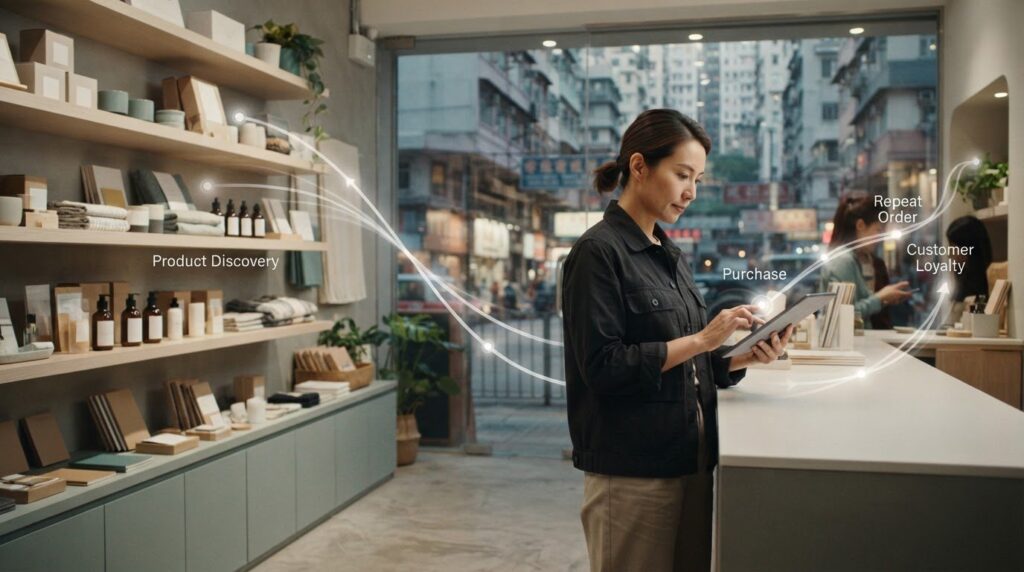
More traffic won’t fix a customer journey that breaks between an ad, a Shopify store and the follow-up. For Hong Kong SMEs, an ecommerce sales funnel agency should connect those touchpoints so the brand promise that attracts a customer carries through to purchase and repeat business. Otherwise, channels can generate activity while the overall system underperforms.
When sales stall, it’s natural to look first at advertising or a store redesign. But sustainable growth depends on how strategy, execution and measurement work together, especially when you serve local customers and expand overseas. The goal is a coherent journey, not a collection of disconnected tactics.
This article explains what an ecommerce sales funnel agency should connect, from brand strategy and Shopify experience to SEO and GEO, Meta and Google advertising, and Klaviyo email automation. You’ll learn how to assess an agency’s strategic fit, execution and reporting, then identify practical next steps to improve conversion, encourage retention and grow across markets with greater consistency.
Key Takeaways
- An ecommerce sales funnel agency should connect brand strategy, Shopify, marketing and retention around one measurable customer journey.
- Assess agency approaches by how well strategy, brand experience, commerce execution and measurement work together.
- Before investing in more traffic, clarify your growth objective, audience and offer, then identify where the customer journey shows friction.
- For local and overseas growth, consistent brand positioning helps advertising and store content deliver on the same promise.
- Senses Group brings branding, Shopify development and marketing together to support a connected customer experience.
What an Ecommerce Sales Funnel Agency Builds Beyond a Landing Page
If your ads bring visitors to your Shopify store but product pages, checkout and follow-up feel like separate efforts, the problem may not be a lack of activity. It may be a disconnected customer journey. Adding another landing page or marketing tool won’t resolve a gap between what your brand promises and what customers experience.
An ecommerce sales funnel agency connects brand strategy, ecommerce and marketing touchpoints to guide customers from discovery through purchase and retention. Its work extends beyond producing a page or installing software. It aligns the messages customers see, the decisions they need to make and the experience that follows a sale, then measures how those parts perform together.
Which stages belong in an ecommerce sales funnel?
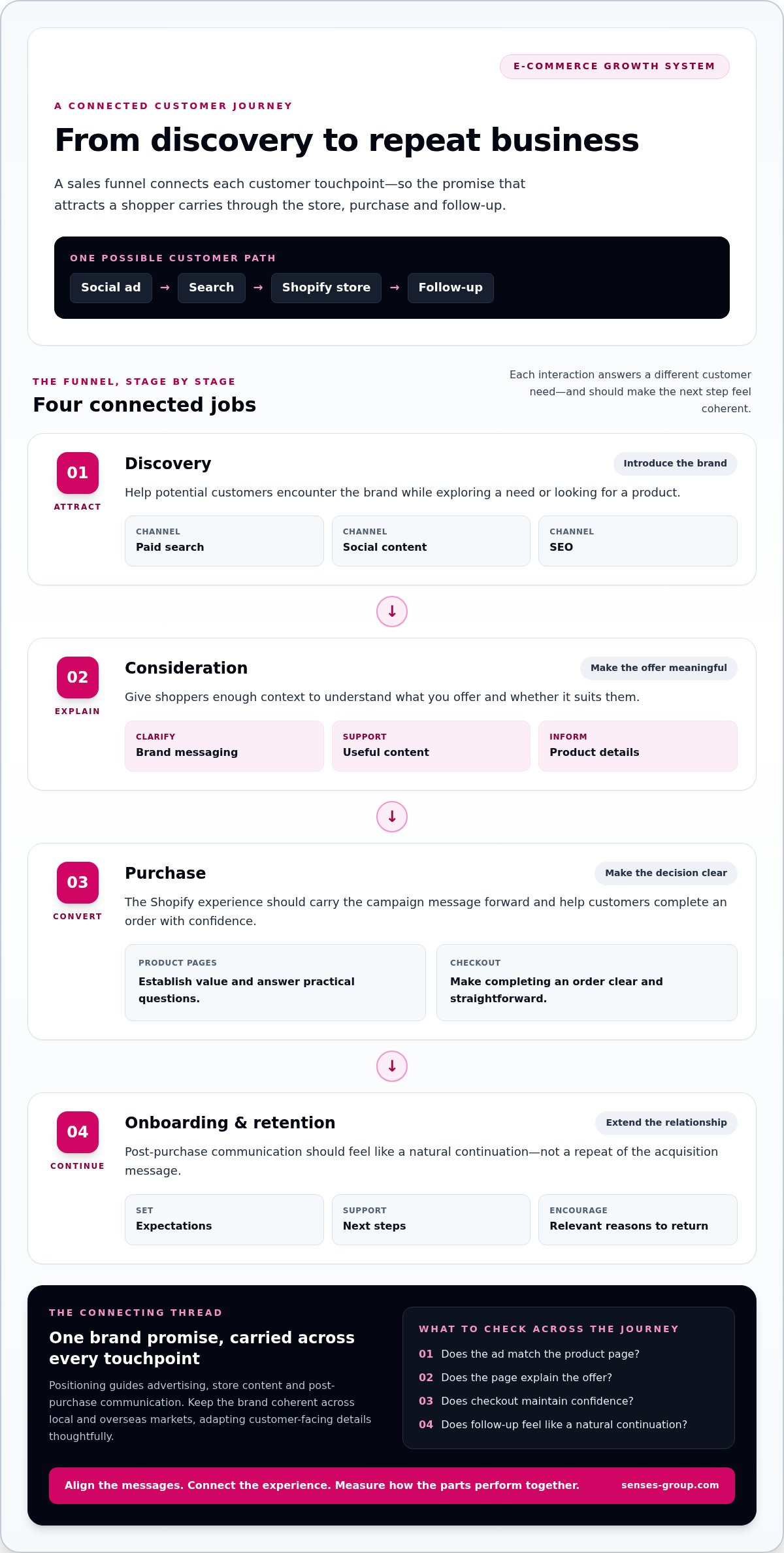
The purchase funnel is often described through stages such as awareness, consideration, decision and purchase, with retention extending the journey beyond the first order. Each stage answers a different customer need:
- Discovery: Paid search, social content and SEO introduce the brand when potential customers are exploring a need or looking for a product.
- Consideration: Brand messaging, useful content and product information help shoppers understand what you offer and whether it suits them.
- Purchase: Product pages establish value and answer practical questions. Checkout should make completing an order clear and straightforward.
- Onboarding and retention: Post-purchase communications set expectations, support the customer’s next steps and give them relevant reasons to return.
These touchpoints have different jobs. A social post may spark interest, while a product page needs to provide enough detail for a considered decision. Follow-up should reinforce the relationship after the transaction, not simply repeat the acquisition message.
Why brand strategy belongs in the funnel
Brand strategy gives each stage a consistent foundation. Positioning clarifies who the offer is for and why it matters. Visual identity and messaging make that promise recognisable across ads, store content and post-purchase communication. Consistency helps customers form expectations before they buy and recognise the brand as they move between channels.
For a business selling locally and overseas, this foundation keeps the brand coherent across markets while allowing customer-facing details to be adapted thoughtfully. A polished campaign cannot compensate for unclear product messaging or a store experience that leaves basic questions unanswered. More traffic may simply bring more people to the same point of friction.
Review the journey from the customer’s perspective. Does the ad match the product page? Does the page explain the offer? Does checkout maintain the same sense of confidence? Does follow-up feel like a natural continuation? A retail brand identity framework can help clarify the visual and verbal cues customers should encounter throughout that journey.
Software can support the funnel, but it can’t define the brand promise or resolve disconnected decisions on its own. A connected system makes each touchpoint work toward the next.
How an Ecommerce Sales Funnel Connects Brand, Shopify and Retention
A customer’s journey rarely follows a neat, single-channel route. Someone may first encounter a brand through a social ad, later search for the product, visit the Shopify store and decide to buy only after a follow-up message answers a lingering question. A connected funnel makes each interaction feel like part of the same brand experience rather than a series of unrelated campaigns.
Consistent positioning links acquisition, conversion and retention by making every customer touchpoint reinforce the same brand promise. That promise should guide advertising, site content and post-purchase communication, while remaining flexible enough for relevant adaptations as a business expands overseas.
Align the brand promise with the Shopify experience
Start with the audience, positioning and product story, then translate them into store structure and strategic content. Navigation should help customers find the information they need. Product pages should express the value proposition established in advertising. Shopify provides the commerce environment, but the experience depends on how clearly the brand organises and presents its offer.
User experience improvements and conversion-rate optimisation help identify friction in that journey. If shoppers reach a product page but hesitate, examine whether it answers their questions, carries through the campaign message and makes the next step clear. A considered 2026 Strategic Shopify Guide for Hong Kong SMEs can help frame platform and store decisions around the business model, rather than treating a rebuild as a visual refresh alone.
Connect acquisition with lifecycle marketing
Meta Ads and Google Ads can introduce audiences through different discovery and intent signals. SEO and AI engine optimisation can strengthen organic discovery, while paid campaigns create additional routes into the store. The connection that matters is what happens after the click: the landing experience should match the message and give shoppers a coherent next step.
Klaviyo can support customer communication across the lifecycle. A welcome flow introduces the brand to new subscribers; behaviour-based messages respond to relevant actions; and monthly promotional campaigns keep customers informed about timely offers or updates. Each message should reflect the brand’s positioning and the customer’s relationship with the business, rather than simply sending another discount. An abandoned-cart strategy is one part of that lifecycle and works best when considered alongside the broader retention plan.
- Before the visit: Align ad creative and search content with the audience and product story.
- On the store: Keep page structure, product information and brand expression consistent with the promise that brought the shopper there.
- After purchase: Use relevant follow-up to support the customer relationship and create a considered path to a future order.
For brands exploring overseas demand, adapt market-facing content without losing the core identity. If the United States is a target market, the U.S. retail e-commerce sales data offers official context for understanding that market. An integrated ecommerce growth approach can bring brand strategy, Shopify, acquisition and retention into one coordinated system.
How to Compare Ecommerce Sales Funnel Agency Approaches
Agency proposals can use similar language while describing very different work. One may offer separate ad management, a store update and email setup; another may connect those activities to a shared customer journey. To compare an ecommerce sales funnel agency fairly, look beyond the deliverables list. Assess how the work links your business priorities to customer experience and measurable decisions.
The comparison below highlights the difference between isolated channel delivery and coordinated funnel work. Use it to identify what an agency’s approach actually connects.
Strategic alignment
Disconnected: Campaigns begin with channel activity. Coordinated: Customer, offer, brand position and funnel objectives inform the plan.
Brand capability
Disconnected: Ads and store content may express different promises. Coordinated: Messaging and visual identity carry a consistent position from discovery to purchase.
Commerce execution
Disconnected: Shopify changes are treated separately from marketing. Coordinated: Store structure, product content and campaign journeys are considered together.
Measurement
Disconnected: Reports list activity without relating it to business priorities. Coordinated: Reporting connects channel and store signals to agreed objectives and informs next steps.
Compare strategic depth and implementation scope
Start with the reasoning behind the proposed work. Does it explain which audience and offer the funnel is designed to serve, what customers need to understand and where the journey currently loses momentum? A sound plan connects those choices to practical execution, rather than treating strategy as a presentation followed by unrelated tasks.
Then consider how Shopify development, SEO, paid media and lifecycle marketing fit together. A store redesign without alignment to acquisition may leave campaign visitors with a mismatched experience. Ads that lead to unclear product information can generate traffic without resolving customer hesitation. For overseas expansion, assess whether the approach can preserve core brand positioning while adapting content and customer journeys for different audiences. The aim is coherent growth, not identical execution in every market.
Evaluate proof, measurement and realistic expectations
Useful evidence identifies the client, the work carried out and the reported result. It also makes clear what the result does and doesn’t establish. A case study can illustrate an approach, but it doesn’t guarantee the same outcome for another business with different products, audiences or operating conditions.
Be cautious of universal conversion claims, unexplained benchmarks and broad promises of rapid growth. Instead, assess whether the proposed reporting can help your team make decisions: which measures relate to the stated objective, how will customer-journey friction be assessed, and what findings could change the next round of work? Reporting should connect evidence to action without presenting forecasts as certain results.
For an SME balancing local sales with overseas ambitions, strategic fit comes down to whether the agency can connect brand, commerce and marketing to the business’s actual priorities. The strongest approach is not the longest service list. It’s the one that makes each investment part of a coherent customer journey and uses measurement to keep improving it.
How to Prepare Your Ecommerce Funnel for Sustainable Growth
Growth is easier to manage when you understand what the current customer journey is doing. Before increasing campaign activity or adding automation, establish what the business needs to achieve, who it serves and where customers encounter friction. This gives each change a purpose and helps distinguish a genuine funnel problem from a lack of evidence.
Use this readiness sequence to build a practical baseline:
- Clarify the objective. Decide whether the priority is attracting qualified visitors, improving purchase completion, encouraging repeat orders or preparing for a new market. Keep the immediate business goal clear.
- Define the audience. Describe the customers the offer is intended for, including relevant differences between local and overseas audiences. Avoid treating every visitor as if they have the same needs.
- Sharpen the offer. Make the product value, positioning and key customer questions clear. If the offer is difficult to understand, more traffic may amplify the confusion rather than resolve it.
- Map the journey. Record how customers move from discovery to the store, through purchase and into post-purchase communication. Include the channels and touchpoints the business currently uses.
- Review current performance. Bring together available reporting on acquisition, store behaviour, sales and retention. Use the business’s own verified data as a baseline, not a generic benchmark that may not fit its model.
Set a clear baseline before changing the funnel
Document where visitors come from, which store pages they reach, where they leave the journey and what follow-up they receive. Then connect each proposed change to a business goal and a customer behaviour. For example, if product-page visits are present but customers aren’t progressing, investigate the page experience and offer clarity before expanding acquisition activity.
Set measurement priorities before changing campaigns or automations. Choose indicators that relate to the objective and can be tracked consistently. A useful baseline helps you assess whether a change is working, without relying on unsupported targets or promises of a particular return.
Prioritise changes across markets and channels
Sequence the work. Establish clear brand positioning and a coherent Shopify journey before layering on additional campaign complexity. As you expand into overseas markets, preserve the core meaning of the brand while adapting content and customer experience to the audience and context. Consistency doesn’t require identical execution; it requires each version to express the same underlying promise.
An ecommerce sales funnel agency can contribute effectively when it has a clear view of your objectives, audience, offer and current evidence. A coordinated channel plan can then build on sound foundations rather than multiply disconnected activity. Senses Group’s integrated digital marketing approach connects strategic priorities with marketing execution, while an integrated digital marketing scaling guide can help frame how channels support business growth.
How Senses Group Builds an Ecommerce Sales Funnel as a Growth System
Once you’ve identified what your funnel needs to achieve, connect the work around that goal. Senses Group’s custom-crafted approach brings brand strategy, Shopify development and marketing into one growth system. Rather than applying a standard sequence of tactics, the work is shaped around the business, its customers and the journey from first discovery to an ongoing relationship.
That connection matters for SMEs seeking growth at home and overseas. A clear brand foundation supports consistent communication, while a considered store and coordinated marketing give customers a more coherent experience as they move between channels and markets.
From brand foundations to a high-converting website
Strategy defines the audience, position and product story; brand identity gives those decisions a recognisable expression. Together, they guide communication across the Shopify store and marketing, so customers encounter a consistent promise rather than disconnected messages.
Shopify development then turns that foundation into a practical buying journey. Site structure, user experience and conversion-rate optimisation can be shaped around customer needs and observed friction. The scope is tailored to the business, rather than forced into a fixed package or tied to a promised result.
From acquisition to ongoing customer relationships
SEO and AI engine optimisation support discovery through search, while Meta and Google Ads create paid routes to relevant audiences. These channels work best when the campaign promise matches the store experience. Klaviyo automation can continue the conversation through welcome and behaviour-based flows, while social channels provide further opportunities to maintain consistent brand communication.
These capabilities work together, not as isolated deliverables. Acquisition brings potential customers into the journey; a coherent store helps them evaluate the offer; relevant follow-up supports the relationship beyond the first purchase. Reporting can then help the business understand what is working and where to focus next.
Documented client work offers one example of this integrated approach. Following a complete ecommerce rebuild for Monchhichi Jewelry Atelier, the client’s revenue doubled shortly after the ecommerce system launched. That result belongs to Monchhichi’s project; it isn’t a guarantee of what another business will achieve. It illustrates why evaluating the whole customer experience, rather than a single channel or page, can matter.
For a growing brand, the right system should reflect current priorities and provide a considered foundation for future expansion. Senses Group brings branding, Shopify, SEO and GEO, paid advertising, Klaviyo and funnel thinking together as a strategic partner, helping businesses build toward sustainable, scalable growth without treating every company as if it has the same needs.
If you’re ready to connect your brand, store and marketing around a clearer customer journey, discuss building a connected growth engine with Senses Group.
Build the Next Stage of Growth with Intention
For an ecommerce business, the next growth opportunity may not be another campaign. It may be a clearer brand promise, a smoother store journey or a more relevant connection with customers after purchase. The right priority is the one grounded in customer behaviour and business objectives.
An ecommerce sales funnel agency should help turn that priority into connected action, aligning brand, Shopify and marketing around a customer experience your business can strengthen over time. This gives local and overseas expansion a more considered foundation, without relying on disconnected tactics or assumed outcomes.
Start by identifying the point in your customer journey that deserves attention now. With a clear priority, you can focus your resources, measure what changes and make the next decision with greater confidence.
Let’s build your growth engine with a connected strategy for your brand, store and marketing. Sustainable growth starts with a system designed to move your business forward.
Frequently Asked Questions
What does an ecommerce sales funnel agency do?
An ecommerce sales funnel agency helps a business plan and improve how customers move from discovering a brand to buying and returning. Depending on the business’s needs, this can involve brand strategy, Shopify development, SEO, paid advertising and Klaviyo automation. For example, if an ad attracts the right audience but product pages don’t explain the offer clearly, the agency can align the campaign message with the store experience.
How is an ecommerce sales funnel agency different from a marketing agency?
The distinction depends on scope. A funnel-focused partner examines how marketing activity connects to the store and the customer relationship, while a marketing agency may focus on particular channels or deliverables. Neither label alone guarantees an integrated approach. When comparing options, consider whether the proposed work connects campaign goals to the Shopify experience and post-purchase communication, or concentrates on channel activity in isolation.
Can an ecommerce sales funnel agency help a Shopify store grow overseas?
Yes. An agency can help prepare a Shopify experience and marketing plan for overseas audiences by adapting customer-facing messaging, content and campaign priorities while keeping the brand’s core identity recognisable. For instance, a business can review whether product information explains the offer clearly to customers unfamiliar with the brand. Expansion planning should also account for the company’s operational readiness and market knowledge, rather than assuming one funnel will suit every audience.
How do I know whether my ecommerce business is ready for a sales funnel agency?
Your business may be ready if you can describe what you sell, who it serves and which growth priority matters most, even if the customer journey still has gaps. Useful starting evidence includes store analytics, campaign reports, customer enquiries and repeat-order patterns. You don’t need a perfect measurement system first. A clear business question, such as why product-page visitors don’t proceed, gives the work a focused starting point.
What should I measure when improving an ecommerce sales funnel?
Measure indicators that correspond to the change being made. For a product-page update, review visits and progression toward checkout; for a retention initiative, examine returning customer activity and orders over time. Track acquisition source as well, so you can distinguish which traffic is engaging with the store. Interpret these signals together and compare them with your own baseline. A single metric rarely explains the full customer journey.
How do branding and sales funnels work together in ecommerce?
Branding gives customers a consistent reason to recognise and trust the business, while the funnel carries that meaning through each interaction. If an ad presents a clear product benefit, the store should support that expectation with relevant information and a coherent visual experience. After purchase, communications should still sound and feel like the same brand. This continuity helps a growing business present itself consistently across channels and markets.